The Rail Line Into London Gateway
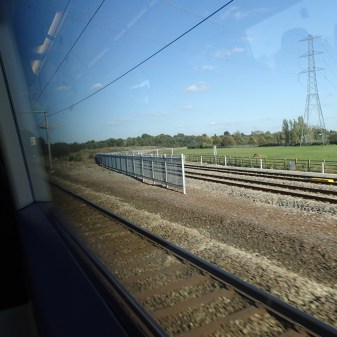
I took this picture as my train to Stanford-le-hope passed the rail line into London Gateway.
The Rail Line Into London Gateway
It shows the double-tracked rail line into the port.
I would assume it will be electrified, when the main routes through London, like the Gospel Oak to Barking Line, are also fitted with overhead wires, so that freight trains can use efficient electric haulage.
Should The Valley Lines Be Electrified?
I travelled about thirty percent, if that, of the Valley Lines that fan out from Cardiff. But it gave me a feeling of the strengths and weaknesses of the lines.
Stations
A Strength
If I compare the stations I saw on the Valley Lines most would score better than the average of those on the Lea Valley Lines, being taken over by the London Overground. The platforms seemed in good condition and most stations had some form of shelter, which was often new. They certainly didn’t have the same sense of abandonment of some stations on the Lea Valley Lines.
Platforms in some stations might also be big enough for a small kiosk. Obviously, coffee outlets work in London and probably Cardiff, but would they work in the valleys?
On the subject of stations, I hadn’t expected to find a ten million pound project at Pontypridd.
Footbridges
A Possible Weakness
I didn’t see any truly dangerous footbridges, that are very much the norm on the Lea Valley Lines, so hopefully they are not as common.
But some footbridges like Taff’s Well may well have to raised for electrification.
Step Free Access
A Possible Weakness
According to a Network Rail document on the Internet, several stations will have improved access.
On point on step-free access and lifts, is that Network Rail are installing this across the network and I have a feeling that they’re getting better at doing it, as some of the schemes in London, seem to have gone in extremely fast. Perhaps, their project management is getting better.
Road Bridges
A Strength
Network Rail’s documents don’t seem to mention any bridges being reconstructed.
An aside here, is that they are putting in extra tracks in places and this is mentioned.
So perhaps there isn’t work to do with the bridges to accommodate the overhead wires.
Signalling
A Strength
This looks like a separate project to the electrification, as unlike in many places you can do the signalling first and then electrify.
It’s all described in this Network Rail web page.
In one way, the signalling will give more train paths and capacity, before the electrification is complete. But where do you get the required diesel trains?
Interchanges
A Strength
I only did a couple of simple journeys on the Valley Lines, but like the East London Line, you can do same or cross platform changes in a lot of places.
Current Trains
A Weakness
The Class 142 trains that work the lines are clapped and in a few years time, they’ll have to be withdrawn because of the disability regulations.
The Class 150 trains may be possible to be updated, as some Class 153 have been. But would that be throwing good money after bad?
New Trains
A Weakness Or A Strength
New trains are expensive and these Valley Lines could require quiet a few sets.
But there are Class 315 and Class 317 trains available for cascade, as new trains arrive on Thameslink. Crossrail and the Overground in London in the next few years.
The Class 315s are nearly forty years old, but were refurbished between 2204 and 2008. In a section on their future Wikipedia says this.
As most duties of the 315s will be taken over by new Class 345 Aventra trains once Crossrail is built, it has been suggested that the 315s could be cascaded to Wales to be used on Valley Lines services in the Cardiff area following electrification.
I travel regularly on Class 315s and they certainly are a better ride than a Class 142. Their problems are the awful pink décor, dirty windows and lack of a passenger information system. Some might find the lack of toilets a problem too!
Information systems are apparently being fitted, but obviously not on the ones I’ve used and the dirty windows doesn’t seem to be a problem that affects Welsh trains, like it does Greater Anglia. They are all four car sets, which can be paired to make 8 car trains with seats for over 600.
The Class 317s are the electric cousins of the Class 150s operating on the Valley Lines now, are not quite as old as the Class 315s and some of them were refurbished to a high-standard in the 1990s. I used to travel on the latter regularly into London from Suffolk, and they’re certainly better than the 315s. They could also be fitted with better electrical equipment. A demonstrator is currently running round East London and Essex. South West Trains have recently refurbished their Class 455s, which are their version of the 317.
You have to remember that underneath the awful paint jobs and bad interior design of Class 317 and Class 455 trains is a legendary 100 mph Mark 3 carriage, which is struggling to get out. South West Trains have shown what is possible.
I suspect as there are large numbers of both classes, some will end up on the Valley Lines. I’d put my money on Class 317s as their 100 mph capability gives them the ability to run longer-distance stopping services on main lines.
Power Supply
A Strength
One of the high cost parts of railway electrification is getting the electrical feed to the the overhead lines. And our piecemeal policy of the last few decades has made things worse, as you can’t do clever and sensible things to make things simpler and cheaper. For example, the Great Western Main Line electrification, will not have its own power supply at the London end, but will share one with Crossrail.
So as the South Wales Main Line will be electrified all the way to Swansea, it should be possible to feed the Valley Lines off the infrastructure installed on the main line.
Conclusion
As I travelled around the Valley Lines yesterday, several railway staff were sceptical that electrification will go ahead.
I may be wrong, but it seems to me that if after the Great Western Main Line is electrified in 2017, it would actually be more expensive to not do the Valley Lines electrification, as you’d still have the problem of the trains and you’d have a series of lines with good stations, ready to electrify.
It does seem to me, that Network Rail have done their project management superbly well on the updating of the Valley Lines.
I have this feeling, that the scheme when completed will be a big success, as the Valley Lines have so much going for them in terms of location.
The more I look at the Great Western and its branches in Wales and the West Country, I just can’t understand, why these schemes we are doing now, weren’t carried out decades ago.
There are an awful lot of politicians of all parties, who should hang their heads in shame.
How Much Work Needs To Be Done On Footbridges?
I ask this question, as when we were waiting at Taff’s Well, a train went under the footbridge.

The Footbridge At Taff’s Well
If the line is to be electrified, then the bridge might need to be raised, as it looks that the clearance might be a bit small for the overhead wires.
And I suspect, some stations will need some form of step free means to cross the line.
Liverpool To Manchester Is Getting A Twenty-First Century Railway
One of the scandals of the UK rail network, is the train services between Liverpool and Manchester. The lines from these two cities to London were fully electrified by the mid-sixties and even Glasgow was reached in 1974. The details are on Wikipedia.
But the train services are still run mainly using some of Northern Rail’s scrapyard specials or Class 142 and Class 150 diesels as they prefer to call them. Are there two as important cities anywhere in the world, which has to put up with such terrible elderly rolling stock on a rail route between them.
It has always puzzled me, why this train service wasn’t electrified, as after all both cities are served by electrified main lines.
I have read that both Harold Wilson and Margaret Thatcher didn’t like trains, but surely electrifying the route between Liverpool and Manchester would give a boost to both cities.
On the other hand the other obvious pair of cities ripe for joining by an modern electrified railway are Edinburgh and Glasgow. And of course the original line via Falkirk is still run by diesel trains! You’d think that Blair or Brown would have found the funding for that to buy a few votes in Scotland!
But at last nearly fifty years after it should have been carried out as a follow-on to the West Coast Main Line, construction crews are working on the line. I took these pictures as they are upgrading Huyton station.

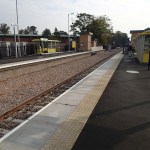
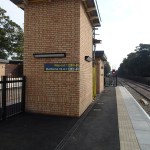
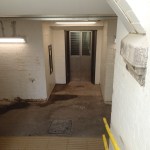
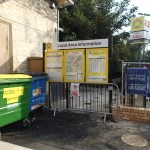
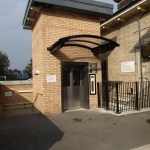
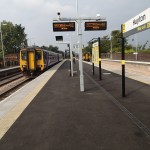
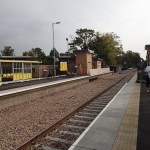
It’s all rather ironic to see this, giving Harold Wilson’s attitude to rail, considering that he was the MP for the area.
I took a train from Huyton to Leyland, so I didn’t see how far the electrification has got from the Manchester end, but work was obvious all the way from Huyton to Wigan North Western station.
There is no reason to believe that Class 319 electric trains will not be running between Liverpool and Manchester, on the planned December 2014 timetable change.
Whatever happens, Huyton will be getting a four-platform station with lifts between the platforms and the existing subway.
If all goes to plan, they’ll be getting an updated service between Liverpool and Manchester.
It’ll be interesting how this all works out by say the end of 2015. And then when all the electrification is completed in 2017.
1. Will the generally two trains per hour service frequency between Liverpool and Manchester Victoria be increased?
Even if they are not, they’ll be longer trains and they’ll be a lot faster. They’re will also be an improvement to the services that stop at all stations on the route, as the Class 319 trains are faster with much better acceleration.
2. As the line between Huyton and Wigan will be electrified, will there be electric services between Liverpool and stations on the West Coast Main Line?
Liverpool has a disadvantage here when compared to Manchester, in that there is significant traffic from Scotland to Manchester Airport. This was the reason that TransPennine introduced Class 350 trains on the Glasgow to Manchester Airport route. So Liverpool will never have as many direct trains from Scotland as Manchester.
At present generally about two trains per hour from Liverpool connect with perhaps a fifteen to twenty minute wait at either Wigan North Western or Preston for Scotland. The problem with introducing direct Liverpool to Scotland services is the lack of paths for trains. So perhaps we might see trains time-tabled to mean the change at say Preston was a simple walk across the platform.
An alternative would be to have two four-car trains from each of Manchester and Liverpool, join together at Preston for going onward to Carlisle and Scotland. Some train companies seem loathe to do this, whereas when done properly as I observed at Cambridge, it makes for an efficient railway.
3. Will the increase in the number of trains available for the route, mean an increase in late night services?
Obviously, there will have to be a need for the trains, but my train back from Wigan, wasn’t just two sad Ipswich fans and a guide dog.
One thing I found, when talking to some fellow passengers at Huyton, was how little some of them knew about the developments going on. Have Northern Rail and Network Rail got their PR right?
An Unusual Picture
I have cut this picture out of Google Earth of the railway north-west of Chorley.
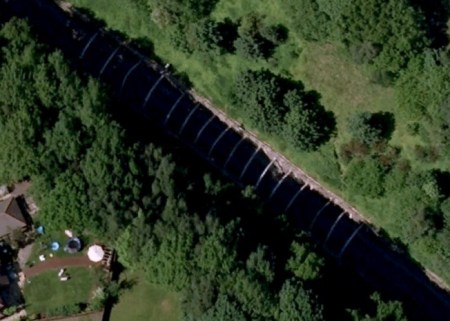
Sixteen Butresses
There would appear to be sixteen buttresses over the twin track railway.
They are actually some of the last examples of flying arches on UK railways. There’s more about the Chorley Flying Arches here.
I’m posting this, as the line through Chorley has just reopened after the related Chorley Tunnel has been expanded to allow for electrification. That is reported here on Modern Railways. It says this about the arches.
As well as upgrading the tunnel, the 16 historic Chorley flying arches – Grade II listed structures on the approach to the tunnel which are the only remaining examples on the British rail network – were refurbished following co-operation and consultation with English Heritage.
On the 22nd of this month, I’m going to see Ipswich play at Wigan. I think, I’ll go and look at these unique structures.
How many countries would actually restore te arches, rather than replace them with modern steel structures?
Will The Gospel Oak To Barking Line Be Extended To Hounslow?
The Modern Railways report on the Mayor’s Transport Infrastructure Plan for 2050 says this.
There may be a case for further orbital rail capacity, says the document – it shows an indicative, uncosted network to link Hounslow, Old Oak Common, Neasden, West Hampstead, Harringay, Walthamstow, Barking, Abbey Wood, Bexleyheath, Norwood Junction, Sutton and New Malden and back to Hounslow, with another route between Abbey Wood and New Malden via Lewisham, Peckham Rye and Wimbledon.
I did a brief piece of research on the route yesterday between West Hampstead and Harringay, and it would appear that there is a link off the Gospel Oak to Barking Line (Goblin), that enables trains to move to and from the Midland Main Line. I got a picture of the link just before my train from Gospel Oak arrived at Upper Holloway station.
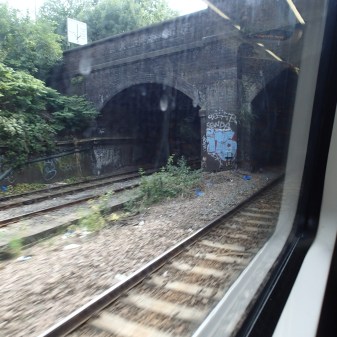
Goblin To MML Link
I suspect freight trains use it to get from the Goblin to the Dudding Hill Line, which branches off the Midland Main Line, just north of Cricklewood station.
So an Overground train could run the same way stopping at West Hampstead and Cricklewood stations, before taking the Dudding Hill Line, through new Neasden and Old Oak Common stations on the way to Hounslow.
The Route
Perhaps it is a good idea to list the stations on the extended line in order from Harringay Green Lanes to Hounslow.
Harringay Green Lanes – My only observation, is that I use this station to pick up the Goblin, as I can get a 141 bus direct to and fom the station from within a hundred metres from my house.
Junction Road – This doesn’t exist at present, but is constantly being talked about to link the Goblin to the Northern Line.
West Hampstead – In a few years this will have grown into a full blown interchange, between Thameslink, Chiltern Railways, Jubilee and North London Lines. Having the new extended Goblin call here would improve the transport opportunities for those who live and work all across North London.
Neasden – This will probably be a new station, somewhere near the current Neasden station on the Jubilee line. I visited the area, when I was researching the Dudding Hill Line. It might be a place where some clever architect and developer could create a very useful interchange combined with some much-needed residential properties.
Harlesden – As the Dudding Hill Line runs virtually over the top of the current Harlesden station on the Bakerloo and Watford Overground Lines, like Neasden this could be a development opportunity.
Old Oak Common – I have seen in some reports Old Oak Common has been described as the Canary Wharf of the West. Also, every time I read about the area, more rail lines and ideas get thrown into the mix.
North Acton – The route has now joined the southern end of the North London Line. An interchange at North Acton has been talked about for years. There’s a discussion here.
Brentford – In recent years, this station was on the London Crosslink between Norwich and Basingstoke.
Points Raised
Listing the stations shows several important points.
1. Interchanges With Other Lines
This part of the line has interchanges to many other lines. You could put these on the list.
2. Development Opportunities
Many of the stations seem to have development opportunities. Perhaps not on the scale of West Hampstead and Old Oak Common, but there would to be scope at many stations.
3. Important Areas Served
The line effectively links Tottenham, which is one of the most deprived areas of London, through most of North London through Old Oak Common to Hounslow in the West. The western end point is close to Twickenham Stadium, which is not the easiest place to get to from North and East London.
I have not seen any figures, but surely this line would open up a lot of employment and leisure opportunities.
4. Freight
An electrified line, as it obviously will be, would also speed freight along the line, perhaps allowing more freight trains to between ports like Felixstowe and London Gateway and the lines to the North and West.
4. No New Rail Lines, Bridges Or Tunnels
In this brief look, it would appear that most of the infrastructure, except for station and the catenary, is already in existence. I can’t see too many protest groups and Nimbys objecting to what is being proposed.
6. Possible Objectors
Perhaps the biggest objectors will be other train companies objecting to London Overground encroaching on their territory.
Summing Up
So to sum up, I think that this part of the proposed line, might be developed in the near future, as it provides an important link without costing the multi-billions of a Crossrail.
Redesigning The Ugly
There are lots of everyday common blots on the landscape, that are just downright ugly.
Take the electricity pylon. In all my years of travelling, I’ve never seen any that could be described as beautiful. If we didn’t want them to spoil the landscape, we’d bury them, as happens in most towns and cities.
However, there was a competition a few years ago with a £5,000 prize to find a better pylon. It’s all described in this report.
I’ve not seen any better ones yet!
So now it is time for the designers to look at the overhead lines used on railway lines. The thoughts and ideas are detailed here.
How many everyday objects can be improved by better design and materials?
Is This A Case Of More With Less Electrification?
When asked in the House of Lords about the cost of extending Crossrail to Reading, Baroness Kramer, the Transport minister, said it would save £10million. It’s all reported here in New Civil Engineer. As it has been reported for some time Crossrail and the Great Western Main Line electrification will share some infrastructure like transformers, I don’t think the cost saving is unexpected.
What Do We Do With Four-Four-Two?
I’m not referring to the formation used in football, but the Class 442 trains used on the Gatwick Express from Victoria.
At nearly twenty years old they are still comfortable trains in which to travel and I’ve used them a couple of times to get to or from Gatwick Airport and Brighton from London. As far as I’m concerned, they are not my preferred way to get to the airport, as they leave from Victoria, which is not as easy to get to as London Bridge from Dalston.
But there is nothing wrong with the Class 442 as trains, especially as they are based on the legendary Mark 3 coach and they hold the speed record of 174 kph for third rail electric trains.
The fact that they are third-rail only electric trains, is one of their two main problems. The other is that they weren’t designed as airport trains and are fairly unsuited for loading and unloading heavy cases.
It should be noted, that all of the third-rail electrics trains, built in the last few years are either dual voltage trains or they have a pantograph well, so they can be easily modified, so they can work with 25kV overhead electric lines.
The renewed franchise holder for Gatwick Express is reported as going to acquire a new specialist fleet of trains for the service, which will be delivered in 2016.
So we have the problem of a set of twenty-four five coach trains, with no service for which they are suitable.
They are fast trains, which means that only the suitable lines on which they could run are from Victoria to Brighton and Waterloo to Portsmouth, Southampton, Bournemouth and Weymouth. But they are unsuitable for the Victoria service, and they are not needed on the Hampshire services.
They are probably too old and too difficult to convert to overhead electric. It would seem to me with my engineering hat on, that to convert trains from third rail to overhead, unless that was in mind in the original design, is not a job with a small budget.
So conversion is probably a complete no-no!
So does the scrapyard beckon?
I would think so, but then a new coach costs around £1.5million and there are 120 coaches.
On the other hand, rail engineers have been living off scraps from the government for so long, that they are not short of innovative and oddball ideas. As an example read this article about how the previous Gatwick Express trains, the Class 460, were split up and used to lengthen the Class 458.
There are only two places where the Class 442 could appear to find a home.
The first is the two Coastway lines; East and West, which run from Ashford in the East to Portsmouth and Southampton in the West, via Hastings and Brighton. It would release other trains for use elsewhere, but I doubt it would need many of the twenty-four trains.even if the frequency was increased significantly.
The only other place where they could be used is on an electrified West of England Main Line to Salisbury and Exeter. I found this letter from South West Trains on the Network Rail web site. It states a whole list of advantages of electrying fom Basingstoke to Exeter.
So could the Class 442 find a home here on a third-rail electrified railway to Exeter?
It would probably go against policy to electrify such a long line in the archaic and incompatible third-rail system, but the upgrading does come with a set of fast affordable second hand trains in good condition, with an increasing reputation for reliability.
Another factor is whether Network Rail build a new route to Plymouth, as is outlined here on the BBC. If they do, I would suspect they would electrify it with overhead wires, so to have third rail to Exeter from Basingstoke, wouldn’t be that sensible.
So I still think that the Class 442 will go to the scrapyard.
But I wouldn’t mind being shown to be wrong and that the trains find a good home on somewhere like the West of England Main Line or the Coastways.
Is Electrification The Key To More Diesel Trains?
My two trips on Saturday to Norfolk and Tuesday to Wiltshire, show that sometimes off the main lines, the backbone of the trains are elderly Class 150, Class 153, Class 156 and others, which are totally overcrowded and inadequate for the task. Up North and even more far flung places, it’s even more grim with quite a few dreadful Pacers, which were built as a stopgap in the 1980s with a twenty year lifetime and don’t match the latest disability regulations.
So something drastic needs to be done.
On Tuesday, the crowded Class 150, I used between Salisbury and Westbury, was totally inadequate for the task of running a long distance service between Cardiff and Portsmouth. It was like expected four people with luggage to make the journey between the two cities in an Issigonis-designed Mini. I suppose you wouldn’t do it, unless you were hard up and wanted to get to Glastonbury.
The Class 153 train, that I used between Westbury and Swindon are probably adequate with a bit of refurbishment on branch lines like Ipswich to Felixstowe, but being only a single coach, if traffic continues to grow, they will be totally packed for much of the day.
The Class 156 trains, I used in Norfolk had been updated with new disabled toilets and are probably ideal for the East Anglian branch lines, until traffic means that three carriages are needed.
The Class 153 and 156 trains can probably soldier on reliably for some years after refurbishment, but I doubt there is much future for the Class 150, unless a clever engineer/designer comes up with a solution, that converts them into something completely different. They could certainly be msade good enough to replace the single coach Class 153s on routes like Ipswich to Felixstowe.
When I travel to somewhere like Blackpool, Barnsley or to Sheffield via Doncaster, I sometimes end up on a Pacer, as I did here. The title of the post, which is In Style to Sheffield And Then This, sums up Pacers in my mind.
As a lot of visitors will encounter Pacers, as I did as the last leg of a journey to the area, the managers of such as Virgin, East Coast and the other long distance companies, must despair that their passengers have their journey ruined by the connecting train. How many say go from London to Scunthorpe once by train and never do it again because of the inadequate Pacers?
But hope for the end of these dreadful trains is at hand if Modern Railways is to be believed, with an article with a headline of Pacer Replacement Likely. It is all down to the replacement Northern Rail franchise, which I suspect is unviable financially and possibly illegal with a third of the fleet being inadequate and unable to meet the disability regulations.
London Overground has shown how you replace trains. Until quite recently, the North London Line was served by Class 313 trains built in the 1970s. Al;though even older than Pacers, some are still running on the network after refurbishment, and to travel in one is an experience that is almost twice as good as travelling in a Pacer. But even some of these are destined for the scrapyard in the next few years according to Modern Railways.
London Overground replaced its Class 313s with new Class 378 trains. These were designed to be three coach trains and have been lengthened to four and are now going to five, by just plugging extra coaches in the middle. I’ve no idea what the limit is for trains of this family, but Greater Anglia regularly couple their closely-related Class 379 trains together to make longer trains.
But these trains are electric, although they do have a diesel cousin, the Class 172, which comes in both two and three coach versions. So it would appear that they can be lengthened in a similar fashion to the Class 378 on the Overground.
In a sane and sensible world with money everywhere, you’d have Class 172 or something with a similar nature coming out of the factories to replace the Pacers and Class 150s.
As the Class 172 trains are British-built in Derby by Bombardier, there is surely a strong case to keep the production lines busy there and use them as replacements across the network. As London Overground and other operators have shown, these trains work well and having a type that is widespread must help with Maintenance and staff training.
Wikipedia’s entry for the Class 172, says this about new orders for the type.
As part of its franchise agreement, London Midland has an option to purchase an additional 26 Class 172 vehicles which could potentially allow further cascade of its existing rolling stock.
In 2008, First Great Western applied to the Department for Transport to re-equip its Cardiff to Portsmouth via Bristol services with 11 new four-car DMUs which would potentially allow the existing Class 158 Express Sprinter trains to be transferred to other services. According to the West of England Partnership, these were likely to be “similar to Class 170s”, suggesting that they might be Class 172 Turbostars.
The Government announced in December 2008 that Bombardier, with its Turbostar design, was one of the pre-qualified bidders (along with CSR of China, CAF of Spain and Rotem of South Korea) for the first 200 DMU vehicles of its planned 1300 new carriages. These new trains were intended for use on suburban and inter-urban services operated by First Great Western, First TransPennine Express and Northern Rail. However, with the announcement of the electrification schemes in the North West and on the Great Western Main Line, the DMU order was cancelled, with the needs of the train operating companies planned to be met by transfers of existing stock.
But why do we need to get the new trains built outside of the UK?
The piece talks about the transfer of stock, as lines are electrified. In fact, eight virtually-new Class 172s will become surplus, when the Gospel Oak to Barking line is electrified. According to this article in the Barking and Dagenham Post, this will happen by 2017.
But as my trip to Westbury showed, some of the worst problems are on longer services like Portsmouth to Cardiff, which probably have to be run using diesel trains. But as the extract shows, First Great Western is pressing to get new and better trains on that route.
From personal experience in the last few years, there are a host of services, where more and longer diesel services are required.
One collection of routes, I have talked about for years is the lines from Ipswich and Norwich to Peterborough and on to Birmingham, Nottingham and Liverpool.
Some of the lines within East Anglia , like Cambridge to Norwich and Ipswich, and Ipswich to Lowestoft, could also benefit from more trains. But hopefully,as I pointed out here, electrification is the key and that would release trains to improve the secindary routes and branch lines.
Sheffied to Leeds, Hull and Manchester, are three lines where the trains are a discouragement to travel. Eventually, these three lines will get electrified, but in the meantime. some longer and more modern trains would be very welcome.
Obviously we could just build more trains, but trains are expensive at about £1.5million a coach, if all of the other things are taken into account.
However, we do have electric trains that are being replaced by new trains.
First Capital Connect has a lot of electric trains that will not be needed when the new Class 700 trains replace them. As there is going to be 60, eight-car and 55, twelve-car trains, there will be a lot of Class 319 and Class 377 sets to be moved on.
The Cl;ass 377 are virtually new, whereas the Class 319 are from the late 1980s. I’ve travelled on the Class 377 trains regularly and as multiple units go, there are many worse examples on the UK’s railways.
According to Wikipedia, these are the plans for the Class 319, once they are replaced, by the Class 700.
As part of its announcement of the electrification of both the Great Western Main Line and the Liverpool to Manchester (via Newton Le Willows) route, the Government has announced that when new Class 700 Thameslink rolling stock arrives from 2015-2018, Class 319s will be refurbished, fitted with air-conditioning, and transferred to the following two routes:
Suburban services between Oxford, Newbury, Reading and London
Manchester Airport to Liverpool Lime Street and Manchester Victoria to Liverpool Lime Street servicesOn 2 April 2014 it was announced that the first 14 units would be transferred to Allerton Depot in time to enter service between Manchester and Liverpool from the December 2014 timetable change.
So as electrification progresses, these trains will release much-needed diesel trains.
The other big schemes like the Great Western Main Line and Midland Main Line electrification, and Crossrail will also see lots of new trains and push out older electric and diesel sets for other uses.
Probably one of the biggest problem or opportunity is what to do with all the High Speed Diesel Trains. I suspect some will worm their way into all sorts of strange places, where the designer and his team, never dreamt they could ever be used.
No-one makes predictions where these trains are concerned, as they are held in such tremendous affection by staff and passengers alike. Their replacement on the Great Western and East Coast Main Lines, the Class 800 and 801 have a very hard act to follow!
We appear to be going round in virtuous circles. So I think the answer to the question I posed is yes!
 The Anonymous Widower