Race For Clean Power Surges Ahead As New Electricity Superhighway Greenlit
The title of this post, is the same as that of this press release from Ofgem.
These three paragraphs, explain the infrastructure.
Flagged by the National Energy System Operator (NESO) as an essential element in achieving the Government’s Clean Power 2030 ambition, Eastern Green Link 1 (EGL1As part of its mission to rapidly upgrade the energy system with a minimum cost to customers, Ofgem has identified over £43m of savings which have been cut from the project costs without impacting delivery or quality. Communities that host the infrastructure in Scotland and North-East England are also set to benefit from a £7.9m social value and community benefit fund.) is a high voltage electricity superhighway able to transport 2 gigawatts of homegrown wind generated electricity between Torness, East Lothian and Hawthorn Pit, County Durham. A gigawatt (GW) is equivalent to one billion watts, and one gigawatt hour (GWh) of electricity is enough to power one million homes for one hour. Most of the 196km cable will be under the North Sea, with the remaining 20km of cables underground linking the cable to substations and converter stations in Scotland and England.
The project will reduce Great Britain’s reliance on volatile international gas markets by further harnessing the power of homegrown North Sea wind. NESO’s recent Clean Power 2030 Report has also shown that the project will deliver annual saving of over £870m by reducing the need to compensate British wind generators who are currently asked to turn off production during times of high wind due to lack of grid capacity. This in turn will help drive down consumer bills.
Note.
- Eastern Green Link 1 (EGL1) is a high voltage electricity superhighway able to transport 2 gigawatts of homegrown wind generated electricity between Torness, East Lothian and Hawthorn Pit, County Durham.
- This is the second down the eastern side of the UK.
- In Contracts Signed For Eastern Green Link 2 Cable And Converter Stations, I described how contracts were signed for EGL2 from Peterhead in Scotland to Drax in England .
- Most of the 196km cable will be under the North Sea, with the remaining 20km of cables underground linking the cable to substations and converter stations in Scotland and England.
There are another two 2 GW cables to follow in the current plan!
Hawthorn Pit Solar Farm
This document from the Department of Business, Industry and Industrial Strategy lists all the Contracts for Difference Allocation Round 6 results for the supply of zero-carbon electricity.
Hawthorn Pit solar farm was given a Contract for Difference.
The solar farm has a web page on the Aura Power web site, where this paragraph describes the solar farm.
Aura Power is working on a solar farm proposal between Murton and South Hetton, with a capacity of up to 49.9MW (Megawatts). The solar farm will be built without subsidy and would generate enough clean electricity to power the equivalent of over 17,000 homes, saving around 15,203 tonnes of CO2 from entering the atmosphere each year.
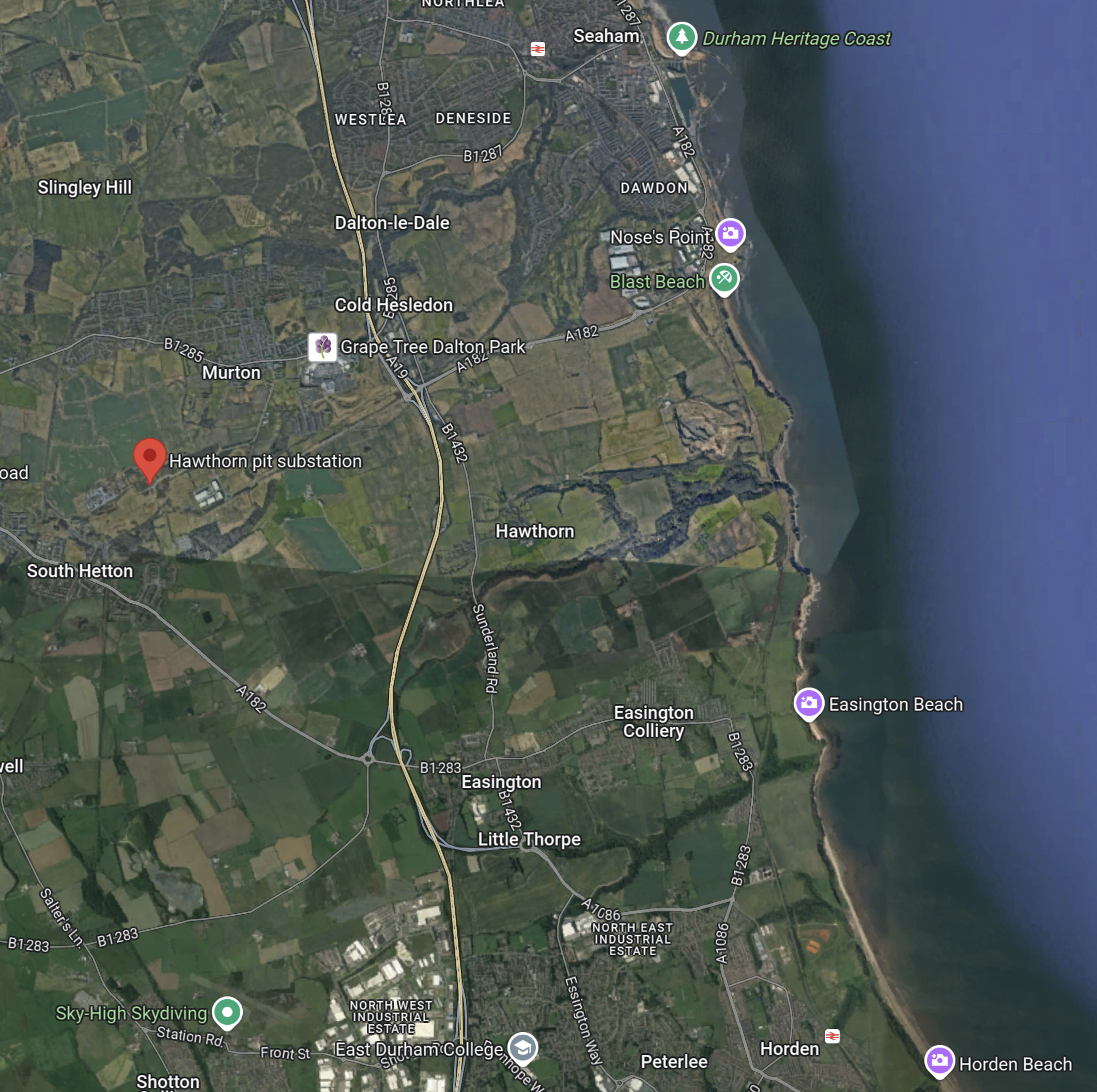
This Google Map shows the location of Hawthorn Pit.
Note.
- The Durham coast is at the East with Seaham at the North and Horden at the South.
- The A 19 runs North-South in the middle of the map.
- Hawthorn Pit substation is marked by the red arrow.
This second Google Map shows the substation in more detail.
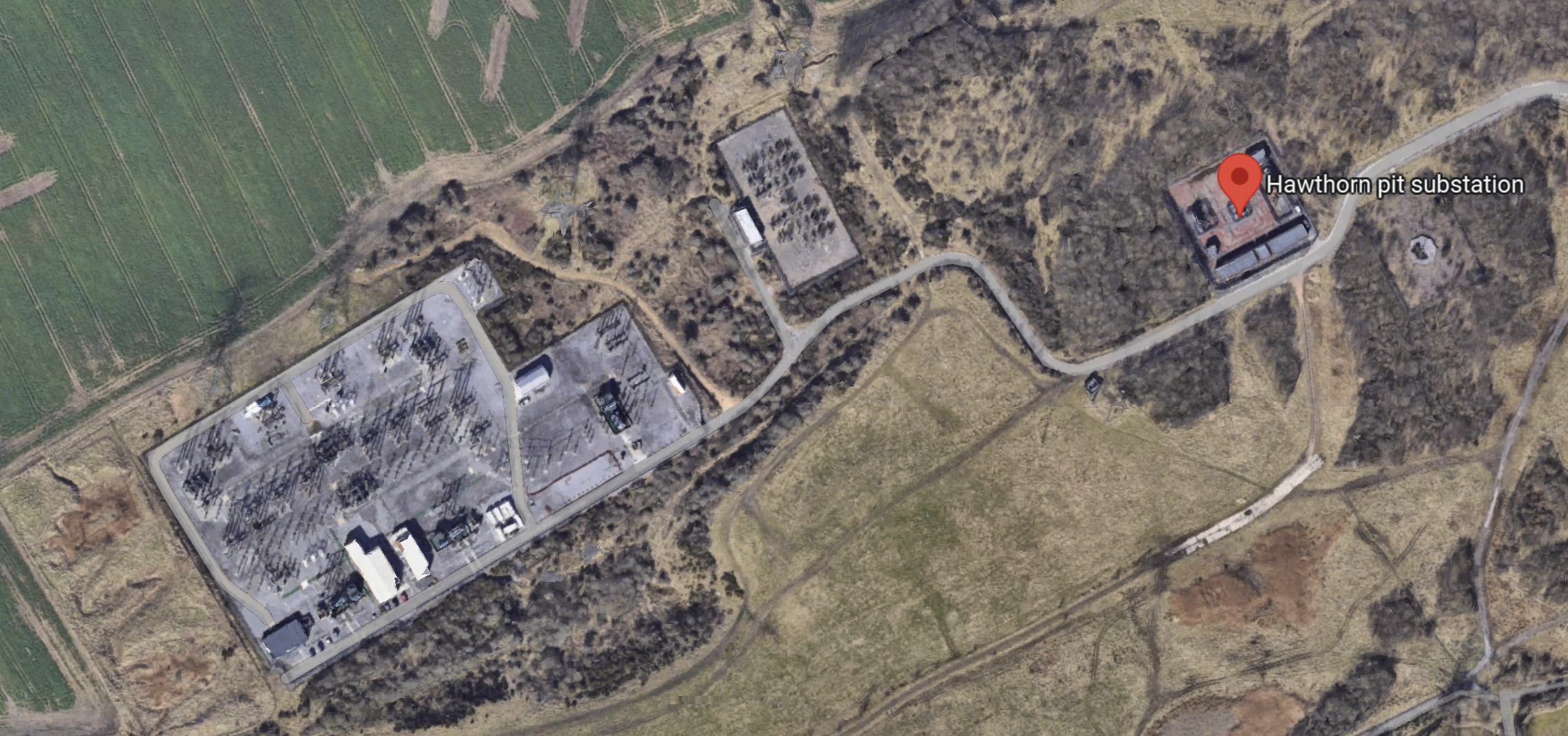
There are a lot of switches and wires.
From the map on the Aura Power web site, it appears that the solar farm is to to the North side of the substation.
Eastern Green Link One
In the future Hawthorn Pit substation will also host the Southern end of Eastern Green Link One, which will be a a 2 GW high voltage direct current (HVDC) electrical superhighway to be built between the Torness area in East Lothian, Scotland and Hawthorn Pit in County Durham, England.
This is number one of four such 2 GW undersea connections that will distribute energy between England and Scotland.
Conclusion
Hawthorn Pit substation could growto an important interchange in the grid.
 The Anonymous Widower