The Future Of Drax Power Station
This first paragraph from the Wikipedia entry for Drax power station gives a factual description of the power station.
Drax power station is a large biomass power station in Drax, North Yorkshire, England. It has a 2.6 GW capacity for biomass and had a 1.29 GW capacity for coal that was retired in 2021. Its name comes from the nearby village of Drax. It is situated on the River Ouse between Selby and Goole. Its generating capacity of 3,906 megawatts (MW), which includes the shut down coal units, is the highest of any power station in the United Kingdom, providing about 6% of the United Kingdom’s electricity supply.
This second extract from Wikipedia gives details of its current biomass contract and subsidy.
Drax’s subsidy scheme was scheduled to end in 2027, with Drax arguing for an extension to 2030. In February 2025, the UK government extended its operation from 2027 to 2031, but at a reduced 27% maximum load factor using 100% sustainable wood, so it would run “less than half as often as it currently does”, generally only at times of high electricity demand. Drax was given a contract for difference at £113/MWh in 2012 pounds, CPI inflation linked so about £155/MWh in 2025.
Note.
- Rishi Sunak’s Government extended the contract.
- It will now run on 100% sustainable wood, which includes sources like sawmill residues, forest thinnings and certain agricultural products.
- It has a similar type of contract to wind farms and energy storage.
I asked Google AI,”Does Drax Power Station Provide Grid Stability?, and received this answer.
Yes, Drax Power Station—along with its affiliated hydro assets—provides critical grid stability to the UK. As the UK’s power grid shifts toward intermittent renewables like wind and solar, Drax’s dispatchable generation and specialized system support services help maintain a secure electricity network.
The key stability services provided by the Drax portfolio include:
Inertia: Drax’s large spinning turbines and pumped hydro facilities provide vital inertia to the grid. This acts like a shock absorber, helping to control changes in frequency (maintaining 50Hz) and preventing power cuts.
Reactive Power: The facilities help manage voltage support and move power efficiently across different parts of the network.
Dispatchable Power: Unlike weather-dependent generation, Drax’s biomass and hydro plants can be ramped up or down on demand, providing firm capacity and flexible response to real-time grid needs.
Pumped Storage Support: Through its subsidiary Cruachan Power Station in Scotland, Drax operates a pumped hydro storage plant that actively balances supply and demand and holds specialized stability contracts with the National Grid Electricity System Operator (ESO).
So if you love or loathe the power station, it does a lot more than burn biomass to generate electricity.
Drax Power Station And Eastern Green Link Two
The Eastern Green Link Two web site is here.
This is the sub-heading
Eastern Green Link 2 (known as EGL2) is one of the most significant strategic energy infrastructure developments the UK has seen in recent years, connecting the north of Scotland to Yorkshire via the sea.
These two initial paragraphs gives more details.
EGL2 is a 505km electricity superhighway which will enable the transfer of power from Scotland to England (and vice versa) via a subsea cable. This two-gigawatt high voltage direct current (HVDC) cable is connecting Peterhead in Aberdeenshire and Drax in North Yorkshire and once operational, will carry enough electricity to power two million homes.
EGL2 will scale up the UK’s capacity to transport home-produced clean energy, predominantly from offshore wind, from where it is generated to where there is demand. By doing so it will increase the security, resilience, and stability of the UK’s transmission network.
EGL2 is the second of a planned seven interconnectors between Scotland and the South.
The first was the Western HVDC Link between Hunterston in Scotland and Flintshire Bridge in Wales, which became operational in 2013.
EGL2 will go between Peterhead in Scotland and Drax power station.
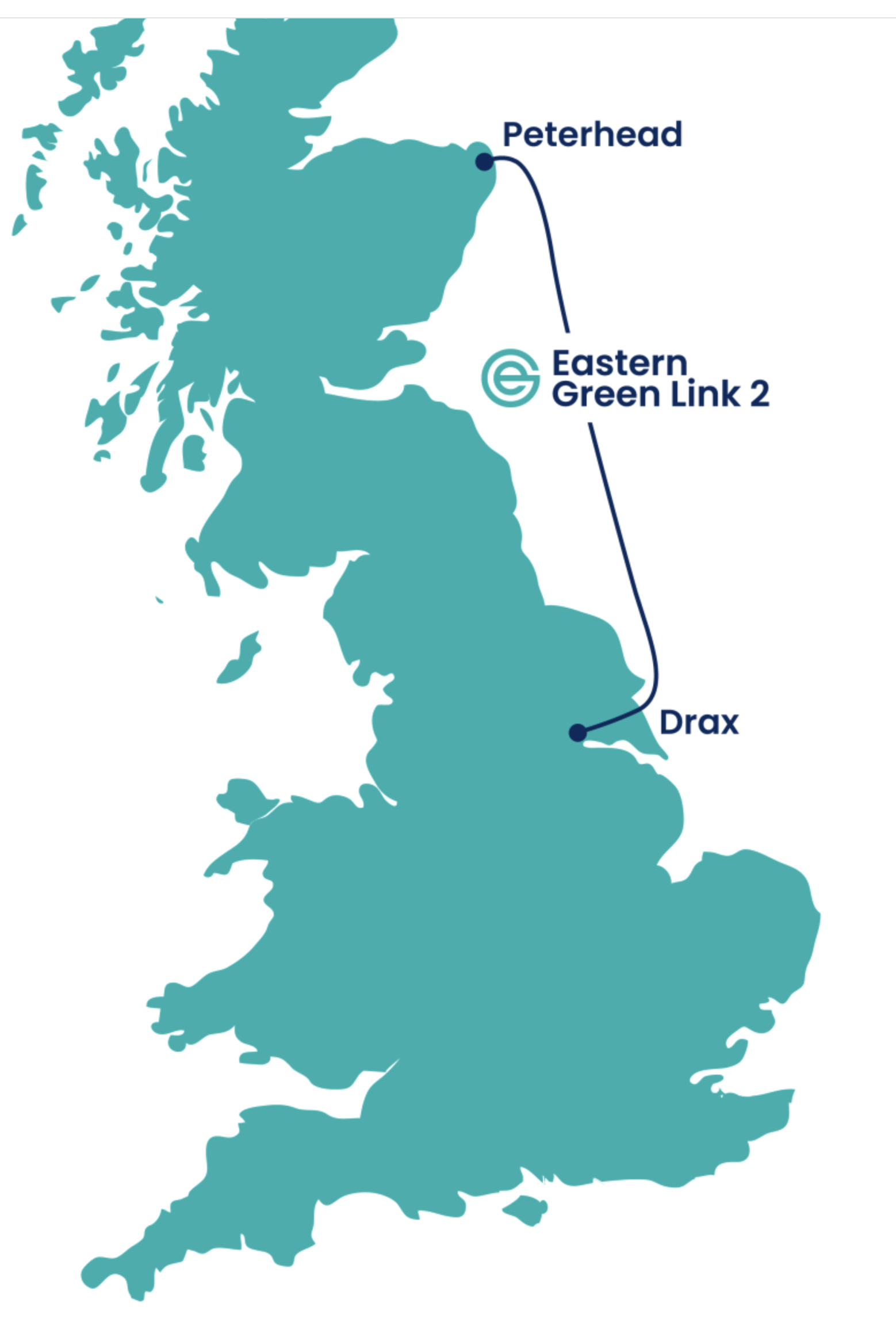
So electricity from Scotland will be able to replace up to two GW of the biomass, that Drax power station currently uses as fuel.
Drax And Solar Power
This Google Map shows Drax power station.

If Drax wanted to add solar power to the site, I’m sure it would be possible.
- There is plenty of space.
- There is a substantial connection to the electricity grid.
After the purchase of Bluefield Solar Income Fund, Drax probably are well-placed to develop as much solar-power as they need.
Bluefield Solar Income Agrees To PS548 Million Cash Offer From Drax
The title of this post is the same as this article from A J Bell.
These two paragraphs give more details of the deal.
Bluefield Solar Income Fund Ltd on Monday said it had agreed to a £548 million cash offer from Drax Group PLC, which implies an enterprise value of £1.08 billion.
The solar-power focused investment firm has received a bid from Drax Smart Generation Holdco Ltd, which is wholly-owned by Selby, North Yorkshire-based electricity generator Drax. Both firms are members of the FTSE250 index.
I see this deal, to be very much like Centrica’s purchase of the Grain LNG Terminal, which I wrote about in Investment in Grain LNG.
I asked Google AI,”How Do Drax And Centrica Compare Financially?”, and received this answer.
Centrica and Drax have contrasting financial profiles:
Centrica operates on a much larger scale as a diversified retail and energy supply giant, generating £22.4 billion in annual revenue, while Drax is primarily an electricity generator focused on biomass, generating £5.4 billion.
Both companies face challenges from lower global energy prices.
I asked Google AI,”How Do Drax And Centrica Compare On Engineering And Research?”, and received this answer.
Drax and Centrica approach engineering and research from opposite ends of the energy sector: Drax is a mega-scale renewable generator focused on heavy industrial decarbonization, while Centrica focuses on consumer technology, smart energy networks, and servicing.
In addition, now that Centrica has bought the Grain LNG Terminal, Centrica seems to do a lot of LNG trading and storage and they appear to be moving into the bunkering of low-carbon fuels for shipping and have added a second site to Grain, with the acquisition of Severn power station at Newport.
Drax haven’t laid out their plans in detail yet.
These to paragraphs from Drax give a few hints.
Drax sees the purchase supporting growth in the UK renewables market, complementing its existing assets and facilitating £2 billion in incremental investment which Drax has planned for ‘flexible’ energy between 2025 and 2031.
Bluefield generated earnings before interest, tax, depreciation and amortisation of about £130 million in financial 2025, Drax noted, and has the potential ‘to grow Drax’s Ebitda from renewables, offering greater predictability and visibility of cash flows from a large operational portfolio’. This will reduce Drax’s earnings risk from grid connection delays, Drax added.
The last sentence seems to hint, that the deal comes with good connections to the grid, which given what you read about the problems of connecting must be a good thing.
Why Are Drax Building Open Cycle Gas Turbine Power Stations?
I asked Google AI, this question and received this answer.
Drax is building Open Cycle Gas Turbine (OCGT) power stations to provide rapid-response, back-up electricity when weather-dependent renewables (like wind and solar) cannot meet grid demand. This flexible generation stabilizes the UK grid, secures energy supplies, and supports the transition to a lower-carbon energy system.
Drax’s strategic move into OCGT is driven by several key factors:
Fast Start Capabilities: OCGT plants act like giant jet engines. They can go from a cold start to full power output in less than 20 minutes, making them ideal for meeting sudden spikes in electricity demand.
Back-up for Intermittent Renewables: Because output from wind and solar fluctuates with the weather, OCGT stations fill the generation gaps, ensuring continuous energy security without relying on older, dirtier coal power.
System Stability (Synchronous Compensation): Drax has equipped its new OCGTs (such as the Hirwaun Power Station) with a special clutch mechanism.
This allows the turbines to disconnect from the generator so the plants can act as “synchronous compensators.” In this mode, they provide crucial grid stabilization services—like inertia and voltage control—without burning gas.
Meeting Capacity Market Needs: These facilities primarily operate only during times of peak stress or low renewable output (e.g., 500 to 1,500 hours a year), providing a cost-effective support mechanism for the wider electricity system.
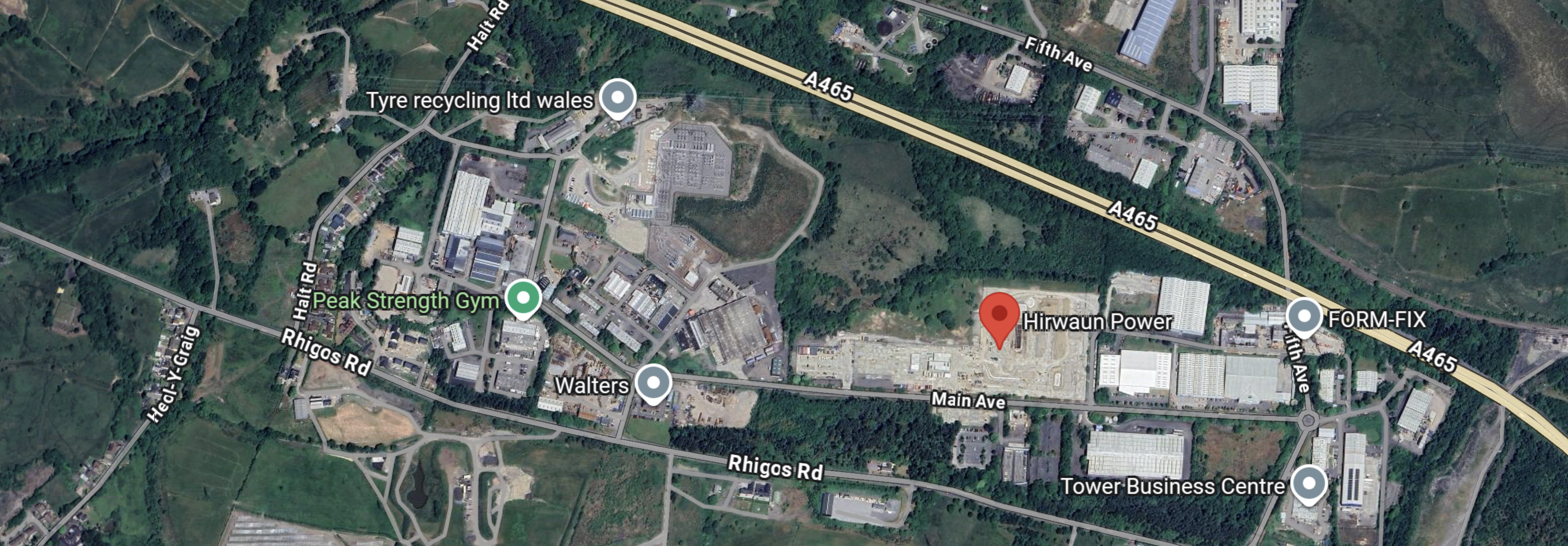
This Google Map shows Hirwaun Power Station.
Note.
- Hirwaun Power Station is indicated by the red arrow.
- Hirwaun Power Station is a 399 MW Open Cycle Gas Turbine Power Station.
- The A 465 is the Heads of the Valleys Road.
- Solar farms can be seen between the buildings.
Could Drax see commercial advantages to put the two systems together?
Huddersfield Station – 30th September 2025
This press release on the Network Rail Media Centre is entitled Huddersfield Station Set To Reopen Next Week With New Temporary Layout.
As it is now next week, I went to have a look at the progress today.
I made a mistake and got on a Grand Central Train, which meant, I had to change at York.
Speeding past Drax power station on the Selby Diversion, I took these pictures.











We were only in a 125 mph diesel, so we couldn’t take advantage of the 160 mph running, that the East Coast Main Line’s new signalling might allow on this section. The Wikipedia entry for the Selby Diversion, says this about the possible speeds.
The line was the first purpose-built section of high-speed railway in the UK having a design speed of 125 mph; however, research by British Rail in the 1990s indicated that the route geometry would permit up to 160 mph operation, subject to the necessary overhead line equipment and signalling upgrades. The new line also avoided the speed restriction over the swing bridge at Selby. The former ECML route, the NER’s 1871 York and Doncaster branch line, was closed from Selby northwards.
As the Selby Diversion opened in 1983, I wouldn’t be surprised that the calculations were performed on British Rail Research’s Pace 231-R, which was similar to the one I used at ICI and the pair, that NASA used calculate how to land Apollo on the moon.
When I eventually got to Huddersfield, I took these pictures.



























Note.
- In I’ve Just Glimpsed The Future Of Train Travel Across The North Of England And I Like It, there are pictures of Huddersfield station, that were taken on the 21st August, soon after the work started.
- In Huddersfield Station – 15th December 2023, there are pictures of Huddersfield before the work started.
- Much of the work seems to have been done at the Western end of the station to lengthen the platform on the Penistone Line to Sheffield.
- Platform 2 for the Penistone Line has also been renumbered Platform 1.
Work still to be carried out at Huddersfield station, includes refurbishing the roof, installing the electrification and adding a couple of new platforms.
These are my thoughts.
Which Platforms Will Be Electrified?
This OpenRailwayMap shows the proposed electrification in Huddersfield station.
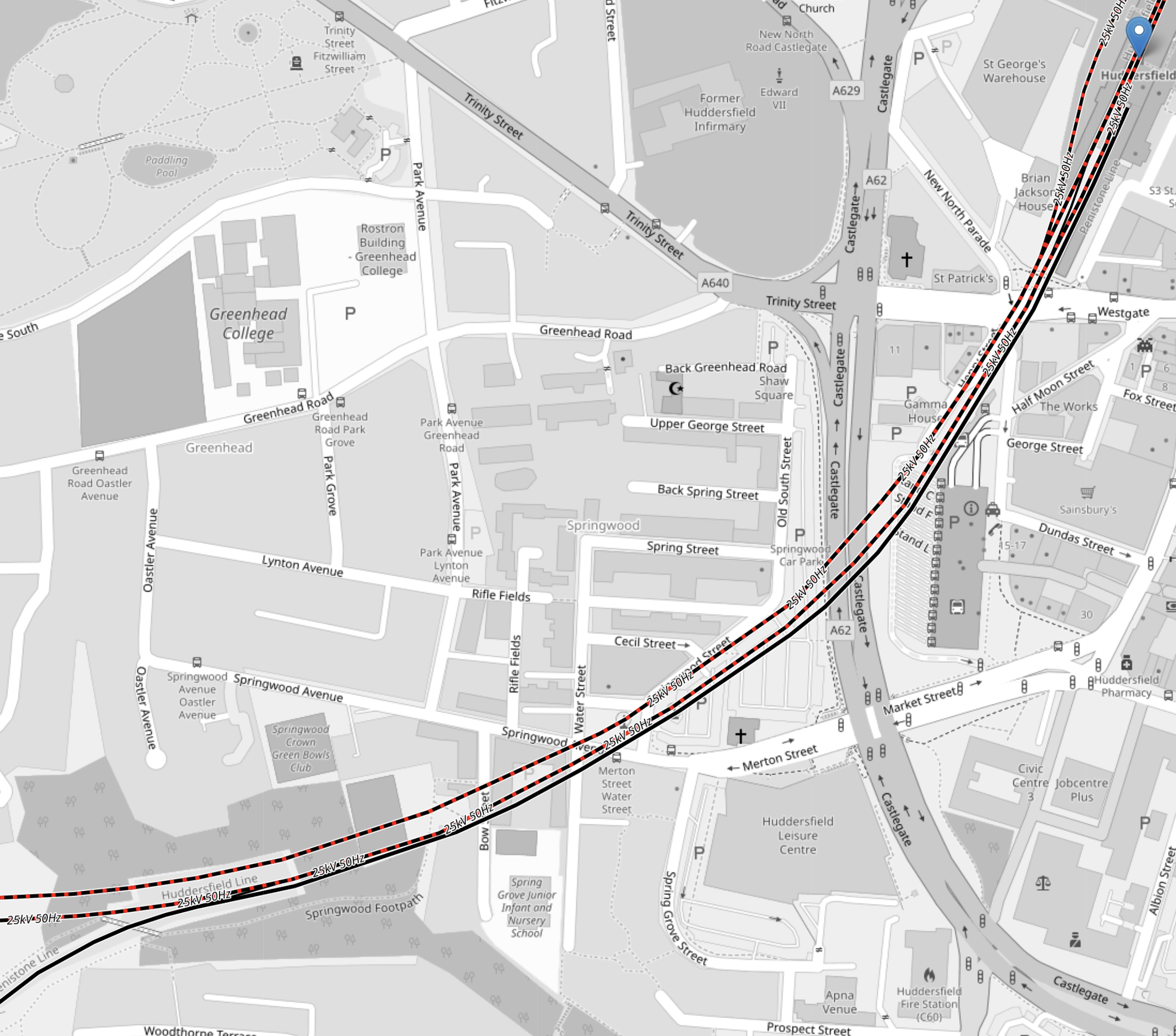
Note.
- The blue arrow in the North-East corner of the map indicates Huddersfield atation.
- The two red-and-black tracks going diagonally across the map are the Hudderfield Line.
- The red-and-black colour, indicates that the two tracks will be electrified.
- South of these two tracks, the Penistone Line sneaks into Platform 1 at Huddersfield station.
- The Penistone Line goes to Sheffield in a South-Westerly direction.
- There appears to be a crossover, so that trains from the Penistone Line can use both Platforms 1 and 2 in Huddersfield station.
- The OpenRailwayMap appears to show planned electrification between Stalybridge and Leeds stations.
- To the East of Leeds planned electrification is shown as far as Micklefield and Church Fenton stations.
Once installed, this electrification will create a complete electrified route across the Pennines from Liverpool Lime Street in the West to the East Coast Main Line in the East.
This OpenRailwayMap shows the planned electrification between Micklefield and Hull stations.
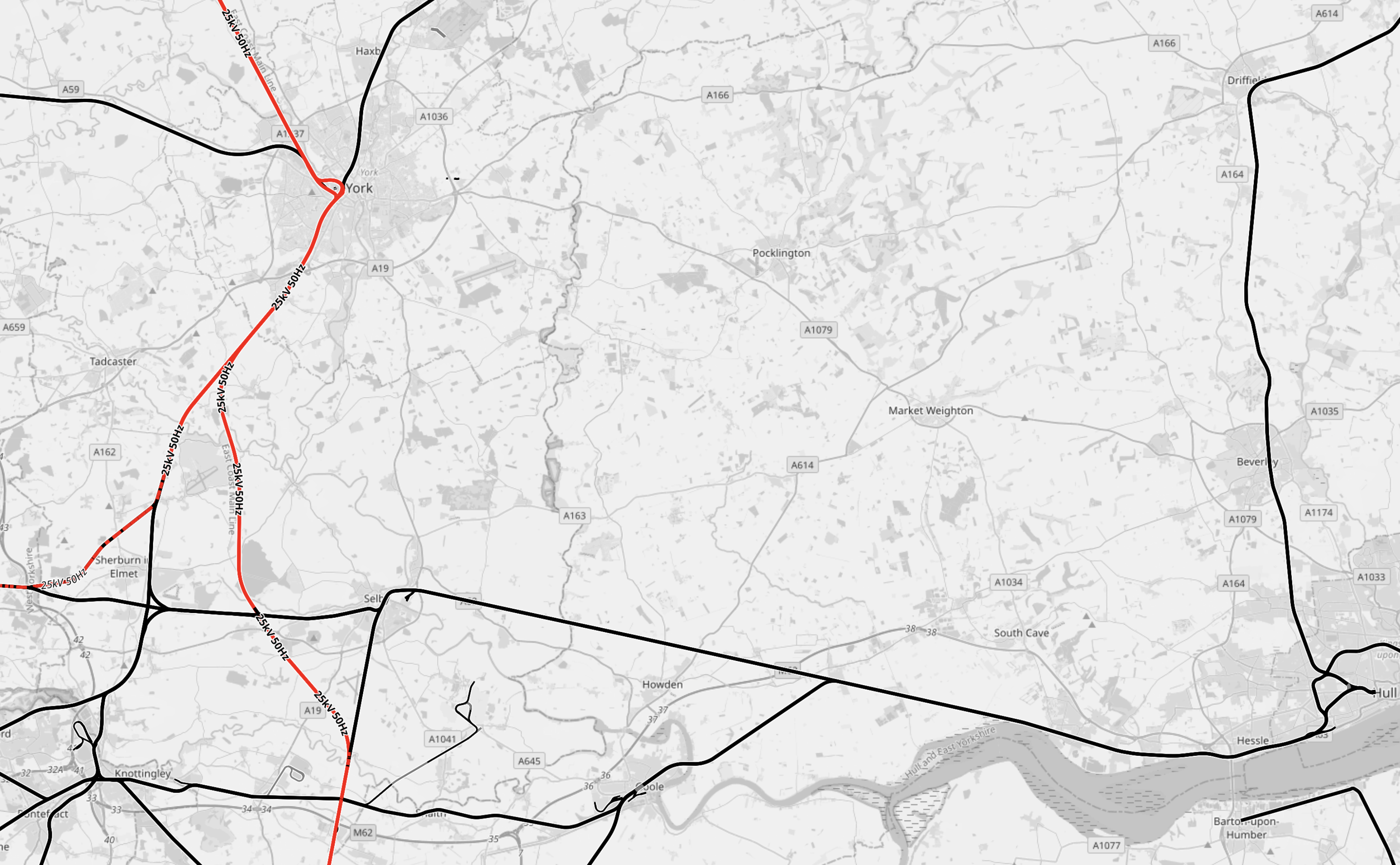
Note.
- Red tracks are electrified.
- Black tracks are not electrified.
- York is in the North-West corner of the map, with the electrified East Coast Main Line going through the station North-South.
- South of York, the East Coast Main Line now splits.
- The Western branch includes an electrified line to Micklefield station, Neville Hill depot and Leeds station.
- The Eastern Branch is the Selby Diversion, which is an electrified 160 mph line, that avoids the Selby coalfield.
- Running West-East across the map is the unlectrified Micklefield and Hull Line, which goes via Selby.
- Hull is in the South-East corner of the map.
- Hull is 42 miles from Micklefield and 36.1 miles from the Temple Hirst junction on the Selby Diversion, so it is within range of battery-electric trains, with charging at Hull station.
- Hitachi’s battery-electric Class 802 trains, used by Hull Trains and TransPennine Express, which are currently on test, should certainly be able to serve Hull.
Hull can become an electrified station, without the expense and disruption of full electrification.
How Long Is Platform 1 At Huddersfield Station?
This OpenRailwayMap shows the new Platform 1 at Huddersfield station.
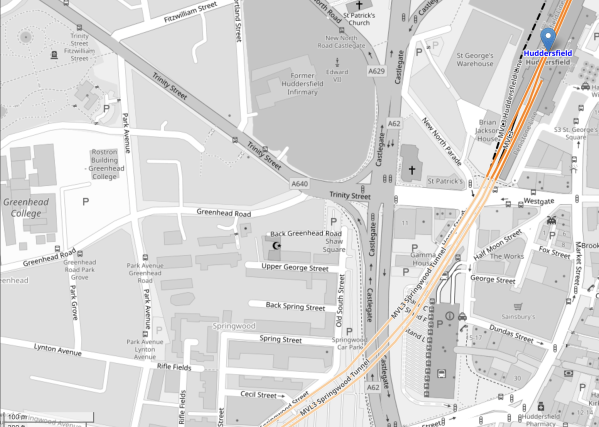
Note.
The blue arrow indicates Huddersfield station.
- The three darker orange lines indicate the two through platforms 2 and 3, and the reconfigured bay platform 1.
- There is a cross-over between platforms 1 and 2, which connects Platform 2 to the Penistone Line.
- In the South-West corner of the map is a hundred metre scale.
- Using the scale, I estimate that the length of the bay platform 1 is around 120 metres.
- In the last two rows of pictures in the gallery of this post, a three car Class 150 train is shown in Platform 1.
- A three car Class 150 train is approximately sixty metres long.
Looking at the pictures, I wouldn’t be surprised if the new platform has been designed to take two three-car Class 150 trains. It would certainly take a pair of two-car Class 150 trains.
Other trains and their lengths that might use the platform include.
- Class 170 – three-car – 70.85 metres
- Class 195 – two-car – 48.05 metres
- Class 195 – three-car – 71.40 metres
- Class 195 – 2 x two-car – 96.10 metres
- Class 810 – five-car – 120 metres
The Class 810 uses 24 metre cars, so that a pair of trains, will fit in St. Pancras. But with perhaps selective door opening could a single Class 810 train run a St. Pancras and Huddersfield service, perhaps with a split and join at Sheffield.
Electrification Across The Pennines
The TransPennine Route will be electrified between Liverpool Lime Street and Micklefield stations, once the current works between Huddersfield and Leeds are complete.
Sections without electrification include.
- Bradford Interchange and Doncaster – 52.1 miles
- Cleethorpes and Doncaster – 52.1 miles
- Harrogate and Leeds – 18.3 miles
- Hazel Grove and Doncaster – 52.6 miles
- Hull and Micklefield – 42 miles
- Hull and Temple Hirst junction – 36.1 miles
- Saltburn and Northallerton – 28.1 miles
- Sunderland and Northallerton – 46.8 miles
- Scarborough and York – 42.1 miles
I expect that Hitachi trains with batteries or CAF’s tri-mode trains will be able to handle these routes in a low-carbon manner.
Electrification Between Stalybridge And Huddersfield
This section is shown as being electrified on OpenRailwayMap.
But as it is only 18 miles and includes the Standedge Tunnels will the route use battery-electric trains?
Government Approval For Large Solar Farm
The title of this post, is the same as that of this article on the BBC.
This is the sub-heading.
A large solar farm in East Yorkshire has been given the go ahead by the government.
These two introductory paragraphs add more detail.
The 3,155 acre (1,277 hectares) site will be built on land around Gribthorpe, Spaldington and Wressle and Howden.
Its developers said it would produce 400 megawatts of electricity – enough to power 100,000 homes.
Note.
- This solar farm is five square miles or a 2.2 mile square.
- Due to the size of the scheme the planning application was handled by the Planning Inspectorate as it was classed as national infrastructure.
- Ed Miliband may have been involved in the final decision.
- The solar farm would connect to the National Grid at the Drax substation in North Yorkshire.
But the solar farm is not without opposition, as these last three paragraphs indicate.
George McManus, spokesman for East Riding Against Solar Expansion (ERASE), said the approval “brings us a step closer to enormous swathes of agricultural land being blanketed in a million, Chinese manufactured, solar panels.”
He added: “Other projects in the pipeline will see another 20,000 acres disappear under glass.
“The East Riding is being industrialised and people need to wake up to that.”
Nothing is said about where Reform UK’s Mayor for Hull and East Yorkshire sits.
Arriving In Liverpool Lime Street Station – 10th May 2025
Liverpool Lime Street station has one of the more spectacular approaches of British railway stations, as these pictures show.



























These sections describe the approach.
Crossing The Mersey
You cross the Mersey at Runcorn on the Ethelfreda or Britannia Bridge, which is described in this Wikipedia entry.
It was completed in 1868 and hopefully in a few years, it will be carrying High Speed Two trains between London and Liverpool.
On your right as you cross the Mersey to Liverpool is the Silver Jubilee road bridge, which is a through arch bridge that opened in 1961 to replace a historic transporter bridge. I am just a little bit too young to have seen the transporter bridge.
Further to your right, you can see the Mersey Gateway Bridge, which is a cable-stayed bridge, that opened in 2017 and is described in this Wikipedia entry.
Drax’s Biomass
As you approach Lime Street station, you pass through Edge Hill, where there are the GB Railfreight sidings, where the biomass trains for Drax power station are marshalled for their journey across the Pennines. These Drax trains seem to be one of the few freight trains in the UK, that carry advertising. Tesco trains also do, but their’s is just big letters.
In Do Cummins And Stadler Have a Cunning Plan?, I talked about the possible conversion at some date in the future of GB Railfreight’s new electro-diesel Class 99 locomotives to electro-hydrogen locomotives. These locomotives will surely be ideal for hauling Drax’s biomass trains across the Pennines.
I do believe that these Class 99 locomotives are the future of heavy freight trains in the UK. In Iarnród Éireann Looks At Diesel Loco Replacement Options, I write about speculation, that Stadler may build a version for the Irish.
Through The Edge Hill Cutting
From Edge Hill a deep cutting through the sandstone takes you into Lime Street station.
It looked good in the sun, but the first time I arrived in the city to start my studies at Liverpool University, it was chucking it down and the cutting was very dark and wet.
It was a very different welcome to that, which I got yesterday.
My Train Arrived In Platform 10
Liverpool Lime Street has two cast iron train sheds.
- The Western shed has platform 1 to 5 and generally handles trains from the East.
- The Eastern shed has platform 6 to 10 and generally handles trains from the South.
Note.
- Changing between trains is just a step-free walk across the station concourse.
- Both sections have their own taxi rank and full-size clock.
- The Ticket Office is in the Western train shed.
I just walked from my train to the Ticket Office, bought a Lancashire Day Ranger ticket and then walked fifty metres to my next train.
How many stations have such an easy change of trains?
Is Liverpool Lime Street Station Ready For High Speed Two?
Consider.
- I travelled North in an 11-car Class 390 train, which is 265.3 metres long and can carry 607 passengers.
- As the last pictures show, the train fitted easily into platform 10.
- High Speed Two plans to send 200 metre classic-compatible trains to Liverpool Lime Street, with each having a capacity of up to 528.
It looks to me, that these High Speed Two classic-compatible trains will fit into Liverpool Lime Street station, at any platform that currently accepts an eleven-car Class 390 train.
Looking on Real Time trains over the last few days, I’ve found eleven-car Class 390 trains using platforms 9, 10 and 6.
It seems that Network Rail’s engineers have done a superb job to turn the Grade II Listed station, into one of the best operationally.
Eastern Green Link 2 Moves Up A Gear Using Low Carbon Fuel For Material Handling Trucks
The title of this post is the same, as that of this press release from National Grid.
These three bullet points act as sub-headings.
- Eastern Green Link 2 (EGL2), a high voltage direct current (HVDC) 436km subsea transmission cable connecting Scotland and England, is being delivered as a joint venture by National Grid Electricity Transmission and SSEN Transmission.
- Project sustainability efforts are accelerating by adopting Hydrogenated Vegetable Oil (HVO) fuelled trucks to move materials in Yorkshire.
- The introduction of HVO fuel will deliver up to 90% reduction in direct CO2 emissions.
The use of HVO fuel is good and the carbon dioxide emission savings are to be welcomed, but there is only so much of this HVO fuel available.
If hydrogen-fueled trucks were available, then this would deliver up to 100% reduction in direct CO2 emissions.
This paragraph from the press release talks about where the HVO fuel will be used.
HVO, a low-carbon biofuel made from waste vegetable oils, will be used at the Wren Hall converter station site in North Yorkshire, where 20-tonne construction trucks will transport approximately 370,000 tonnes of quarry stone from a quarry 27 miles away. This switch from conventional diesel to HVO is expected to deliver up to a 90% reduction in direct CO2 emissions and an 80% reduction in other harmful emissions such as particulate matter.
This Google Map shows the location of Wren Hall with respect to Drax power station.
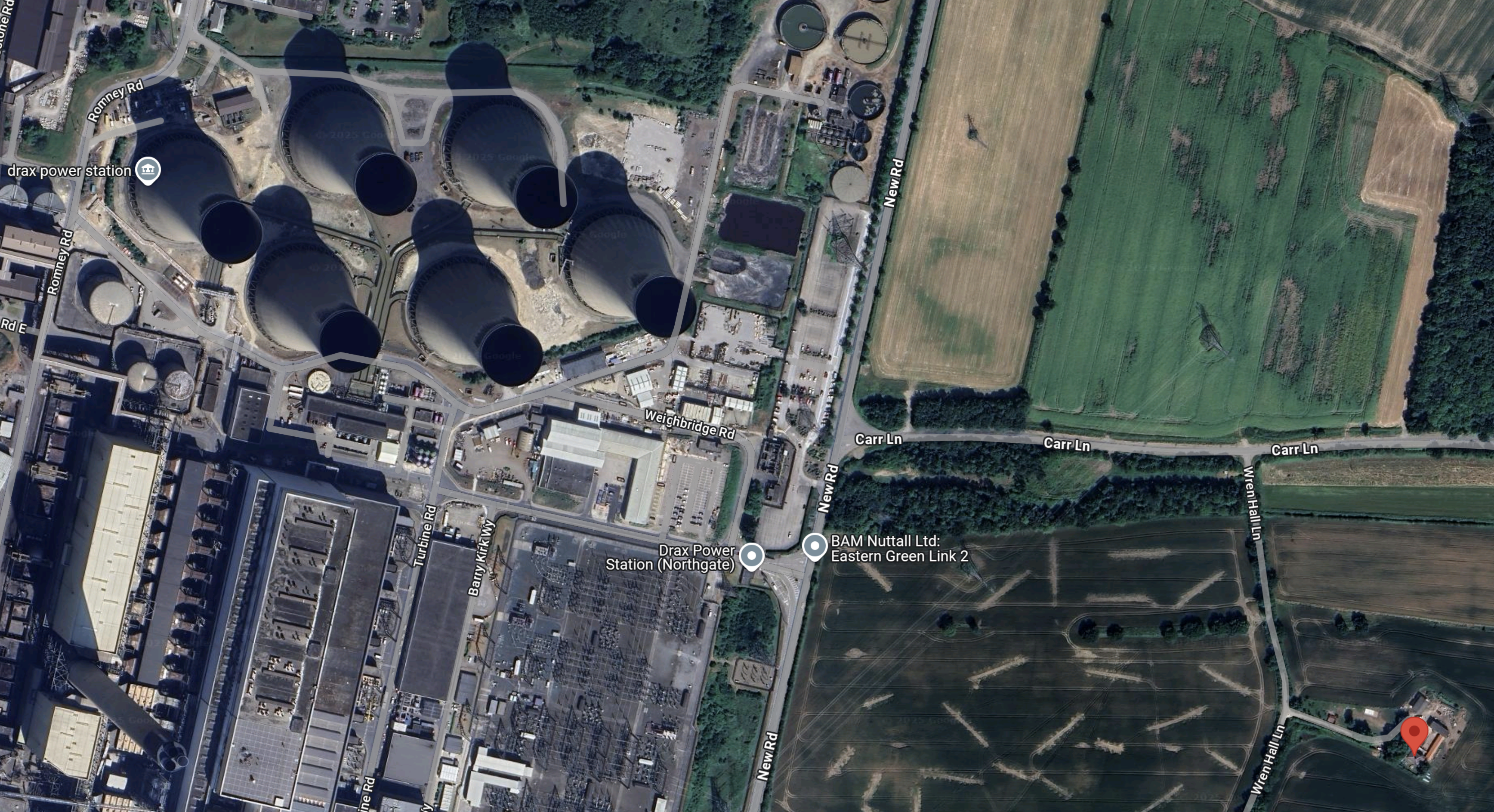
Note.
- The six large cooling towers of the Drax power station are in the North-West corner of the map.
- Google Maps indicate, where they think Wren Hall is, with a red arrow.The lane running North-South to the West of the red arrow is called Wren Hall Lane.
- There is a legend saying BAM Nuttall Ltd Eastern Green Link 2 on the opposite side of the square of lanes to the red arrow.
Click the map to show it to a larger scale.
It looks to me, that if hydrogen could be provided on the Drax site, then the 370,000 tonnes of quarry stone from a quarry 27 miles away could be brought to the site by hydrogen-powered 20-tonne construction trucks.
So how could hydrogen be provided on the Drax site?
- Drax is a 2.6 GW biomass power station, so I’m sure that some electricity could be used to generate hydrogen.
- Drax is a rail-connected site, so hydrogen could be brought in by rail.
- Depending on the amount of hydrogen needed, hydrogen could surely be brought in by road.
I feel that if hydrogen-powered 20-tonne construction trucks were available, this transfer of quarry stone could be performed carbon-free.
Conclusion
This project illustrates a problem with large infrastructure projects all over the UK.
Moving the large amounts of stone, concrete, sand and rubble into and out of construction sites generates a lot of carbon dioxide and pollution from the 20-tonne trucks employed.
If I were to be given Ed Miliband’s job of Secretary of State for Energy Security and Net Zero, one of my first actions, would be to say that all new 20 tonne construction and cement trucks would have to be zero carbon.
I suspect, that zero-carbon with trucks this size, will mean hydrogen, as the weight of the battery would destroy the mathematics of the truck.
This would obviously reduce carbon emissions, but more importantly, what would it do for the health of those working on large construction sites?
In MAN Expands Its Zero-Emission Portfolio, I show MAN’s heavy hydrogen trucks.
This is an articulated heavy hydrogen truck.

I’m sure that MAN could build a hydrogen-powered 20-tonne construction truck.
In Cummins Agrees To Integrate Its Hydrogen ICE Technology Into Terex® Advance Trucks, I talk about the solution to the cement truck problem.
This is a side view of the top-of-the-range monster.

Note.
- Front is to the right.
- I suspect the driver doesn’t have to get out of the cab to discharge the concrete.
- The engine is at the rear with vertical exhausts.
- All axles are driven.
You’d certainly notice one of these if they were to be used in the City of London.
And this is the baby of the range.

Three axles is normal for the UK. so I wonder if this machine will ever make it across the pond.
This last paragraph in the original article describes the X15H hydrogen internal combustion engine.
The X15H was showcased at the Advanced Clean Transportation (ACT) Expo in May (2023), along with its hydrogen ICE-powered concept truck. The X15H features a 700-bar pressure 80kg capacity hydrogen storage system and a range of more than 500 miles, with up to 500 horsepower.
Could one of these trucks really deliver ready-mix concrete from London to Manchester and return?
The trucks would appear to be available, so let’s get a few over and try them out.
Incidentally, if someone had told me ten years ago, there would be rear-wheel drive trucks like Volkswagen Beetles, I’d have said they were wrong in no uncertain terms.
The Wren Hall substation would appear to be an ideal trial project for hydrogen-powered construction trucks and cement trucks.
Ministers Will Relax Rules To Build Small Nuclear Reactors
The title of this post is the same as that of this article in The Times.
This is the sub-heading.
Britain’s five nuclear power stations, which generate about 6GW in total, powering 13 million homes, are all nearing the end of their lives
These first three paragraphs indicate the reasons why, the government wants to relax the rules.
Ministers are preparing to relax planning rules to make it easier to build mini nuclear power plants in more parts of the country in order to hit green energy targets and boost the industry.
They are also examining whether it is possible to streamline the process for approving the safety of new nuclear power plants as a way to reduce construction delays.
At present rules state that only the government may designate sites for potential nuclear power stations, of which there are eight, severely limiting where they can be built.
The article includes a vote and surprisingly to me, the vote embedded in the article, shows 92 % in favour of relaxing the rules and only 8 % against.
I must admit these figures surprise me, as I’d have thought more would have been against.
Certain Words Frighten The Public
It is because nuclear is one of those words, that I felt that the vote in favour would have been much lower.
Regular readers of this blog will know, that in the 1960s,, I worked for ICI doing itinerant computing and instrumentation tasks, in my first job after leaving Liverpool University with a degree in Control Engineering.
I can now classify the experience as a superb apprenticeship, where I learned a lot that has been useful to me in later life.
For a time, I was working on nuclear magnefic resonance or NMR scans. ICI Mond Division in Runcorn had one of the best installations for analysing chemicals using this technique, which is described in this Wikipedia entry, which starts with these sentences.
Nuclear magnetic resonance (NMR) is a physical phenomenon in which nuclei in a strong constant magnetic field are disturbed by a weak oscillating magnetic field (in the near field) and respond by producing an electromagnetic signal with a frequency characteristic of the magnetic field at the nucleus. This process occurs near resonance, when the oscillation frequency matches the intrinsic frequency of the nuclei, which depends on the strength of the static magnetic field, the chemical environment, and the magnetic properties of the isotope involved; in practical applications with static magnetic fields up to ca. 20 tesla, the frequency is similar to VHF and UHF television broadcasts (60–1000 MHz).
One day, the Senior Scientist, who ran the machine came in to work and announced that the property of nuclear magnetic resonance would be replacing X-rays, as the technology had just been used to give a three-dimensional image of something like the tail of a mouse.
Now fifty-five years later, many if not most of us have had MRi scans.
The Wikipedia entry for Magnetic Resonance Imaging or MRi, explains, what happened to the dreaded N-word.
MRI was originally called NMRI (nuclear magnetic resonance imaging), but “nuclear” was dropped to avoid negative associations.
Perhaps, it would be easier to build nuclear power stations, if the level of science teaching in the UK was better.
The Three Paragraphs In Detail
Earlier, I copied three paragraphs from The Times, into this post.
I shall now look at each in detail.
Paragraph 1
Ministers are preparing to relax planning rules to make it easier to build mini nuclear power plants in more parts of the country in order to hit green energy targets and boost the industry.
I was in Suffolk, when the planning of Sizewell B was undertaken.
There appeared to be little strong opposition, but the general feeling was what there was from second home owners, who were worried that the value of their holiday home would decline.
Employment and commerce created by Sizewell B was certainly good for the area in lots of ways.
At the time, my late wife; C was practicing as a family barrister in chambers in Ipswich. She believed that the building of Sizewell B had had a good effect on the area, as it had injected work and money, which had created the finance to allow a couple to end a marriage, that had long since died. She stated a couple of times, that Sizewell B was good for her practice.
Paragraph 2
They are also examining whether it is possible to streamline the process for approving the safety of new nuclear power plants as a way to reduce construction delays.
My worry about streamlining the process for approving safety, is that we approve nuclear power stations so rarely, do we have the qualified personnel to replace elapsed time with people. I would suggest that we don’t.
But we could have.
- We have some excellent universities, where Nuclear Engineering can be studied.
- How many personnel leave the Royal Navy each year, who could be trained as nuclear safety inspectors?
- If say Rolls-Royce and/or Hitachi are building several small modular nuclear reactors a year in the UK, then nuclear engineering will become fashionable, as electronics was for my generation of engineers and it will attract the brightest students.
Perhaps an established university, with access to the needed skills should be funded to set up a Nuclear Safety Institute
Paragraph 3
At present rules state that only the government may designate sites for potential nuclear power stations, of which there are eight, severely limiting where they can be built.
I can envisage new small modular nuclear reactors being built in the UK, where there is a need for lots of electricity to support developments like.
- Offshore wind farms
- Data centres
- Green steelmaking
- Metal refining
- Hydrogen production.
Rolls-Royce have said that their small reactors will be around 470 MW, so I could imagine power stations of this size being placed on disused coal-fired power station sites to boost power in an area. I have already suggested building some on Drax in The Future Of Drax Power Station.
In some locations, the choice could be between a small modular nuclear reactor and some form of energy storage.
Powering Germany
But there is one controversial area, where we can take advantage.
- The Germans are very short of electricity because of their reliance on coal and Russian gas that needs to be replaced.
- The 1.4 GW NeuConnect interconnector is being built by European and Japanese money between the Isle of Grain and Wilhelmshaven.
- The AquaVentus hydrogen system could be extended to Humberside to link with UK hydrogen production and storage.
- A couple of small modular nuclear reactors could be built on Humberside to back up hydrogen production, when the wind isn’t blowing.
But Rolls-Royce and other companies have been putting small nuclear reactors close to the sea bed safely for decades, so why no design an offshore reactor that can be placed at a safe distance offshore?
We would need to solve the Putin and friends problem first, but I can see the UK exporting a lot of electricity and hydrogen produced by nuclear energy.
The Future Of Drax Power Station
Drax power station is not liked by a lot of environmentalists.
I have been thinking about the future of the power station and the public company that owns it.
Drax power station has a nameplate capacity of around 2.5 GW running on biomass.
It also will be the Southern end of EGL2, which will be an undersea electricity 2 GW superhighway distributing Scottish wind power from Peterhead in Scotland. So the dreaded biomass hated by certain groups will be relegated from the Premier League of electricity generation and replaced by Scottish wind.
As reported in various publications, Drax has signed a deal in the US, so that the biomass can be used for the production of sustainable aviation fuel (SAF)
To my mind, the Drax site could be an ideal one for one or more small modular nuclear reactors.
- The large Drax site has been producing electricity for 52 years.
- In 1986, the site produced nearly 4 GW of electricity.
- I would suspect that the substations on the site could be enlarged to distribute 4 GW of electricity.
- EGL2 will bring in 2 GW of Scottish wind-generated electricity.
- The site has excellent rail connections.
- The site has twelve cooling towers and is encircled by the River Ouse.
- Could all this water be used for cooling the small modular nuclear reactors.
I believe that perhaps three small modular nuclear reactors could be built on the Drax site to backup EGL2 and bring a reliable source of sustainable power to Yorkshire.
Drax is also only about forty miles from the vast hydrogen stores at Aldbrough and Rough, so if Drax needed, if could use excess electricity to create hydrogen for storage.
SSE is consulting on a 1+ GW hydrogen power station at Keadby, so perhaps Drax should have a similar hydrogen power station on its site?
Lakeside Facility Connects To Grid And Becomes UK’s Largest Transmission Connected Battery
The title of this post, is the same as that of this press release from National Grid.
These three bullet points, act as sub-headings.
- National Grid plugs TagEnergy’s 100MW battery project in at its Drax substation.
- Following energisation, the facility in North Yorkshire is the UK’s largest transmission connected battery energy storage system (BESS).
- The facility is supporting Britain’s clean energy transition, and helping to ensure secure operation of the electricity system.
This paragraph introduces the project.
A battery storage project developed by TagEnergy is now connected and energised on the electricity transmission network, following work by National Grid to plug the facility into its 132kV Drax substation in North Yorkshire.
- Lakeside Energy Park’s 100MW/200MWh facility is now the largest transmission connected BESS project in the UK following energisation.
- The new facility will boost the capacity and flexibility of the network, helping to balance the system by soaking up surplus clean electricity and discharging it back when the grid needs it.
- To ensure a safe connection, National Grid, working with its contractor Omexom, upgraded its Drax 132kV substation to accommodate the additional clean power.
- Works included extending the busbars – which enable power flows from generation source on to power lines – upgrading busbar protection and substation control systems, and installing an operational tripping scheme, all of which helps keep the network stable and operating securely.
Owned and operated by TagEnergy – with Tesla, Habitat Energy and RES as project partners – the newly-connected battery will help exploit the clean electricity potential of renewable projects in the region, storing and releasing green energy to power homes and businesses and also helping to relieve any system constraints.
National Grid’s adjacent Drax 400kV substation already hosts the connection for Drax power station – the UK’s largest biomass facility – and will also connect the Eastern Green Link 2 electrical superhighway when it starts importing clean energy from Scotland in 2029.
Drax power station seems to be growing into a large node with several gigawatts of electricity, the UK’s largest BESS, a large biomass power station and the Eastern Green Link 2 electrical superhighway which will import clean energy from Scotland from 2029.
Drax appears to be transforming from the dirty man of the UK into a Jolly Green Giant.
I can see further power stations and sources, storage devices and technology joining the party at Drax.
This Google Map shows the Drax site.
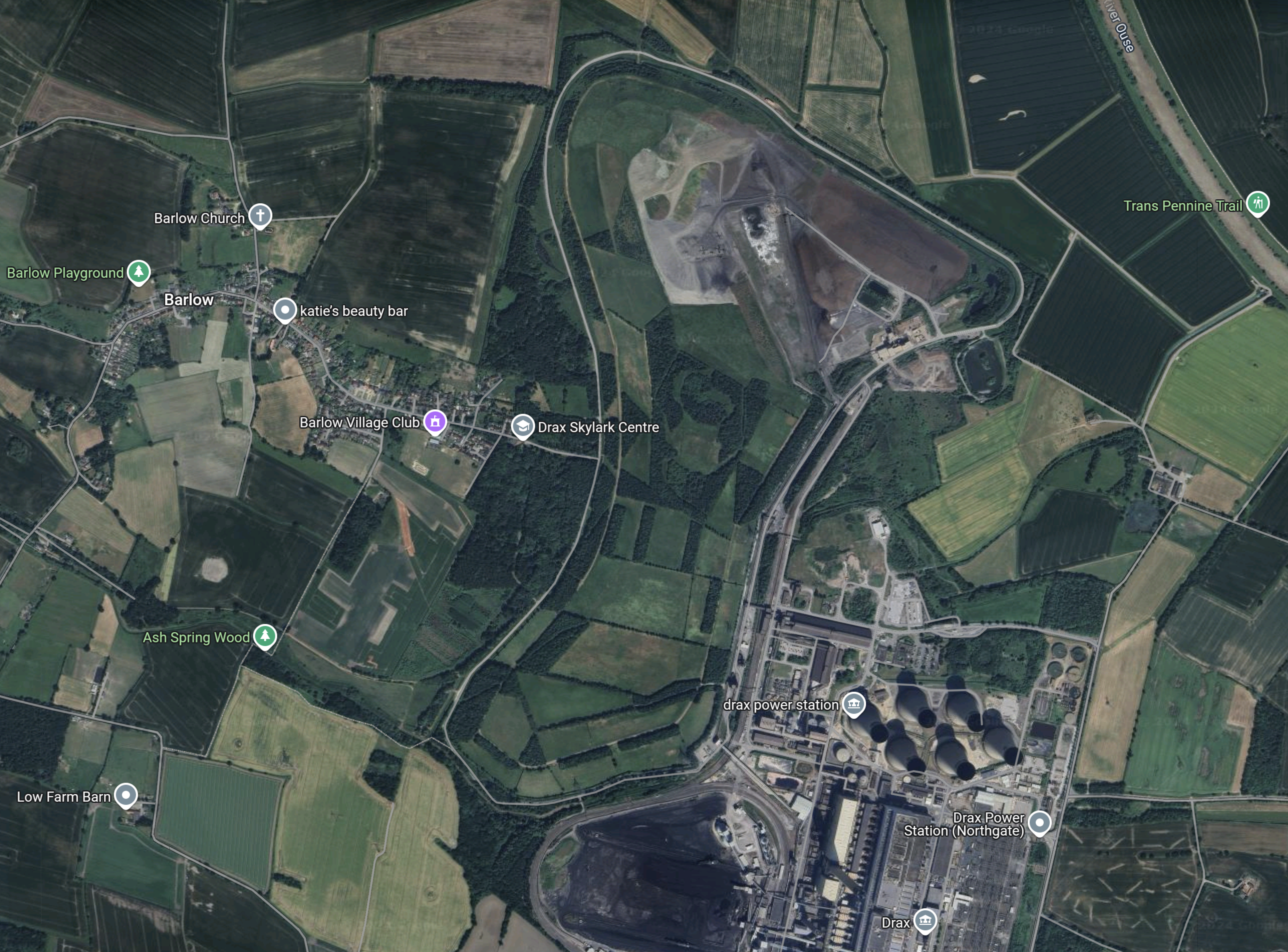
Note.
- The cooling towers can be picked out in the South-East quarter of the map.
- The site is rail and road connected, with the River Ouse nearby.
- There is a lot of space.
Surely, Drax would have a big enough space, with a high quality and high capacity electrical connection for Ørsted and Highview Power to put one of their three 200 MW/2.5 GWh batteries, that I talked about in Centrica Business Solutions And Highview Power.
Race For Clean Power Surges Ahead As New Electricity Superhighway Greenlit
The title of this post, is the same as that of this press release from Ofgem.
These three paragraphs, explain the infrastructure.
Flagged by the National Energy System Operator (NESO) as an essential element in achieving the Government’s Clean Power 2030 ambition, Eastern Green Link 1 (EGL1As part of its mission to rapidly upgrade the energy system with a minimum cost to customers, Ofgem has identified over £43m of savings which have been cut from the project costs without impacting delivery or quality. Communities that host the infrastructure in Scotland and North-East England are also set to benefit from a £7.9m social value and community benefit fund.) is a high voltage electricity superhighway able to transport 2 gigawatts of homegrown wind generated electricity between Torness, East Lothian and Hawthorn Pit, County Durham. A gigawatt (GW) is equivalent to one billion watts, and one gigawatt hour (GWh) of electricity is enough to power one million homes for one hour. Most of the 196km cable will be under the North Sea, with the remaining 20km of cables underground linking the cable to substations and converter stations in Scotland and England.
The project will reduce Great Britain’s reliance on volatile international gas markets by further harnessing the power of homegrown North Sea wind. NESO’s recent Clean Power 2030 Report has also shown that the project will deliver annual saving of over £870m by reducing the need to compensate British wind generators who are currently asked to turn off production during times of high wind due to lack of grid capacity. This in turn will help drive down consumer bills.
Note.
- Eastern Green Link 1 (EGL1) is a high voltage electricity superhighway able to transport 2 gigawatts of homegrown wind generated electricity between Torness, East Lothian and Hawthorn Pit, County Durham.
- This is the second down the eastern side of the UK.
- In Contracts Signed For Eastern Green Link 2 Cable And Converter Stations, I described how contracts were signed for EGL2 from Peterhead in Scotland to Drax in England .
- Most of the 196km cable will be under the North Sea, with the remaining 20km of cables underground linking the cable to substations and converter stations in Scotland and England.
There are another two 2 GW cables to follow in the current plan!

