Could A Bombardier Innovia Monorail Be A Modern Replacement For The Liverpool Overhead Railway
Speak to many Liverpudlians born before about 1950 and they will talk about the Liverpool Overhead Railway with deep affection.
The railway ran North-South along Liverpool Docks.
- The original railway ran for five miles, which was later extended to seven.
- There were almost twenty stations, including one at Pier Head.
- It was the second oldest electric metro in the world.
Sadly, the Dockers’ Umbrella wore out, went bust and closed in 1956.
If it had survived, with Liverpool becoming an increasingly important destination for cruise ships and visitors, and with the development of the dockside with modern housing, commercial and leisure developments, including a new Bradley-Moore Dock Stadium for Everton, the Liverpool Overhead Railway would have remained a very important part of Liverpool’s transport infrastructure.
But it’s not there and some Liverpudlians still call for its rebuilding.
In writing Bombardier Transportation Consortium Preferred Bidder In $4.5B Cairo Monorail, I found this video promoting the Innovia monorail.
If Bombardier wanted a high-profile site to install a system to demonstrate its capabilities, there would probably not be a better place in the UK.
But could it be built at an affordable cost?
- The Cairo monorail is 100 km long and the project cost including trains and maintenance for several years is $4.5billion. So a very rough estimate for a ten kilometre system in Liverpool could be around £300 million.
- It should be noted that the 5.5 kilometre long Trafford Park Line of the Manchester Metrolink is costing £350million and that doesn’t include any rolling stock.
- Liverpool is also spending nearly £500million on updating Merseyrail with new Class 777 trains.
I would think it is unlikely, that it will be built, unless the decision is taken for political, property development or tourism reasons.
Conclusion
A monorail could be a welcome and spectacular addition to Liverpool’s waterfront.
But I doubt it would be an easy development to finance.
Bombardier Transportation Consortium Preferred Bidder In $4.5B Cairo Monorail
The title of this post is the same as that of this article on the Toronto Star.
This the first three paragraphs of the article.
Bombardier Transportation says its consortium has been named preferred bidder in a C$4.5 billion contract to build and supply a new monorail system in Egypt’s capital.
The company’s potential share of the design and build contract for the system in Cairo is C$1.8 billion with an operations and maintenance deal valued at about C$1.67 billion over 30 years.
The 54-kilometre monorail will connect East Cairo with the New Administrative City and a second 42-km line will connect 6th October City with Giza.
The railway division of Bombardier Inc. will deliver the project in partnership with two Egyptian companies Orascom Construction and the Arab Contractors with the trains being developed and built in Derby, Britain.
The article then mentions the Bombardier Innovia monorail.
- The latest Innovia 300 monorail is automated and driverless.
- These trains can travel at 80 kph
- They can handle 48,000 passengers per hour in both directions.
- The latest versions are manufactured in Brazil, Canada and China
- The latest versions are installed or planned in Brazil, China, Saudi Arabia and Thailand.
I think there must be more to this project than the article in the Toronto Star.
What Are The Strengths Of The Innovia 300 Monorail?
This is Bombardier’s video of the monorail.
It looks to be a well-designed system, that has several strengths.
- It is automated and driverless.
- Cars are short and the trains can take quite curves, with as low as a 46 metre radius.
- Trains can have up to eight cars. The Cairo trains will be four cars.
- The latest cars look stylish, with cab design not unlike an Aventra.
- The cars appear to be walkthrough.
- The track is a slender concrete beam with walkways on either side for passenger evacuation and maintenance.
- The tracks wouldn’t necessarily have to be elevated.
- Construction could be quicker than a conventional railway.
- It could also be built to travel over roads, railways, water and building, by placing the beam at the right height.
I would like to see one in operation, but Brazil is a long way, so I’ll stick with the video for the moment.
Why Develop And Build In Derby?
Why would a big company like Bombardier, with already three production lines for the monorail, want to setup another production line in Derby?
Bombardier say that the trains will also be developed in Derby.
Perhaps, some or all of these reasons apply.
- The cross-section of an Innovia 300 monorail car looks to be about the size of a British train.
- Can Derby’s manufacturing technology that has been used successfully to build Electrostar and Aventra bodies be applied to the Innovia monorail.
- Derby has good relations with a large number of appropriate suppliers in the UK and Europe.
- The new version will use the Aventra parts bin to cut development and manufacturing costs.
- Supporting the Egyptian system from Derby will not be difficult.
- Canada has better relations with the UK, than Brazil or China.
But even so, development could surely have been continued in Canada.
So Bombardier must have very good reasons!
Are Bombardier Proposing A Closely-Related Design For The Tyne And Wear Metro?
The current Class 994 trains of the Tyne and Wear Metro have the following dimensions.
- Width – 2.65 metres
- Height – 3.45 metres
- Car Length – 27.8 metres
- Train Length – 55.6 metres
The Class 710 train, which is an Aventra has the following dimensions.
- Width – 2.77 metres
- Height – 3.76 metres
So it would appear that the standard Aventra might be too large to fit the Metro, where Bombardier are approved bidders.
It does appear that Bombardier have designed the Aventra’s body from three aluminium extrusions, so these could be resized to fit the smaller dimensions of the Metro.
But looking at the video of the Innovia 300 monorail, I get the impression, that above the floor, the body might be almost the same size as that needed for the trains for the Metro.
So Bombardier would need to design an appropriate chassis, to replace that used for the monorail.
This could mean that the bodies on both trains could be identical.
- Four fifteen metre cars, would give a length of sixty metres.
- If longer trains are needed, then extra cars could be inserted up to a length of eight cars.
- The trains would be walk-through with lots of doors for easy exit according to the video.
- The four-car design would enable tight curves could be negotiated.
- There would surely be advantages in support and maintenance.
- Cabs could be provide for the driver if required.
I also believe that any new trains must have step-free access between train and platform. This picture shows a current train at South Shields station.
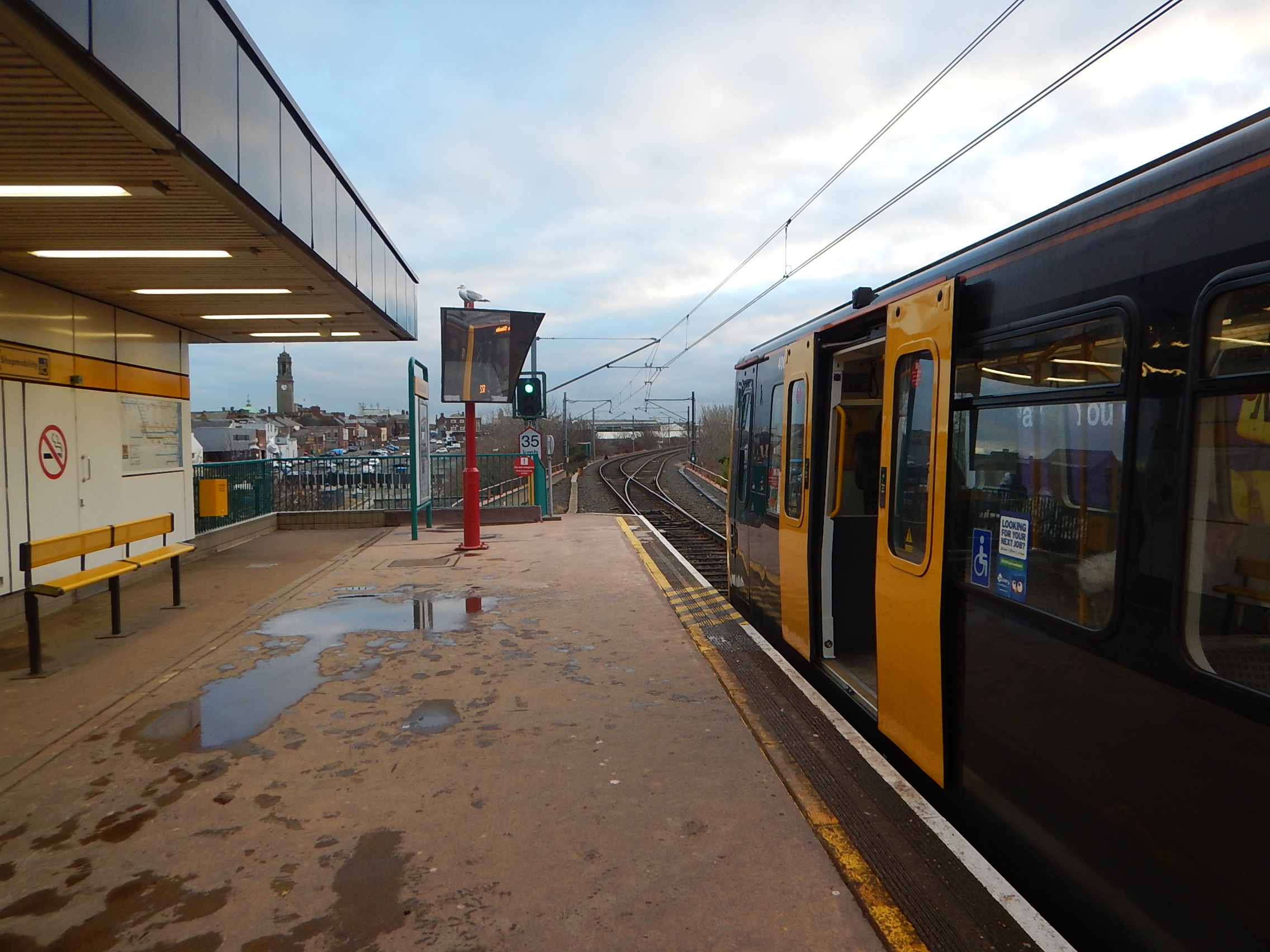
That is not bad for a system that opened forty years ago.
I would think that Bombardier will make the access better, when designing a new chassis from scratch.
But the big advantages of commonality between the Innovia monorail and the Metro cars, would be in the areas of support and expansion or lengthening of the fleet in the future.
What About The Docklands Light Railway?
The Docklands Light Railway like the Tyne and Wear Metro, is another one-off system, that is incompatible with most other rail systems in the UK.
The DLR is intending to replace the rolling stock and Bombardier has been shortlisted.
The current trains of the DLR have the following dimensions.
- Width – 2.65 metres
- Height – 3.47 metres
- Car Length – 28 metres
- Train Length – 56 metres
Give or take a few millimetres, they are almost the same size as the trains on the Tyne and Wear Metro.
Could we see similar trains on the Tyne and Wear Metro and the Docklands Light Railway?
Wikipedia says that the new DLR fleet will be 87 metres long, so could that mean six 14.5 metre cars?
A Possible Tram-Train?
Bombardier build trams and have supplied them to the UK.
The UK has just started to develop tram-train systems, with the South Wales Metro being developed in the next few years with Class 399 tram-trains.
If Bombardier use the concept, I’ve outlined here for the Tyne and Wear Metro and the Docklands Light Railway, I believe it is only a short development to get a tram-train, that could run in the UK
I’m sure that they could get it to work in Blackpool, where the company supplied their trams for the Blackpool tramway.
Are Bombardier Expecting Orders From Europe?
It was only in 2014, that the first Innovia 300 monorail route, Line 15 (São Paulo Metro), opened in Brazil.
But since then, have several Transport Authorities, City Councils and Governments visited Brazil to have a look?
Do Bombardier feel that they will be selling other systems in Europe?
If so, then Derby will be an excellent sales, development, production and support base.
Could We See Some Monorails In The UK?
If you look at the list of Bombardier Innovia systems on Wikipedia, there are several short systems at places like airports and theme parks and a few longer systems of which the Cairo system will be the longest.
I can see opportunities for the shorter distance systems.
- As a part of developments of Heathrow Airport’s third runway.
- As a part of the development of Gatwick Airport’s second runway.
- Linking Ebbsfleet International and Northfleet stations.
- Linking East Midlands Airport to East Midlands Parkway station.
- Linking the proposed Eden Centre at Morecambe with Lancaster station.
- Linking Bristol Airport to the City Centre
- Greenhithe station to the Bluewater shopping Centre.
- It could be a modern replacement for the Liverpool Overhead Railway.
There are probably other locations at stations, airports and theme parts, where Innovia monorail systems could be installed.
As to a longer system in the UK, the only one I can think off would be to link High Speed Two at East Midlands Hub station to Derby and Nottingham and perhaps East Midlands Airport.
But then that would then be a system on Derby’s doorstep.
Conclusion
There are possibilities and with a billion pound-plus order, the project could be on its way!
But surely, the big advantage to Bombardier is if they get the orders for the new trains for the Tyne and Wear Metro and the Docklands Light Railway, they can create trains with a lot of shared components for all three applications.
The two UK systems would get trains that weren’t totally unique, which must ease maintenance and future expansions of the respective systems.
 The Anonymous Widower