On To Southport And Manchester
I don’t ever remember ever going to Southport and I certainly have never been there by train. I took these pictures as I finished my trip to Manchester after my walk on the beach.
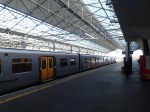






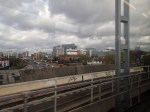
It is a pleasant route and as Merseyrail don’t seem too bothered if you break your journey, it is an interesting excursion, with lots of opportunities for a walk.
Note in the pictures approaching Manchester the new electrification work.
Is this line from Manchester to Southport one of those extra lines that will eventually be electrified under the developing plans for the Northern Hub? It must have strong claims as Southport is a town of 90,000 people and is still a major resort for the beach and golf. It certainly has a clean modernised station, which almost uniquely is in the main shopping street. It also already hosts electric trains, so it might be an easy line to upgrade.
In Wikipedia’s article on the Manchester to Southport line, there is this paragraph.
Additionally Network Rail has identified electrification of Wigan to Southport, together with Ormskirk to Preston Line and the Burscough Curves as a possible source of new services.
So it looks like Network Rail is on the job.
Upgrading the Ormskirk to Preston line would enable better Liverpool to Preston services and the curves would help all services in the area, according to campaigners.
Is The Northern Hub Bold Enough?
Yesterday, on my trip to Blackburn, some of the problems that will be addressed by the Northern Hub developments became obvious.
Admittedly, my problems are slightly worse than most passengers as I’m a coeliac, so my chance of buying a decent gluten free meal in Blackburn is about the sane as finding a cold bottle of water in Hell. There isn’t even a Pizza Express, although they do have restaurants in Blackheath and Blackpool.
So to be safe, I have to go via Manchester or Leeds, where there are several good gluten-free restaurants, or at a pinch Preston, where there is a pleasant Pizza Express.
The main problem is that I’m coming up from London and I want to leave Manchester going to the North. Trains from Manchester Victoria to Blackburn are rather decrepit and cramped Class 150 Sprinter DMU or scrapyard specials as I called them in this post. They seem to run twice an hour, which is better than those from Leeds and Preston, which are just hourly.
You can get from Piccadilly to Blackburn, but it involves a change of train at either Salford Crescent or Bolton. The service is two trains per hour and is probably the best way to do it.
Linking the two main stations in Manchester is the key part of the Northern Hub and involves creating the Ordsall Chord. A plan with a similar objective from 1977 was the Picc-Vic Tunnel, but this much bolder plan was cancelled.
The Ordsall Chord won’t particularly help my journey of yesterday, as I would still do the same short journey to Salford Crescent or Bolton for a train to Blackburn. The stillborn Picc-Vic Tunnel would probably have had a similar effect to Thameslink in London, where for example arriving passengers from Newcastle going to say Sevenoaks dive into the low-level St. Pancras Thameslink station to get their train. So I would have probably dived into Piccadilly low-level station and got the next half-hourly train to Blackburn.
So I have to ask if the Northern Hub plan is bold enough!
But Manchester isn’t London and there is one big difference! London is very much bigger and the numbers of commuters and other rail users is substantially higher.
Another important factor is that Northern Rail runs trains, that discourage rather than encourage more users.
Because of this last point, the fact that a large amount of railway electrification and refurbishment of trains is taking place is very much a positive influence. Some voices in the North may have sniffed at refurbished Class 319 for their new electric services. But if the refurbishment is as good as it was for the Class 455 of South West Trains, no-one except the new train manufacturers will be complaining.
One great advantage of the Class 319, is that there are 86 trainsets, which would mean that electrifying further lines wouldn’t require the purchase of new trains.
We also have the problem in Europe, that there is a shortage of train building capability. So would we prefer to say buy new Chinese trains or refurbish sound trains in places like Allerton, Doncaster, Ilford and Derby? Especially, if the refurbished trains are just as reliable and comfortable, at a fraction of the cost!
In some ways though, the Northern Hub is an extremely bold project, as it is a bit like Topsy on Speed.
The idea of the Northern Hub was only first mooted in 2009 and now there a lot of work in progress like the restoration and roofing of Manchester Victoria station and the electrification of routes. I took this picture yesterday, as I travelled towards Blackburn.
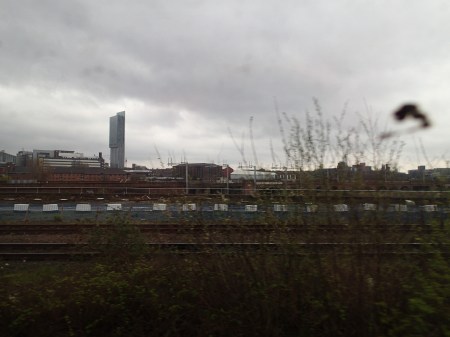
Electrification In Progress
Already the first parts of the project are in place, with new Class 350 electric trains now running from Manchester Airport to Glasgow and Edinburgh via Newton-le-Willows under newly installed wires.
Before the end of this year, you should see a new roof on Manchester Victoria and electric trains connecting Liverpool and Manchester for the first time. When you consider that both cities were electrified for important services to Crewe and the South by 1961 and to London in 1966, it is a disgrace that Liverpool and Manchester have had to wait nearly another fifty years for the electrified link to be inserted.
I described the Northern Hub project as Topsy on speed. In some ways, a project like Topsy is a nightmare to manage, but in one way the scope of this project is expanding relentlessly. And that is in the area of electrification. When first proposed it was intended to electrify the main lines between Liverpool, Preston and Manchester. Since then Blackpool and Huddersfield have been added. There is thought to be no connection between the fact that part of the Huddersfield line is known as the Real Ale Trail and the decision to electrify that line.
Knowing the area and its problems well as I do, I can’t believe that by 2020 there aren’t plans in place to add more lines to the electrification program.
Already the Todmorden Curve is being rebuilt, so that direct diesel services from Manchester Victoria to Burnley can begin later this year. Although Wikipedia says that services might not begin, due to lack of suitable rolling stock. Every line electrified would need new electric trains, but would also release some diesel ones for use elsewhere.
So do we have the virtuous circle, where by refurbishing Class 319 trains, we get the rolling stock to electrify lines, which releases much needed diesel trains to be used to provide a better and more frequent service on other lines to increase the passenger traffic, so that the lines are worth electrifying. And as any number of examples have shown, clean, reliable and frequent electric train services generate a momentum of their own.
In some ways, these lines are very similar to the Valley Lines in Wales. Important to their communities, but neglected and depending on scrapyard specials to move everybody around. But the government has plans for the Valley Lines, as detailed in this extract from Wikipedia.
On 16 July 2012 the UK Government announced plans to extend the electrification of the network at a cost of £350 million. This was at the same time of the announcement of electrification of the South Wales Main Line from Cardiff to Swansea. This would also see investment in new trains and continued improvements to stations. It is thought to start between 2014 and 2019.
We should boldly go on the development of the Northern Hub. On the other hand, progress has been so good this far, perhaps we just need to ensure that it continues at this rate.
I would also suggest that those in charge of the Valley Lines upgrade, take note of what must be good practice in Lancashire.
Could Hebden Bridge Be The UK’s Second City?
This sounds like the sort of idea dreamed up by someone, who really does think that Yorkshire is the centre of the earth.
But the BBC has published a piece entitled The Case For Making Hebden Bridge The UK’s Second City by Evan Davis on their website.
This extract sums up his logic.
The suggestion that it is Britain’s second city came from resident David Fletcher, who was active in the 80s saving the town’s old mills and converting them to modern use.
His point is that Hebden Bridge is an inverted city with a greenbelt centre and suburbs called Manchester, Leeds and Liverpool.
His point was that the real second city of the UK is a northern, trans-Pennine strip that extends the relatively short distance across northern England, joining the built-up areas that lie second, fourth and sixth in the UK ranking.
I think he has a point and treating the area from Liverpool and Blackpool in the West to Leeds and Sheffield in the East, as a megacity, may be a very good idea.
Davis says that it would need a lot of infrastructure, and there would be rivalries and infighting. But there’s enough of that in Manchester already, with one of the worst bus systems in the UK.
To be fair to Network Rail, their plans for the Northern Hub, very much fit the proposal for the Northern megacity and the government, especially in the statements of George Osborne, seem to be backing them.
Is there anything I’d like to see in the North?
I would like to see London’s local transport information systems and ticketing imposed on the North. And probably on everywhere outside London as well.
- I should arrive at any station and be able to find my onward route, by foot, bus or tram without difficulty or bothering any of the station staff.
- If say, I wanted to use a bus where my bus pass is valid, I would just touch in with my pass. Every town or city seems to use a different system.
- If I need to pay for my ticket, then I would just touch in with a contactless bank card.
- All buses would have fully disabled access and at least a separate entrance and exit, like most buses in London.
- I should also be able to find out the next bus, with a simple text-based system, based on five digits for the stop and a short text code. If larger London can do it, why do cities like Leeds have a system that is so difficult.
I shall be watching Evan Davis’s program tonight with interest.
Don’t forget there would be one great argument for making Hebden Bridge the UK’s Second City. It would eventually stop all the arguments.
You also have to ask, whether other megacities could be created.
- Newcastle-Sunderland-Middlesbrough
- Glasgow-Edinburgh
- Wolverhampton-Birmingham-Coventry
- Southampton-Portsmouth-Brighton
Are four that come to mind.
Does Glasgow Need Its Own Rail Hub?
I’ve just been talking to a friend north of the border and he had not heard of the Northern Hub, which finally is getting the treatment and publicity it deserves.
He was unaware of a scheme in Glasgow called Crossrail Glasgow to link the two main stations and make journeys across the city a lot easier.
Reading about it here on Wikipedia, I can’t understand, why it wasn’t implemented before the Commonwealth Games this year.
Crossrail Glasgow and the Northern Hub, are just two of a whole series of projects to improve transport in our major provincial cities, like the Greater Bristol Metro, the extensions to both the Birmingham and Nottingham trams and the reopening of several important commuter railways.
Could it be that the decision on this rail project would have been taken in Edinburgh?
Sense On The Northern Hub
The Northern Hub being developed in Manchester is one of the biggest rail projects North of Watford, but it seems to have been ignored by the media until today. The Times had a very sound article and there was this one on the BBC. Wikipedia has a long article, which is summed up by the first paragraph.
Northern Hub is a series of proposed works across Northern England to stimulate economic growth by increasing train services, reducing journey times and electrifying lines between the major cities of Northern England.[1] It is a partnership between Network Rail, First TransPennine Express, DB Schenker, Freightliner, Department for Transport, Transport for Greater Manchester and Northern Rail.[2] The proposal was first announced in 2009 as the Manchester Hub which entailed a series of upgrades which would cut journey times between cities in Northern England by alleviating the rail bottleneck through Manchester.
I think the area, must be pleased about all the publicity, as it is a very positive story, which must attract jobs and inward investment. It will certainly make some the journeys I’ve done recently a lot easier and much less crowded.
 The Anonymous Widower