There’s A Hole In The Bus
If you’re musical, you can sing it to the tune of the famous Harry Belafonte song.
If you not, then give us a rest, or take singing lessons.
I took this picture of the seat in front of me on the new BYD battery-electric bus this morning.
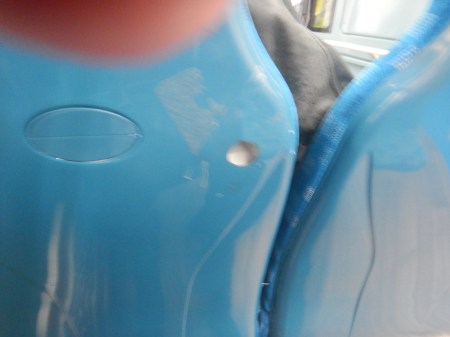
Has the stop button been nicked or has it just fallen out?
Or it could be the centuries old problem of finding good, reliable slaves?
A Nightmare Coming Home
I nearly always come home via Moorgate station, as it has good train and bus connections and I can get both the 141 and 76 buses to near my house.
- The 76 bus is my preference as it is a reliable New Routemaster.
- But the 141 bus takes me all the way home. Unfortunately, it is generally a Chinese BYD battery-electric bus.
Coming home, I arrived at the Northchurch Road in a 76 bus.
- The time was 11:29 and a text said that 141 buses were due in 1, 8, 19 and 20 minutes.
- A second text at 11:39 said that buses were due at 4 and 12 minutes.
Eventually, I got on a 141 bus at 11:44.
This is typical, as the buses don’t seem to synchronise with Transport for London’s bus reporting system.
But today in the cold weather, they have been particularly unreliable.
So I asked Google AI, if hydrogen buses are more reliable in the cold and received this answer.
Yes, studies show hydrogen fuel cell buses generally outperform battery-electric buses (BEBs) in cold weather, experiencing less range reduction because their fuel cells generate waste heat that helps warm the cabin, while BEBs must draw significant energy from the battery for heating, drastically cutting range. While BEB range can drop significantly (over 30%), hydrogen buses see a smaller dip (around 23%), making them more reliable for cold climates.
Sixty years ago, I was using nickel-cadmium batteries to make portable instruments in a chemical factory and I think that they hated the cold, but that lithium-ion solved the problem. Obviously, it doesn’t!
But I do have my suspicions about the design and build quality of these BYD buses!
An Advantage Of IPEMU Trains
My correspondent from the Corbedian Republic Of North Islington, has visited family in Newcastle over the weekend.
But things coming home didn’t go to plan and I received this text.
Our train dropped it’s pantograph.
Driver can’t put it back and train has been declared a failure. I quote. Now waiting to be rescued from Doncaster.
Later I received another text.
Train guard and driver not in touch. Could turn long and silly!
It all got me thinking!
As the train dropped a pantograph it was probably an InterCity 225 and not a diesel InterCity 125, which are built to Carry On Regardless. When I travel North from Kings Cross, I’ll look to see if the train is going to Aberdeen or Inverness, which means it will be a 125, with a reliable lump of a massive diesel engine front and back!
Incidentally, I found this extract in the Wikipedia entry for the Class 91 locomotive that pulls the InterCity 225.
In November 2012, unit 91114 had a second pantograph added as a pilot project operated jointly by Eversholt Rail Group, East Coast, ESG, Wabtec Rail and Brecknell-Willis. The new design uses the same mounting positions as a conventional pantograph but pairs two pantograph arms in an opposing configuration. If there is an ADD (Automatic Dropping Device) activation or the pantograph becomes detached, the train can keep going, so the system provides redundancy in the event of a pantograph/OLE failure.
So it could be that Class 91s regularly drop pantographs like whores drop their drawers!
As far as I can find out, only one locomotive has been fitted with the new pantograph.
But in future, I have a feeling that this type of problem could give a big advantage to an IPEMU train, which has on-board energy storage.
As it rolls along, it will be charging the battery, so if the pantograph fails, it will have a full battery and should be able to run for perhaps another fifty miles or so to a convenient station.
Having two independent systems, is not a bad way of improving reliability.
 The Anonymous Widower