Why Are Some Rails Painted White And What Is Saggy Wire Syndrome?
After reading this article on the Rail Engineer web site, I did think about calling this article something like – Who’d Be A Rail Engineer?
But I just had to include Saggy Wire Syndrome.
The article is a technical article about how using steel wheels on steel rails can be a nightmare for the railways and their engineers in hot weather.
When I was a child, the rails had a length of sixty feet and they were separated by a small expansion gap and connected by fishplates. This gave the clickety-clack. Now rails are continuous for several kilometres to give a smooth ride, so occasionally they buckle. To mitigate the problem rails are made pre-stressed to their length at 27°C, so the problems kick in, when the temperature of the track gets above that temperature.
As switches (points) and crossings are particularly vulnerable in hot weather, they are often painted white in the UK, to reflect the heat.
It’s funny, but after having come across Europe through Poland, Germany and Belgium, I can’t actually remember seeing any rails painted white on my journey. Although, there was no clickety-clack indicating jointed rails. Next time, I go to Germany or Poland I must look.
So what is saggy wire syndrome?
This is where the overhead electric wire stretches in the heat and sags, because the tensioning mechanism can’t cope.
The article finishes with this paragraph.
Summer is a real problem. Roll on winter, when the rails shrink as they get cold and eventually break, earthworks get soggy causing uneven track surfaces, and S&C gets flooded and won’t work.
Who’d be a rail engineer?
All passengers should read the article!
Will Crossrail 2 Get Development Finance In The Budget?
This report in The Independent is entitled Crossrail 2 proposal receives £100m Budget boost from Chancellor. Here’s the first two paragraphs.
If it’s true, it’s short term bad news for me, as more and more Estate Agents will be pouring leaflets through my door, in the hope, they can make a quick killing.
But seriously though Crossrail 2 is needed to connect Tottenham and Wimbledon. With the new double-ended station at Dalston, I will have better connections to the West End, Euston and Victoria.
Racing Trains To Scotland
As a child, I was never a great reader of books, except for encyclopaedias and other factual books. In an effort to get me to read more, my mother got me a book from the library about how the various train companies in the late 1800s tried to outperform each other to Edinburgh in 1888 and Aberdeen in 1895.
All of this has come back to me, as this month’s edition of Modern Railways is talking about developments in the services to Scotland, that could happen over the next few years.
The Press of the time, dubbed this Victorian rivalry as the Race To The North and in the section in the Wikipedia entry about the rivalry to Aberdeen in 1895, this is said.
In his 1958 book about the series of races, Oswald Nock wrote of the 22/23 August journey, “And at that astonishing average speed of 63.3 mph made sixty-three years ago the London–Aberdeen record still stands today”
The time was even more astounding, when you consider it wasn’t beaten until the 1970s by an InterCity125, which still work the route today.
The time on the night of the 22nd/23rd of August 1895 was eight hours forty-two minutes with Victorian steam locomotives and today the 200 kph diesel train takes just a few minutes over seven hours. But the modern train takes the shorter East Coast route!
The East and West Coast routes obviously don’t race each other these days, but according to Modern Railways, it looks like travel between London and Edinburgh is going to get faster and more interesting, as Virgin are aiming for quite a few four-hour trains throughout the day and two new companies are applying to run direct services between the two capitals.
If I understand the article correctly, by 2020 Virgin will be running three trains an hour between London and Edinburgh. The train from London on the hour will stop at Newcastle with York in alternate hours. The one stoppers will do the journey in four hours with the others just a few minutes slower.. Hopefully by 2020, the new Class 800 and Class 801 trains will be running the semi-fast services in four hours twenty-three minutes. The fastest trains now take four hours and twenty minutes.
Two new operators are applying to run trains on the route.
GNER which is ultimately a subsidiary of Deutsche Bahn is planning to use 12×9-car Pendelinos to provide an hourly ‘fast’ service in three hours forty-three minutes from December 2018. They have said, that they are aiming to tempt passengers to switch from plane to train.
The article quotes that rail has a 30% share of the London-Edinburgh market, where there are 42 flights a day. They want to push rail’s share up to 50%.
In Edinburgh – Train or Plane? I compared a journey up by easyJet from Stansted with a return in First on East Coast. Both journeys cost and took about the same time from Hackney to the centre of Edinburgh.
FirstGroup is aiming to run five trains each way between London and Edinburgh in four hours from December 2018, using new Hitachi AT300 electric trains with three stops en route at Morpeth, Newcastle and Stevenage. First has said it will be targeting passengers from the low-cost airlines.
I’ve only talked about Edinburgh in this piece, but a lot of the analysis will also apply to the West Coast Main Line, which has already hsad a dose of a competing service, in the share of First TransPennine to Manchester.
If these plans come to fruition, it would look like the slowest trains on the Edinburgh route will be the Virgin semi-fasts, which will take just a few minutes longer than the fastest trains today.
Out of curiosity, I looked at trains and flights for tomorrow (today is a Monday). I could get the 08:00 out of Kings Cross, which gets me into Edinburgh at 12:20, just in time for lunch, for a Second Class cost of £33.95 and a First Class cost of £65.95 (both costs third-off with Railcard), whereas the easyJet flight from Gatwick or Stansted costs around £60, but would probably mean leaving home well before five in the morning.
This leads me to think, that if all these train services to Edinburgh come to fruition, that the only losers will be the airlines, especially if the large increase in capacity on the route brings down train fares.
A Two Hundred Million Pound Railway Project Of Which You’ve Probably Not Heard
The West Coast Main Line doesn’t have the capacity it needs to speed passengers between London and Liverpool, Manchester, Lancaster and Glasgow.
A few miles north of Stafford is Norton Bridge Junction, which has been likened in the July issue of Modern Railways as a set of traffic lights on the M6.
So a £200 million pound project has been commenced to remodel the junction. This map from Network Rail shows the lines through the area.

Norton Bridge Junction
Note the proposed new lines shown in orange. This Google Map shows the junction in detail.
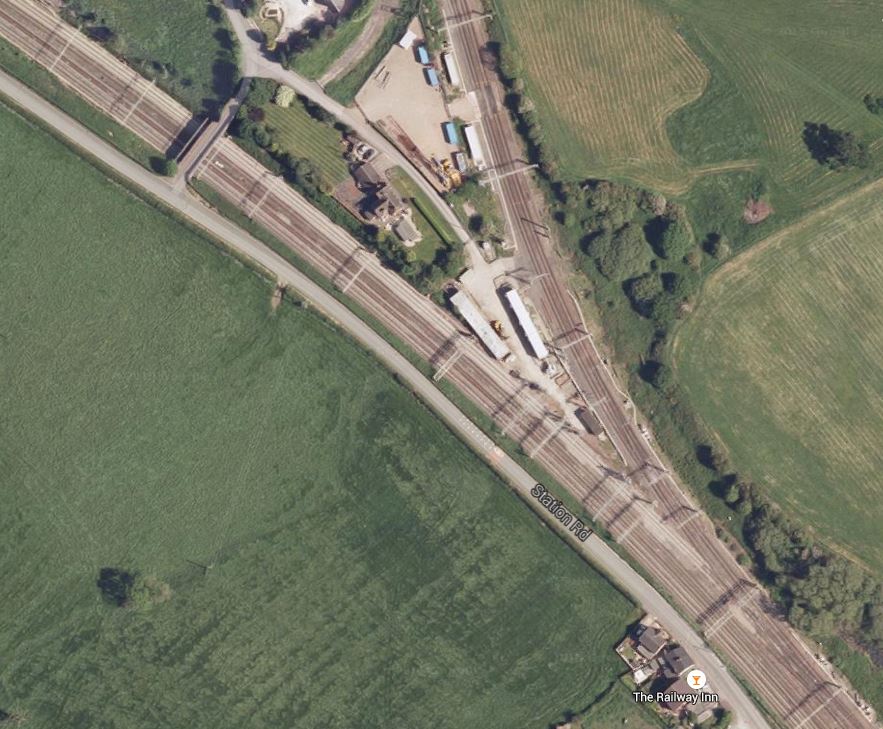
Norton Bridge Junction
It would appear that construction has started, which the images in Modern Railways confirm. There is also a Youtube video, which shows a simulation of the junction.
One of the most interesting things about this project is that it is being implemented by the Staffordshire Alliance, which is an alliance of four major consultancies and construction companies. The structure has been borrowed from Australia, where it is called the Pure Alliance Model. This page on the Laing O’Rourke web site gives more details on how it works.
A detailed explanation is given in this article in Rail Engineer.
Let’s hope it works, as Network Rail needs all the good news it can get.
The outcome, when the project is finished in 2017 are stated in Modern Railways as being.
- Two additional fast services per hour between London and the North West; one to Liverpool and one to Lancaster and Glasgow.
- An additional Birmingham to Manchester service.
- An additional freight service.
These unpublicised projects are opening up new paths on Britain’s railways.
For me, it will mean that there will be more train services from London to Liverpool, Preston and Glasgow.
Thoughts On Double Deck Trains
On my Home Run from Krakow, I travelled on quite a few double-deck trains.

But you don’t travel on a train to look at the outside! When I travel on a double-deck train, I usually try and travel on the top deck, as it’s all about the view.
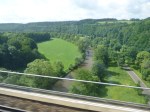

The quality of the view is very much the same as you get out of a Chiltern Railways Mark 3 coach, set up as the designer intended with four seats around a table by each window
Most uninformed comments about double-deck trains seem to come from politicians and journalists, whose only knowledge of engineering, is that it starts with an E. The comments are probably based on a trip on holiday on the top deck of a French, Dutch or German train and the view has told them, that this is the way to travel.
We also have masses of increasingly well-designed buses in this country, so people ask why if we can do it for buses we can’t do it for trains?
Double Deck Train Issues
But having travelled extensively on double-deck trains, I’m convinced they’re not a solution for everyone.
1. Getting On And Off
Speedy boarding is important with any train, but especially with commuter services and this is why increasingly our modern trains have wide doors and are walk-through like the Class 378 trains of the Overground.
But double-deck trains are slow to board for various reasons. Just sit near the stairs on say a German double-deck commuter train at a busy time and see the chaos, which ultimately delays the train.
2. Luggage
This is more of a problem on a long distance double-deck like a TGV Duplex. There may be plenty of space, but passengers want it near them, so it gets in the way of getting on and off in a reasonable time.
3. Cramped Seats Downstairs
One of the reasons, that I go upstairs is that often on a double-deck train, the lower deck seats are cramped and claustrophobic.
4. Disabled Issues
Perhaps on the Continent, they don’t have so many disabled as we do or perhaps they’re not as organised, but their trains are not as disabled-friendly as are our trains.
As a dimple example, many of our new trains are just step across and this helps everybody with a mobility difficulty. Few and none of the double-deck trains, I’ve seen feature this important design detail. Often it’s a couple of steps down or up to get on or off the train.
5. Tram-Trains
Tram-trains running under the Karlsruhe model and train-trams under the Chemnitz model are showing a lot of promise in Germany and France. I believe that more cities will embrace these methods of integrating urban transport, but I can’t see double deck trains running as trams through the main square at Kassel.
6. Design Issues
On one German train recently, I was on the upper deck and needed to go to the toilet. I had to go down the stairs and then fiight my way between the wheelchair passengers, babies in buggies and passengers with bicycles crammed into the lobby downstairs. Then after I’d done my business, I had to fight my way upstairs.
This illustrated to me, how difficult it is to design a usable double-deck train for all types of passenger.
UK Issues
In the UK, there are other issues, that affect double-deck trains.
1. Loading Gauge
The big problem is the UK loading gauge, which is smaller than that on the Continent. Double-deck trains in the UK, that will run on our classic lines, are really trying to fit a quart into a pint pot.
It is interesting to note, that the only attempt to introduce double deck trains in the UK was on the Southern Railway, where the loading guage doesn’t have to accommodate an overhead power supply.
2. Step Across Access
Increasingly, step across access will become the norm all over the UK, just as it is rapidly advancing in London. Any new trains coming into service, which do not have step across access will not be liked by passengers, who will have to lift their beloved wheeled cases in to and out of the train.
3. Go Anywhere Trains
We are innovative in this country and new services are always being examined with existing trains. I think it is true to say, that double-deck trains are often built for specific routes and the infrastructure is modified to suit them.
A Double Deck Train For A Double Deck Line
All of these facts and issues lead me to a conclusion – Any double-deck trains introduced on a network, must be designed for a specific route and the track and stations, must be designed to get the most out of the trains. They would have to have these features.
1. A Connected Train
Internet should go lot further than free wi-fi, which should be available to all passengers.
Some really wacky ideas will be successfully applied, providing the right connections are built into the tain.
2. Seating And Windows
This should be at least as good as Standard Class on the top deck of a German regional train or in a Chiltern Railways Mark 3 coach. Both feature four seats around a window. Some sets would have tables.
In Standard 2+2 seating would be a minimum with 2+1 in First.
3. Wide Aisle
The aisle between the seats must be wide and run the full length of the train.
4. Wide Entrance Doors And Step Across Access
Access into the trains must be through wide doors and there should be no steps up or down, whether passengers are going to the top or bottom deck.
5. Wheelchair Access To The Top Deck
Why not? It must be dreadful to be stuck in a wheelchair all the time, so why deny the disabled the pleasure of travelling on the top deck.
A Double Deck Train Design
It does all sound rather fanciful and expensive.
But if we can have double deck trains, why can’t we have double deck stations?
To build double deck stations for a commuter line would be difficult, but imagine how HS2 with its small number of stations could be designed so that passengers entered and left the train directly into the deck, where their seat was reserved.
Perhaps the only drawback is that all stations would need platform edge doors. But by the time HS2 is operational, train and platform design, coupled with sophisticated control systems could align the platform and train for a simple step across. I’ve never flown in an A380, but I think at some airports, you board directly into the deck, where you will be seated. Surely, what’s good enough for Heathrow and Dubai, is good enough for Euston, New Street and Piccadilly?
The Fences Are Up At Lea Bridge Station
Construction of the new Lea Bridge Station was supposed to start in Spring 2014, but it is only today that I have seen anything substantial on the site.
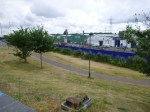


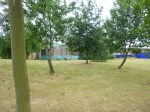


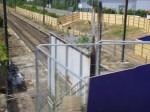
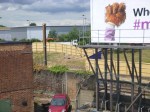
As the pictures show, they are just the fences to keep the unwanted out of the site.
But at least it’s a start!
Now The TransWilts Wants More Stations
According to this article in the Swindon Advertiser, the TramsWilts Community Rail Line wants to open new stations at Royal Wootton Bassett and Blagrove.
The more the merrier I say!
Don’t Let’s Be Beastly to the Germans
The title of this post comes from Noel Coward’s wartime comic song – Don’t Let’s Be Beastly to the Germans.
Generally, the Germany has got more visitor-friendly and on this trip their restaurant menus have improved beyond recognition for coeliacs and other allergy sufferers.
But there is one thing, where the reality does not live up to the German reputation for good design, reliability and efficiency.
Deutsche Bann, their trains and some stations just doesn’t cut the mustard. Or whatever they say in Germany.
In a related area, the local trams, metros and buses I’ve used are much better, even if in some cities, the maps and information aren’t up to the standard of the better cities like Munich or Leipzig!
On the train from Brunswick to Osnabruck, I was talking with a commuter and he was saying his commute was often late.
Service Frequency
One thing you notice in Germany, as that on important main-line routes, trains are not as frequent, as you’d find in say France, Italy or the UK, which seems to have the most frequent trains in Europe.
Comparing Berlin-Hamburg with the London-Liverpool route I know well, shows that for direct trains, the cost is about the same and there is one train an hour on both routes. But Liverpool also has two extra trains each hour, which are only a few minutes slower with a change at Crewe.
But the journeys on this trip, where I was doing an hour or so journey on a main line, I usually had the choice of just one train every two hours.
So when planning a train trip in Germany, make sure you plan well and never rely on if you miss a train, they’ll be another one along soon!
I have found that it is often better to take the slower regional trains, as I did several times on this trip, as although they are slower, many are double-deck and you can hide yourself upstairs and watch the countryside go by.
But I think German regional trains are more under control of the individual state or area, rather than Deutsche Bahn.
If this is the case and coupled with the often excellent interchanges at stations to trams and buses, this must be a good argument for local control of train services. But then as a Londonder could I believe anything else?
Finger-Aching Ticketing
The German automatic ticketing machines work well, but be prepared to wear out your fingers.
I counted that to buy a simple ticket from Liepzig to Braunschweig took a dozen menu choices and that didn’t count typing in the names.
Train Design
Increasingly, in the UK, our trains are a level step from train to platform and vice-versa. Look at this wide easy-entry door on a Class 378 train.
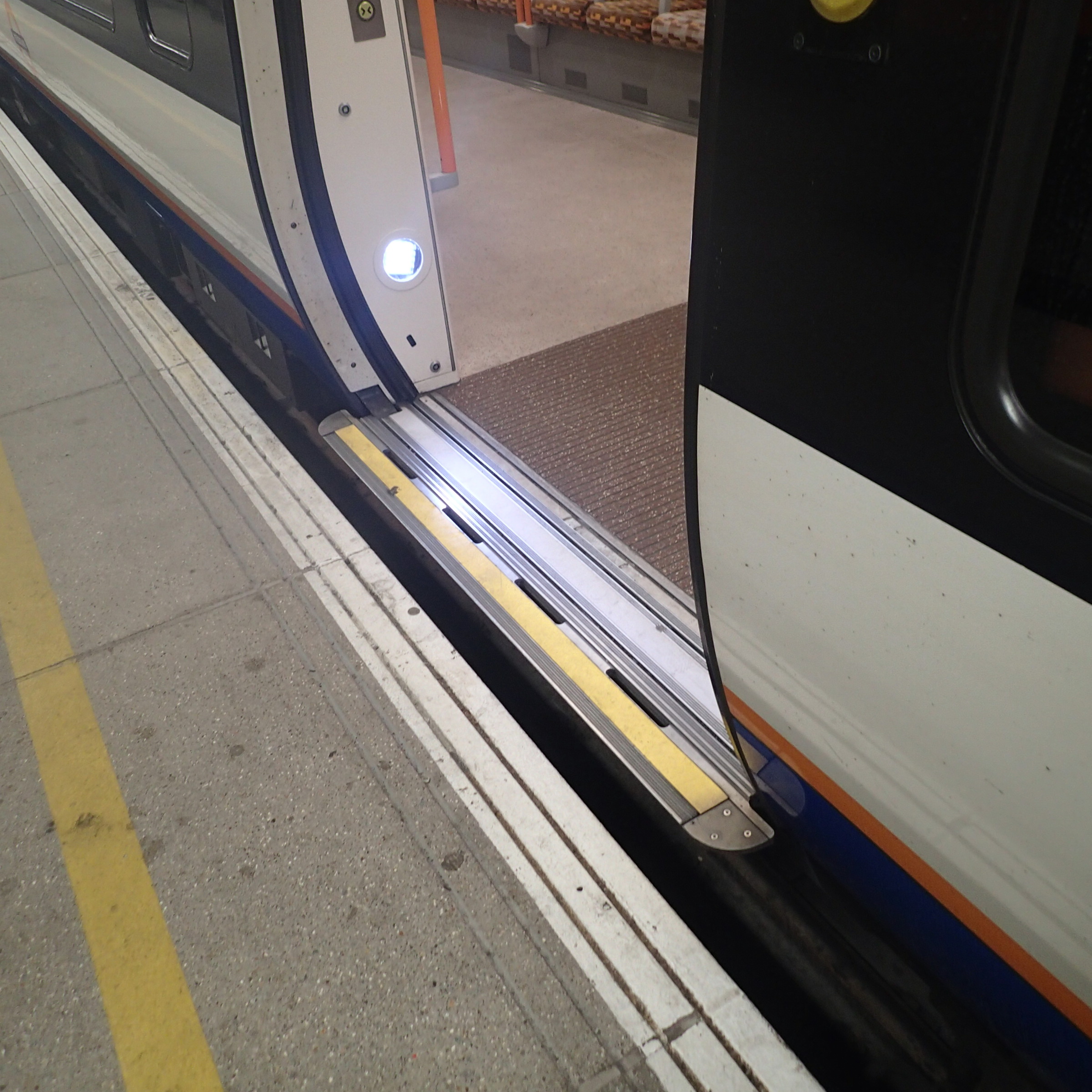
Regularly you see wheelchair-users push themselves across. This is a typical entrance to a Deutsche Bahn IC train.
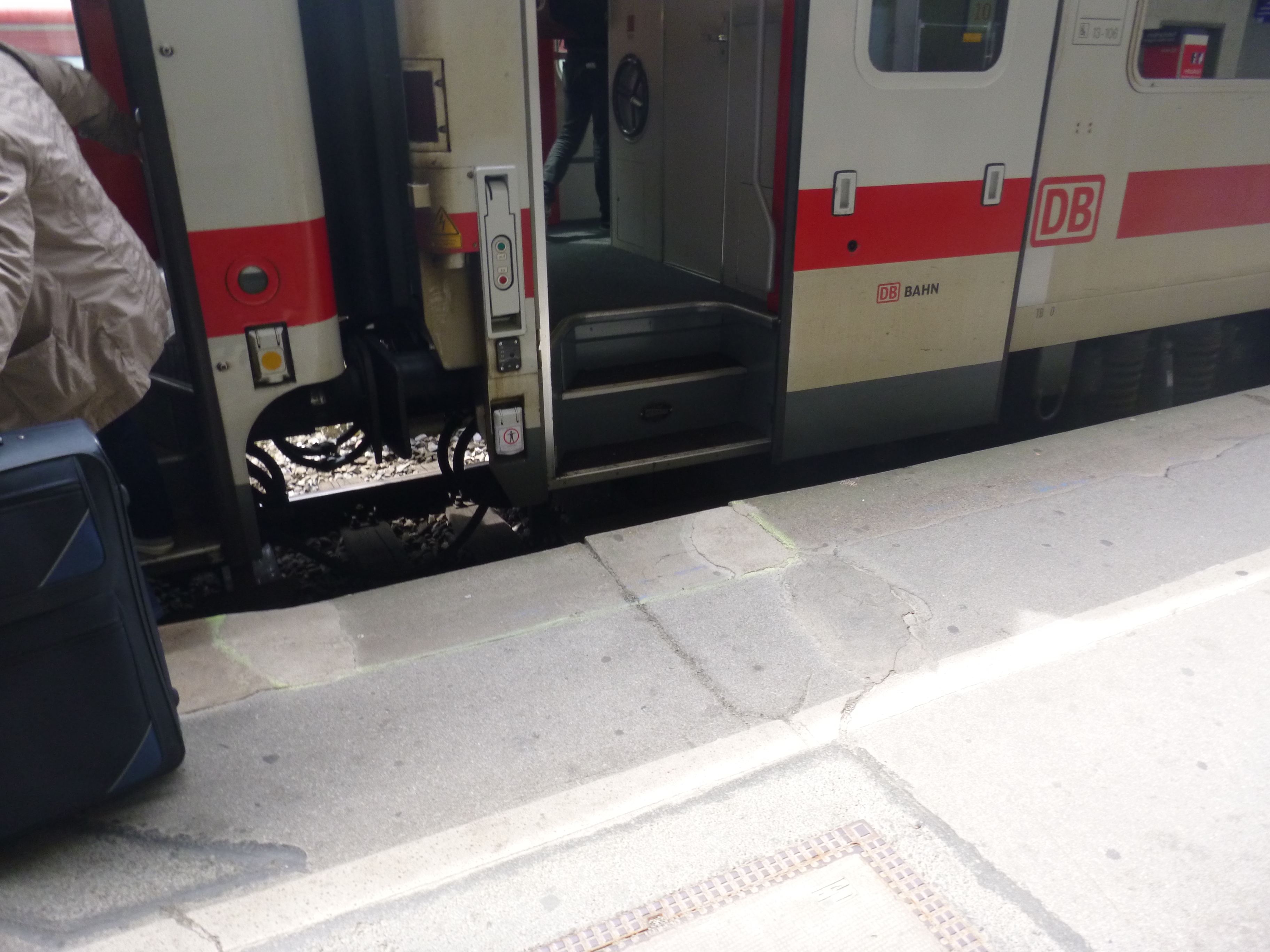
With my eye-sight, I sometimes miss my footing and in Germany, I worry about putting my foot in the often big gap between train and platform, which is never level.
As to wheelchair users in Germany they must despair. I thought that EU disability regulations meant trains had to be disabled-friendly.
On-Train Information
Nearly all the trains had displays for traffic announcement, but the information was a bit thin. As the Belgians were more comprehensive, I suspect it’s just the way they’ve programmed the system.
When you are a tourist in an area you don’t know well, you really do need adequate warning of your station. With Deutsche Bahn you don’t get it every time!
I shall finish this rant later!
Liège-Guillemins Station
As I wandered my way back to Brussels for the Eurostar, I just had to stop of at Liège-Guillemins station and take some pictures.

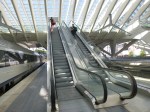
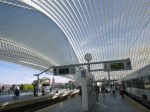
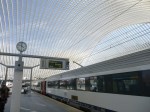
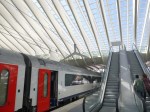
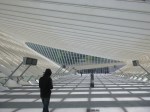

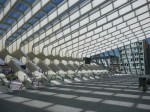



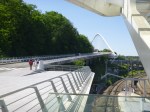
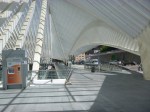

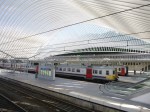

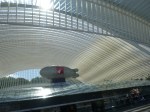



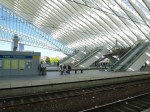
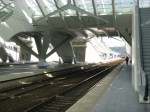
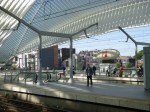
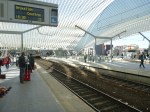
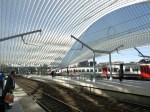
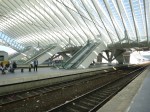
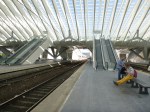
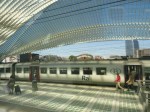
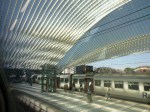
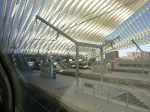
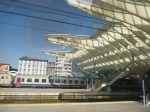
Is there another station like it in the world? This Google Map shows the layout.
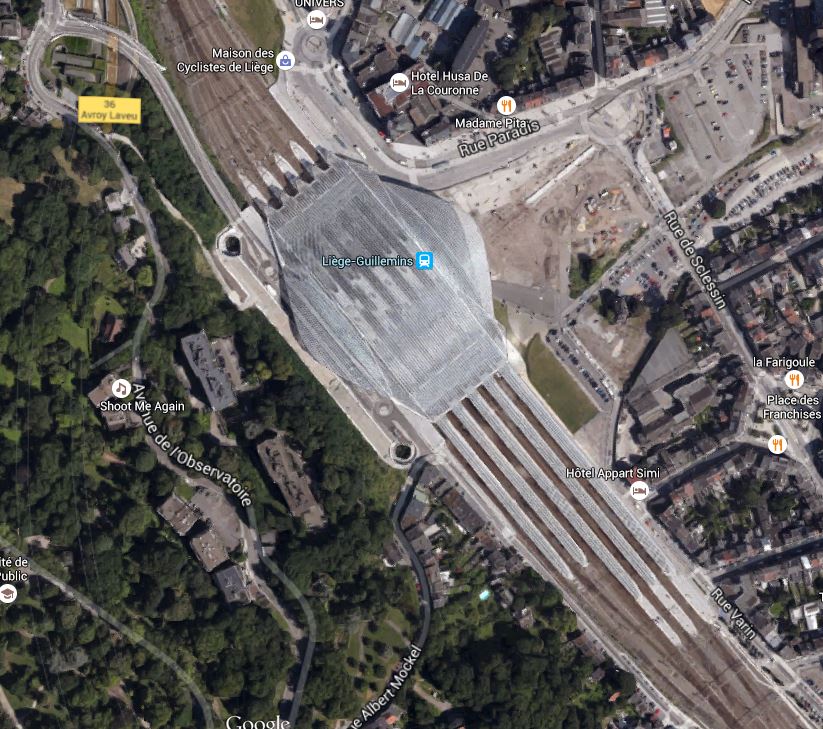
It is a design by Santiago Calatrava. Let’s hope that the Belgians did a good job on building this station. In 2007, I saw some of his buildings in Valencia and the concrete hadn’t worn well!
The totally new station cost €312million, which compares with £500million for the restoration and extension of Kings Cross station. Compare these figures with the reported £44million for the restoration of Manchester Victoria station, the complete reconstruction of Reading and Birmingham New Street stations.
Direct comparisons are difficult, but I cam’t help feeling, that in terms of cost, Manchester Victoria station is out of line with the others. It just shows that god design is often cheaper than bad.
One difference between the British projects and Liège-Guillemins station, is that the British ones are or were updating of existing stations, whereas the Belgian one was a new station built a short distance away.
Perhaps in some ways, to combine rebuilding with moving the station is a better plan, as both Reading and Birmingham New Street could be thought expensive compared to Liège-Guillemins.
So with all the problems there have been during the rebuilding of London Bridge station, would it have been better to have put the rail lines through in an optimal manner for operational purposes and perhaps created a new station further South.
London Bridge station was and still is a difficult problem, but hopefully it’ll be spot on when it opens.
Through The Ardennes
I hadn’t thought I’d see much, but the route through the Ardennes was rather pretty.
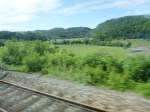
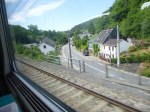
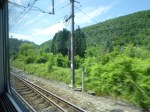
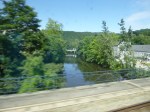
The train was a single-decker, as the pictures show.
 The Anonymous Widower