Three Hours in Ipswich
One of the things I hope to encourage with this blog is internal tourism in the UK. So as I was early and wanted to see a new art gallery in the town, I decided to have a little walk around the centre of the town.
It is actually very compact and sits between the River Orwell and the railway on one side and Christchurch Mansion and Park to the North.
I started by walking from Ipswich Rail Station over the River Orwell and past Portman Road football ground into the town centre. Ipswich Town’s ground must be one of the nearest grounds to a rail station outside of the major conurbations.
My first visit after checking if Marks had something I wanted, (Which they didn’t incidentally!) was to go to the old Ipswich Art School, which has now been turned into an art gallery. The first exhibition is a loan of work from the Saatchi Gallery.
It was very much worth visiting, but as it was the sort of modern art, that I don’t like, I almost got the impression it was a lovely building wrapped around some unlovely art! I hall go again, for the next exhibition!
It was then a short walk up the hill to Christchurch Park, which is a traditional formal park of the sort you get all over the United Kingdom.

Christchurch Park, Ipswich
I ate my packed lunch in the sun, looking out at the War Memorial.

The War Memorial, Christchurch Park, Ipswich
Why is it war memorials always have phrases like “Our Glorious Dead”? Death is never glorious! It’s just an awful waste and a what might have been!
There is also another smaller war memorial in the park. And that is one to the men of Suffolk, who died in the Boer War.
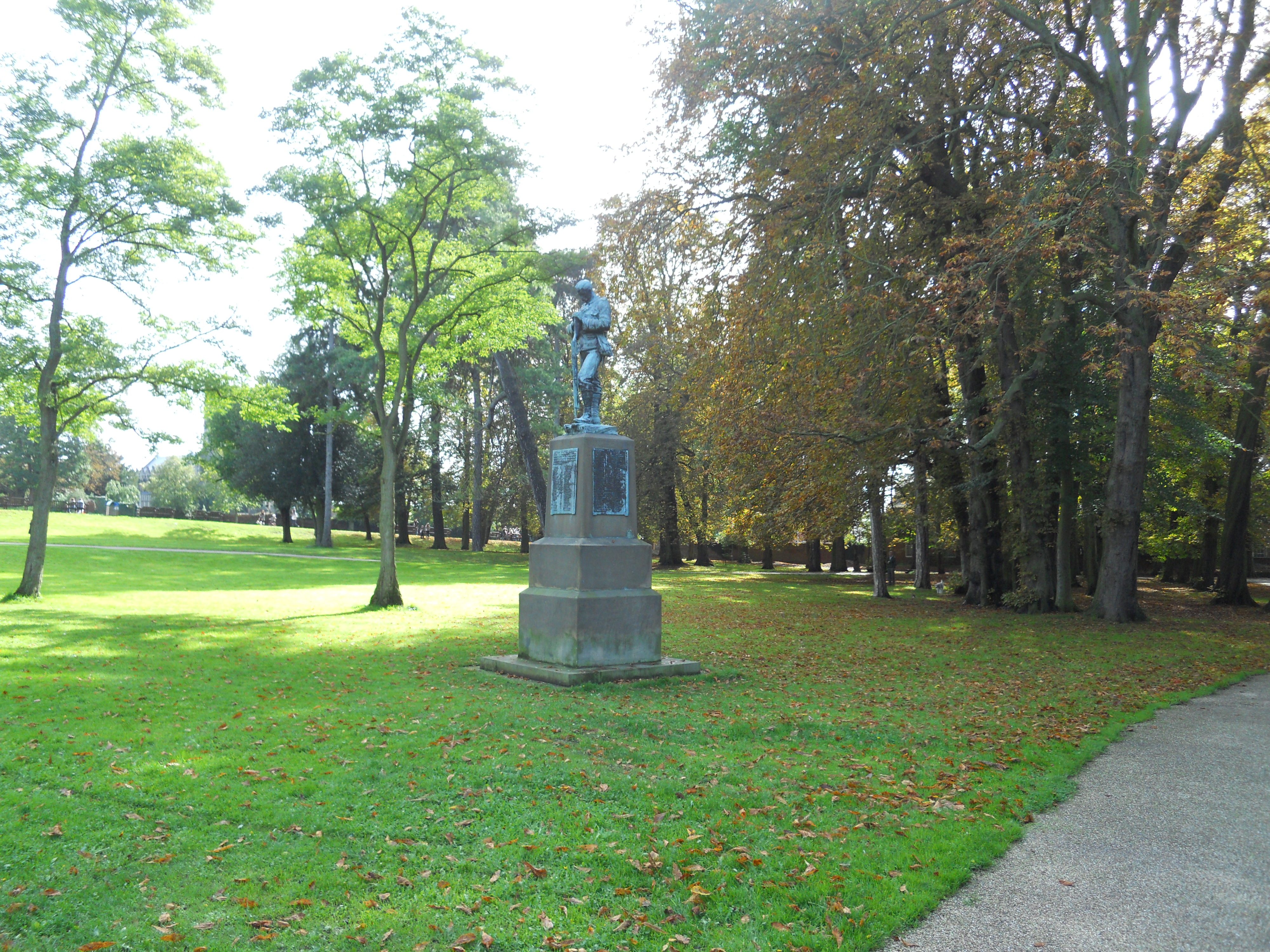
Boer War Memorial, Christchurch Park, Ipswich
I then moved on to Christchurch Mansion, which is effectively inside the Park.

Christchurch Mansion, Ipswich
Strangely, deespite living in the area for many years, I’d only been over the mansion once and that was when I attended a black-tie dinner there in the 1990s.
But I made a mistake and I should have gone more.
For a start there is the house and gardens, but then there is the art gallery with a dozen paintings by both John Constable and Thomas Gainsborough.
These though are not the famous paintings we’ve all seen in National Galleries all over the world, but often earlier ones that they painted locally as they were starting out on their careers. As an example, there is a touching portrait by Constable of his mother, Ann.
For that reason alone, they are worth the walk up from the town centre to Christchurch Mansion.
I then walked back down to the town centre, which has as more old shops, than any other towns I know. It is perhaps a pity that most of the shops as is comon throughout the UK, are national chains. But that is a problem all over the UK.

Ipswich Town Centre
The picture shows the Great White Horse, with its Dickensian connections.
The jewl in the crown of Ipswich dhops is the Gade One Listed, Ancient House.

The Ancient House, Ipswich
It must surely be the most unusual branch of Lakeland!
After walking back along the Buttermarket, I was virtually back where i started and it was a short walk down Princes Street and through an underpass or over a crossing and I was back at Portman Road. The route took me past another Grade One Listed Building, but one that is very diferent to the ancient House. this is Lord Foster’s first important building, the Willis Faber Building.
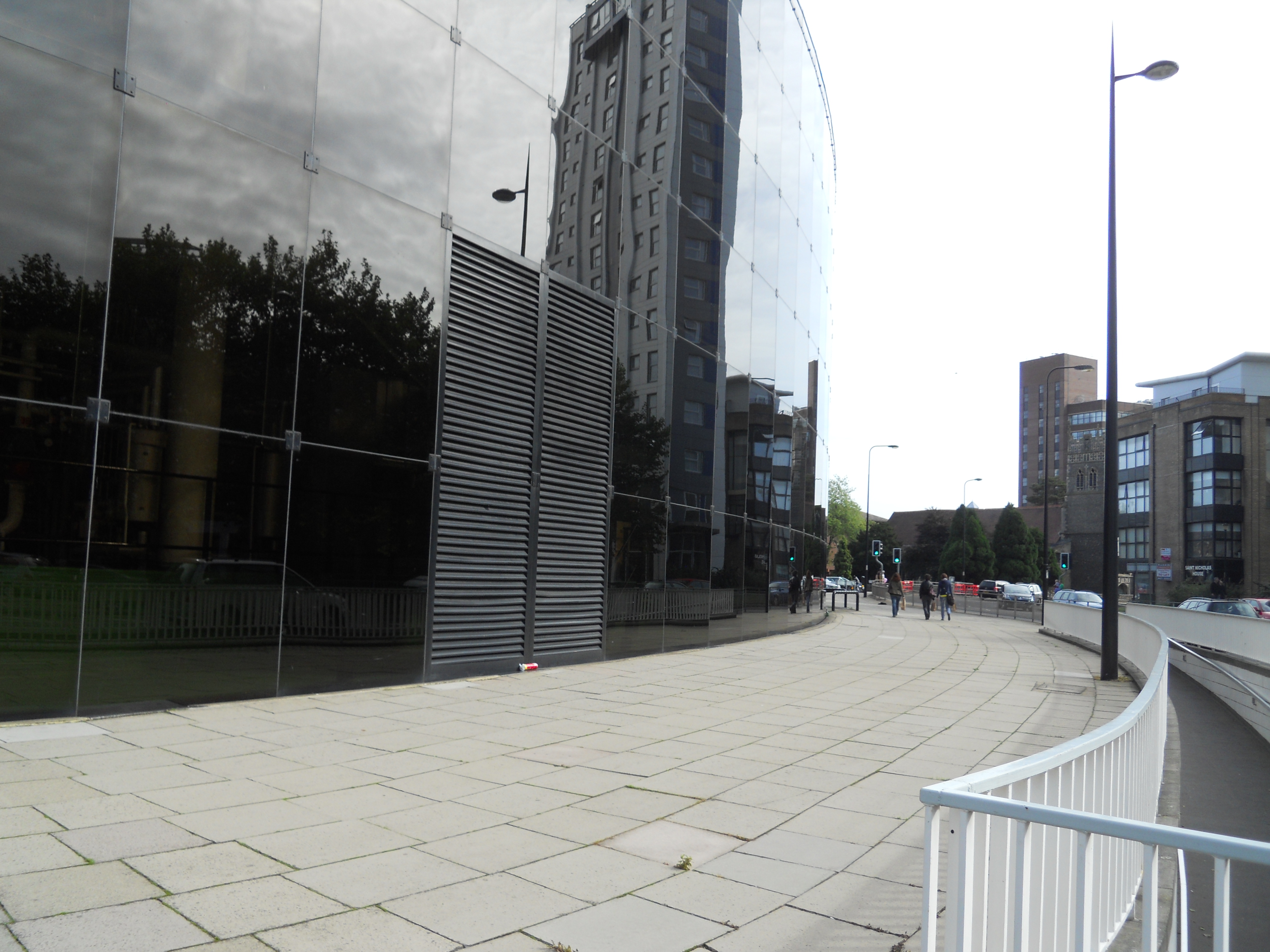
The Willis Faber Building, Ipswich
Note how the building opposite are reflected in the glass. This is now probably the most famous building in Ipswich, as every time Lord Foster is mentioned, they always show some footage.
The walk with a couple of detours had been easy and had taken me two hours, so if you’d decided to have lunch somewhere, you’d have filled the three hours. On a nice day as Saturday was, I wouldn’t eat in the town centre, but I’d get a picnic in Marks or one of the other shops and eat it in Christchurch Park or outside the Mansion. Judging by what I saw, many people were doing just that.
The next time, I am in Ipswich and the weather is good, I’ll walk round the town centre and visit the ten Grade One listed Buildings in the town centre. That is not bad for a town, which has featured heavily in Crap Towns.
The Damned United
In common with many other men of my age, I am not a fan of Leeds United or the Damned United as they were called in David Peace‘s novel, The Damned Utd
So it was with trepidation, that I took the train to Ipswich this morning to see Town play this afternoon. They haven’t been playing too well lately and I felt that a draw was the best we could hope for.
I also went early and this gave me three hours in the town before the match.
The Dutch Lose a World Record to the Iraqis
I don’t think the Dutch will be too bothered, as it’s only the record for the longest time taken to form a government! The full report is here.
McDonalds Customer Survey
This seemed another bit of pointless spam, but then I didn’t click the link to a web site in Malaysia.
Dear customer,
Please give us only 5 minutes of your valuable time to ask you some questions about our products . Please be aware that we will not ask you about any personal information.In return, we will credit $90.00 to your account – just for your time.
If you want to answer our simply 8 questions , please click the link below :
Thank you for helping us to become better .Sincerely, McDonald’s Survey Department.
Please do not reply to this email. This mailbox is not monitored and you will not receive a response.
I should say though that my ISP marked it as spam and it was to that mythical person, “undisclosed-recipients” I suspect that the link asks for your bank account details, so they can empty it.
Dealing with scams like these, is a bit like getting Health and Safety right. It’s just common sense, stupid!
A Sensible Approach To Health and Safety
It is reported today that Lord Young is close to delivering his report on the health and excessive culture in the UK.
Some of the stories I’ve read lately are so silly it’s not true.
I should say that I grew up in my father’s print works, with lots of printing machines, guillotines, paper drillers and noxious substances like printing ink, solvents and of course lead-based type. My father gave me a lot of guidance, but I suspect many of the things I did, would never be allowed now!
Did I have any accidents at the time?
Yes!
I was using a wood-turning lathe at school and got a splinter in my eye, which meant I had to go to Highlands hospital to have it removed. I should have been wearing goggles, but there weren’t any! That was typical of schools at the time! Nowadays, I would never do something like that without protective goggles.
But it was only when I worked in industry that I got any training. At Enfield Rolling Mills it was minimal and was basically a walk round the factory, pointing out what was dangerous. It may seem silly to say that you learned on the job, but then they expected you to observe what you saw and take appropriate precautions to avoid trouble.
At ICI in 1969, I went on a safety course, but the most valuable lesson, I had was a walk round a BCF plant with the foreman, Charlie Akers. To illustrate the dangers of HF dust, he took a speck and placed it on my thumb. It burned, so after that I made sure that I didn’t touch any. I still climb industrial staircases without putting my hands on the top, as that is where all the noxious substances are!
In my view Health and Safety training should begin in schools, as what you need to instill is a simple threat recognition and avoidance culture into children, that they will carry with them all of their lives. How many children have broken arms at five or six in simple situations like getting off a slide or a swing? A researcher into accidents once told me, that he felt there was now a common child accident, where kids were trained to get into their house quickly for their protection and had all sorts of problems, when the car wasn’t parked outside the house, so they ran across the road to get to safety. I once drove up from Cornwall and was suprised to see so many overloaded 4x4s in accidents, because their idiot drivers had not properly understood the problems of excess speed and weight. A proper health and safety education and a bit more practical understanding of Newton’s Laws would have alerted them to the problem before they set out.
The report on Lord Young makes some interesting points.
Launching the review in December, Mr Cameron cited cases of children being told to wear goggles to play conkers, restaurants being banned from handing out toothpicks and trainee hairdressers being banned from using scissors as examples of silly practice.
The Young report says local authorities, in future, should explain their decisions to ban events on health and safety grounds in writing.
The public should be able to refer decisions to an ombudsman and, if deemed to be unfair, they should be overturned within two weeks.
The idea of an ombudsman seems very sensible, especially, as they would affectively lay down good practice.
Lord Young also says flaws in existing legislation have fuelled the number of personal injury lawsuits and pushed up the fees charged by lawyers.
The growth of claims management firms – which are paid referral fees by solicitors to assess whether there are grounds for a claim – has led to a glut of advertising, he says, and resulted in a market in fees where claimants are directed to firms which pay the most not those which are most suitable.
“Many adverts entice potential claimants with promises of an instant cheque as a non-refundable bonus once their claim is accepted – a high pressure inducement to bring a claim if ever there was one,” his report argues.
A culture has developed in which businesses, the public sector and voluntary organisations “fear litigation for the smallest of accidents and manage risk in accordance with this fear,” he adds.
When I was in Middlesborough, there were adverts everywhere for solicitors, who would make a claim for you. In my view where there’s a greedy and unscrupulous lawyer, there’s a claim. I’d ban all forms of advertising by lawyers. You always get the best lawyers by talking to a good friend or someone who really knows what to do, not by phoning a company which then have a vested interest in your claim.
He also is suggesting a Good Samaritan law.
His report also suggests that a “good samaritan” law may be necessary to make it clear that people will not be sued for voluntary actions – such as clearing snow from a driveway – which may inadvertently contribute to accidents.
This is another good idea! But in the driveway example, we should remember good common sense, when we do things like that. In a related example, if we see a loose paving-slab outside our house, which we feel could be dangerous to some people, then coucils must have a reporting system that gets it fixed.
Health and Safety is just one area, where we must rescue our country from the barmy, scientifically-incorrect excesses of Nulabor.
Since my strokes, it is not stretching things to say that my Health and Safety training has been one of the things that has helped me get around and get my life back on track.
 The Anonymous Widower