When Was It Known Hillsborough Had No Safety Certificate?
It has been said many times in the last day or so, that Hillsborough had no safety certificate, at the time of the disaster on April 15th, 1989.
Perhaps, my memory has gone, but although I can remember the disaster, I can’t associate it with what I was doing at the time. I wouldn’t have been at football at Ipswich, as at that time I didn’t go. I can remember where I was when I heard about Lockerbie a few months earlier.
So for how long has it been known that Hillsborough did not have a valid safety certificate at the time of the disaster?
Surely to knowingly book the stadium without a valid safety certificate, is akin to flying a Boeing 747, without a valid certificate of airworthiness.
Or was that something that always happened in those days?
In trying to get more answers to my question, I came across this page on the web site of the Football Industry Group at Liverpool University. It is something everybody should read. This is one of the page’s conclusions.
The disaster was basically caused by the failure of South Yorkshire Police to control a large
crowd of Liverpool fans outside the Leppings Lane End, and the poor state of the ground,
but it was also clear that football’s total failure to learn from the numerous disasters that had
afflicted it during the twentieth century, and a police force conditioned to view supporters as
potential hooligans and so always expecting violence, contributed significantly to the 96 deaths
and many hundreds of injuries.
I agree very much about learning from the past. In the 1960s, I was in a few crushes at White Hart Lane and Highbury, and how they avoided a Hillsborough-type disaster in some matches, was more down to luck than any planning.
The page also says this about the safety certificate and emergency plans.
Sheffield Wednesday had redeveloped parts of the ground without obtaining
a new safety certificate, or telling the emergency services: the result was that the safety certificate was
outdated and useless, and that plans Sheffield Wednesday had developed with the local emergency
services could not be put into practice, as the layout of the ground had changed.
That to me is inadequate, to say the very least. An emergency plan like that, only works without an emergency.
Is This £300m Home Unlucky?
It’s reported in the Standard that a house is being sold for £300m in London.
As the two previous owners died prematurely, would you want to buy such an unlucky house?
I wouldn’t even if I had the money.
And if I did, I certainly would spend that amount on a house.
More CrossRail Green Walls
I visited two more of CrossRail’s green walls today, in Hanover Square and Park Lane.



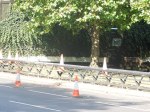
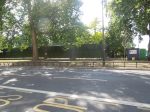




They certainly seem a good way to improve the look of a building site.
Do We Learn From Football Crowd Tragedies?
In my lifetime, there has been three football crowd tragedies; Ibrox in 1971, Bradford City in 1985 and Hillsborough in 1989.
We may have dealt with the problems inside the grounds by better stadium design and rebuilding, but have we properly dealt with the problems the tragedies create for the emergency services and especially the paramedics.
Sadly, I think that it took some time for the message to get through. For example, with the latest news on Hillsborough, it becomes apparent that the paramedics couldn’t cope and this was probably the case at other non-football-related disasters in recent years. The attacks on the London Underground on the 7th of July 2005 come to mind. In that attack, how many lives were also saved as one bomb went off outside the Royal College of Surgeons?
We have to accept that tragedies and disasters will happen. But are we prepared for the worst, when they do? This week for instance there was a coach crash on the A3 at Hindhead, where three died. Did the emergency services of rural Sussex cope well?
Knowing the A14 well, what would happen if a coach crossed the dual-carriageway at say Newmarket and hit another head-on going the other way? The nearest hospitals are in Cambridge and Bury St. Edmunds, almost twenty miles away. Do the emergency services train for such an emergency? Or do they hope it won’t happen?
What I feel sorry about the past couple of decades is that Bradford was the wake-up call and everybody ignored it! There was a mixture there of a dilapidated wooden stand with rubbish underneath it. Just one stray cigarette was al it took.
Doesn’t that sound a lot like the wooden escalator at Kings Cross, that caught fire in 1987. It probably wasn’t that simple, but surely the engineers in London Underground must have thought about the danger, after the fire at Bradford.
But the modern safety culture may be just that. Modern!
In the 1970s, I worked on a chemical plant and an instrument that the section I worked for, found that the plant was going into a regime, where it could explode. The plant manager immediately shut the plant and informed the makers. They informed him, that what we had proven, couldn’t be measured and we should keep the plant going. Two years later their plant buried itself in a hillside, killing a number of people.
So we were right! And they were wrong! It is not a nice thing to say, as people died, because of the blinkered thinking of others.
Even today, on my travels around the UK, visiting all the football grounds, one stood out as a place, where a bad accident could happen again! Not I hasten to add in the ground itself, but in the railway station, which brings large numbers of supporters to the ground.
 The Anonymous Widower