A Phallic Lith
Is there any other way to describe this lith at the Emirates Air-Line?
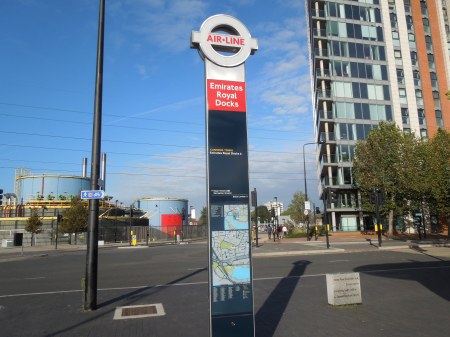
A Phallic Lith
London doesn’t appear to be too dictatorial about the liths, as some like this one seem to go their own way.
Is there any other way to describe this lith at the Emirates Air-Line?
A Phallic Lith
London doesn’t appear to be too dictatorial about the liths, as some like this one seem to go their own way.
October 30, 2013 - Posted by AnonW | Transport/Travel | Emirates Air-Line, Information, Legible London, Liths, Walking
This site uses Akismet to reduce spam. Learn how your comment data is processed.
What this blog will eventually be about I do not know.
But it will be about how I’m coping with the loss of my wife and son to cancer in recent years and how I manage with being a coeliac and recovering from a stroke. It will be about travel, sport, engineering, food, art, computers, large projects and London, that are some of the passions that fill my life.
And hopefully, it will get rid of the lonely times, from which I still suffer.
Why Anonymous? That’s how you feel at times.

 The Anonymous Widower
I love the site but am still at a loss of the origin of the term “lith” as used by you for the street maps on the pillars.
Any chance of a lecture? I can’t really even find details on Google or Wikipedia.
Incidentally, it took me ages to realise that the maps are all posted in different orientations with North rarely at the top. I finally cottoned on to the fact that the top is the direction one is pointing. Almost clever and simpler than the Boris suggestion that ALL maps given out at N London stations like St Pancras/Kings Cross/Euston should have South at the top so as to point in the direction most people would walk. Highly confusing though as peoples stanavs and onmobile maps wwould be the other (right) way up!
Comment by Mike Jay | November 3, 2013 |
This piece from Wikipedia gives the signs official names as monoliths, midiliths and miniliths.
http://en.wikipedia.org/wiki/Legible_London#Elements
So I’ve just termed a collective term for them all of liths. As to the orientation of the maps, it probably relaes to the way my generation was taught to use a map in the 1950s in the Scouts. Say you were walking in the countryside and came to the top of a hill and wanted to identify where you are, you would lay the map on the ground and line up recognisable features like church spires with the map and then the lines all led to where you are. I was in Ipswich on Friday night and that town is now well-lithed. I was able to use them easily in the dark, as there was just enough light from a street lamp to make out the map on the lith.
Using one term for the lot of them, means I don’t go into all sorts of tortuous phrases.
Comment by AnonW | November 3, 2013 |