Is This Really A Pacer In A New Outfit?
I don’t like Pacers, which I often refer to as scrapyard specials, as in most cases those places should be their next destination.
Today, my heart sank as the conductor of a crowded Class 158 train at Rotherham Central station, refused entry to the train to proceed to Sheffield.
I knew what would happen and it did!
Ten minutes later and a dreaded Pacer in the form of Class 144 train hove into view. But at least it was four carriages and it would take the happy remnants of the Ipswich away supporters to Steel City!
Only after I’d been sitting in the last coach for a couple of minutes did I realise this was not an ordinary Pacer, as the seats were like Noah’s animals in a 2×2 formation and it looked like the paint and seats and their covers were all new. Above our heads was a new digital display informing the occupants of the route. This was much needed, as this particular train circumnavigated a large portion of South Yorkshire.
I took these pictures.


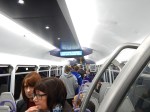


I had heard of the E for Evolution version of the Class 144 train before! So were we all travelling in the prototype of this train?
The pictures confirm we were.
Some other points.
- Passengers seemed to be suffering from New Train Syndrome, judging by the surprised look on their faces.
- The train sounded like a Pacer, but perhaps a bit quieter.
- Ride seemed better, than the standard Class 144 train I took to get to Rotherham. Perhaps, the maintenance engineers had tightened the nuts and tweaked the bogies or something?
- I spoke to a few passengers, who I reckoned would know nothing of the project to create the Class 144E and they seemed impressed and felt the train was a lot better than the ones they normally travel on.
- The train had the clearest information display, I’ve seen on any train. This near seventy-year-old with stroke-damaged eyesight loved it!
This Class 144 E design could convert the twenty-three Class 144 trains into something that meets the Rail Vehicle Accessibility (Interoperable Rail System) Regulations. Wikipedia says this about the train.
The demonstrator Class 144e unit (144012) features a number of upgrades such as the addition of new 2+2 style seating, a fully accessible toilet, two wheelchair spaces and spaces for bicycles and luggage. as well as Wi-Fi and media screens.
It has one problem!
The politicians have said the Pacers would be gone.
But to replace them with new electric trains and put up all that overhead wiring, would cost a fortune and more importantly take a long time.
However in the short term, an upgrade of the Class 144 trains would improve the lot of passengers some way towards the level of new trains.
So would politicians be prepared to do a U-turn and upgrade the Pacers?
Ian Walmsley in Modern Railways has said that this demonstrator is a good start and the lessons learned should be applied to upgrading other multiple units like the various Class 15X trains.
But he doubts the economics and reliability.
For myself, if I was the Transport Secretary I would take a pragmatic decision, as we desperately need more trains.
I would convert perhaps five or six of the Class 144 trains and use them on routes with severe capacity problems or train shortages. Passengers would be surveyed and a detailed analysis of all the results would be published.
I might even put a set on the Gospel Oak to Barking Line, where they would be compared to modern Class 172 trains. It would be a tough ask, but after what I experienced today, it wouldn’t be the unfair fight it would be with the standard Class 144.
Only then would a final decision be made as to whether all Class 144 trains were upgraded or scrapped!
Will Glasgow Ever Get Crossrail?
I have a Google Alert for Grossrail and occasionally it picks up an article for Glasgow Crossrail, like this comment in The Scotsman entitled Glasgow Crossrail: Will the ‘missing link’ be built?
If you look at the major cities in the UK, many have cross-city links tying the railways on both sides of the city together.
London has several.
- Thameslink
- The East, North and West London Lines
- The Gospel Oak to Barking Line
A major East-West link in Crossrail is being built and another Crossrail 2 is being planned.
Except for Manchester, where the Ordsall Chord is being built, I don’t know of a major city in England, where services are disconnected across the city.
In the last few years, I’ve walked across Glasgow a couple of times to connect between the South and East.
As a Sassenach, I can’t understand, why the Glassgow Crossrail is not given a high priority by the Scottish Government.
Perhaps the reason, is that one of the groups that would benefit most, would be English travellers arriving in Glasgow, who wanted to go North to places like Inverness, Aberdeen and Fort William.
Or could it be those old friends of the railways: the airlines, are lobbying against it, as it would allow services direct from Aberdeen and Inverness to Manchester?
Walthamstow Doesn’t Like Going Dutch!
This article from the Waltham Forest Guardian is entitled Grand opening of mini Holland scheme dominated by angry protestors.
I have posted it, as we are getting the Cycle Superhighway through where I live in the northern part of D Beauvoir Town in the near future and there are various opposing groups wanting or not wanting road closures and different parking restrictions.
As a Control Engineer, who has quite a bit of experience of dealing with complex liquid flow systems in chemical plants, I think that Councils tend to take a too definitive approach to the problem.
So my experience of chemical plants was in the late 1960s and we used an amazing PACE 231R. But that machine was the state-of-the-art computer of its day for solving differential equations. The computer was also the unrecognised star of the amazing rescue of the astronauts on Apollo 13.
The aim of the modelling in the chemical plant was to get different chemical streams flowing at the right rate into various reaction vessels, where they could be safely reacted and handled. The reaction products would then flow off in a controlled manner in other directions.
On a chemical plant the flows are controlled by various measures, but typically by valves, of which a domestic example is your mains water stop cock.
Often after modelling the flow system, it was found that the various valves were set almost to a fixed position for normal running of the plant.
If you look at traffic flows in say Walthamstow Village, as in the article, or De Beauvoir Town, you have an area bounded by main routes, which is crossed in a random manner by buses, cars, cyclists, pedestrians and trucks.
So what is different between modelling fluid and traffic flows?
Mathematically, it is the same process, but there is no variable method for regulating traffic flows.
The only regulation in De Beauvoir Town and other traffic systems is the brain of cyclists, pedestrians and regular drivers, who adapt their route according to their knowledge.
What the Mini Holland system in Walthamstow and other systems try to do is modify the thought processes of regular uses. The problem is that it may do that with the regular uses, but it doesn’t influence say your casual driver, who ventures into the area.
So in Walthamstow the local businesses and others see the drop in traffic and protest.
We need to apply more subtle ways of regulating the traffic, through areas like Walthamstow Village, that are understood by everybody.
- Speed limits should be set to twenty and they should be enforced. The Police need all the money they can get, so I would be happy to see mobile enforcement cameras on the top of Police vehicles parked at the side of the road.
- Computer-controlled traffic lights can be used as restrictors, so for instance at a notorious place where rat-runners enter an area, a pedestrian-crossing with lights could be placed. Timings could be adjusted automatically to the day of the week and time of the day.
- Speed humps aren’t as affective as they used to be. Perhaps car suspensions are better and Councils have softened them, so they don’t get sued?
- Cambridge has used rising bollards, that are automatically opened by certain vehicles, like buses, taxis, fire engines and ambulances.
- Even physical gates can even be opened and closed at various times. Suppose to calm an area, there was a need to shut off a road past a church. Why couldn’t it be opened on Sundays?
We are not being innovative enough.
Solutions like mini Hollands and just shutting routes are just too simplistic for a complex city like London.
As an aside, I’m old enough to remember London’s first experiment in traffic managment.
Green Lanes through Harringay in the 1960s was even more crowded with traffic than it is today. So traffic lights were put every fifty metres or so between Harringay Green Lanes and Turnpike Lane stations. There are quite a lot less lights today.
It cut the traffic through the area, but we all diverted through the side streets and made the lives of residents hell!
 The Anonymous Widower