An Advantage Of IPEMU Trains
My correspondent from the Corbedian Republic Of North Islington, has visited family in Newcastle over the weekend.
But things coming home didn’t go to plan and I received this text.
Our train dropped it’s pantograph.
Driver can’t put it back and train has been declared a failure. I quote. Now waiting to be rescued from Doncaster.
Later I received another text.
Train guard and driver not in touch. Could turn long and silly!
It all got me thinking!
As the train dropped a pantograph it was probably an InterCity 225 and not a diesel InterCity 125, which are built to Carry On Regardless. When I travel North from Kings Cross, I’ll look to see if the train is going to Aberdeen or Inverness, which means it will be a 125, with a reliable lump of a massive diesel engine front and back!
Incidentally, I found this extract in the Wikipedia entry for the Class 91 locomotive that pulls the InterCity 225.
In November 2012, unit 91114 had a second pantograph added as a pilot project operated jointly by Eversholt Rail Group, East Coast, ESG, Wabtec Rail and Brecknell-Willis. The new design uses the same mounting positions as a conventional pantograph but pairs two pantograph arms in an opposing configuration. If there is an ADD (Automatic Dropping Device) activation or the pantograph becomes detached, the train can keep going, so the system provides redundancy in the event of a pantograph/OLE failure.
So it could be that Class 91s regularly drop pantographs like whores drop their drawers!
As far as I can find out, only one locomotive has been fitted with the new pantograph.
But in future, I have a feeling that this type of problem could give a big advantage to an IPEMU train, which has on-board energy storage.
As it rolls along, it will be charging the battery, so if the pantograph fails, it will have a full battery and should be able to run for perhaps another fifty miles or so to a convenient station.
Having two independent systems, is not a bad way of improving reliability.
Crossrail 2 Consultation – Angel Station
This Crossrail document is entitled Angel Station.
The current Angel station is not a run-of-the-mill station with long escalators, an unusual platform layout and a situation in the ground-floor of an office block!
But as it was only built in the 1990s, I suspect the design is such to aid the construction of the Crossrail 2 station.
This is TfL’s proposal for the Crossrail 2 station at Angel.
-
2×250 metre long platforms.
-
Station platform tunnels around 30 metres below ground level to the top of tunnel
-
An increase in capacity within the existing Northern line ticket hall to accommodate a Crossrail 2 ticket hall on Islington High Street
-
An enlarged station entrance and a new second entrance onto Torrens Street
-
An underground connection between Crossrail 2 and Northern line services
-
A facility for reversing Crossrail 2 trains
The last item is possibly surprising, as although they need reversing facilities, I didn’t think it would be Angel.
This map from the document shows the layout of the station and the work-sites.

Crossrail 2 – Angel Station
The four work-sites are as follows.
- Site A – The site of the Royal Bank of Scotland building would be used for station tunnelling works and construction of the station entrance, station box and station shaft.
- Site B – Includes Iceland and other properties to the north of White Lion Street. This site would be used for construction of the station shaft. Impacts on Chapel market would be avoided.
- Site C – At the southern part of Torrens Street, the location of the old entrance to Angel station would be used as access to support the construction of the underground connection between Crossrail 2 and the Northern line.
- Site D – The Public Carriage Office site, which is owned by Transport for London, could be used for construction of a facility for reversing Crossrail 2 trains at Angel. This is subject to further investigation.
I have walked round the Angel and the various sites taking pictures in the order A, C, D and B.




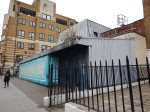


All of this leaves me with these observations, thoughts and conclusions.
- All sites except D are bordered by roads carrying large amounts of traffic.
- The chaotic Junction At The End of White Lion Street needs easing before rebuilding Angel station.
- It is quite surprising how far the Northern Line platforms are from the entrance to the station. Sadly, this history will probably mean that there will be no simple interchange between the two lines as is promised at Balham.
- I would split the Northern Line into two lines before building Crossrail 2, as this might take pressure off Angel station during building of Crossrail 2.
- I think it is also a pity, that there is no entrance to the station shown on the Chapel Market side of the road.
On the plus side, I can’t see the design of the station causing too many problems in both design and construction.
A 2020 Update
It is now over five years since I wrote this post, so these are some new thoughts.
The Reversing Facility
The TfL document says that the facility will be for reversing trains at Angel station.
- As the site is to the West of Angel station, it would reverse trains from the East.
- Usually reversing sidings are between the two tracks and would be long enough to take a full-length train.
- The facility would be underground and it could be built in the traditional way as the new Bank tunnel was recently.
- The effect on buildings, would probably be the same as the main Crossrail 2 tunnels.
Operation of the reversing siding would be as follows.
- Trains would pull into the Westbound platform at the Angel.
- After all passengers had got out, the train would move forward into the siding.
- The driver would then change ends.
- When the line was clear move into the Eastbound platform.
It should be noted that Crossrail doesn’t have a reversing facility under London, and I think it would have been useful in enabling the route to open in sections.
Swansea Tidal Lagoon In The Independent
I have a feeling that the Swansea Tidal Lagoon could be a very worthwhile way of generating electricity.
Today, there is this article in the Independent entitled Swansea’s tidal lagoon project delayed amid concerns over costs.
It is a comprehensive review of the technology and contains some interesting nuggets.
- The Swansea scheme has a capacity of 320MWh
- The company is saying up to five other places could have a lagoon power station and together they would develop eight per cent of our electricity.
But to me, its biggest advantage, is once it is built, with maintenance, it will continue to produce zero-carbon energy for a long time.
I shall be watching this project with a lot of interest.
 The Anonymous Widower