The June 2016 Edition of Modern Railways has a section about The Railway Industry Innovation Awards 2016.
One is labelled the Platform for the Future.
That probably sounds rather boring, but I’m a great believer in disruptive technology and using new and innovative methods to replace something that is rather dull, with something that is better, quicker to be installed and get working and more affordable.
This is said.
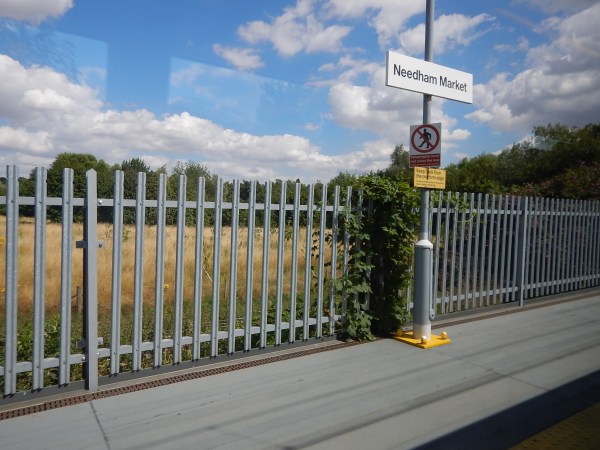
Abellio Greater Anglia and Dura have pioneered the use of a composite platform at Needham Market station in Suffolk, which was installed in just 36 hours.
This installation might be considered surprising as Needham Market station is a Grade II Listed building. So it can’t look like.
A monstrous carbuncle on the face of a much-loved and elegant friend.
But the product comes with these advantages.
The design life is sixty years.
A financial saving of 25% is reported.
As the platforms are built in a factory, the quality should be tip-top.
Hopefully, this would dissuade even the most determined member of the Heritage Taliban from objecting.
There’s more here on the Dura website. There’s also this video, of the platform being installed at Needham Market station.
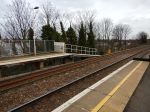
This is a picture I took from a p[passing train.
It looks good and who would think it was long-life hard-wearing plastic.
Only members of the Taliban tendency of the Green and Heritage lobbies would probably object!
I think that this product could find lots of applications, in traditional heavy rail, light rail and tramways. Certainly, it could be used to create some of the needed extensions to platforms on the Gospel Oak to Barking Line.
Look at these pictures taken at Harringay Green Lanes station.
Would composite platforms make extending these platforms an easier process?
The company might also have the solution to the dual-height platforms, that some people feel are needed for tram-trains. The Germans certainly use stepped platforms so that different types of tram-trains have step-free access.
In fact, why restrict it to rail applications?
It could be used to provide a disabled viewing platform at somewhere like a horse racecourse or other sporting venue.
This article in Rail Technology entitled J Murphy & Sons to carry out electrification of Gospel Oak-Barking route, was published on September 29th last year.
I reread the article to see if I could find any reference to the Wightman Road bridge, but there is none.
However, I did find this section.
But Glenn Wallis, secretary of Barking-Gospel Oak Line User Group (BGORUG), said at the time: “Our expert rail industry advisers tell us that for Network Rail to have taken three years to complete GRIP 3 [completed in March this year] indicates that they have not exactly been throwing resources at the job.
“The likelihood of Network Rail completing electrification of the line by mid-2017 is now said to be improbable.”
That looks to me like Network Rail didn’t get all their ducks in a row on this job.
Searching for Wightman Road bridge on the Internet led me to this article on Harringay Online, which is entitled Wightman Road Closure – What Will it Mean? The article was published on December 17th last year. This is said.
Whilst this work has been on the cards for a number of years, its programming to start in Spring 2016 has been driven both by the serendipitous coinciding of the signing off of the nearly £3M budget (from TfL and Network Rail) and the planned electrification works of the Gospel to Barking Oak line.
I find it interesting that in endless articles written about the electrification of the Gospel Oak to Barking Line, the reconstruction of this important road bridge is not mentioned once. This is especially surprising, as bridge reconstructions in Palmerston Road in Walthamstow and Upper Holloway, have been extensively reported.
The Palmerston Road bridge was rebuilt in 2014, but it doesn’t appear that any plans to rebuild the Wightman Road bridge surfaced until December 2015.
I think that any major bridge reconstruction would normally be done before the electrification work, as the masts, gantries and possibly wires, would get in the way of the heavy lifts needed for bridge replacement. Also, a sturdy bridge is a convenient place on which to mount the overhead wires.
So it looks like some seriously bad planning to me, that this bridge wasn’t replaced before the electrification started!
The only feasible alternative, is that because of a particular problem, the bridge replacement and the electrification need to be done at the same time.
But if that was the case, then you’d think that the bridge replacement would take place after the complete closure of the line on September 24th, 2016.
What this blog will eventually be about I do not know.
But it will be about how I’m coping with the loss of my wife and son to cancer in recent years and how I manage with being a coeliac and recovering from a stroke. It will be about travel, sport, engineering, food, art, computers, large projects and London, that are some of the passions that fill my life.
And hopefully, it will get rid of the lonely times, from which I still suffer.

 The Anonymous Widower