Along The Felixstowe Branch
In the December Edition of Modern Railways magazine there is an article entitled Loop Planned For Felixstowe Branch.
The Proposal
To allow an increase in the numbers of freight trains on the line from 33 to 47 every day, Network Rail propose to do the following.
- Create a 1.4 km loop at Trimley. Note that 775 metres is the maximum train length in the UK.
- Close six level crossings
- Create a bridge for a bridleway.
Network Rail hope that this will be sufficient for a few years, but in the future the aspiration is for double-tracking and electrification all the way between Felixstowe and Nuneaton.
I have flown my helicopter along the route and it is single track all the way between Westerfield and Trimley stations, with the exception of a passing loop East of the Spring Road Viaduct, which is centred on Derby Road station.
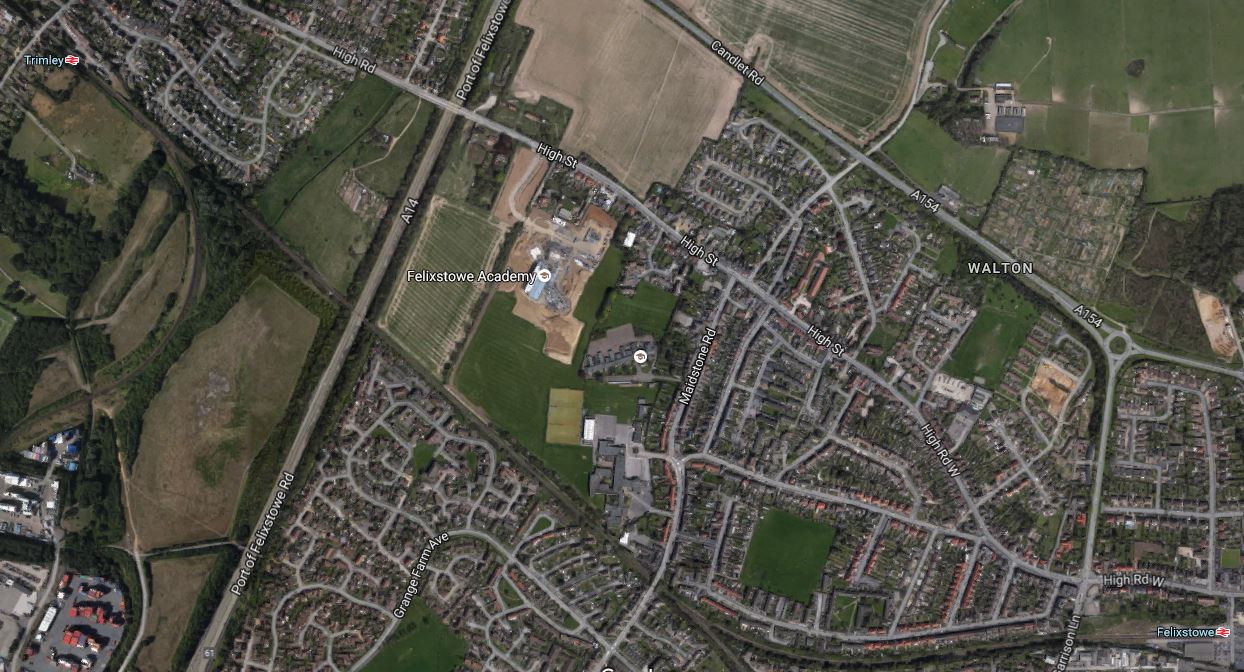
This Google Map shows the Branch Line East of Trimley station.
The Eastern End Of The Felixstowe Branch Line
Trimley station is in the North West corner of the map, whilst Felixstowe station is in the South East corner.
Just before the level crossing at Trimley, the line splits into two and the two tracks run together for a time, before the Southern track branches off to the North Terminal at the Port of Felixstowe.
The other track then continues East and splits with one branch going straight into Felixstowe station and the other going to the South Terminal at the Port.
All tracks are single track, except between Trimley station and the first junction.
The Intermediate Stations
I think it is probably true to say, that Westerfield, Derby Road and Trimley stations are one the worst run of three stations in the country.
In James Cook Station – The Reinvention Of The Halt, I talked about the new James Cook station, that serves Middlesborough Hospital. This station had 23,000 passengers in 2014/15, as against the 30,000 average for these three Suffolk stations in the same year.
I’m sure if they were of the same standard as James Cook station, they would see an increase in passengers.
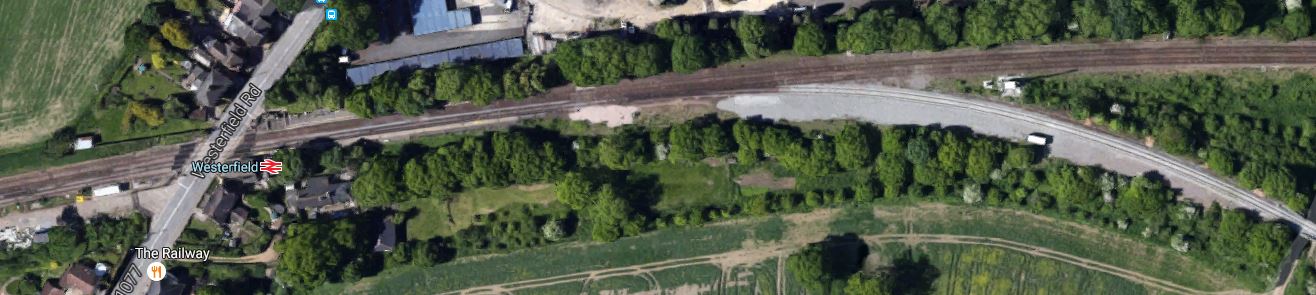
This Google Map shows Westerfield station.
Westerfield Station
Note how the single-track Felixstowe Branch leaves the double-track East Suffolk Line to the East of the station.
A large housing development called Henley Gate, which is part of the Ipswich Garden Suburb could be built to the West of the station. This might be an opportunity to improve the station and the level crossing. This web page on the Ipswich Borough Council web site, shows a map and a few details.
If the thousand houses promised for the site are built, I’m sure Westerfield station could be one that attracted a few more passengers, who cycled to the station.
According to Wikpedia, this Derby Road station used to be a lot busier. This is said.
People living on the eastern side of the town generally preferred to use Derby Road when travelling to Felixstowe and the station could be very busy on sunny weekends with day trippers to Felixstowe Beach and Felixstowe Pier stations. They could reach the station on the Ipswich Tramway which terminated outside the station entrance.
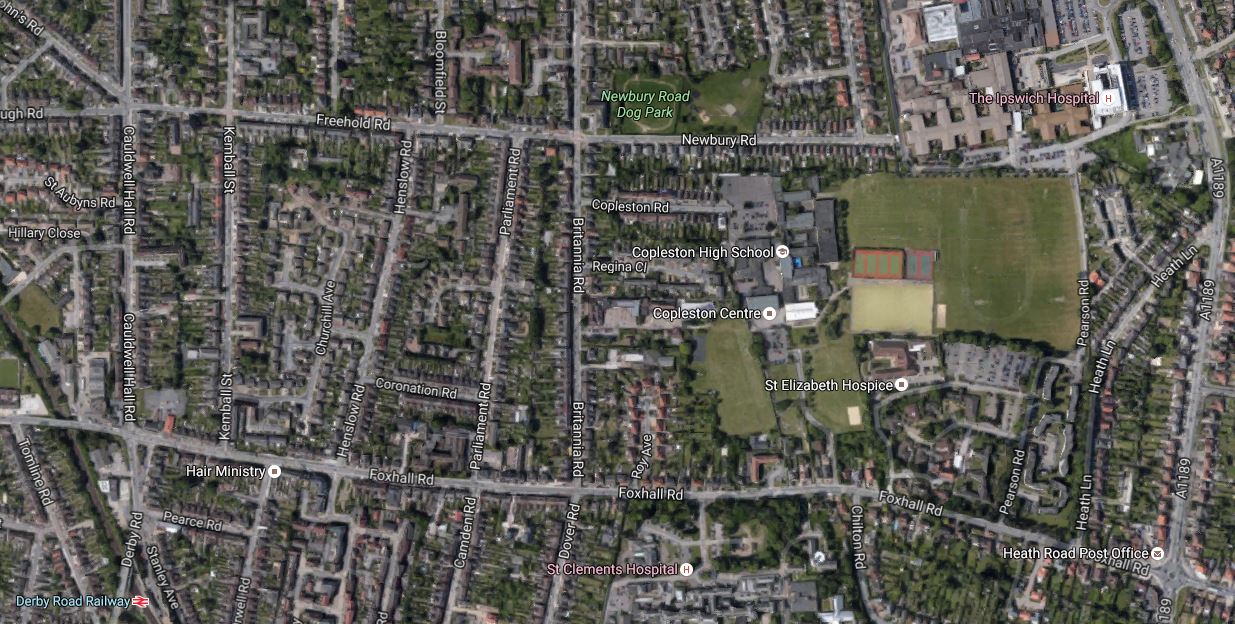
But this Google Map, of the area round the station show that it surrounded by housing.
Around Derby Road Station
The station is at the South West corner of the map, with The Ipswich Hospital is at the North East corner of this map. I ask these questions.
- Is there a shuttle bus between the station and the hospital?
- Is there secure bicycle parking at Derby Road station?
- Could it be that if a decent train with greater capacity and perhaps better provision for bicycles and buggies ran through the station, that there could be an increase in passengers?
From what I’ve seen of the station, it’s suffering from Abellio’s Managed-from-Norwich Syndrome, which a lot of stations in East London did, until placed under the control of Transport for London.
The next station after Derby Road used to be Orwell station, which served the villages of Orwell and Nacton.
At some point in the future, I wouldn’t be surprised to see a station between Derby Road and Trimley, either inside or outside of the A14.
Trimley station is virtually derelict, but there are plans to convert it for community use.
I believe, all the intermediate stations on this line could have a future. Factors involved could be.
- Nearby housing and/or commercial development.
- Cycle-and-Ride passengers.
- A decent train to Ipswich and Felixstowe, with plenty of space for bicycles and buggies.
- A reliable clock-face hourly service.
- Easy connection to Long distance trains at Ipswich station.
- A cafe or coffee kiosk
Passengers, who are going to work, need a service that is totally reliable, and this service has suffered in the past few years.
Dualling The Line
If my virtual helicopter ride, showed one thing, it was that there are wide margins around the current single track from Derby Road to Trimley, which hopefully would make installation of a second track reasonably straghtforward.
However, I did count six level crossings with barriers and what looked like five crossing points without. All will have to be upgraded for the second track or removed.
It is interesting to see, that Network Rail are proposing to close six crossings in their current plan, so is this to get rid of one of the major problems of the dualling early?
Perhaps, they have decided that removing six level crossings and dualling the line at the same time, would raise too many simultaneous problems for their legal department. But doing the level crossings first with a less ambitious dualling is less likely to be challenged.
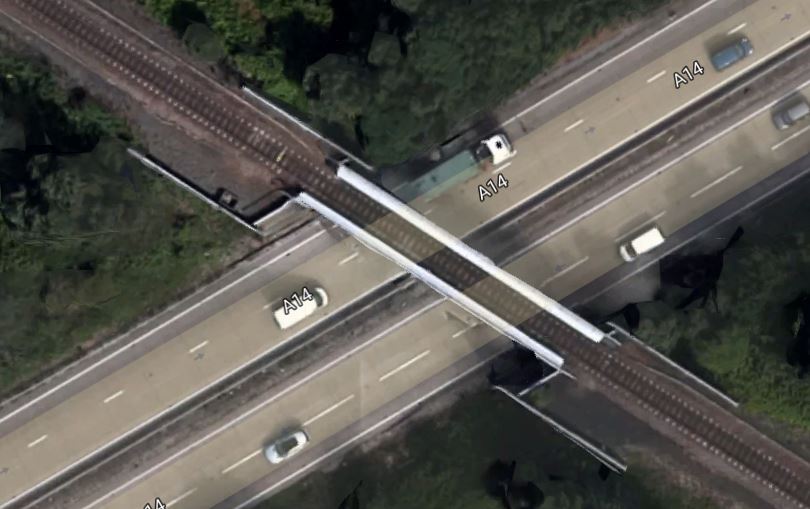
The other big problem could be widening the bridge over the A14 dual-carriageway.
This Google Map shows the bridge.
The Felixstowe Branch Line Crosses The A14
But it looks to me, that everything is there to just slip in a second span.
So that could be at least future-proofed!
Where Is The Proposed Dualling?
According to the article in Modern Railways, the loop at Trimley is 1.4 km. long.
My estimate is that the distance between the two junctions, where the two branches go off to the Port of Felixstowe, is about this distance.
So could it be, that the loop is not for freight trains, but to allow the passenger trains to access Felixstowe station?
- The Northern track would be bi-directional and connect Trimley and Felixstowe stations and would be for exclusive use of passenger trains.
- The Southern track would be bi-directional and connect Trimley station to both the lines to the Port of Felixstowe and would be for exclusive use of trains to and from the Port.
- At night, the track could be configured, so that two bi-directional tracks, that joined just to the West of Trimley station, went to each freight terminal The Northern track would serve the South Terminal and the Southern Track would serve the North Terminal.
The Port of Felixstowe has argued at times, that the Felixstowe Branch Line should be freight-only. Is this Network Rail’s proposal to create two separate freight and passenger lines using the same track?
From my observations at Ipswich that I wrote about in Curious Rail Construction At Ipswich Station, I am convinced that they have simplified track layout around Ipswich Freight Yard, so that freight and passenger trains, don’t conflict with each other at Ipswich.
So does this proposal remove conflicts at Felixstowe?
I think it does.
After the proposed loop is built, the line will be effectively in three sections.
- A core line between Westerfield and Trimley stations with the existing passing loop at Derby Road.
- At the Felixstowe end, there will effectively be separate lines into Felixstowe station, and the North and South Freight Terninals.
- At the Ipswich end, there will be separate lines into Platforms 0 and 1 at Ipswich station, Ipswich Freight Yard and to both directions on the Great Eastern Main Line.
- All of the connecting end lines would work with the simple rule of only allowing one train on the line at any one time.
At Felixstowe, freight trains might even be paired with one going into the North Terminal at the same time as one came out of the South Terminal. And vice-versa!
The train coming out, would wait at a signal before the junction for its branch and then when the other train had cleared the other junction going into the Port, it would be allowed to proceed through Trimley.
At night, trains could also be assembled as flights, so that several trains came in and out of the port in a stream. The reorganised Ipswich Yard must help in this.
As the new passenger trains will be somewhat faster than the current Class 153 trains and will be able to get away from stations quicker, I wonder if the timings will be such that two trains per hour might be possible.
These are current timings between Westerfield and Trimley in the core section.
- Passenger train – 14 minutes
- Freight train – 16 minutes
As trains don’t conflict on the double-track outer sections and have their own separate routes, it should be possible to have one 14 minute passenger and one 16 minute freight cycle in every half-hour, provided the trains pass at Derby Road.
With faster trains, fitting in two passenger trains and two freight trains in both directions in every hour might well be possible.
But you also have to content with other services on the East Suffolk Line and other constraints, so I suspect that by being extremely thorough and downright devious, that the published figure of 47 trains a day is very feasible. And feasible when running two tph between Ipswich and Felixstowe!
Two passenger trains would be needed for the service.
Higher Speed Between Westerfield And Trimley
Once all the improvements at the two ends of the line are complete, the major constraint on capacity on the line is the time a train takes between Westerfield and Trimley.
The line is configured for 75 mph, but I wonder what sort of speed could be reached could be attained safely on the line between Westerfield and Trimley, with the following.
- Removal of level crossings
- Improved signalling.
- Some minor track improvements.
It should be born in mind that there are no junctions from where the Felixstowe Branch leaves the East Suffolk Line at Westerfield and Trimley.
The speed limit would then probably be set by the maximum speed over the Spring Road Viaduct.
The distance between Westerfield and Trimley is almost exactly 10.5 miles.
This means that the freight train averages about 40 mph and the passenger train a miserly 45 mph.
So what sort of speeds can the various trains achieve.
- Class 153 – 75 mph
- Class 170 – 100 mph
- Class 66 – 65/75 mph
- Class 67 – 125 mph
- Class 68 – 100 mph
- Class 70 – 75 mph
- Class 88 – 100 mph
It could be that the slow speed of the Class 66 locomotives are one of the constraints on the line, as timings must assume that locomotives could be the 65 mph variant.
If it were possible to raise the line speed to 90 mph, it could reduce timings on the line between Westerfield and Trimley.
These figures certainly show, why Network Rail are so keen to remove the level crossings on the line.
I suspect that suitable trains and locomotives could reduce times as follows if the line had a 90 mph limit.
- Freight – 13 from 16 minutes.
- Passenger – 12 from 14 minutes.
It might only save a couple of minutes with my crude estimate, but it certainly shows there are savings to be made by upgrading the line and using modern trains and locomotives.
Class 66 Locomotives
I don’t like Class 66 Locomotives and have believed for some time, that they have little place on the electrified lines in built-up areas. I wrote The Noisy Class 66 Locomotive on the subject a couple of years ago.
My crude analysis in the previous section shows that their slow speed actually cuts capacity.
Freightliner are one of the big operators of |Class 66 locomotives to and from the Port of Felixstowe. Wikipedia has a section on Class 66 Locomotives operated by Freightliner.
This is said.
Freightliner followed EWS by initially ordering five new Class 66/5 locomotives, and have continued to order in small batches. As of summer 2010, the 66/5 fleet had reached 98 examples; 66521 was withdrawn after the 2001 crash at Great Heck and later scrapped.
In 2000 a new Class 66/6 sub-class was built, with a lower gear ratio, enabling heavier trains to be hauled, albeit at slower speed. There are presently 25 examples of this class, numbered 66601-625. Some of these locomotives have since been exported for use with Freightliner Poland.
As freight trains are getting longer, it would appear that the slow 66/6 locomotives should be removed from this route as their 65 mph maximum speed is a constraint on maximising traffic between Westerfield and Trimley.
Electrification
Electrification is often talked about with respect to the Felixstowe Branch.
Reasons in favour include.
- Freight trains going to and from London could be electric hauled.
- Engine changes at Ipswich Yard would be minimised.
- Electric haulage is more environmentally friendly.
But there are powerful reasons not in favour.
- Cranes in a Port and 25kV overhead wires are bad bedfellows.
- If the Class 88 Locomotive and other electro-diesel types are a success, they are probably more affordable than electrification.
- Passenger services in the near future will be run by trains with an on-board power source; diesel, bi-mode or battery.
- The main route to the Midlands via Peterborough and Nuneaton is not electrified.
But above all we seem so bad at electrification, the risk in wiring the line is too great.
I don’t think it is likely that the Felixstowe Branch will be electrified until the whole route to the Midlands is wired.
Wattway
I was pointed to this French innovation by the Sunday Times.
Effectively, Wattway, is a system of solar panels that you can put in a road and drive on.
Click here for the Wattway web site.
I have a feeling that it will lead to all sorts of applications, especially where power is needed at a remote location.
I suspect too, that it doesn’t need planning permission as such, whereas even a small wind-turbine might!
The Definitive Branch Line For An Electric Train With On Board Energy Storage
In Curious Rail Construction At Ipswich Station, I described how the current five-car Platform 1 has been electrified and given an electrified route of a few hundred metres to the Felixstowe Branch Line.
I then outlined how an ow an electric train with on-board energy storage, could work the Ipswich-Felixstowe service.
- I’ll assume that a fully-charged train starts from the new depot at Manningtree or some other suitable overnight stabling.
- The train positions early in the morning for the first service from Felixstowe, using overhead power to Ipswich and on-board power on the branch.
- Passengers load at Felixstowe and the train proceeds to Ipswich under on-board power to the current Platform 1 at Ipswich.
- The train would sneak into the platform on the North side of Ipswich Freight Yard, well out of the way of the Great Eastern Main Line and any freight movements.
- If the platform was busy and the train had to wait at a signal, it could even up pantograph to start the recharging of the on-board energy storage.
- Once in Platform 1, the train would either start or continue the charging process.
- The pantograph would be lowered, when the charging was complete or at any time before the train left for Felixstowe.
The process would continue all day.
But things don’t always go to plan, so what happens at Ipswich, if Platform 1 is blocked by a failed train?
As the train will be approaching Ipswich on a dedicated line, it would stop at a signal and wait. As the overhead wire to the station will be continuous, it would immediately up pantograph to start the charging process, to make certain, it wasn’t stuck with a flat battery.
There has been a lot of thought, in how trains with on board storage should be operated.
Similar layouts seem to be being installed at other places.
Maidenhead and the Marlow Branch Line
Maidenhead station is where the Marlow Branch Line connects to the Great Western Main Line.
Platform assignments after Crossrail will probably be.
- Down Fast
- Up Fast
- Down Slow – Crossrail
- Up Show – Crossrail
- Marlow Branch
Note that Platform 5 has recently been extended to the full Crossrail length of 200 metres, so could this platform be shared between the Marlow Branch trains and the Class 387 trains that will start to shuttle between Maidenhead and Paddington in mid-2017.
These are pictures taken at Maidenhead station.
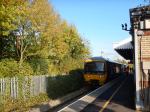
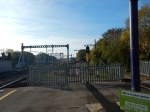
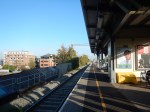
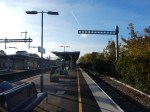
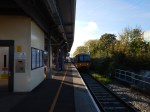
Note the platform 5 for the Marlow Branch and the first couple of hundred metres of the branch are being electrified.
Trains with on-board energy storage between Maidenhead and Bourne End stations could certainly use the same procedure as the one I outlined for trains between Ipswich and Felixstowe. They would probably come into Platform 5 at Maidenhead, as the Marlow Branch trains currently do.
But they also have the advantage at Maidenhead of a very long two hundred metre Platform 5.
Note that four-car Class 387 trains couldn’t go past Bourne End station, so the remainder of the branch to Marlow would probably be served by a diesel shuttle.
On November 25th, 2016, I took this picture from a passing train.
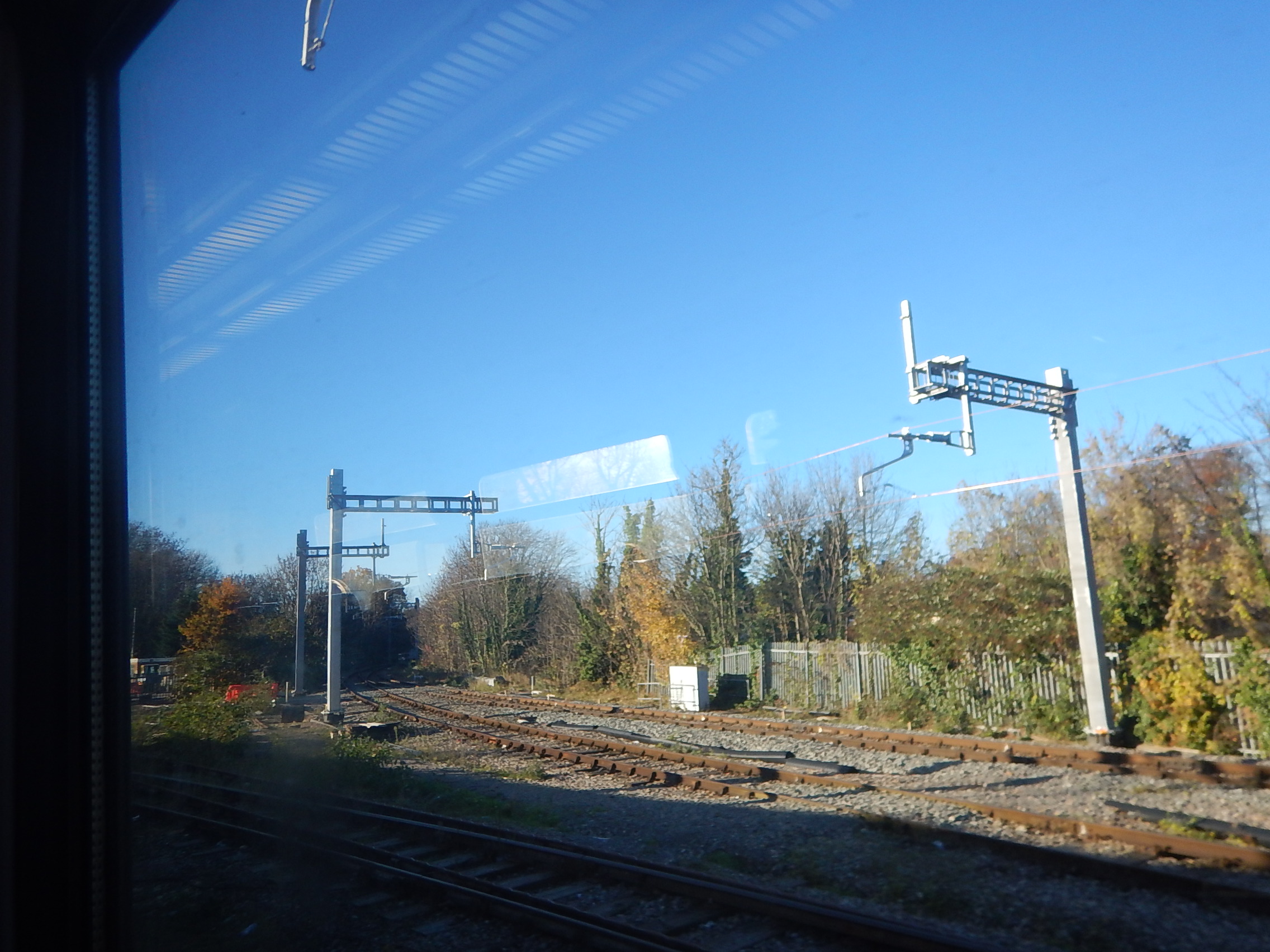
Note.
- I was looking directly down the Marlow Branch.
- The two lines join around the position of the last gantry and the nearest one goes into Platform 4, with the farthest one going into Platform 5.
- You can’t really see it too well in the picture, but the overhead wire appears to be only above the line into Platform 5.
This Google Map shows a close-up of the Western \end of Platforms 4 and 5 and the start of the Marlow Branch.
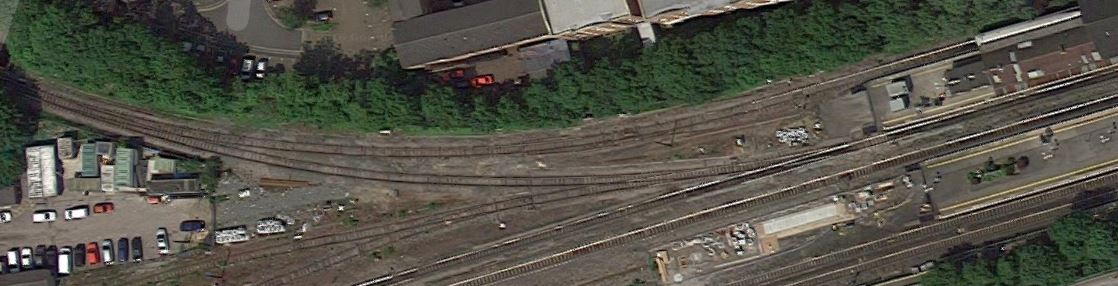
Hopefully, it will be clearer than mud now!
Note the two-car train in Platform 5.
So why is there no connecting electrification between Platform 4 and the Marlow Branch Line?
It could be that it hasn’t been erected yet, but on the other hand, it could be that it isn’t needed.
- All trains arriving at Maidenhead from Bourne End would use Platform 5.
- These trains would only use the wiring to the West of Platform 5, if say the platform was blocked, by say a failed train.
- Trains between Bourne End and Paddington, after arriving at Platform 5 would up pantograph and after leaving the platform, they would use an existing crossover to access the Up Slow line for Paddington.
- Trains between Paddington and Bourne End would probably use the existing crossovers to stop in Platform 5 after arriving on the Up Slow. Once in Platform 5, they would down pantograph and continue to Bourne End under on-board power.
So a second electrified line not being needed, could be the explanation of only one being created.
Note that when Crossrail starts, Crossrail trains will use Platforms 3 and 4 and will reverse using a reversing siding to the West of the station..
So the Marlow Branch and Crossrail will effectively be two separate systems with their own tracks, trains and arrangements.
Slough And The Slough to Windsor & Eton Line
Slough station is where the Slough to Windsor & Eton Line connects to the Great Western Main Line.
As I passed through Slough station, I noticed that the gantries are such, that just as at Maidenhead, the bay Platform 1 could have a short length of overhead wiring installed, so that the shuttle to Windsor and Eton Central station could be run using an electric train with on-board energy storage.
This small add-on to the electrification, would create a branch line independent of the main line.
- It would be worked as a single train shuttle.
- The train would be electric with on-board energy storage.
- The train would charge at Slough station.
- It would have dedicated platforms in the two terminal stations; Slough and Windsor and Eton Central.
- The train could be worked using the principle of only one train on the line at a time or One Train Working.
- Trains would enter and leave the dedicated branch tracks for servicing and other tasks, as they do now, through a connection to the Fast lines at Slough station.
Unlike the Marlow Branch, it would not need protection for failed trains, as there is only one train.
I would suspect that capacity at the Windsor end of the branch would limit any expansion unless a scheme like the Windsor Link Railway was brought forward and that a four-car electric shuttle train would be sufficient to work the line for many years.
Twyford And The Henley Branch Line
Twyford station is where the Henley Branch Line connects to the Great Western Main Line.
I wrote about using trains with on-board energy storage on the Henley Branch in Twyford Station And The Henley Branch and came to the conclusion, that electric trains of this type could serve this short branch of just four miles in length, with very little change to the infrastructure
Installing a short length of electrification in the bay platform 5 at Twyford station and for a short distance on the branch could be used to charge the trains.
As on the Marlow Branch and the Slough to Windsor and Eton Line, this would create a branch line independent of the main line.
I doubt that this line will ever be fully-electrified.
Certainly, as I passed the line today, there was no sign of any electrification.
West Ealing And Greenford Branch Line
West Ealing station is where the Greenford Branch Line connects to the Great Western Main Line.
But seeing as the last direct train from Greenford to Paddington seems to be on the 23rd of December 2016, the Greenford Branch Line will become an independent branch line with its own bay Platform 5 at West Ealing station, where passengers will have to change to and from Paddington.
In West Ealing Station – 12th October 2016, I showed the progress a couple of months ago and as at Slough gantries are in place, that could be used to electrify the new bay platform.
Once the wires were in place at the platform, all it would need to provide a quality service to Greenford, would be suitable electric train with on-board energy storage.
- The journey would take around ten minutes.
- Trains would charge their storage at West Ealing.
- Two trains per hour would be possible with one train.
- Four trains per hour would be possible with two trains, as the branch has a lot of double-track to allow passing.
The only infrastructure needed, other than the electrification might be some platform lengthening for the new trains.
As I passed the line today, there was some evidence of wires going up, but they probably can’t be completed until the new station is finished at West Ealing station.
Surely, if the branch was going to be run in perpetuity by diesel trains, there would be no evidence of electrification in the bay platform 5 and at the start of the Greenford Branch.
The Emerging Design
If you look at all these examples, most of which are ongoing projects, they have a series of common features.
- The branch line is fairly simple, often just a shuttle between two dedicated terminal platforms.
- The branch line is within the range of an electric train with on-board energy storage, to go out and return.
- Some branches are worked using the principle of only one train on the line at a time or One Train Working.
- At least one terminal platform will be electrified, so that the on board energy storage can be charged.
- The branch line is within the range of an electric train with on-board energy storage.
The only feature not common to all the detailed examples, is where the electrified platform could be shared as at Ipswich and Maidenhead,
In these cases, provision must be made for another train failing in the station.
If Network Rail can get this philosophy right, it has the following advantages.
- New or refurbished environmentally-friendly electric trains can replace elderly diesel trains on suitable routes.
- As the electric trains will typically be four-cars or more, there will be large capacity increases.
- There will be very little infrastructure work, except for platform lengthening and possibly electrifying an extra platform in a station on an already electrified line.
- Network Rail will gain a bit of credibility.
As an example, Ipswich Felixstowe could go from an hourly single -car Class 153 train to an hourly five-car modern Aventra with Wi-fi and lots of space.
 The Anonymous Widower