A Crossrail For Aberdeen
Cross-city lines are all the vogue.
- London has Thameslink, several Underground and Overground Lines and will shortly have Crossrail.
- Edinburgh has Crossrail.
- Liverpool has the Northern Line.
- Paris has the RER.
- Leipzig has a cross-city tunnel.
- Birmingham has the Cross-city Line.
So why shouldn’t Aberdeen propose Aberdeen Crossrail?
Aberdeen Crossrail
This Google Map shows Aberdeen.
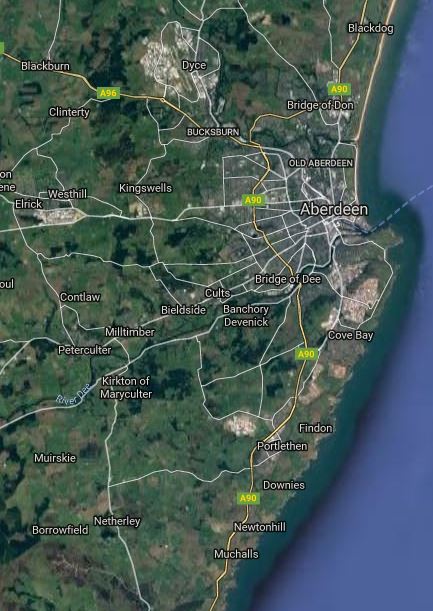
Note.
- The white blob on the map above the City, which is Dyce Airport.
- The Aberdeen to Inverness Line links Dyce Airport to Aberdeen station in the City.
- The Edinburgh to Aberdeen Line and the Glasgow to Aberdeen Line share a common route South from the City as far as Dundee.
- The shared line South runs along the coast, through a succession of towns, some of which have stations.
The Aberdeen Crossrail plan is to link the Aberdeen to Inverness Line to the shared line to the South and create a frequent service along the route.
That is a standard philosophy for a cross-city line.
This diagram from Wikipedia, shows the proposed line and the stations.
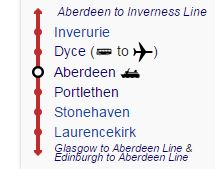
It is a simple plan and a simple route with one big difference to most of the other proposed or built Cross-city lines – There is no expensive central tunnel. It is almost solely a marketing concept, based around existing services.
Implementation
Wikipedia says this about Implementation.
Transport Scotland announced in March 2016 that the scheme will go ahead as part of a wider timetable recast in 2018. The new service will run between Inverurie & Montrose, serving all existing intermediate stations and one at Kintore from 2019. The Aberdeen to Inverurie section will then have a 30-minute interval service in operation. Infrastructure enhancements on the Aberdeen to Inverness line (including the redoubling of track from Aberdeen to Inverurie) are also scheduled to be completed by this time, as part of a £170 million route upgrade project.
All it needs is to add lots of stations.
It is a project manager’s dream to build, as once trains are running and the pattern of passenger use develops, the authorities can add trains and stations, as needs and the budget dictate.
Similarity To The London Overground
The nearest cross-city lines in concept to Aberdeen Crossrail are probably the North London and East London Lines of the London Overground, where two cross-city lines were created from some very tired track, stations and trains, by refurbishing the first two and replacing the trains.
Like the London Overground, Aberdeen Crossrail is updating the route. Aberdeen’s current trains are probably better now than the travelling urinals, that the Overground inherited from Silverlink.
One thing that I think Aberdeen Crossrail will need is a Turn-Up-And-Go frequency of four trains per hour (tph), that has been used so successfully on the Overground and Merseyrail.
Frequency Issues
The route of Inverrurie to Montrose has been deliberately chosen.
- Inverurie to Aberdeen takes around 23 minutes.
- Montrose to Aberdeen takes around 35 minutes.
So with slightly faster trains and line speed, than currently used, it should be possible for a train to go from Inverurie to Montrose and back in two hours to include a few minutes to turn the train round.
A two hour round trip means that a train leaving Inverurie at say 06:00 in the morning, will if all goes well, be back in Inverurie to form the 08:00 train.
How convenient is that?
This means that one tph will need two trains, two trph will need four trains and four tph will need eight trains.
Possible Stations
In A Look At New Station Projects, I’ve found several.
- Kintore is a planned new station.
- Aberdeen Airport is a possible new station.
- Aberdeen Exhibition And Conference Centre is a possible new station.
- Cove is a possible new station
- Kittybrewster is a possible new station in Aberdeen.
- Girdle Ness is a possible new station in Aberdeen.
- Newtonhill is a possible new station South of Portlethen.
I am sure there are others.
Girdle Ness
Girdle Ness could be a station in a spectacular location on the coast.
This Google Map shows Aberdeen.
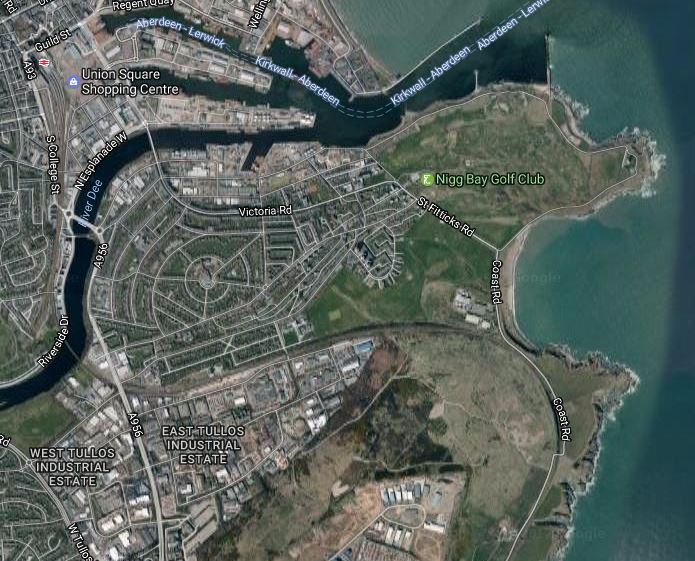
Aberdeen station in the top left corner and Girdle Ness is the lower of the two promontories on the right.
What looks like a wall curving behind the promontory is in fact the railway crossing across the city and the turning South to Montrose, Dundee and Edinburgh.
If an average architect couldn’t make good use of this location, then they’re not even average.
Conclusion
This proposal is very likely to be a success, but I feel that it needs to offer a frequency of four trph.
The Rebuilt Tunnel Under Bank Station
I never took the connection tunnel between the Waterloo and City Line or Drain platforms at Bank station to the escalators that eventually get you out into the air by Lombard Street, where I used to visit clients at a major clearing bank.
I doubt, it was as good as it is now!





I was travelling home from Waterloo using the Drain and once back on the surface, I just crossed King William Street and got a 141 bus home.
It might be upwards of a hundred metres underground, but it’s light, airey and traffic-free.
We need more pedestrian tunnels like this under London.
Obviously, it wasn’t Rush Hour!
Will Trains Enable Chinese And Other Tourists To Invade Loch Ness?
In my list of possible stations from my friend Nick, there is the innocent station called Ness.
This could be any one of the following.
As the others, are probably not destinations that would generate a lot of traffic to pay for the station, I suspect that Ness refers to Loch Ness.
There used to be a Fort Augustus Pier station, at the Southern end of Loch Ness. I assume from the giveaway word in the station name, that this was the transit point for Victorian hunters going to shoot Nessy
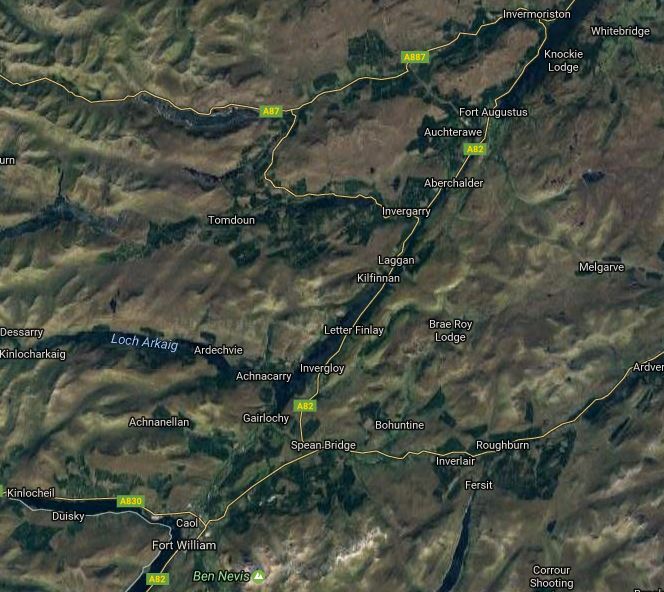
The station was the Northern terminus of the Invergarry and Fort Augustus Railway. At its Southern end the railway connected to the West Highland Line at Spean Bridge station.
This Google Map shows the area.
Fort Augustus To Spean Bridge
Loch Ness intrudes from the North and Spean Bridge station is close to Ben Nevis at the bottom.
This diagram shows the various stations on the Invergarry and Fort Augustus Railway.
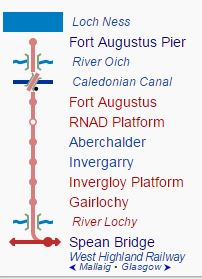
Surprisingly, the railway has not been completely dismantled and Wikipedia says this.
Some of the line today has been built over by roads and holiday parks, although it mostly survives in a reasonably good, if overgrown, condition. The many bridges and single tunnel are in particularly good condition. Some of the line along Loch Oich has been incorporated into the Great Glen Way, and a further section is proposed to become part of National Cycle Route 78.
A restoration project is (2016) under way at Invergarry Station, the last remaining station that is largely intact. The Invergarry Station Preservation Society plan to create a static museum, with a short length of track and several freight wagons.
It would be an interesting way to get to Inverness, if you could get a boat from Fort Augustus.
The South Wales Mountain Railway
South Wales might not have the reputation of beautiful mountains, of say Snowdonian, the Cairngorms or Switzerland, but some of the Valley Lines that go up to places like Merthyr Tydfil and Ebbw Vale Town stations have spectacular views.
I was looking for a possible station at a village called Nelson and found a single-track railway passing to the North of the village.
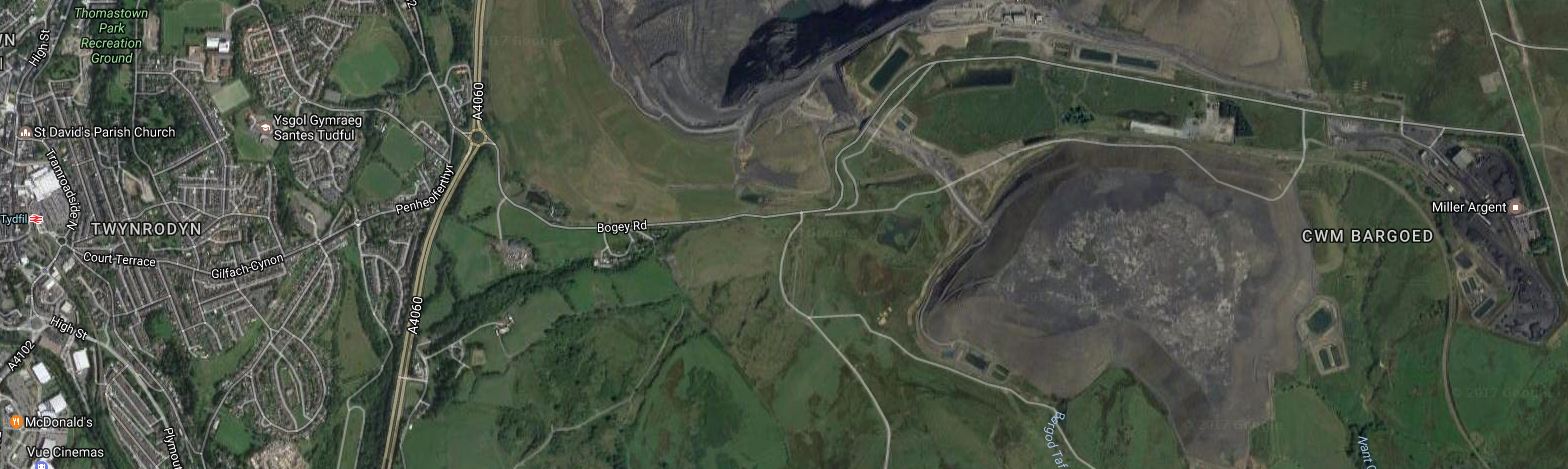
I followed the track with my helicopter up the mountain and this is a Google Map of what I found.
Merthyr Tydfil And The Ffos-y-fran Land Reclamation Scheme
The station on the left is Merthyr Tydfil and on the right is the massive Ffos-y-fran Land Reclamation Scheme. This is opening paragraph in the Wikipedia entry.
The Ffos-y-fran Land Reclamation Scheme is a major opencast coaling operation to the north-east of Merthyr Tydfil in South Wales. Miller Argent is owned by Gwent Investments Limited, which is based in South Wales and is a privately owned family business. The scheme development is the last part of the East Merthyr Reclamation scheme, and will extract 10 million tonnes of coal over 15 years, the revenues from which will redevelop the current former industrial workings into residential and recreational use.
It is a controversial scheme and I am usually against using coal for combustion purposes, but some of these Welsh landscapes are dotted with dangerous mine workings and slag heaps, so they certainly need cleaning up.
There is a Transport section in the Wikipedia entry for the scheme. This is said.
Under agreed planning rules, the site is not allowed to transport coal from the site via road. All extract is therefore moved to the rear (East) of the site where the coal is separated and washed at the Cwmbargoed Washery. Built in 1959 on land to the north and east of the railway connection to Fochriw Colliery, the coal washery was refurbished by Celtic Energy in 1992. DB Schenker trains then move the washed coal from site to Aberthaw Power Station, along the former route of the Rhymney Railway. Joining the modern Rhymney Line just south of Ystrad Mynach railway station, the trains then travel onwards via Cardiff and the Vale of Glamorgan Line to Aberthaw, enabling Ffos-y-fran to supply 40% of the coal to Aberthaw power station.
It must be challenging driving a Class 66 locomotive with a train of full coal wagons down the mountain.
It was this railway I had followed up the mountain.
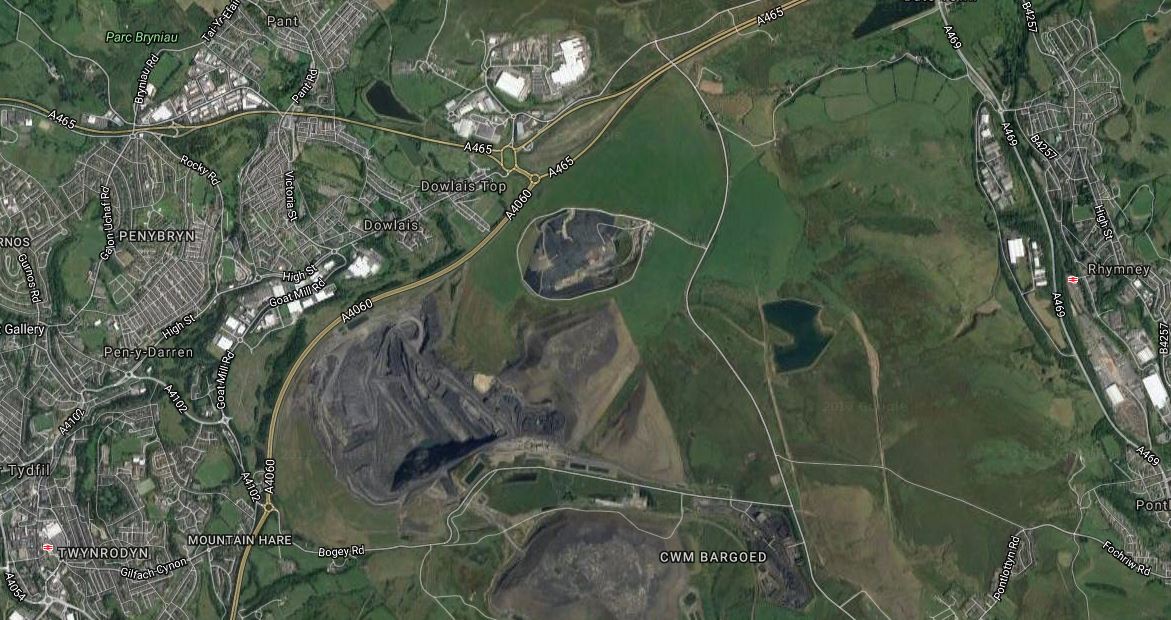
Before I leave Merthyr Tydfil, look at this Google Map of the town.
Merthyr Tydfil And Rhymney
The East Merthyr Reclamation Scheme is in the middle, flanked by Merthyr Tydfil in the West and Rhymney in the East.
So if the Authorities in South Wales are thinking of building a station on this line at Nelson, are they thinking of reopening this line after the scheme has finished extracting coal, as a second rail route to Merthyr Tydfil?
Coming back down the mountain from Merthyr, the first possible station from my list of possible stations is Bedlinog.
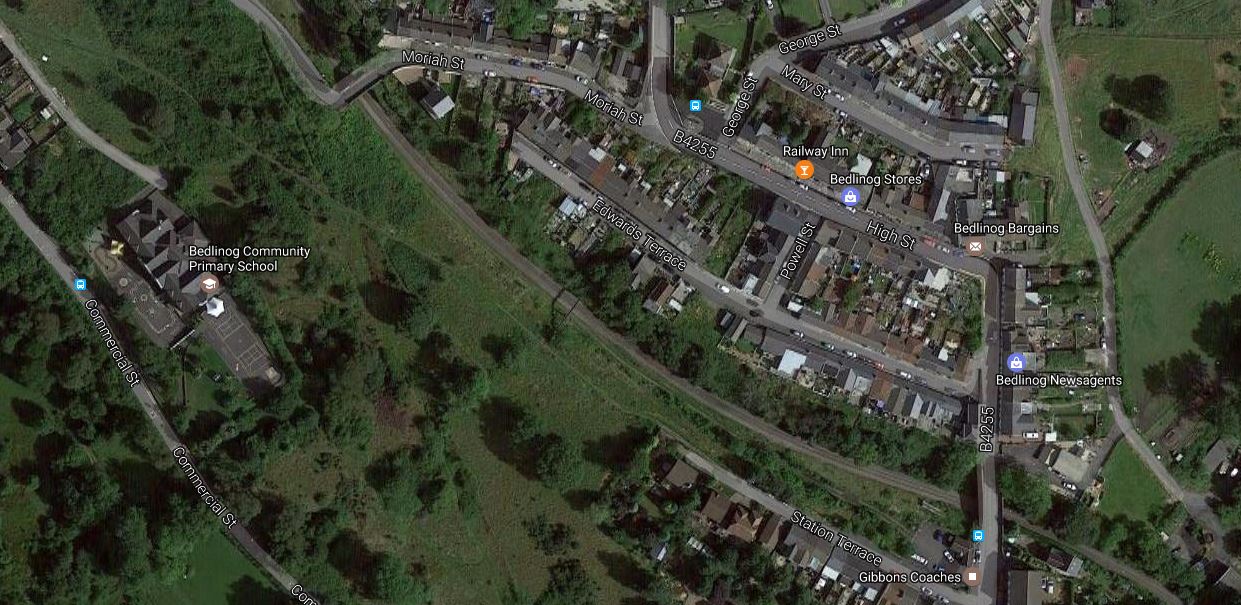
This Google Map shows the rail line going through the village.
Bedlinog And The Railway
Note that Bedlinog already has a Railway Inn.
After Bedlinog, the next one on the list is Trelewis. This is the Google Map
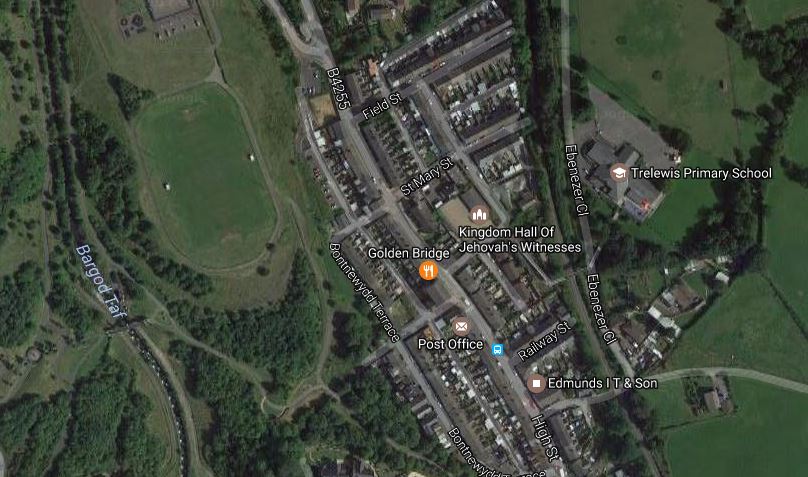
Trelewis And The Railway
The railway goes between the Primary School and the Kigdom Hall.
And then it’s back to where I started this quest at Nelson, of which this is the Google Map.
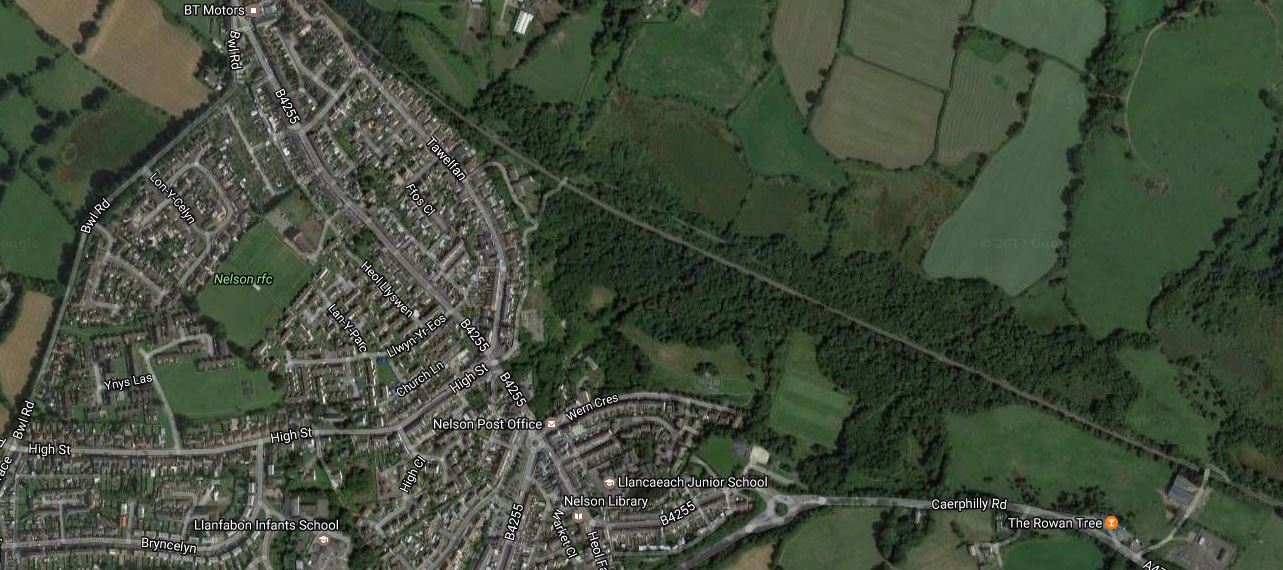
Nelson And The Railway
The railway then goes South-East to join the Rymney Line at Ystrad Mynach station.
Trains For The Route
The task of hauling empty wagons up the mountain is not to much for a Class 66 locomotive, so I suspect that a multiple unit could be designed to handle a route like this, of which there are several in the Cardiff Valley Lines.
Either electric or diesel multiple units could probably manage the climbs, if they were designed for it, but would electreifying these routes be a feasible undertaking, given the difficulties of working on these busy lines.
But train technology is moving on and with the Class 319 Flex, we are getting close to having a true tri-mode train, with diesel, electric and battery power.
The Welsh Government have said they want new trains for these routes and I suspect engineers are working on a product tailored to run these routes efficiently.
So could we see a quad-mode train for the Valleys?
- Four-car electrical multiple unit.
- Onboard energy storage.
- Perhaps even a small diesel generator for the difficult bits.
- Gravity power, which the lines have in abundance, to use with regenerative braking to charge the batteries on the descent.
- As modern trains can deploy pantographs automatically, some selective electrification could be added as the project develops.
I would also commit the ultimate heresy and use third-rail electrification on the steep parts at the heads of the valleys.
Consider.
- Bombardier, Siemens and others make reliable dual-voltage trains.
- Both electrification systems have their good and bad points.
- It must be less intrusive and disruptive to install third-rail electrification.
- Is overhead electrification more prone to weather damage?
- Network Rail seem to be terribly accident-prone when it comes to overhead electrification.
In the end costs and overall reliability will decide.
But I do think sometimes, that Network Rail always chooses overhead electrification, even if third rail will be more reliable, less intrusive and more affordable.
But I’m sure that all the technology has now been proven to create a very efficient modern electric train to work the Valley Lines, which have been electrified using a great deal of innovation and common sense.
 The Anonymous Widower