Andy Burnham Set For Clash With MPs Over North Sea Oil And Gas
The title of this post, is the same as that of this article in The Times.
This is the sub-heading.
The prime minister must decide whether to approve the Rosebank oilfield and Jackdaw gasfield but will face opposition from backbenchers if he goes ahead
These are the first three paragraphs.
Andy Burnham faces a potential showdown with Labour MPs after suggesting faster extraction of North Sea oil and gas could help pay for the transition to clean energy.
The prime minister is preparing to decide whether to approve the Rosebank oilfield and Jackdaw gasfield after consultations on both projects closed.
Industry sources have told The Times they believe Burnham will approve Jackdaw but may resist calls to go ahead with Rosebank because of opposition from MPs.
These are my thoughts.
My Boiler, Gas And Jackdaw
Consider.
- This year my boiler died. So I spent several thousand pounds, but I did get a new gas boiler with a 12-year guarantee.
- I am now 79, so can this government, or any for that matter, give me a guarantee, that I will live to 91 to get value from my boiler?
- I know enough about heating, as I have installed a couple of systems for myself, to know that my current house is not suitable for a heat pump.
- But it may be suitable for some type of electric data centre boiler like heata, which was invented by British Gas Research. But, I’m not hopeful yet!
- Meanwhile, Centrica have done a large hand-full of deals to keep the country in enough gas to power us through the winter.
- Some of these are MiQ-certified, which is a bit like Organic for methane, except that emissions are kept to a minimum.
- I covered MiQ-certification in What Is MiQ-Certification?.
So provided we don’t get an extreme-left scientifically-incorrect government, led by someone like the lady with pink hair in Hackney, I should be able to keep myself warm in winter.
But would I vote for any party, that was going to cut off my gas supply?
But Centrica have been clever.
- They have plenty of gas storage at Rough.
- Their press releases show they are buying gas according to MiQ.
- Grain LNG Terminal, which they bought last year has an export facility, so any spare gas they have can be exported to a country to replace coal or Russian gas.
- MiQ-certified gas probably fetches a higher price.
- Centrica would be an obvious purchaser for any North Sea gas.
This gives some dates of the players and Jackdaw
- BG Group and Centrica were demerged from British Gas plc in 1997.
- BG Group discovered Jackdaw in 2005.
- BG Group were taken over by Shell in 2015.
If I was the owner of Jackdaw, I would make sure that my gas had the highest MiQ possible.
If I was energy minister, I’d enforce it.
Will Jackdaw Be A Tie-Back To Shearwater?
I’ve read that it might be, so I asked Google AI and received this answer.
Yes, Jackdaw is designed and developed as a 30-kilometer (approx. 18.5 miles) subsea tie-back to the existing Shearwater platform in the central North Sea.
Project Connection Details
Infrastructure: A multi-phase subsea pipeline links the unstaffed Jackdaw wellhead platform directly to the Shearwater hub.
Processing: Hydrocarbons extracted from Jackdaw will be processed and routed through Shearwater before final export onshore to the St Fergus terminal.
Distance: The subsea pipeline spans roughly 30 kilometers (18.5 miles) northwest from the Jackdaw field to the Shearwater installation.
I also found this detailed article on the Chemical Engineer which is entitled Shell To Invest In Shearwater Gas Infrastructure Hub.
Shell certainly seem to be doing comprehensive planning to bring the gas from Jackdaw to the mainland.
- Currently, gas from the Shearwater hub is sent to Bacton in Norfolk.
- After, Jackdaw is connected to Shearwater, the gas will be sent to St. Fergus, which is North of Aberdeen.
- Google AI says that The Shearwater hub is located approximately 140 miles (225 kilometers) east of Aberdeen in the Central North Sea.
It’s probably all in a day’s work for engineers in the North Sea, but it doesn’t sound to be the easiest project to me.
Will The Jackdaw Gas Field Be Used For CO2 Storage?
I felt this could be a possibility, so I asked Google AI, the question and received this answer.
No, the Jackdaw gas field will not be used for CO2 storage.It is an active natural gas extraction project in the North Sea, though CO2 separated from its extracted gas may eventually be routed to external storage.
Field Status and CO2 Handling
Extraction only: The underground reservoirs at Jackdaw contain natural gas and high-pressure/high-temperature hydrocarbons rather than being purposed for carbon storage.
Onshore processing: Gas from the field comes ashore at St Fergus, where carbon dioxide mixed into the raw gas stream is removed during processing.
Broader CCS links: While Jackdaw itself is a producing asset, its operations tie into Shell’s broader involvement with the regional Acorn Carbon Capture and Storage project, which aims to pipe and sequester CO2 elsewhere.
That was a definite no, that Jackdaw will not be used for Carbon Capture and Storage, but the carbon dioxide in the gas may be stored in the Acorn Carbon Capture and Storage project.
Will Centrica Be Applying Just-in-Time-Delivery To Gas Cargoes?
One of the jobs, I was involved in was scheduling container ships for OCL, in the 1970s.
- I’m fairly certain, that ships were speeded up and slowed down, so that ports weren’t overloaded.
- It was all done with my PERT7 project management software, which ran on Time Sharing at Great Portland Street.
I can envisage a clever programmer at Centrica writing a large simulation of all their natural gas deals and calling off gas cargoes, when required.
- Gas tankers would be constantly sailing between the gas fields in the Americas and LNG Terminals like Grain, where the cargo was needed.
- It would be nice to have a local supply of natural gas to fill in the gaps between cargoes, but delaying and speeding up of deliveries would have the same effect.
- I also suspect cargoes could be diverted to Germany, Poland or the highest bidder, when there is a glut of gas.
It could be a classic example of advanced control engineering, but very similar to what OCL were doing fifty years ago.
By applying just-in-time-delivery to gas cargoes, Centrica would reduce the need for storage in the UK.
At least gas doesn’t have a sell-by date!
How Much Liquid Natural Gas Storage Is There At The Grain LNG Terminal?
Google AI gave me this answer to the question in the title of this section.
The Grain LNG terminal on the Isle of Grain in Kent has a total liquid natural gas (LNG) storage capacity of 1.2 million cubic metres (1,200,000 m³) following recent site expansions.
Terminal Storage Overview
Total Capacity: 1.2 million m³ of cryogenic tank space (increased from the original 1.0 million m³ capacity).
Tank Configuration: Consists of massive full-containment cryogenic storage tanks (such as the 190,000 m³ tanks added in phases).
System Throughput: The facility can process up to 15 million tonnes per annum (mtpa), meeting a significant share of the UK’s total gas demand.
It should be remembered that storing gas as liquid reduces the space needed.
What Is The Capacity Of A Typical LNG Carrier?
Google AI gave me this answer to the question in the title of this section.
A typical modern liquefied natural gas (LNG) carrier has a cargo capacity of approximately 174,000 cubic meters (m³).
This size has become the conventional standard for new builds, balancing port compatibility with transport scale, though global fleet capacities range widely from small-scale vessels to massive ultra-large ships.
Vessel Size Categories
Small-scale carriers: Hold roughly 1,000 m³ to 40,000 m³, used for regional distribution and bunkering.
Medium-scale carriers: Range from 40,000 m³ to 80,000 m³.
Conventional large carriers: Standard modern designs cluster around 140,000 m³ to 180,000 m³, with 174,000 m³ dominating recent ship orders.
Maxi-size carriers (Q-Flex and Q-Max): Specialized ultra-large vessels reach capacities between 210,000 m³ and 266,000 m³, primarily built to service long-distance routes out of Qatar.
Grain LNG Terminal can hold about four cargoes from the largest LNG Carriers.
My extensive experience of writing scheduling algorithms, which go back to one I wrote at ICI Mond in 1968, feels that by scheduling the arrival of the ships, there may well be enough storage at Grain LNG Terminal to keep the UK in gas.
I wonder, if for some time, Centrica have known, that they don’t need Rough for natural gas storage, which is why they have ambitions to turn it into hydrogen storage.
Encomara’s Floating Wind Installation Technology Gets ABS Design Approval
The title of this post, is the same as that of this article on offshoreWIND.biz.
This is the sub-heading.
Encomara’s floating wind installation technology, Squid, has received Product Design Assessment (PDA) certification from the American Bureau of Shipping (ABS)
These three paragraphs add more details.
The PDA follows an Approval in Principle (AiP) granted by ABS in November 2025 and moves the system a step closer to commercial deployment, according to Encomara, as it advances the technology along its qualification pathway towards Technology Readiness Level assessment and market adoption.
The technology is developed by Encomara and manufactured by Aurora Energy Services (AES), which acquired the Aberdeen-based company in 2025.
Squid integrates pre-installed mooring lines and electrical connections into a single subsea unit, enabling floating wind turbines to be connected using a “plug-and-play” approach.
In some ways the project reminds me of a floating oil and gas production platform, on which I did the calculations.
But the Balaena Structures design never sold a platform and the company, which was based in Cambridge, folded.
Encomara have a web site, which is well worth a visit.
Does Floating Wind Power Have A Higher Capacity Factor Than Fixed Foundation Wind Power?
I asked Google AI the question in the above sub-title and received this answer.
Yes. Floating wind power typically achieves higher capacity factors than fixed-foundation wind power.
The main reasons for this performance edge include:
Stronger, More Consistent Winds: Floating platforms allow turbines to be placed much further offshore, where wind speeds are higher, steadier, and less turbulent.
Access to Deeper Waters: Over 80% of deep-water offshore wind resources exist in waters too deep for fixed-bottom structures.
Performance Comparisons: Fixed offshore wind turbines typically see capacity factors ranging between 45% and 60% (depending on the location), whereas floating installations can push past 60%. For instance, the Hywind floating wind farm in Scotland achieved a capacity factor exceeding 65% in its first months of operation.
Despite this higher generation yield, floating wind technology is generally more complex and features higher installation and capital costs than fixed-bottom turbines.
I also believe that some of the floating wind technology, lends itself to advanced production and installation methods.
Is The UK Developing Sea-Drones To Protect Wind Farms?
I asked Google AI the question in the title of this post and received this answer.
Yes, the UK is actively developing and utilizing sea-drones (and autonomous boats) for its offshore wind farms. This technology is being used to protect the farms by patrolling subsea infrastructure, inspecting underwater turbine foundations, and delivering heavy equipment to mitigate human risk.
Here is a look at how sea drones and autonomous systems are being developed and used for the UK’s offshore energy sector:
Subsea Security and Patrolling: The UK and NATO are highly focused on protecting critical subsea cables and wind networks from adversarial interference. Firms like Aberdeen-based Honuworx have been contracted to develop autonomous underwater vehicles capable of prolonged remote operation for defense and infrastructure surveillance.
Underwater Structure Inspection: Projects like the UNITE program (led by Heriot-Watt University and supported by the National Robotarium) are testing AI-controlled underwater robots to operate in turbulent seas and maintain offshore wind infrastructure. Meanwhile, Beam (an offshore wind services company) successfully deployed the world’s first AI-driven autonomous underwater drone at Scotland’s Seagreen wind farm, cutting inspection times in half.
Sailing Drones & Remote Operations: Energy companies like Vattenfall are controlling uncrewed surface vessels (USVs) and sailing drones from remote operation centers in Aberdeen to patrol and keep North Sea wind farms safe and efficient.
Heavy-Lift Cargo Drones: Beyond sea drones, energy giant Ørsted has utilized giant autonomous drones to deliver heavy equipment—like 70kg boxes of safety gear—directly to the tops of offshore wind turbines in the UK, removing the need for ships and cranes in rough seas
We should fight fire with innovation.
JERA Nex BP, EnBW Submit Morven Offshore Wind Farm Application
The title of this post, is the same as that of this article on offshoreWIND.biz.
This is the sub-heading.
A joint venture between JERA Nex BP and EnBW has submitted Section 36 consent applications for the Morven offshore wind farm to the Scottish government
These two paragraphs add a few details.
The developer secured the seabed rights for the Morven offshore wind farm as a single project in the ScotWind Leasing Round in 2022 and split it into two separate projects during the early development phase.
Located around 60 kilometres off the coast of Aberdeenshire at its closest point, the site is planned to house Morven North and Morven South, which would have a combined installed capacity of up to 3 GW and around 190 wind turbines in total.
Morven Offshore Wind Farm now has a comprehensive web site.
The web site says that the electricity will be brought ashore at Hawthorn Pit.
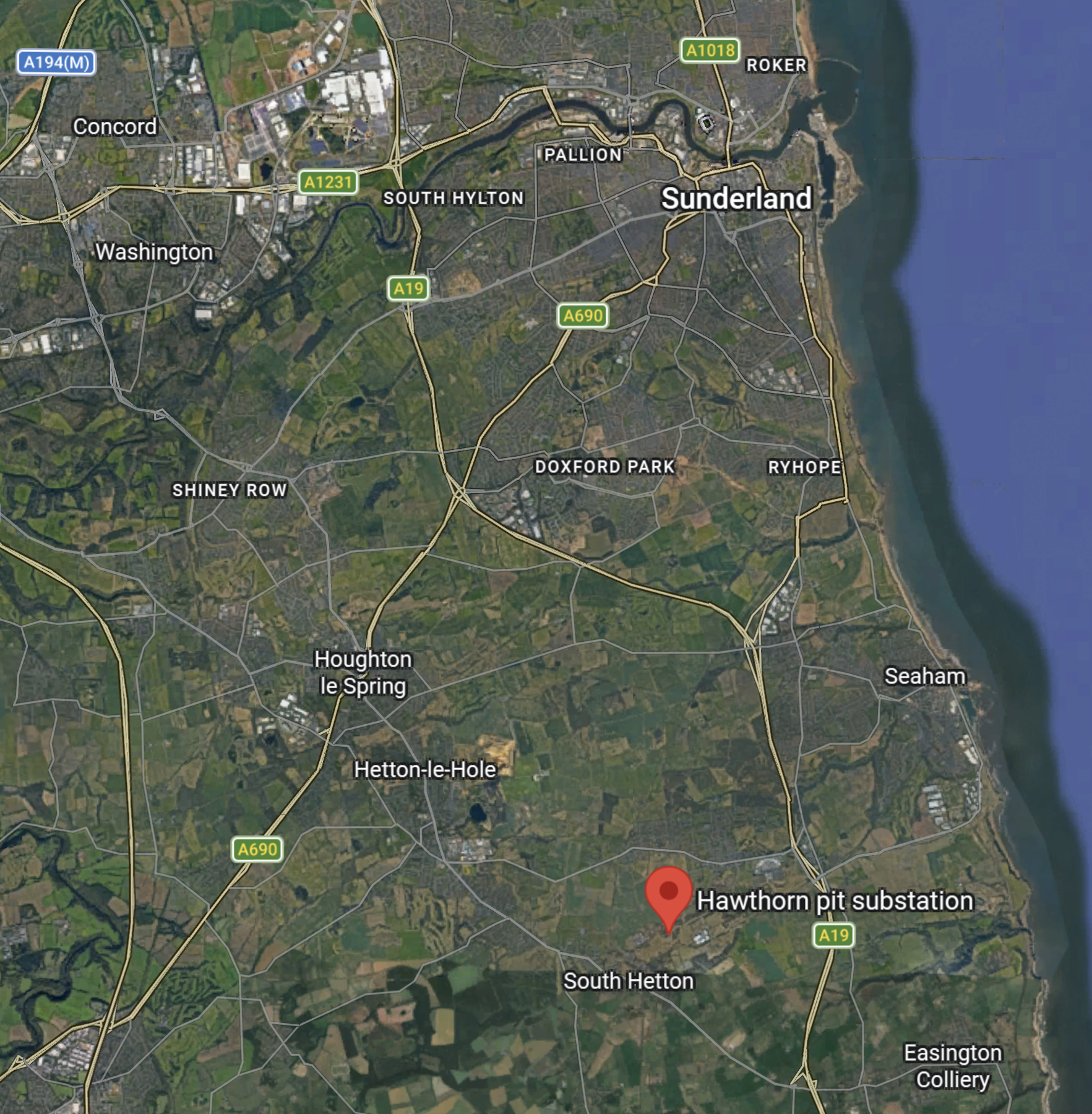
This Google Map shows the location of Hawthorn Pit.
Note.
- Hawthorn Pit is indicated by the red arrow.
- Sunderland is at the top of the map on the coast.
- Aura Power has already obtained planning permission for Hawthorn Pit solar farm, which will be up to 49.9 MW.
- Zenobe are developing a battery-energy-storage-system(BESS) 1.5 km to the South-East of the new Hawthorn Pit substation, which will have an output of 300 MW. Sloppily, there is no detail on capacity, but Google AI indicates, it is a 300 MW/600 MWh battery.
- Hawthorn Pit substation is also the expected to be the Southern end of Eastern Green Link 1, which will help to bring Scottish wind power to England, which will be a 2 GW undersea interconnector to Torness.
In Murphy Starts Work On £2.5bn Eastern Green Link 1, I detail the start of building of Eastern Green Link 1 and say it should be operational by 2029.
When Is The Morven Offshore Wind Farm Expected To Be Commissioned?
I asked Google AI the question above and received this answer.
The 2.9 GW Morven offshore wind farm is expected to be fully commissioned and operational between 2031 and 2035, with initial grid connections and power export potentially starting as early as 2030.
The timeline for full deployment of the Morven Offshore Wind Farm remains somewhat flexible as it depends on final planning approvals and connection offers from the National Energy System Operator (NESO).
The Cables For The Morven Offshore Wind Farm And Eastern Green Link 1
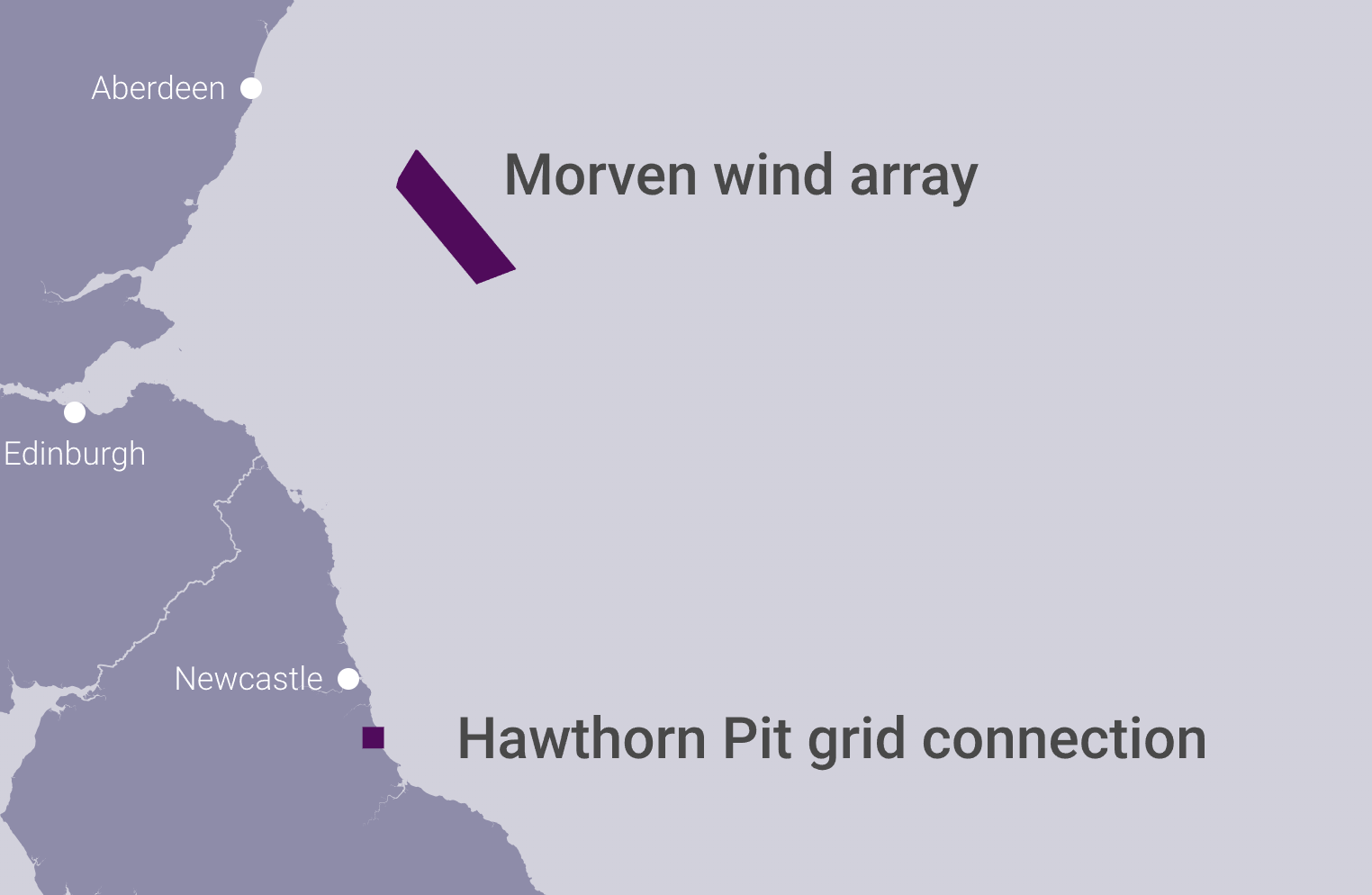
This map clipped from the Morven Offshore Wind Farm web site, shows the locations of Aberdeen, Hawthorn Pit and the Morven Offshore Wind Farm.
Note.
- The location of the Morven wind array was first mentioned in June 2020, as part of ScotWind by Crown Estate Scotland.
- The development of Eastern Green Link 1 was first mentioned in May 2021, by National Grid.
- Torness is to the East of Edinburgh.
- Eastern Green Link 1 connects Torness and Hawthorn Pit.
- the Morven wind array connects to England at Hawthorn Pit.
Over the last few years National Grid and other companies have been developing a technique called offshore hybrid assets, which I describe in What Are Offshore Hybrid Assets?.
An offshore hybrid asset typically connects two countries via a large offshore wind farm, which can then send electricity to both countries.
In a traditional design, there would need to be.
- A 2 GW cable between Torness and Hawthorn Pit.
- A 2.9 GW cable between Morven and Hawthorn Pit.
In the Offshore Hybrid Asset design, there would need to be.
- A 2 GW cable between Torness and Morven
- A 2.9 GW cable between Morven and Hawthorn Pit.
I suspect cable would be saved.
This map shows the position of each ScotWind Leasing wind farm.

Note.
- The numbers are Scotwind’s lease number in their documents.
- Morven is ScotWind lease number 1.
- Eastern Green Link 1 is one of four interconnectors down the East Coast of the UK.
- I have added up the ScotWind lease numbers 1-6 and they total 10.5 GW.
That would be a lot of power to capture just by converting the four Eastern Green Link interconnectors into offshore hybrid assets.
How Will Aquaventus Connect To Aberdeen?
This is RWE’s description of AquaVentus, which is sub-titled Hydrogen Production In The North Sea.
Hydrogen is considered the great hope of decarbonisation in all sectors that cannot be electrified, e.g. industrial manufacturing, aviation and shipping. Massive investments in the expansion of renewable energy are needed to enable carbon-neutral hydrogen production. After all, wind, solar and hydroelectric power form the basis of climate-friendly hydrogen.
In its quest for climate-friendly hydrogen production, the AquaVentus initiative has set its sights on one renewable energy generation technology: offshore wind. The initiative aims to use electricity from offshore wind farms to operate electrolysers also installed at sea on an industrial scale. Plans envisage setting up electrolysis units in the North Sea with a total capacity of 10 gigawatts, enough to produce 1 million metric tons of green hydrogen.
RWE have also put this AquaVentus video on their web site.
Note, that in the video AquaVentus connects Germany to Denmark, Norway, The Netherlands and Aberdeen and Humberside in the UK.
I asked Google AI, the question in the title of this section, and received this answer.
AquaVentus connects to Aberdeen through a strategic infrastructure partnership with Hydrogen Scotland. The two organizations are integrating offshore wind power, offshore electrolysis, and a shared cross-border pipeline to link Scottish renewable generation with European industrial markets.
The connection strategy relies on a multi-stage approach across the North Sea:
Offshore Production & Transmission: AquaVentus aims to produce green hydrogen directly offshore. It will be transported via a pan-European pipeline network—such as the planned 400 km AquaDuctus to link offshore hubs with both the UK and mainland Europe.
Scottish-German Export Corridor: Building on previous research like the Scot2Ger study, this pipeline corridor directly connects Scotland’s abundant offshore wind resources to European demand, establishing Aberdeen as a critical origin node.
Integrated Energy Backbone: The initiative champions hybrid connection concepts (combining both power cables and hydrogen pipelines). This allows for maximum flexibility when integrating Aberdeen’s local onshore hydrogen infrastructure with broader transnational energy grids.
I will now ask Google AI some supplementary questions about AquaVentus in UK waters.
“Will AquaVentus Produce Hydrogen In UK Waters?”
Google AI gave this reply.
Yes, AquaVentus plans to produce green hydrogen in UK waters. The German-led consortium has partnered with Hydrogen Scotland to harness Scotland’s offshore wind potential for large-scale, cross-border hydrogen production and export.
Key Details of the UK-German Initiative
Production Scale: The initiative aims to install 10 gigawatts (GW) of offshore electrolysis capacity in the North Sea by 2035, producing up to 1 million metric tonnes of green hydrogen annually.
The “Pipes and Wires” Model: Offshore wind parks will be equipped with hybrid connection concepts, providing the flexibility to either send electricity directly to the grid or convert it into hydrogen via offshore electrolysers.
Transportation: The produced hydrogen will be transported to land via a shared transnational subsea pipeline corridor, linking Scottish resources to Germany and mainland Europe.The partnership is specifically aimed at creating a North Sea hydrogen corridor to boost energy security and build the foundational European Hydrogen Backbone.
“Will AquaVentus Land Hydrogen In Scotland?”
Google AI gave this reply.
Yes, the German-led AquaVentus initiative plans to land green hydrogen in Scotland as part of a coordinated North Sea energy corridor.
The cross-border initiative involves the following components:
The Pipeline Connection: A key part of the plan is the AquaDuctus offshore subsea pipeline, designed to collect green hydrogen produced from central North Sea wind farms and land it on the coast.
Scottish Partnership: Hydrogen Scotland and AquaVentus have formalized a Memorandum of Understanding to combine Scotland’s massive offshore wind potential with German infrastructure and electrolysis expertise.
Export Ambitions: Scotland aims to produce up to 3.3 Mt of green hydrogen per year by 2045, heavily relying on pipelines and networks to export this to mainland European hubs like Germany.
Offshore Facilities: The broader initiative plans to install 10 GW of offshore electrolysis capacity in the North Sea to produce up to 1 million tonnes of hydrogen annually.
Note that Google AI has told me that a Megatonne of hydrogen is currently worth around £2.5-5 billion.
“Will AquaVentus Connect To Any Of The ScotWind Leasing Wind Farms?”
Google AI gave this reply.
Yes, AquaVentus plans to link Scottish offshore wind resources (including ScotWind farms) to mainland Europe. Through an agreement with Hydrogen Scotland, AquaVentus intends to utilize hybrid “pipes and wires” infrastructure to transmit power or convert it into green hydrogen for direct pipeline transport.
The partnership serves several strategic goals:
The “Pipes & Wires” Concept: Wind farms built under the ScotWind leasing round will have the flexibility to either route electricity to the UK grid or convert it into green hydrogen via offshore electrolysers.
Cross-Border Pipelines: The hydrogen generated by Scottish offshore wind is targeted to be fed into the planned AquaDuctus pipeline, which forms a transnational energy corridor connecting the UK to Germany and the rest of Europe.
Policy Integration: AquaVentus is actively advocating for legal reforms to accommodate these cross-border hybrid connections, allowing direct pipeline integration for future offshore parks.
I believe these ScotWind Leasing wind farms could be connected to AquaVentus.
- 1 – Morven – 2.9 GW – JERA Nex BP, EnBW
- 2 – Ossian – 2.6 GW – SSE Renewables
- 3 – Bellrock – 1.2 GW – Falck Renewables
- 4 – CampionWind – 2 GW – Scottish Power, Shell
- 5 – Muir Mhòr – 0.8 GW – Vattenfall
- 6 – Bowdun – – 1 GW – Thistle Wind Partners
Note.
- All companies are major energy companies.
- The wind farms are in a cluster to the South-East of Scotland.
- Wind farms 2-5 are floating, and 1 and 6 are fixed.
- There is a maximum power of 10.5 GW.
- These wind farms would not need to be shut down, when there was too much wind, if the excess electricity could be converted into hydrogen.
- The “Pipes & Wires” Concept would allow all energy generated to be transferred to shore, either as electricity or hydrogen.
Cables would need to be laid to perform the functions of the Eastern Green Links 1-4.
- Eastern Green Link 1 – Torness and Hawthorn Pit
- Eastern Green Link 2 – Peterhead and Drax
- Eastern Green Link 3 – Westfield and Lincolnshire
- Eastern Green Link 4 – Peterhead and Lincolnshire
Eastern Green Link 5 is under development between Aberdeenshire and Lincolnshire.
“Is Anderby Creek An Important Node In The Electricity Grid?”
Google AI gave this reply.
Yes, Anderby Creek has become a highly important landfall location for the UK’s electricity grid, acting as a crucial connection point for high-capacity subsea cables bringing renewable energy from Scotland and offshore wind farms into England.
Its role in the national grid’s infrastructure centers on several major “superhighway” projects:
Eastern Green Link 5 (EGL 5): This £3bn National Grid project involves a 585km subsea High Voltage Direct Current (HVDC) cable carrying up to 2 GW of clean power (enough for two million homes) from Aberdeenshire, Scotland, to Anderby Creek.
Eastern Green Links 3 & 4 (EGL 3 / EGL 4): These are additional massive subsea cable projects that also plan to make landfall at Anderby Creek to transport Scottish wind energy down the UK coastline.
Offshore Wind Export Cables: Beyond long-distance transmission, the village already hosts export cables from local offshore wind developments like the Triton Knoll Wind Farm.
Because of the massive volume of power coming ashore, Anderby Creek serves as the starting point for significant onshore infrastructure. The cables transition underground at the beach and run roughly 8km inland to a proposed new converter station near Bilsby/Alford, where the power is converted and integrated into the broader Great Grid Upgrade.
“Will AquaVentus Have Access To The UK’s hydrogen Storage On Humberside?”
Google AI gave this reply.
Yes. Through a strategic partnership with Hydrogen Scotland, the AquaVentus initiative aims to establish cross-border offshore infrastructure that connects the central North Sea with existing and planned hydrogen networks across the UK, including those on Humberside.
The pipeline infrastructure associated with AquaVentus is envisioned to reach the UK just south of the massive hydrogen storage facilities located in East Yorkshire. While the German offshore pipeline (like AquaDuctus) is focused on landing green hydrogen into Germany, the broader AquaVentus framework is designed to integrate with British transmission networks and link to underground cavern storage in the UK.
On Humberside, major energy giants (including Centrica, Equinor, and SSE Thermal) are developing the integrated Humber Hydrogen transport and storage network. This system encompasses large-scale hydrogen storage at the Aldbrough Hydrogen Storage site and Rough Gas Storage. Because the AquaVentus UK branch connects to the Humber area’s onshore network, it positions the initiative to take advantage of these regional storage assets as a cornerstone for international trade and domestic energy resilience.
I think this is key as it gives AquaVentus access to very large hydrogen storage.
Conclusion
It almost looks to me, that National Grid and AquaVentus are combining their pipes and wires between the Southern North Sea and Aberdeen.
- Hydrogen offtake for Germany will be at Wilhelmshaven.
- Hydrogen offtake for England will be at Humberside.
- Hydrogen offtake for Scotland will be at Aberdeen.
- Electricity offtake for Germany will be at Wilhelmshaven.
- Electricity offtake for England will be at Anderby Creek.
- Electricity offtake for England will be at Hawthorn Pit.
- Electricity offtake for Scotland will be at Torness.
- Electricity offtake for Scotland will be at Aberdeen.
Note.
- There will probably be other connections to onshore locations and offshore wind farms.
- Hydrogen imports will be possible from Denmark, Norway and The Netherlands direct into AquaVentus.
News From Four Big Projects On The 15th May 2026
Are things hotting up in the offshore wind business in the UK? Or is it just a coincidence?
But these four projects were all announced on the 15th May 2026.
Aberdeenshire Council Greenlights Onshore Plans For 1 GW Scottish Floating Wind Project
The Buchan Offshore Wind consortium, comprising BayWa r.e., Elicio, and BW Ideol, has received planning consent from Aberdeenshire Council for the onshore infrastructure that will connect the proposed 1 GW Buchan floating wind farm to the grid. Commissioning in 2033.
Ocean Winds Receives Full Onshore Planning Consent for 2 GW Caledonia Offshore Wind Farm
Ocean Winds, a 50-50 joint venture owned by EDP Renewables and ENGIE, has received full onshore planning consent for its 2 GW Caledonia offshore wind farm following approval by Aberdeenshire Council’s Infrastructure Services Committee on 14 May. Commissioning in 2032.
UK Grants Development Consent For 3 GW Dogger Bank South Offshore Wind Project.
The UK Department for Energy Security and Net Zero has granted development consent for two Dogger Bank South (DBS) offshore wind farms, Dogger Bank South West and Dogger Bank South East, which are planned to have a combined installed capacity of 3 GW. Commissioning in 2031 (DBS West) and 2032 (DBS East).
RWE and SSE Secure Consent For 1 GW North Falls Offshore Wind Farm
The North Falls Offshore Wind Farm joint venture between RWE and SSE Renewables has been granted development consent for its 1 GW project by the UK Department for Energy Security and Net Zero (DSNEZ). Commissioning in 2030.
It looks like another 7 GW of onshore wind is on its way! The commissioning dates are my best estimates based on past history.
Offshore Vessel Charging Tech Developer Plans Commercial Rollout In UK
The title of this post, is the same as that of this article on offshoreWIND.biz.
This is the sub-heading.
Stillstrom, part of A.P. Moller – Maersk and based in Denmark, has established a dedicated entity in Aberdeen, Scotland, with plans to roll out its offshore vessel charging solution commercially in the UK.
These three paragraphs add more details.
The solution is transitioning from development to commercial deployment, and, according to a press release issued by Stillstrom on 16 March, the company is targeting one of the world’s most active offshore wind markets for the commercial rollout.
Stillstrom has been developing offshore charging solutions for service operations vessels (SOVs) since 2019, with testing and collaboration carried out with shipowners and developers in Aberdeen. SOVs are amongst the most energy-intensive ships operating at offshore wind farms, according to Stillstrom.
The company says that this has now translated into tangible momentum, with significant discussions underway with major wind farms, as well as partnership and compatibility agreements signed with leading SOV owners and operators.
Scotch Whisky Is In A Unique Position
Scotland has so much zero-carbon energy now, let alone in a few years, that Scotch whisky would not be the most difficult of industries to make completely zero-carbon, which could marketing-wise completely trump any tariffs, that Trummkopf might impose.
- Already some small distilleries are using hydrogen to distill the whisky.
- Some glass bottles are already made using hydrogen instead of natural gas to make zero-carbon malt whiskies.
- I’m sure Cummins in Darlington, JCB in Rocester and Ricardo in Sussex will be pleased to help make farm machinery, mechanical handling and road transport zero carbon.
- Soft fruit like raspberries are already used to absorb the carbon dioxide from the distillation process in some areas of Scotland. I’m sure dealing with more quality raspberries would not be a problem.
- A large electrolyser is planned for Kintore in the North of Scotland. Think of the good publicity for say Centrica or SSE, if they built the world’s largest hydrogen plant to help make zero-carbon whisky.
These are some more thoughts.
Taste Is Everything
As only the method of providing heat and electricity will have been changed, I can’t see there will be any change to the taste.
It’s Already Happening
This page on the Annandale Distillery web site is entitled Annandale Distillery Pioneers Zero-Carbon Whisky Production with EXERGY 3 Project.
The Kintore Electrolyser
These figures summarise the Kintore Electrolyser.
- Total Electrolyser Capacity – 3 GW
- First Phase – 500 MW
- Hydrogen – 200 kTonnes per year
Explore the Kintore Hydrogen web site.
Marketing Advantage
Scotland, is probably, the only country, where the main ingredients for whisky come together in abundance ; barley, energy, tradition and water.
It also is all produced in a single country in many different brands and types, which could all be produced in a zero-carbon manner.
Conclusion
Let’s give Trump a beating and the planet a kiss.
Donald Trump To Open Second Aberdeenshire Golf Course In 2025
The title of this post, is the same as that of this article on the BBC.
These opening two paragraphs introduce the course.
The 18-hole links MacLeod Course – named after the former US president’s Lewis-born mother, Mary – will welcome players at the Trump International resort in Menie from the Summer of 2025.
The resort claimed the course would feature the “largest sand dunes in Scotland” and form “the greatest 36 holes in golf” alongside the original course, completed in 2012.
It sounds to me that the environmental aspects could be rather detrimental. But then Trump has form for a poor record in this area, as I wrote in Trump Forgot The Ace Of Clubs!
SeaTwirl And Verlume Join Forces To Drive Decarbonisation Of Offshore Assets
The title of this post, is the same as that of this article on offshoreWIND.biz.
This is the sub-heading.
Swedish energy-tech company SeaTwirl and UK-based energy management and energy storage firm Verlume have signed a memorandum of understanding (MoU) to collaborate on the electrification of offshore assets and decarbonisation of the oil and gas industry.
This is the first two paragraphs.
The MoU will see the two companies identify and pursue potential opportunities for decarbonisation of offshore oil and gas and other associated offshore electrification opportunities using renewable energy, seabed-based energy storage, and intelligent energy management.
SeaTwirl and Verlume plan to develop systems for commercial sale, using combined technologies.
Note.
- This YouTube video introduces SeaTwirl.
- This YouTube video introduces Verlume.
This could be an MoU made in engineering heaven.
Verlume And Wave Power
The last two paragraphs of the article describe another project involving Verlume.
Aberdeen’s intelligent energy management specialists Verlume has developed a GBP 2 million (approximately USD 2.5 million) project linking the Blue X wave energy converter constructed by Mocean Energy with a Halo underwater battery storage system.
The industry-supported project, situated five kilometres east of Orkney Mainland, demonstrates the integration of green technologies to deliver consistent and sustainable low-carbon power and communication to subsea equipment.
Could Verlume, be the missing link that wave power needs?
Are LNER Going To Take On The Airlines?
Nine years ago, I wrote Edinburgh – Plane Or Train?, after a trip to Scotland, where I took easyJet up and came back in First Class by train.
- Both trips were about five hours door-to-door.
- The flight was about six quid more,
- But I got free food and drink on the train.
- Security on the plane was a pain.
- I had to take my passport for identification at Stansted.
I haven’t flown internally in Great Britain since, although, I have flown to Belfast.
For shorter flights the market is going towards rail, as these posts seem to suggest.
- 2.7M Tonnes Of Co2 Could Be Saved Per Year If UK Domestic Flights Went Electric
- Air Travellers To Be Hit By Carbon Charge On All Tickets
- Climate Change ‘May Curb Growth In UK Flying’
- France Bans Short-Haul Flights To Cut Carbon Emissions
- KLM Replaces Plane With High Speed Train
- Lumo Carbon Data Shows Its Trains Are 22 Times Greener Than Flying
- Next Time I’ll Go By Train
- Ryanair One Of Europe’s Top Polluters, EU Data Suggests
- Stop Taking Internal Flights And Go Green, Says Lib Dem Contender Davey
The climate seems to be turning against flying short-haul.
This is a paragraph, in this press release from LNER, which is entitled First Tri-Mode Long Distance Trains For The East Coast Main Line.
This new fleet of trains will keep LNER on track to reduce its emissions by 67 per cent by 2035 and be net zero by 2045. LNER has already reduced carbon emissions by 50 per cent compared with 2018/19. Per mile, LNER trains produce 15 times less carbon emissions than a domestic flight.
Are LNER building a number of climate-based sticks, with which to beat the airlines on the routes, where they compete?
These are my thoughts on the various routes, where LNER compete with airlines.
Newcastle
Newcastle is an interesting one.
- Newcastle station is in the city centre and is on the Tyne and Wear Metro.
- London King’s Cross is one of London’s major Underground hubs.
- There are lots of buses and local trains within walking distance of both stations.
- There are three trains every two hours and an additional eight trains per day (tpd) between the two London King’s Cross and Newcastle stations.
- Lumo also run five tpd on the route.
- There are generally no security delays at rail stations.
- London King’s Cross is laid out to maximise passenger flows. If it gets busy, everybody just walks out into King’s Cross Square.
- I’ve never had a problem at Newcastle station with overcrowding.
Perhaps, if you live near one of the airports, flying is more convenient.
LNER’s weapons against the airlines between London King’s Cross and Newcastle will be convenience and journey times.
Convenience is all about the location of the stations, their excellent local transport networks and good walking routes around the station.
Journey times will only get better, as the magic of digital in-cab signalling, allows the Azumas, the new CAF tri-mode long distance trains and the few remaining InterCity 225s to show what they were designed to do.
Dalton-on-Tees, where the first phase of the digitally signalling will end, is 39.8 miles South of Newcastle, so once the Newcastle train is passes Dalton-on-Tees on the East Coast Main Line, it will be a digital-signalled electrified railway all the way to Woolmer Green.
- Dalton-on-Tees is 39.8 miles South of Newcastle
- Woolmer Green is 244.8 miles South of Newcastle.
- Dalton-on-Tees and Woolmer Green is 205 miles.
- Newcastle and Dalton-on-Tees takes 37 minutes.
- Woolmer Green and King’s Cross takes 18 minutes
- Trains take typically an average three hours and nine minutes between London and Newcastle.
- A typical train time by LNER between Dalton-on-Tees and Woolmer Green is two hours and 14 minutes.
- This is an average speed of 91.8 mph between Dalton-on-Tees and Woolmer Green.
- Between London King’s Cross and Newcastle is fully-electrified.
I can build a table of timings and savings at various average speeds.
- 120 mph – 103 minutes – two hours and 38 minutes – 31 minutes
- 125 mph – 98 minutes – two hours and 33 minutes – 36 minutes
- 130 mph – 95 minutes – two hours and 30 minutes – 39 minutes
- 135 mph – 91 minutes – two hours and 26 minutes – 43 minutes
- 140 mph – 88 minutes – two hours and 23 minutes – 46 minutes
Note.
- The first field is the average speed between Dalton-on-Tees and Woolmer Green.
- The second field is the time between Dalton-on-Tees and Woolmer Green.
- The third field is the time between London and Newcastle.
- The fourth field is the saving over current timings.
- The London and Newcastle time is calculated by adding the times for the three sections together.
I have regularly timed trains at a very constant 125 mph, so with digital signalling, I suspect an average of 130 mph is possible.
This would mean, times of a few minutes under two hours and thirty minutes could be possible between London and Newcastle.
Edinburgh
Edinburgh builds on the improvements South of Newcastle.
Edinburgh station Waverley is a well-connected station.
- There are lots of buses, local trains and the Edinburgh Tram within walking distance of Edinburgh Waverley station.
- There are three trains every two hours and an additional seven tpd between the London King’s Cross and Edinburgh Waverley stations.
- Lumo also run five tpd on the route.
- Trains take typically an average four hours and thirty minutes between London and Edinburgh Waverley.
- Any savings because of the digital in-cab signalling between London and Newcastle can be applied to London and Edinburgh Waverley services.
As my calculations showed that averaging 130 mph between Dalton-on-Tees and Woolmer Green could save 39 minutes on journey times, I am fairly sure than a sub-four hour journey time will be possible between London and Edinburgh Waverley.
It should also be noted that that the power supply has been improved between Newcastle and Edinburgh Waverley.
- The distance between Newcastle and Edinburgh Waverley is 124.2 miles
- Newcastle and Edinburgh Waverley takes around one hour and 30 minutes.
- This is an average speed of 82.8 mph between Newcastle and Edinburgh Waverley.
- Between London King’s Cross and Edinburgh Waverley is fully-electrified.
As the record time for between London King’s Cross and Edinburgh Waverley was set by an InterCity225 train in 1993 at three hours and twenty-nine minutes, I suspect that with more digital signalling and some track improvements, that there are more journey time improvements to be squeezed out.
I certainly believe that a time of three hours and fifty minutes between London and Edinburgh Waverley will be regularly achieved. This is a journey time saving of around forty minutes.
Dundee
Dundee has an airport and a station on the East Coast Main Line.
Trains between London King’s Cross and Dundee take around five hours and 45 minutes.
LNER run three trains per day to and from London King’s Cross and one tpd to and from Leeds.
CrossCountry also run services.
Loganair has two flights per day to Heathrow.
Aberdeen
Aberdeen builds on the improvements South of Edinburgh.
The four direct tpd between London and Aberdeen take around seven hours and ten minutes.
This should come down to around six hours and thirty minutes with the journey time savings between London King’s Cross and Edinburgh Waverley.
Will this tempt travellers from the airlines?
Battery-Electric Trains To Dundee And Aberdeen
One thing that will help, is that Edinburgh and Aberdeen is to be partially electrified.
InPiling Work To Get Underway To Electrify Line To Fife, I included this Network Rail map of the electrification.
This map has been downloaded from the Network Rail web site.
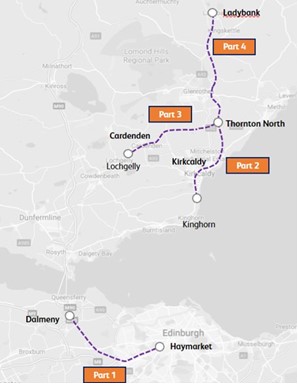
The electrification is split into four phases.
- Haymarket and Dalmeny – 25 km
- Kirkcaldy and Thornton North – 25 km.
- Lochgelly and Thornton North – 20 km.
- Thornton North and Ladybank – 34 km.
Note.
- The last three phases of electrification connect to Thornton North.
- The new rail link to Leven will also be electrified. and connected to Thornton North.
- The Forth Bridge is not to be electrified.
As Ladybank station is just 91.4 miles from Aberdeen, I suspect LNER will use Hitachi Intercity Battery Hybrid Trains to serve Aberdeen.
If these trains haven’t got the range, then I suspect LNER’s new CAF Tri-Mode Trains could handle the route.
Inverness
Inverness has a problem.
Zero-carbon trains will be unlikely to get to the city without full electrification of the Highland Main Line.
- Dunblane is the nearest electrified station to Inverness, but it is 146.2 miles away over a route with lots of steep climbs.
- I doubt that a battery-electric train could handle that route.
One solution would be for LNER to run the new CAF Tri-Mode Trains to Inverness using HVO or biodiesel.
Glasgow
Glasgow is the only other Scottish city with an airport and good rail connections to the South.
I am sure that Avanti West Coast will target airline passengers, if LNER prove it is a successful policy.
Other Factors
These are other factors, that will come into a traveller’s choice.
First Class
Some travellers like a bit more comfort and service.
Ability To Work
Some travellers like to work on a train.
You Don’t Get Tables On a Plane
I like to open a paper or magazine flat, which is difficult on a plane.
Views Tend To Be Better On a Train
Providing you get a window!
Parking Tends To Be Better At An Airport
But it may be more expensive!
Security Is Less Hassle On A Train
At the moment!
You Don’t Need To Prove Your Identity On A Train
Not in the UK! Yet!
Conclusion
It looks like LNER can offer the airlines to four of our major Northern cities serious zero-carbon competition.

