Authorities Plan Joint Tram-Train Procurement
The title of this post is the same as that of this article in Global Rail News.
This is the first paragraph.
Several European transport authorities are planning to work in partnership to procure new tram-trains in order to bring down the cost enough to make the transport mode more commercially viable.
This later paragraph gives the members.
The new association includes Karlsruhe’s transport authorities, Albtal-Verkehrs-Gesellschaft (AVG) and Verkehrsbetriebe Karlsruhe (VBK), Saarland tram-train operator Saarbahn Netz, Kassel operator Kasseler Verkehrs-Gesellschaft, Upper Austria’s Schiene Oberösterreich, Erms-Neckar-Bahn and Regionaltangente West in Germany’s Rhine-Main area.
I hope Network Rail keeping a watching brief!
After all, the Class 399 tram-train being trialled in Sheffield is a 25 KVAC version of the tram-trains used in Karlruhe, where the main line voltage is 15 KVAC.
This picture shows a Class 399 tram-train in Sheffield.

This is one of Karlsruhe’s similar tram-trains.

There are some cosmetic differences and the German tram-trains have a coupler for multiple working.
Surely, any initiative for a standard European tram-train, that could work all over the Continent would bring benefits.
- Prices would probably be more reasonable.
- Solutions and problems could be shared.
- \setting up a new tram-train line should become easier and more affordable.
Having travelled extensively on Karlsruhe’s tram-train network, it would appear that they are using not only the tram-trains, but several other ideas in Sheffield.
Different Voltages
Overhead line voltages vary across Europe.
- 15 KVAC is used in Germany
- 1,500 VDC is used in The Netherlands and for some local networks.
- 25 KVAC has become an international standard and is generally used for high speed lines.
Surprisingly, all our overhead electrification used on railways is 25 KVAC. All other systems have been either replaced or closed.
All these different voltages can be handled by a good electrical system on the tram.
This will handle the problem ehere a route runs between two areas or countries with different voltages.
Changing From Tram To Train Mode And Vice-Versa
In Karlsruhe this is performed by connecting the two systems together with a cermaic rod in the catenary to separate the voltages.
Tram-trains just drive across, with perhaps some battery assistance.
I suspect Sheffield are using a similar method to Karlsruhe.
Platform Height
If the tram-trains are to have level access, as most low floor trams do these days, then platform height can be a problem.
Trams generally have low platforms as this picture from Tramlink shows.
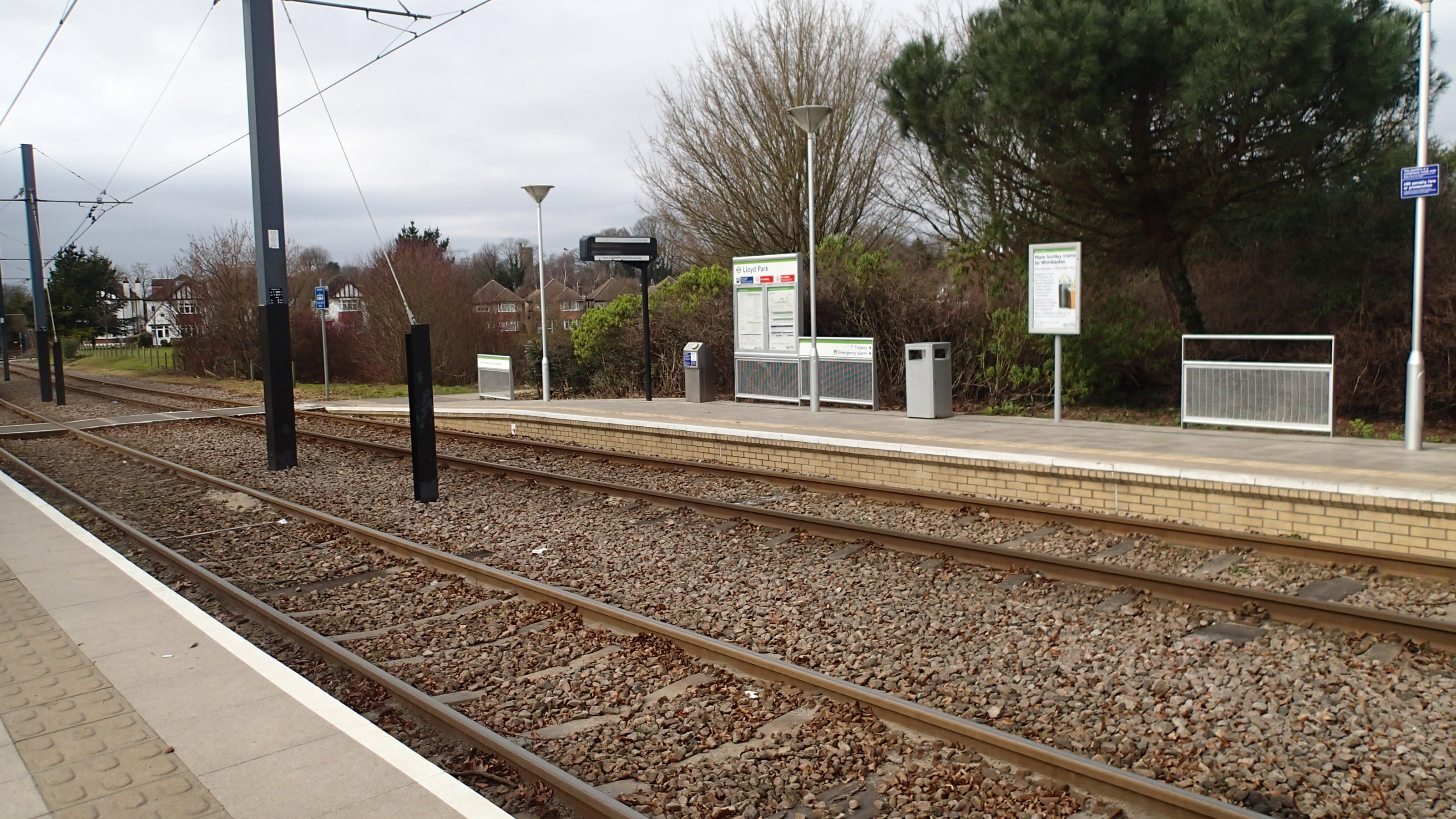
On the Continent, the main line platform heights are often simiar, so level access can be easy.
But in the UK, platform heights are generally higher. The problem appears to be being solved at Rotherham Central station by means of dual height platforms. This technique is used in Karlsruhe.
The article says this about platform height.
VDV has said the tram-trains will be available as two or four-door vehicles and will be able to meet different platform heights and maximum axle loads.
So hopefully, it will be one size fits all!
Karlruhe
This is a paragraph from the article.
AVG and VBK would receive more than half of the new vehicles under the arrangement. AVG said it had already been approached by other transport companies interested in adopting the so-called Karlsruhe model tram-train system.
Karlsruhe certainly seem to be leading this project, in more ways than one.
The Sheffield tram-train trial could be said to use the Karlsruhe model.
Conclusion
I believe that nothing I have seen on the various tram-train systems, I have visited, would stop a common tram-train that worked being developed.
This must lead to the development of a lot more tram-train systems.
Talgo Explores Options For Building UK Test Track
The title of this post is the same as that of this article in Rail Magazine.
This is the first paragraph.
A new UK test track, available to all companies, is being proposed by Spanish manufacturer Talgo as it looks to develop its standing in this country.
It is interesting that the ttrack will be available to all companies, but probably a sensible decision.
- Hitachi have been testing some of their new Class 385 trains in Germany.
- Porterbrook have been testing the new Class 769 train on the Grand Central, which is a herotage line.
So perhaps we do need another convenient test track!
As Talgo are bidding to make trains for HS2, the test track will probably need to be a bit longer than the thirteen miles of the cuirrent Old Dalby Test Track.
The First Hydrogen Trains Have Been Ordered
This article on Global Rail News is entitled Alstom Confirms Orders For Its Hydrogen-Powered Coradia iLint.
There is also this Press Release on the Alstom web site, which gives a lot more details.
Given that this is a real order worth millions of euros, I think we can assume that another practical motive power source for trains has arrived.
One interesting point is that the deal involves the Linde Group, who are the world’s largest industrial gas company.
 The Anonymous Widower