Gospel Oak-Barking Fleet Plan Remains Unclear
The title of this post is the same as that of this article on Rail Magazine.
In the article, there is a picture of 378232 at Barking station.
According to the Wikipedia entry for Class 378 trains, this unit is listed as being four-cars and TBA (To Be Allocated?)
So is it a spare train, that is used for driver and staff training and route proving?
It was certainly doing the latter at Barking.
The Situation On The Gospel Oak To Barking Line Is Critical
This page on the Barking-Gospel Oak Rail User Group web site is their latest newsletter, which was issued on the 14th of January.
These are the headlines on the newsletter.
- Train Service On Brink Of Collapse
- Not Enough Trains For Viable Service
- TfL Has No Idea When New Trains Will Be Fit For Service
- Rail Users Demand Mayor Takes Action To Restore Reliable Train Service Now
- Rail Users Demand Compensation After Years Of Misery
It’s all strong stuff.
Trains that work are urgently needed to replace the diesel Class 172 trains, which will all leave by the end of April or even March.
Possible Replacement Trains
These types of trains have been touted as replacement trains.
Class 315 trains
TfL has started to send some Class 315 trains, made redundant by TfL Rail, for scrapping.
Could some of these be held back for use on the Gospel Oak to Barking Line?
- They should fit the route.
- London Overground already runs these trains to Cheshunt, Chingford and Enfield Town.
- The expertise and driving experience must be there to run a service.
But, as there have been no reports of any Class 315 trains on the route, I suspect that there’s a reason, why these trains can’t fill the gap.
Could it be the disability regulations, which kick in at the end of 2019?
The proposed Class 710 rains ordered for both Gospel Oak to Barking Line and the Watford DC Line are dual voltage.
As the Willesden TMD was built to handle trains with the ability to use third-rail electrification, is this ability needed to access the depot?
But Class 315 trains are 25 KVAC only, so this could mean they are unsuitable.
Class 365 Trains
Class 365 trains got ScotRail out of trouble, but like the Class 315 trains, they are 25 KVAC only, so may have the same stabling issues.
They would also be a new train class for London Overground.
Class 319 Trains
Class 319 trains are dual-voltage and could probably be used on both routes, but they would need a refurbishment and would also be a new train class for London Overground.
Class 378 Trains
Class 378 trains already work the Watford DC Line and after the test of a four-car unit to Barking, London Overground probably know how difficult, it would be for four-car trains to work the route.
The trains are dual-voltage and London Overground’s strategy of basing trains for both routes at Willesden TMD would probably be possible.
Drivers and other staff know them very well, as do the passengers.
I am drawn to the conclusion, that of the trains available in the event of non-delivery of Class 710 trains, the Class 378 trains are the best choice.
How Many Trains Are Needed For The Gospel Oak To Barking Line?
The full service was run by a fleet of eight Class 172 service.
As the same number of Class 710 trains have been pencilled in for the route, I must assume that this is the number of trains required. I think six trains are needed for the service, with two in reserve or maintenance.
How Many Class 378 Trains Are Needed For A Full Overground Service?
If I go through the routes of the original Overground, I find the following.
Dalston Junction And Clapham Junction
Trains take 46 minutes to go South and 44 minutes to come North and a round trip would take two hours.
This means thatthe current four trains per hour (tph) service would need eight trains.
Dalston Junction And New Cross
Trains take 22 minutes both ways and a round trip would take an hour.
This means that the current four tph service would need four trains.
Highbury & Islington And Crystal Palace
Trains take 44 minutes to go South and 43 minutes to come North and a round trip would take two hours.
This means that the current four tph service would need eight trains.
Highbury & Islington And West Croydon
Trains take 52 minutes both ways and a round trip would take two hours.
This means that the current four tph service would need eight trains.
Euston And Watford Junction
Trains take 47 minutes to go South and 50 minutes to come North and a round trip would take two hours.
This means that the current three tph service would need six trains.
Stratford And Richmond/Clapham Junction
Between Stratford and Richmond, trains take 59-64 minutes to go West and 62 minutes to come East.
Between Stratford and Clapham Junction, trains take 62 minutes to go West and 64 minutes to come East.
The round trip times are very similar and are around two and a half hours.
This means that the current eight tph service would need twenty trains.
Summarising, these services gives.
- Dalston Junction and Clapham Junction – 8 trains
- Dalston Junction and New Cross – 4 trains
- Highbury & Islington and Crystal Palace – 8 trains
- Highbury & Islington and West Croydon – 8 trains
- Euston and Watford Junction – 6 trains
- Stratford and Richmond/Clapham Junction – 20 trains
This gives a total of 54 trains. As there are fifty-seven Class 378 trains, this means there are three spares to cope for maintenance and breakdowns.
London Overground have plans to increase frequencies and they are detailed in this table.
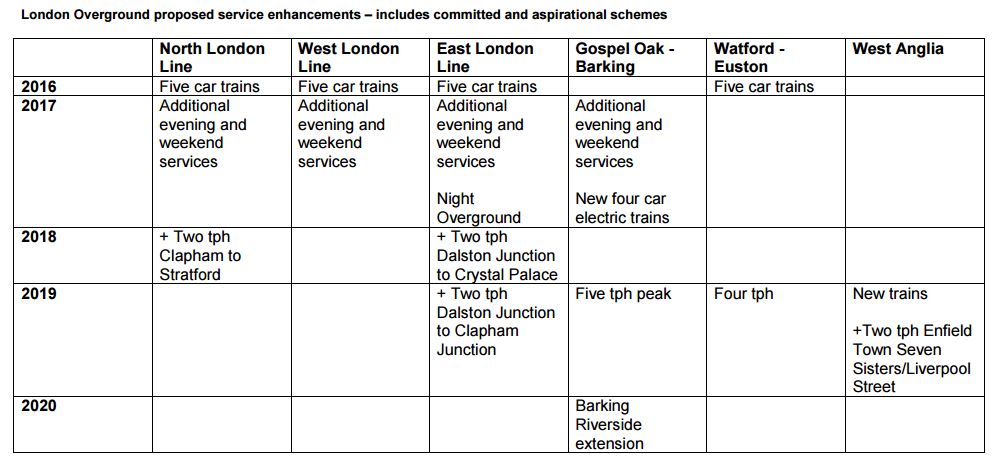
Note that four extra services are planned for the East London, North London and Watford DC Lines.
- Two extra tph between Stratford and Clapham Junction, which has already been implemented.
- Two extra tph between Dalston Junction and Clapham Junction. This would mean that twelve trains would be needed for this service.
- Two extra tph between Dalston Junction and Crystal Palace. This would mean that twelve trains would be needed for this service.
- One extra tph between Euston and Watford Junction. This would mean that eight trains would be needed for this service.
Summarising again gives.
- Dalston Junction and Clapham Junction – 12 trains
- Dalston Junction and New Cross – 4 trains
- Highbury & Islington and Crystal Palace – 12 trains
- Highbury & Islington and West Croydon – 8 trains
- Euston and Watford Junction – 8 trains
- Stratford and Richmond/Clapham Junction – 20 trains
This gives a total of 64 trains.
As London Overground only has 57 Class 378 trains, this proposed timetable is impossible without some new Class 710 trains.
London Overground plan to use some of the Class 710 trains to release Class 378 trains from the Watford DC Line, to reinforce East London Line services.
So it looks like the late delivery of the Class 710 trains has also scuppered London Overground’s plans to increase services on the East London Line.
How Many Class 378 Trains Could Be Scraped Together?
This table shows the number of Class 378 trains needed for the current service.
- Dalston Junction and Clapham Junction – 8 trains
- Dalston Junction and New Cross – 4 trains
- Highbury & Islington and Crystal Palace – 8 trains
- Highbury & Islington and West Croydon – 8 trains
- Euston and Watford Junction – 6 trains
- Stratford and Richmond/Clapham Junction – 20 trains
This gives a total of 54 trains. With just three trains spare.
As the Gospel Oak to Barking Line needs eight trains to run a full service, this is not enough.
What strategies can be applied to increase the number of trains available?
Reduce The Stratford And Clapham Junction Service To Two tph
The Stratford and Clapham Junction service was two tph until recently, when it was raised to four tph.
Reducing it back to two tph, would reduce the number of trains required on Stratford and Clapham/Richmond services by five.
This would give eight spare trains, which would be almost enough to run a full service on the Gospel Oak to Barking Line.
Provided of course, that there was a hundred percent availability, which is rather an impossible dream.
Introduce The Class 710 Trains On The Watford DC Line
The Class 710 trains for the Gospel Oak to Barking Line are dual-voltage trains, which will also run on the Watford DC Line. So would it be a sensible idea to introduce these trains first on the Watford DC Line?
- The third-rail electrification on the line is at least fifty years old, so must be fully tested.
- The drivers have extensive route knowledge of running electric trains on the route.
- Willesden TMD, where the Class 710 trains are stabled, is on the Watford DC Line.
- The route is only shared with the Bakerloo Line.
- The route is to be equipped with six Class 710 trains anyway.
Every Class 710 train introduced will release a Class 378 train.
But if the Class 710 trains don’t work, this is no help!
Introduce The Class 710 Trains On The North London Line
Running on the North London Line is more complicated than the Watford DC Line, but five-car Class 710 trains, are planned for this route.
They could be introduced to release Class 378 trains.
The Four-Car Train Problem
Every four-car train created means that a trailer car is removed from a five-car Class 378 train.
I would assume that it is most likely, these spare cars will be put into store until the, the new Class 710 trains finally enter service.
Or would they be added to other Class 378 trains to create six-car trains, which would then be run on the North or West London Lines, where the platforms could be almost long enough? Selective door opening on the trains could also be used at short platforms.
Conclusion
I feel if the London Overground swap trains around and perhaps reduce the Stratford and Clapham Junction service to its old level of 2 tph, then enough Class 378 trains would be available to run a full four-car service on the Gospel Oak to Barking Line.
 The Anonymous Widower
The irony of all this is while we still wait for the Class 710 trains we have 8 carriage Class 315 trains which could become 2 x 4 carriage trains being sent for scrap!
It’s worth remembering that the Class 315 trains are like sister units to the Class 313 trains which used to operate the North London Line and its therefore likely that Willesden Depot has former Class 313 drivers who could have been trained for similar Class 315s for a temporary service until 710s are cleared for operational duties.
Comment by Melvyn | January 14, 2019 |
I have a feeling that running four-car 315s with four-car 710s with their different interior layouts could be a nightmare for the operator. After all, it’s a fairly obvious solution.
1. 710s will replace 315s on the routes to Cheshunt, Chingford and Enfield Town.
2. Four-car units are the same length.
So there must be a valid reason why it hasn’t been done. There also has been no reports of 315s testing on the route.
I know they work well with 345s on the Shenfield service, but they were the incumbent train.
There’s more to this than meets the eye!
For instance, as the services to Cheshunt, Chingford and nfield Town, will always be run by 2 x four-car 710s, would it not be better to use eight-car trains
Comment by AnonW | January 15, 2019 |
[…] In Gospel Oak-Barking Fleet Plan Remains Unclear, I wrote a section, which was entitled.The Situation On The Gospel Oak To Barking Line Is Critical. […]
Pingback by TfL’s Reaction To The Gospel Oak To Barking Problem « The Anonymous Widower | January 16, 2019 |
[…] In Gospel Oak-Barking Fleet Plan Remains Unclear, I calculated that the following numbers of trains are needed for a full service. […]
Pingback by Modified Electric Trains To Be Used Temporarily On London Overground’s Gospel Oak To Barking Line « The Anonymous Widower | January 25, 2019 |
[…] In Gospel Oak-Barking Fleet Plan Remains Unclear, I talked about the problems caused by late delivery of the new Class 710 trains. […]
Pingback by Rail Operations Group Gets Serious About Thunderbirds Etc. « The Anonymous Widower | January 26, 2019 |
[…] wrong with that. After all, we’ve all had our fill of the dreaded Rail Replacement Buses. In Gospel Oak-Barking Fleet Plan Remains Unclear, I talked about the problems caused by late delivery of the new Class 710 trains. The problem would […]
Pingback by Rail Operations Group Gets Serious About Thunderbirds Etc. « The Anonymous Widower | January 27, 2019 |
[…] Gospel Oak-Barking Fleet Plan Remains Unclear, I calculated that running the current combined eight tph service between Stratford and Clapham […]
Pingback by The Dalston Kingsland Station Problem « The Anonymous Widower | March 24, 2019 |
Is this possible? Remove three 378s from Watford DC line and replace with Bakerloo units to Queens Park. Run a 378 shuttle between Queens Park and Euston. That would give GOBLIN two extra 378s with the third used as the Euston shuttle. Swap the two DC units for dual voltage units from elsewhere on LO.
Comment by Mike Davis | April 3, 2019 |