The Shape Of Things To Come On The Gospel Oark To Barking Line
Since modernisation in 2010, the service on the Gospel Oak To Barking Line has been run using six two-car diesel Class 172 trains.
Today was the first weekday, when one of the diesel trains had been replaced by a four-car electric Class 378 train.
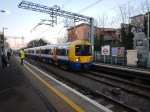
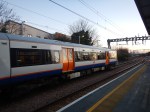
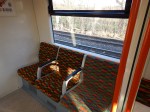
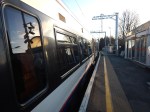
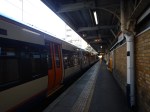
I was able to ride on a Class 378 train between Harringay Green Lanes and Gospel Oak stations. I then doubled back and travelled all the way East to Barking station.
These are a few observations.
Electric Trains
Riding the electric Class 378 trains is a very different experience to riding the diesel Class 172 trains.
- There is a lot less noise and vibration.
- You sit longitudinally in London Undergound fashion, as opposed to transversely.
- There was more capacity in the four cars of the electric train, as opposed to the two-car diesel trains.
I also got the impression that the Class 378 trains accelerated faster and cruised at a higher speed, than the Class 172 trains. I will check this out.
Train Capacity
I said in the previous section, that physical capacity is doubled from two to four cars.
- I actually went from Harringay Green Lanes to Gospel Oak twice in the morning Peak; once in a Class 172 and once in a Class 378.
- The former was jam-packed and the second was very comfortable, with only a few stansdees.
- The Class 172 train has 120 seats in a 47 metre train, which works out as 2.6 seats per metre.
- The Class 378 train has 136 seats in a 80 metre train, which works out at 1.7 seats per metre.
The lower seat density and the wide central isle, probably explains, why the electric train was more comfortable.
Note that in a few months, the Class 378 trains will be replaced with Class 710 trains, which will likely have a similar passenger capacity to the Class 378 trains.
So the capacity and passenger ambience of the Class 378 trains can probably be read across to the internally-similar Class 710 trains.
Platform Length Issues
I did my usual trick of riding in the last car and looking at where the end of the train came on the platform.
The line has been built, so that all platforms fit the standard British Rail four-car length of eighty metres, which applies to both four-car Class 378 and Class 710 trains.
The Possibilities Of Five-Car Trains
London Overground run five-car trains through four-car stations at Shadwell, Wapping, Rotherhithe and Canada Water on the East London Line, by allowing the last car to overhang the platform.
They get away with it without any trouble because.
- The Class 378 trains have selective door opening and a walk-through interior, with large lobbies.
- The announcements on the train are high-quality and advise passengers in the last car to move forward at short platforms.
- East Enders quickly learn how to get in and out of the train with little fuss
So could five-car trains be run the Gospel Oak to Barking Line?
- Barking station has a long platform.
- Some stations like Woodgrange Park, Wanstead Park, Leytonstone High Road, Leyton Midland Road and Upper Holloway originally had longer platforms and these could probably be extended.
- Other stations like Gospel Oak, South Tottenham and Blackhorse Road are probably at maximum length and would use selective door opening.
I suspect that if the demand needed the extra capacity, that the new trains could be lengthened from four to five cars, which would give a twenty-five percent increase in capacity.
Typical Passengers
I have a feeling that the Gospel Oak to Barking Line doesn’t have well-defined typical passengers, like a lot of routes do.
Using the train in the Peak, you notice that many passengers just hopped a couple of stops on the line.
One guy was going from Harringay Green Lanes to Shoreditch High Street, with changes at Gospel Oak and Canonbury.
This journey is probably a reflection on the badly-designed bus routes in the area it serves.
Gospel Oak To Barking Line Connectivity
The line is well-connected to the Underground, especially if you are up for a ten-minute walk.
- District and Hammersmith & City Lines at Barking
- Crossrail at Wanstead Park
- Victoria Line at Blackhorse Road
- Piccadilly Line at Harringay Green Lanes
- Northern Line at Upper Holloway
- North London Line at Gospel Oak
There are also good connections to North-South buses at several stations.
Will Electric Trains Attract More Passengers?
I suspect London Overground will be looking at the passenger statistics on the route with considerable interest, during the period, when some trains are two-car diesels and the others are four-car electrics.
This may well give the answer to my question.
I have a feeling that the reduced crowding on the route will mean that more passengers are attracted.
The new Class 710 trains will have wi-fi and USB charging points, so I wonder how many passengers this will attract.
But as I said earlier, a twenty-five percent increase in capacity may be possible by adding another car to the trains.
Conclusion
I have a very strong feeling that the upgrade to the Gospel Oak to Barking Line and the new electric trains, will change North-East London for the better.
As the London Overground lines to Cheshunt, Chingford and Enfield Town are also getting new trains, I would suspect that the effects will be bigger and more widespread than anybody has predicted.
- Trains will get crowded.
- New stations will be added to the network.
- Existing stations will be upgraded with step-free access
We could even see a serious outbreak of London Overground Syndrome.
Future Additions
These are projects that will or could happen along the Gospel Oak to Barking Line.
- Extension to the new Barking Riverside station.
- Five trains per hour in the Peak
- A new station at Cann Hall.
- A direct link between Walthamstow Queens Road and Walthamsow Central stations, when the latter is upgraded.
- South Tottenham station will be on Crossrail 2 and could be on a future Enfield Town-Stratford service.
- Harringay Green Lanes station could be connected to the Piccadilly Line underneath.
- Reopening of Junction Road station with a link to the Northern Line.
At present only the first two will happen.
 The Anonymous Widower
I do still wonder why a decision to introduce basically a brand new train type was made given how few train the GOBLIN uses and the DMUs were destined for transfer from London operation.
We had a situation where Gospel Oak was loosing its trains and yet Class 315 trains made surplus by new Crossrail trains have been sent for scrap despite each 8 carriage train being able to provide two 4 carriage trains on GOBLIN!
This solution of using shortened Class 378 trains should have been made much sooner given that these trains can still be used on the existing electrified network with Euston to Watford a suitable route re demand and on GOBLIN services providing extra capacity even with fewer trains !
I still wonder if trials of Class 710s might be better on say Euston to Watford service where Class 378s would be available and only when the trains are reliable should they be transferred to GOBLIN services.
Comment by Melvyn | January 28, 2019 |
I think the problem was that Transport for London had ordered lots of Class 345 trains for Crossrail and Bombardier were planning to convert to Aventra production, as they needed a new train after faling to win the Thameslink order.
oi I suspect that it wasn’t possible to just order lots of Class 378 trains.
Or perhaps, Bombardier needed to pitch a train, that was more efficient to get the order. After all, you can’t deny, it hasn’t been a successful train for winning orders.
In this week’s Rail Magazine it says this on Page 7.
The removal of guards in the Gospel Oak-Barking route in 2013 meant the use of Class 315s, 365s or even locomotive-hauled trains was not possible, because station duties must be carried out by trained staff (usually a guard), by the driver using platform-mounted mirrors or television screens, or by the driver using in-cab screens.
Comment by AnonW | January 28, 2019 |