East-West Rail: Along The Marston Vale Line
For the initial phase of the East West Railway, it doesn’t appear that the Marston Vale Line will be improved.
As I write this, I have not heard of any improvements between Bedford and Bletchley.
Perhaps, with all the arguments about the section of the East West Railway between Bedford and Cambridge, the Government, Network Rail and the East West Railway feel that the best approach, is to do what they can with the existing track layout and the rebuilt viaduct at Bletchley.
These are my thoughts.
The Capacity Of The Marston Vale Line
In the Wikipedia entry for the Marston Vale Line, this is said about the infrastructure of the line.
Apart from a short length of single track at both ends, the line is double track, and is not electrified. It has a loading gauge of W8 and a line speed of 60 miles per hour (97 km/h). The line’s signalling centre is at Ridgmont.
The line has a length of only 16.5 miles.
I believe with modern signalling and well-trained drivers, that the line could accommodate at least two trains per hour (tph) in both directions.
At its simplest every half hour, a train would leave both end stations and the two trains would pass each other on the long double-track section in the middle.
Proposed Train Services
Train services on the East West Railway will be as follows, when it opens between Oxford and Milton Keynes and Bedford, are proposed to be as follows.
- 2 tph – East West Railway – Oxford and Milton Keynes Central via Oxford Parkway, Bicester Village, Winslow and Bletchley
- 1 tph – East West Railway – Oxford and Bedford via Oxford Parkway, Bicester Village, Winslow, Bletchley, Woburn Sands and Ridgmont
- 1 tph – West Midlands Trains – Bletchley and Bedford via Fenny Stratford, Bow Brickhill, Woburn Sands, Aspley Guise, Ridgmont, Lidlington, Millbrook, Stewartby, Kempston Hardwick and Bedford St Johns
If the East West Railway uses the Marston Vale Line between Bletchley and Bedford, then there will be two tph along the Marston Vale Line.
I believe that if the Marston Vale Line is not improved until later, then the proposed initial train service pattern can be achieved.
The New Bletchley Viaduct
The tracks appear to have been laid on the Bletchley Viaduct.
This Google Map shows the tracks on the viaduct.
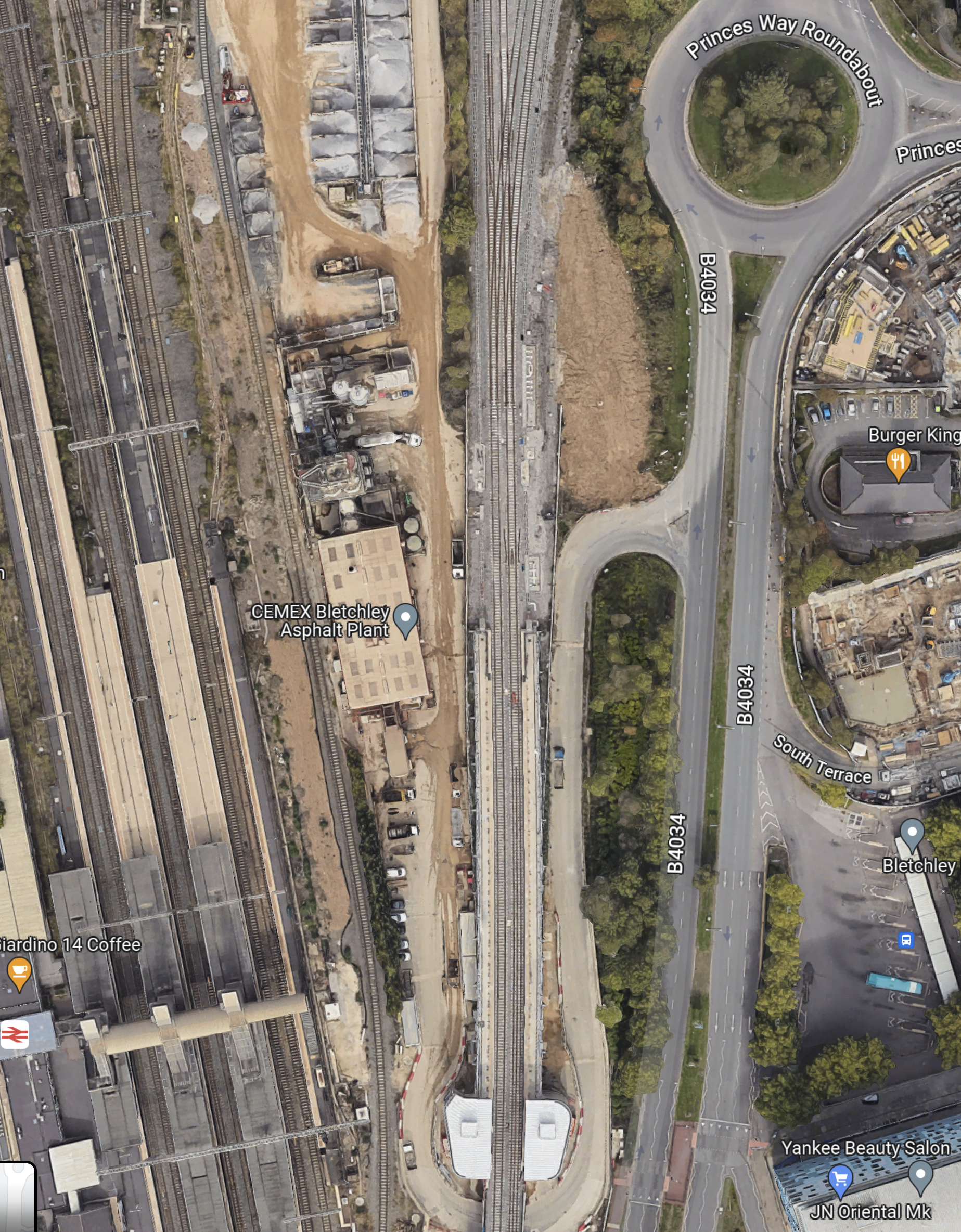
Note.
- The double-track viaduct runs North-South in the middle of the map.
- The two platforms appear to be substantially complete.
- The two lift and stair towers are at the Southern end of the platforms.
This second Google Map shows the section of the viaduct by the roundabout.
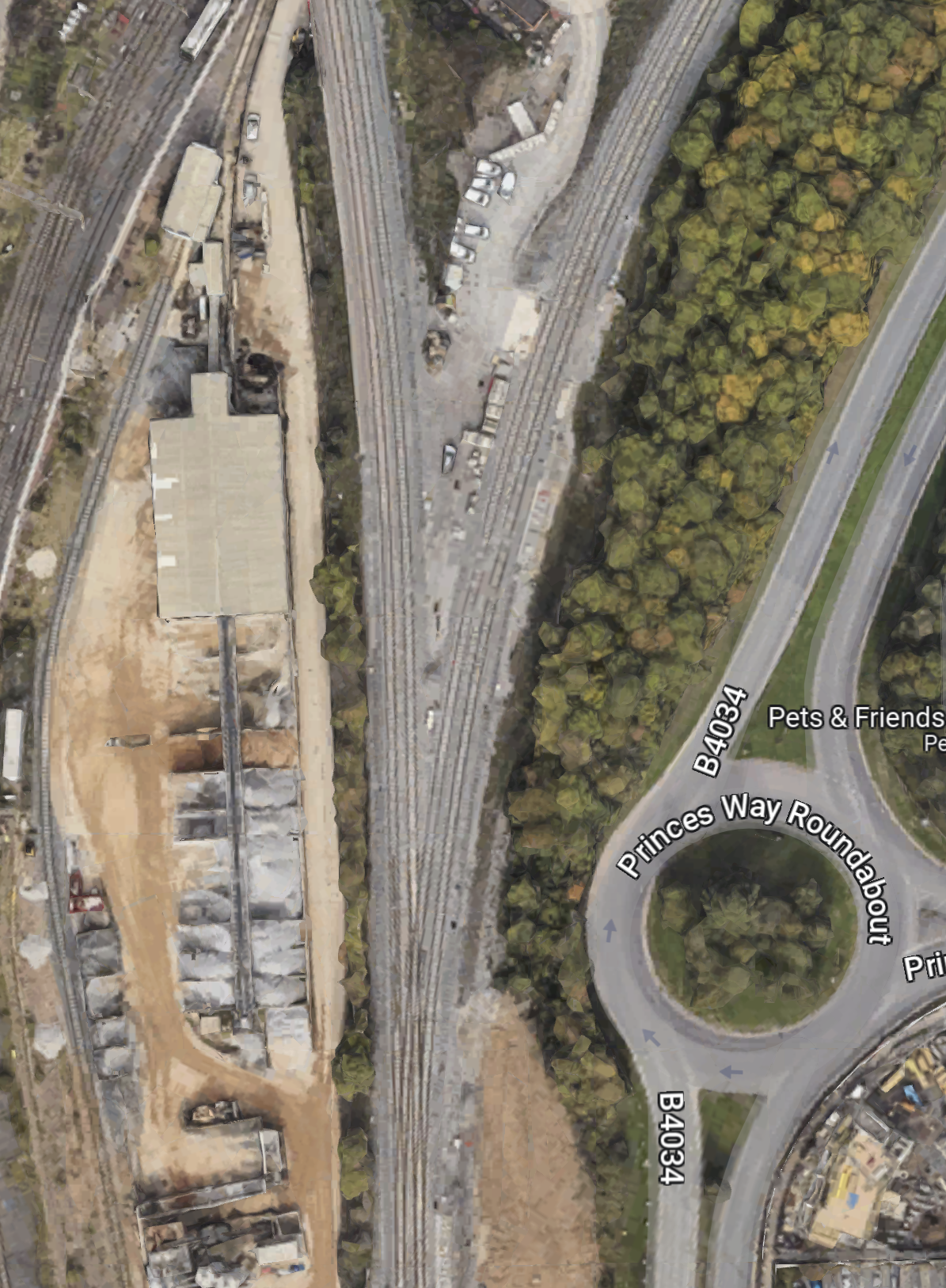
Note.
- The viaduct splits with two tracks going North-West to Milton Keynes Central and two tracks going North-East to Bedford.
- There is a complicated junction, which appears to allow a lot of flexibility for train operations.
I have followed the Milton Keynes tracks and there are cross-overs, so that trains can go between Platform 2A at Milton Keynes Central station and either of the viaduct platforms at Bletchley station, which they will need to do to run services between Oxford and Aylesbury, and Milton Keynes Central.
This Google Map shows the tracks between the viaduct and Fenny Stratford, which is the first station towards Bedford.
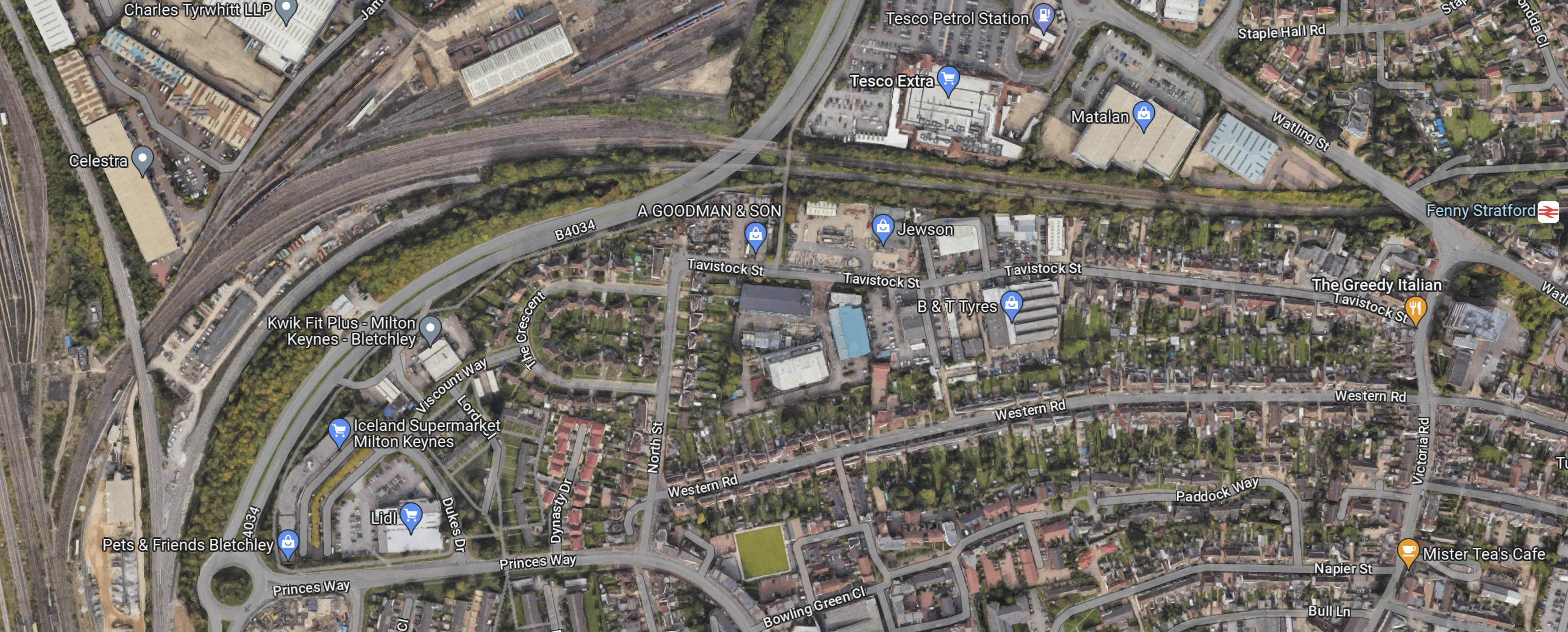
Note.
- The Princes Way roundabout in the West of the map.
- The Milton Keynes and Bedford tracks divide close to the roundabout.
- Fenny Stratford station in the East of the map.
- The tracks gradually combine from West to East, so there is only one track for the single platform at Fenny Stratford station.
This Google Map shows the Western section of the tracks between the viaduct and Fenny Stratford.
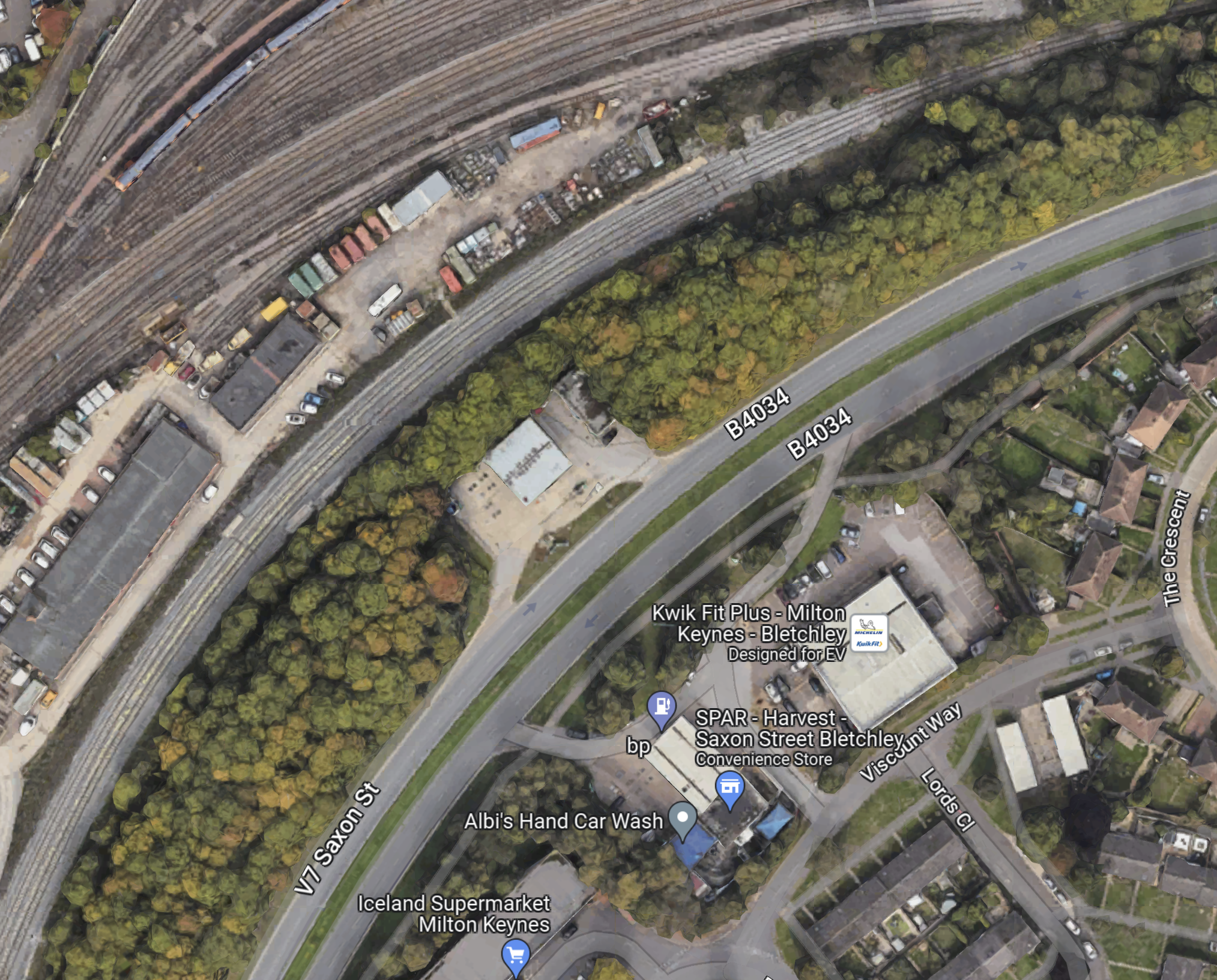
Note, how the two tracks on the viaduct join into one for going towards Fenny Stratford in the North-East corner of the map..
I’m certain, that this track layout, allows a train to go between the single platform at Fenny Stratford station and either of the viaduct platforms at Bletchley station.
A Milton Keynes Central And Bedford Service
In the Wikipedia entry for the Marston Vale Line, there is a section, which is entitled Extension to Milton Keynes Central, where this is said.
In June 2005, the then franchisee, Silverlink Trains announced an intention to extend the Marston Vale service via the West Coast Main Line to Milton Keynes Central, where a new platform and track would be built alongside the up slow track. Work began on 4 December 2006 at the station to prepare for a service connection. The platform was ready for use in January 2009 but the service did not materialise and there are no longer any published plans for it to do so. A firm service pattern on East West Rail remains to be announced but the illustrative pattern has no Bedford–Milton Keynes Central service; passengers will continue to have to change at Bletchley. There is no east-to-north chord between this line and the WCML: As of December 2020, the route the chord might take is occupied by trade outlets and a warehouse.
But.
Supposing a Milton Keynes to Bedford train did this.
- It ran from Platform 2A at Milton Keynes Central to the Northbound platform on the Bletchley viaduct.
- It would then reverse and run to Bedford along the Marston Vale Line.
- It would terminate in Platform 1A at Bedford station.
And supposing a Bedford to Milton Keynes train did this.
- It ran from Platform 1A at Bedford to the Northbound platform on the Bletchley viaduct.
- It would then reverse and run to Milton Keynes Central along the tracks alongside the West Coast Main Line.
- It would terminate in Platform 2A at Milton Keynes Central station.
Note.
- There would be some bi-directional running.
- Trains would only reverse on the Northbound platform on the Bletchley viaduct.
- Platform 2A at Milton Keynes Central would handle 4 tph.
- Platform 1A at Bedford station would handle 2 tph.
As the only reversing happens on the Northbound platform on the Bletchley viaduct, would it be sensible for a new driver to step-up, so that the reverse was fast?
I believe that with some innovative running, that a Milton Keynes and Bedford service is possible, because of the comprehensive track layout that has been installed.
 The Anonymous Widower
[…] East-West Rail: Along The Marston Vale Line […]
Pingback by East-West Rail: Route For £5bn Bedford To Cambridge Link Announced « The Anonymous Widower | June 3, 2023 |
NR spent 35m resignalling this line 20 years ago but restricted it to 60mph. It was actually one of Railtracks daft attempts to undermine the British signalling industry by importing products from overseas so its a one off and will no doubt not be suitable for modification so thats a 100m on the bill already to improve that aspect. It has ten LXings and as soon as you try and upgrade a line now NR wants to eliminate LXings which will cost a small fortune and be impractical in the villages anyhow. The routes geometry is good for 100mph albeit you would probably limit it to 90mph as that requires a lower standard of construction and maintenance costs. BR would have come up with a best fit solution to squeeze time out where you could for modest expenditure NR never does enough of that hence you come with vast capital expenditure to improve anything which would buy a lot more in other public services so the industry does need to get a grip but i fear the culture now is just too disconnected from that which BR created in teh 1980s that delivered a lean railway.
Comment by Nicholas Lewis | June 3, 2023 |
I was going to do a proper analysis, but as the 230s aren’t running Real Time Trains aren’t publishing any times for the line.
But it does seem that the track layout would allow a Bedford Milton Keynes service with a reverse on the viaduct.
I know that in the spec for the HS2 Classic-Compatible trains, a fast reverse is asked for. I think this is so Leeds London could be done with a reverse in Birmingham.
Comment by AnonW | June 3, 2023 |
They could reverse in P5 or 6 as now although i suspect DfT will say there is ample trains between Bletchley and MKC and it avoids diesel running under the wires. The most beneficial way to effect modal shift is to speed up the MK to Bedford service with the fast EWR service but really needs 2TP to do that.
Comment by Nicholas Lewis | June 3, 2023
Both Platform 1A at Bedford and Platform 5 at Milton Keynes Central are electrified and the wires go for at least a couple of hundred metres from the buffer stops. But from the Bletchley viaduct to the start of the electrification out of the station, Milton Keynes Central is not electrified. It’s also nearly three miles.
So there won’t be much running under wires.
But it does seem to me, that the Marston Vale Line is being prepared for battery-electric trains.
If a Class 777 IPEMU can do 84 miles, what could a Porterbrook Class 350, with engineering by Siemens, or an Eversholt Class 321 do?
Using the string method on a map, I reckon Oxford and Cambridge are about 90 miles apart.
That is battery electric territory.
Comment by AnonW | June 3, 2023 |
There’s quite a bit of discussion of how to improve this section in the route upgrade report https://eastwestrail.co.uk/routeupdate though they seem to be rolling back some of their original proposals. Having said that, the whole thing is still subject to public consultation next year. So whatever they propose is not necessarily what will actually be implemented.
Comment by Peter Robins | June 3, 2023 |
T’m getting to think, that this project is a lot more than just creating a railway between Oxford and East Anglia. I think, this could be the pathfinder for battery electric trains. I’m writing a post about electrification of the route and there’s some things that have been done or said, that only point to the adoption of battery electric trains.
By the way, as battery-electric trains can easily be made as zero-carbon, do they count under electrification or are they a separate category?
Comment by AnonW | June 3, 2023 |
I think we have to wait and see what the strategy of the next government is. The current lot don’t seem to have one. There will always be budget constraints though, which will rule out large-scale track electrification.
Batteries are surely train electrification – if you want to categorise these things.
Comment by Peter Robins | June 4, 2023
Some years ago, I did some data analysis work with British Rail on signal cable breakage. A lot was down to theft and some was even targeted to get BR to replace new fibre optic cables with traditional copper.
I was delayed once for nearly a whole day by overhead cable theft South of Ipswich, when trying to get home.
A French friend, says that Albanians are thieving overhead cable all the time in France.
ERTMS signalling and battery electric or hydrogen trains are part of our response to cable thieves.
Comment by AnonW | June 4, 2023 |
I see full service is resuming on Marston Vale on Monday – using 150s https://www.bbc.co.uk/news/articles/cpdejkg5z2po
Comment by Peter Robins | February 14, 2024 |