Copenhagen Infrastructure Partners Takes FID On 1,000 MWh Battery Energy Storage Project
The title of this post, is the same as that of this press release from Copenhagen Infrastructure Partners.
This is the sub-heading.
The battery energy storage system Coalburn 1 will be one of the largest battery storage projects in Europe. Construction has commenced in November 2023 and the project will be 500 MW / 1,000 MWh once complete.
These two paragraphs outline the project.
Copenhagen Infrastructure Partners (CIP) through its Flagship Funds has taken final investment decision and commenced construction on a 500 MW / 1,000 MWh energy storage system in Coalburn, Scotland, which will be one of the largest of its kind in Europe.
The facility is the first project to be developed from the partnership between CIP and Alcemi to deploy 4 GW of energy storage assets across the UK. CIP aims to take final investment decision on two other projects next year with a combined capacity above 1 GW. The portfolio will provide vital support to the UK’s energy network, accelerating the integration of renewable energy and the transition to net zero by 2050.
Note.
- FID means final investment decision.
- 500 MW / 1,000 MWh could become a common size as it is two hours of power and easy for politicians to add up.
- CIP and Alcemi seem to be planning a total amount of energy storage, eight times bigger than Coalburn 1.
This battery could be the largest in the UK, when it is commissioned.
Who Are Copenhagen Infrastructure Partners (CIP)?
Their About CIP web page gives a lot of details.
Who Are Alcemi?
Their Who We Are web page gives a lot of details.
Environmental Considerations
The press release says this about environmental considerations.
The Coalburn 1 facility has been developed with extensive landscaping and ecological mitigation measures, including the maintenance of peat reserves, tree and wildflower planting, and new habitats, promoting biodiversity across the site.
I’ll agree with that, but add that I hope that they look after the hares. It will be interesting to see how big batteries and big bunnies co-exist. As co-exist they will!
Operation
The press release says this about operation.
The scheme will reduce the need for fossil fuel power generation during periods of peak demand leading to a decrease in CO2 emissions but also provide balancing services to help lower the costs for end consumers to manage the UK Power system.
As a Control Engineer, I suspect, it will act in a little-and-large mode with Scotland’s pumped storage.
Location
This page on the SP Energy Networks web site is entitled Coalburn Connection – South Lanarkshire.
There is this introductory paragraph.
SP Energy Networks own and maintain the electricity network in central and southern Scotland. As part of our infrastructure, Coalburn Grid Substation is a key installation in the transmission network situated to the south of Lesmahagow in South Lanarkshire.
Underneath is this map.
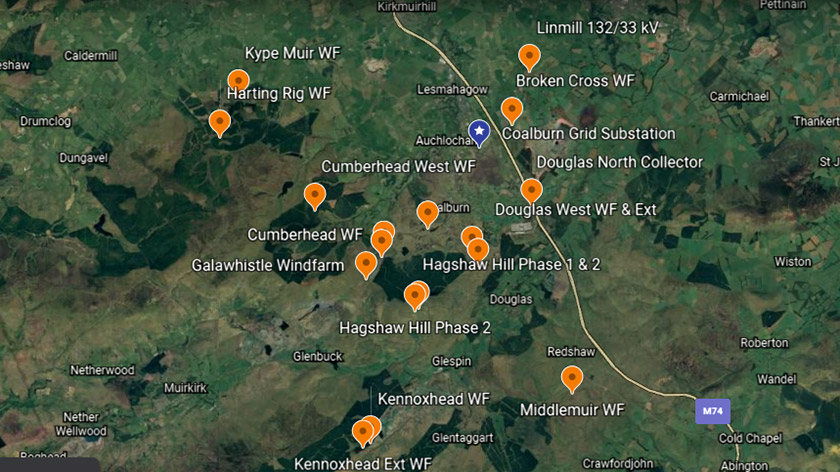
Note.
- The orange arrows are wind farms and there appear to be around a dozen of them.
- The blue arrow is Coalburn Grid Substation.
- Running through the area is the M74 between Glasgow and Carlisle.
- There are some remains of opencast coal-mines in the area, which have been restored and turned into wind farms.
- I have found the capacity of fourteen of the existing wind farms and it totals 946 MW, which is an average capacity for each wind farm of 67 MW.
- During my search for capacity, I found a couple of wind farms that were being upgraded with larger turbines.
- The SP Energy Networks page gives a date of Q3 2025 for connection of the Coalburn battery to the sub-station.
With the 500 MW/1000 MWh Coalburn 1 battery, I wouldn’t be surprised that this massive onshore wind farm complex has been designed to provide a guaranteed 1000 MW to the grid.
 The Anonymous Widower
This is CEGB system thinking locating a large battery (i would have gone for 4hr mind you) at a source of generation that often has to be constrained off (150m cost in Oct alone) due to the lack of transmission capacity from South Scotland into England. The latter isn’t going to be fixed anytime soon as environmentalists (yeah the ones that want us to go green) don’t want more pylons and they have to be 400kV to be of any use so tall as well so these constraints will persist. As ive said on your blogs before they should mandate batteries now with all new wind and solar installations. Furthermore the ESO should incentivise any BESS developer who wants to connect batteries of this size to areas of the grid where constraints are a recurring problem as they are on forecasting to spend FOUR BILLION this year on balancing activity albeit that’s not all constraint management.
If this is a genuine climate emergency (i remain agnostic) then a govt would go on a “war” footing and give the task to a CEGB MkII to coordinate the response. Can still have privateers involved but deployed in a way that drives the end goal not the random approach we have now.
Comment by nickrl | December 12, 2023 |