UK’s Largest Onshore Wind Farm To Be Rebuilt With Fewer, Larger Turbines
The title of this post is the same as that of this article on the BBC.
This is the sub-heading.
One of Europe’s biggest onshore wind farms is to be flattened and rebuilt with fewer, taller turbines, its owner has announced.
These three paragraphs add more detail to the story.
Whitelee Windfarm has been producing electricity for about 20 years on a stretch of moorland near Eaglesham, south of Glasgow, but is reaching the end of its life.
Scottish Power Renewables says the existing 215 turbines will be replaced in three phases with around 124, each of which will be about 110m (361ft) taller.
The £1.5 billion “repowering” project will take 10 years to complete and will double the electricity output from 539 megawatts to 1 gigawatt, which is enough to power about 650,000 homes.
I asked Google AI,”Will there be any objectors to the repowering of Whitelee Wind Farm” and received this reply.
While there are no formal objectors on record yet, opposition to the repowering of Whitelee Wind Farm is highly anticipated. The developer, ScottishPower Renewables, officially filed their proposal with the Scottish Government in July 2026, but the formal planning application is not expected to be submitted until December 2027.
Anticipated objectors and their concerns typically include:
Campaign Groups & Environmentalists: Organisations like Scotland Against Spin generally challenge large-scale onshore wind projects over landscape dominance, ecological impacts, and the sheer scale of the new turbines.
Visual and Height Concerns: The repowering plan proposes replacing the existing 215 turbines with roughly 124 much larger machines. Each new turbine will stand roughly 110m taller than the current ones, which is expected to draw objections from those concerned about the visual alteration of the moorland.
Aviation and Radar Issues: Taller turbines and longer blades frequently raise fresh concerns and potential clearance objections from civil aviation and military radar stakeholders.
The BBC article finishes with this paragraph.
The work at Whitelee is expected to generate about £330m for the Scottish economy.
How many Scottish jobs will a third of a billion pounds sustain?
Crown Estate To Re-Tender 1.5 GW Offshore Wind Site Relinquished by EnBW And JERA Nex BP
The title of this post, is the same as that of this article on offshoreWIND.biz.
This is the sub-heading.
The Crown Estate will launch a competitive tender process next month to bring the 1.5 GW Morgan offshore wind project in the Irish Sea back to market, with plans to appoint a new developer by late 2026.
These two paragraphs add more detail.
The Morgan site was originally awarded through Offshore Wind Leasing Round 4 in 2021, but development was discontinued in January 2026 by the joint venture between EnBW and JERA Nex BP, which held the lease rights.
After EnBW decided to exit the Morgan and Mona offshore wind projects in the UK, its joint venture partner JERA Nex BP acquired EnBW’s stake in 1.5 GW Mona, while the joint venture discontinued the development of the Morgan project and returned the lease rights to the Crown Estate.
There is no Morgan web site, but there is a joint web site with the Morecambe wind farm, which also has its own web site.
The joint web site has a home page showing both Morgan and Morecambe wind farms connecting to Penwortham substation.
In Mooir Vannin Offshore Wind Farm, I say that this web farm will also have a connection to the Penwortham substation.
There does seem a lot of bitterness about using the Penwortham substation being built.
This Ørsted map shows the large number of wind farms in the Irish Sea.
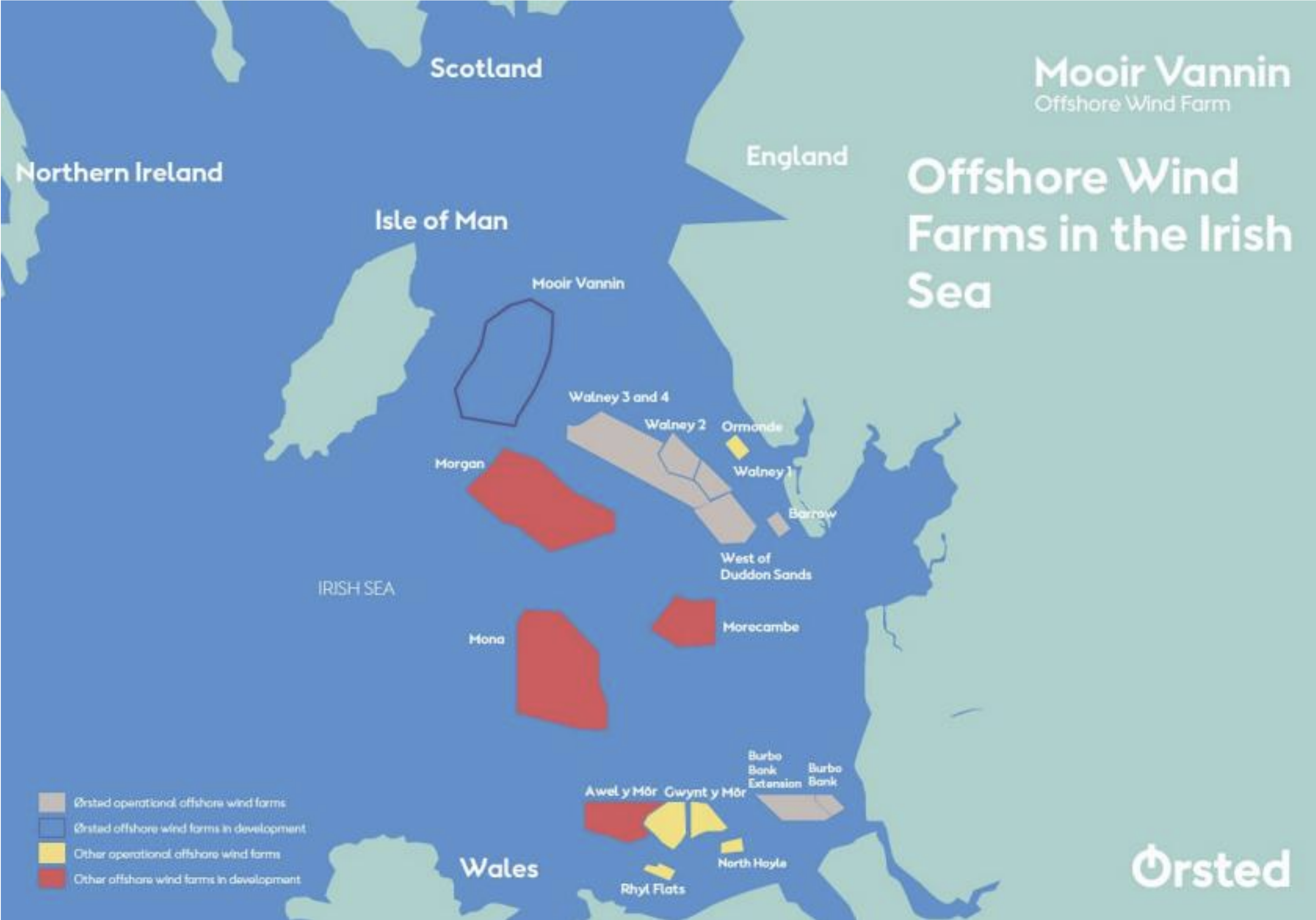
Note.
- Mooir Vannin is a 1.4 GW wind farm being developed to the East of the Isle of Man
- Morgan wind farm would have been a 1.5 GW wind farm to be South of Mooir Vannin.
- Mona wind farm will be a 1.5 GW to the South of Morgan.
- Mona will connect to the North Wales coast.
- Morecambe will be a 480 MW wind farm to the East of Morgan and Mona.
- Mooir Vannin will connect to the Isle of Man.
- Morgan and Morecambe wind farms were all planned to connect to the Penwortham substation.
- Mooir Vannin will additionally connect to the Isle of Man.
It will be interesting to see, what proposals are put to the Crown Estate for a replacement of the Morgan wind farm.
I wouldn’t be surprised to see something to do with offshore production of hydrogen, as there is much more hydrogen production on the East side of the UK, due to the massive German AquaVentus project.
‘Our Wind Farm Won’t Discourage Bronte Tourists’
The title of this post, is the same as that of this article on the BBC.
This is the sub-title.
The developers of England’s largest wind farm have claimed that the turbines will not discourage visitors to moors once loved by the Bronte sisters.
These three paragraphs add more detail.
Calderdale Energy Park is applying to construct 34 turbines on Walshaw Moor, between Hebden Bridge and Haworth – the village associated with Bronte tourism.
As a nine-week public consultation begins, chief executive Christian Egal told objectors that the development would provide “cheap, reliable and stable” energy.
Campaigners who oppose the plans for the West Yorkshire moorland said that the wind farm would turn the scenic area into an “industrial complex”.
It is worth reading the whole BBC article as it gives a lot of detail and if you are worried about this sort of development, you should visit.
I have some thoughts.
Saint Brieuc Wind Farm
This wind farm has a web site.
Christian Egal says this about this wind farm of the coast of Brittany in France.
“There are thousands of visitors every day taking a boat to visit the wind farm, it has been demonstrated that at similar sites the balance is not negative, there are lots of circumstances where wind farms attract a lot of interest.”
The developers should make the wind farm visitor-friendly.
Peat
I know that peat on these and other moors is a sensitive subject and this is said about it.
Access roads will be built over the moor but Egal said: “We avoid deep peat, each turbine is located where the peat is shallow and any peat that is removed will be reinstated locally so the net balance will be zero loss of peat.
That looks to be the right attitude!
Will There Be A Battery?
This Google Map shows Haworth.
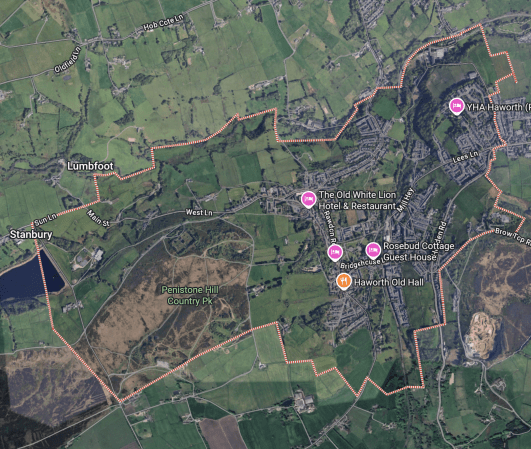
Note.
- Haworth is outlined in red.
- There appears to be something like a quarry on the Eastern edge of the map.
I wouldn’t be surprised if a suitable space for on of the new technology batteries can be found.
Rheenergise is one company that comes to mind.
Cardiff And Caerphilly – 24th March 2026
I took this pictures, as I rode up the Rhymney Valley from Cardiff to Caerphilly.





















Note.
- The trains I took up and down the valley were both Class 756 tri-mode trains.
- My train reversed to Penarth in Platform 1.
- I think they were running using the diesel power in the power pack.
- There is an overhead conductor rail in Platform 1 at Caerphilly station to charge trains.
- The electrification North of Caerphilly station can be seen through the bridge in one of the pictures.
- Platforms 2 and 3 are not electrified.
I think Caerphilly station is a very neat electrification layout for occasional charging of battery-electric or tri-mode trains.
I have some specific thoughts.
What Have Caerphilly And St. Pancras Thameslink Stations Got In Common?
These pictures show the rigid conductor rail through St. Pancras Thameslink station.




It looks remarkably similar to that in Platform 1 at Caerphilly station.
Judge in this picture.
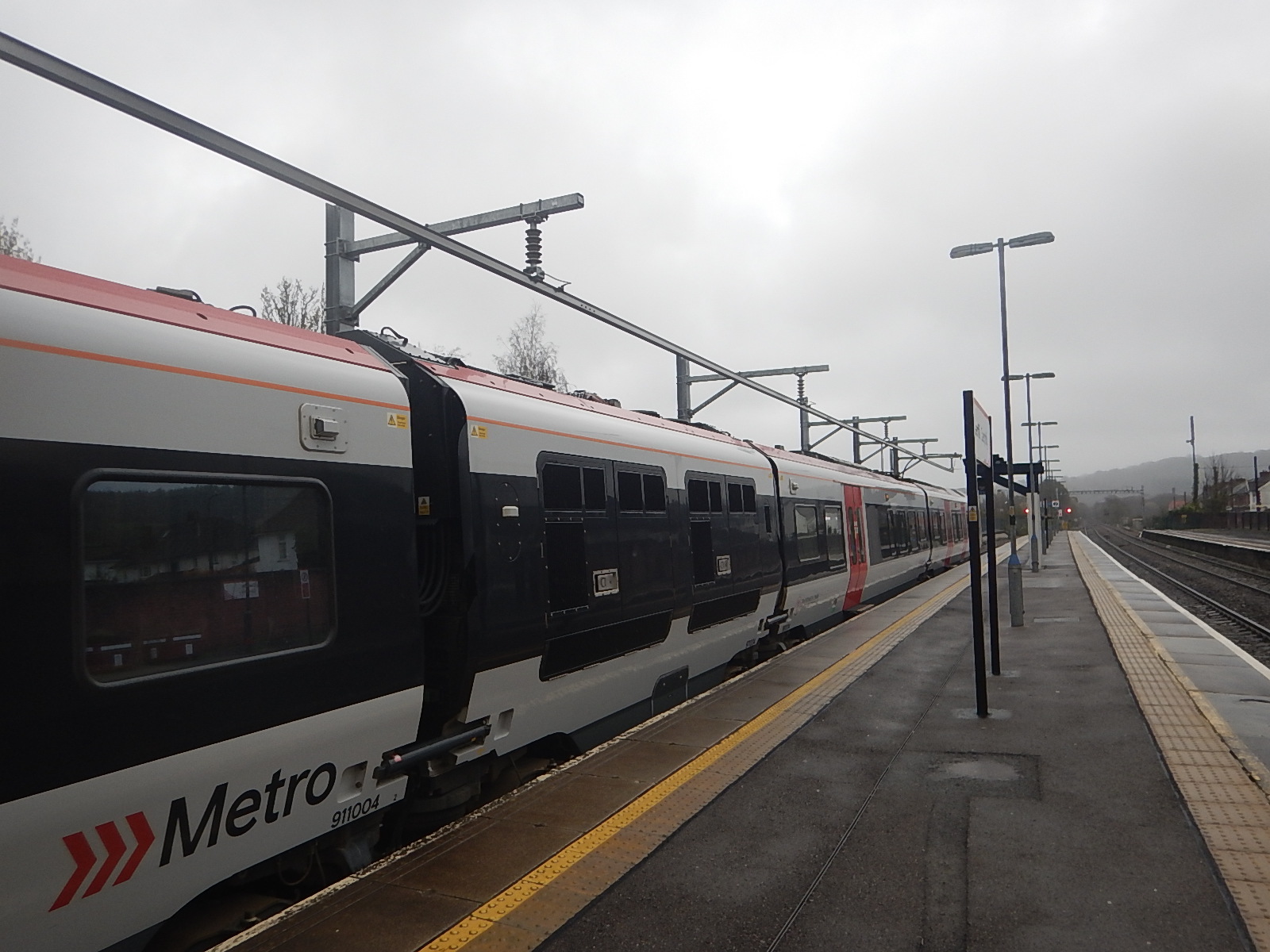
The rails are probably out of the same Swiss electrification maker’s parts bin.
Both look equally professional with an I-section conductor, which could be aluminium, as it is lightweight and a good electrical conductor.
Google AI finds this.
The I-beam overhead conductor system used in St. Pancras Thameslink station is made of a hollow extruded aluminium profile. This system, known as a conductor beam, holds a conventional copper contact wire, providing a rigid, low-profile alternative to traditional overhead wires.
Key details:
Material: Extruded aluminium profile.
Structure: Hollow, designed to hold an un-tensioned, conventional copper contact wire.
Application: Developed by Balfour Beatty to reduce the required depth of overhead line equipment.
Installation: Often installed in a sinusoidal wave to ensure consistent wear on the pantograph.
This technology is used in areas with restricted overhead space, such as tunnels and some modern station approaches, to manage 25kV AC electrification.
It looks like it’s been used to provide a charging rail in Caerphilly station.
Is The Conductor Rail In Platform 1 Used To Create A Continuous Electrical Connection Around Caerphilly Station?
Look at this OpenRailwayMap, which shows the completed electrification through Caerphilly station.
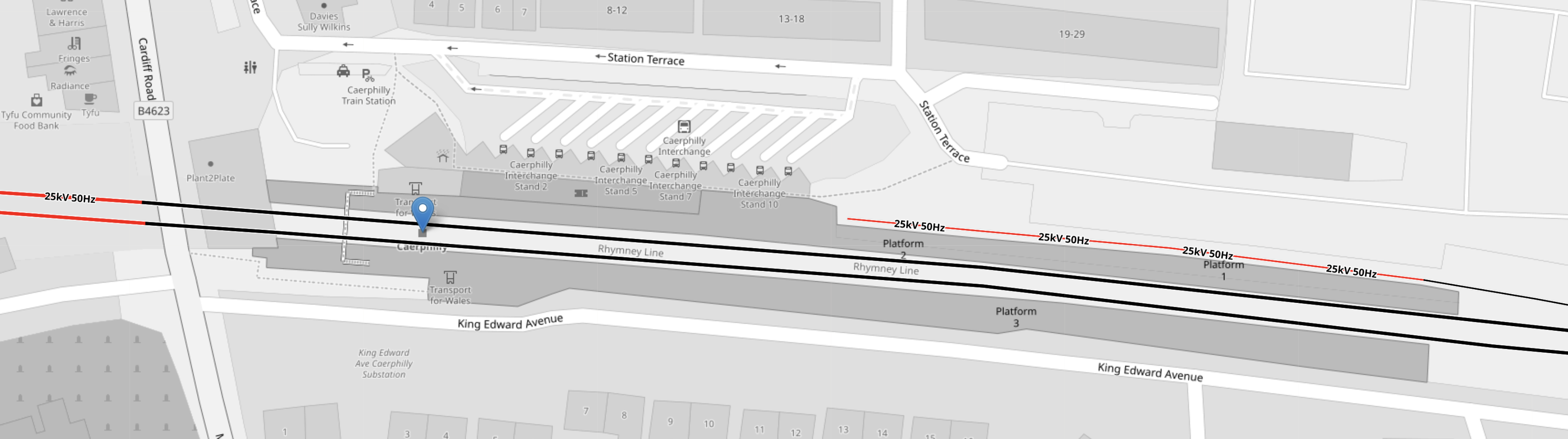
Note.
- Red tracks are electrified.
- Black tracks are not electrified.
- Caerphilly station is indicated by the blue arrow.
- The electrification continues to the Western end of the station.
- The two main platforms 2 & 3 are not electrified.
- The bay platform 1 is electrified to charge trains for return to Cardiff.
- Class 756 tri-mode electric-diesel-battery trains are already in service.
- There appears to be a comprehensive bus interchange.
The power for Platform 1 could come from the electrification at the Western end of the station.
I wouldn’t be surprised that the Rhymney Line will be fed with electricity at the heads of the valleys and it is fully-connected down to Cardiff to give a secure electrical connection.
Will Welsh Wind Power From The Heads Of The Valleys Be Used To Power The Cardiff Valley Lines?
To start with, as I know it can be blowy there, I asked Google AI, this question.
“Is Onshore Wind Planned At The Heads Of The Valleys In South Wales?”
I received this answer.
Yes, there is significant onshore wind energy development planned and in progress along the Heads of the Valleys area in South Wales. This region, encompassing areas like Merthyr Tydfil, Blaenau Gwent, and northern Rhondda Cynon Taf, is part of a broader push to increase onshore wind capacity in Wales, with many projects located on Natural Resources Wales forestry land.
Key Developments and Proposed Projects (2025-2026):
Trydan Gwyrdd Cymru: The Welsh government-owned developer has selected sites in South Wales for new, large-scale wind farms intended to be operational by 2040.
Carreg Wen Wind Farm: A planned 18-turbine project located between Aberdare and Maerdy (Rhondda Cynon Taf), near the Hirwaun/Heads of the Valleys area.
Hirfynydd Renewable Energy Park: A proposed project located on the Hirfynydd mountain range between Seven Sisters and Banwen, north of Neath, near the western end of the Heads of the Valleys.
Mynydd Llanhilleth and Trecelyn Wind Farms: Projects in the pre-application or planning stages by Pennant Walters in the Blaenau Gwent area.
Abergorki Wind Farm: A consented three-turbine project on Mynydd Maerdy (Rhondda Cynon Taf) with construction scheduled for 2026.
Operational Context:
Pen y Cymoedd: Already operational and currently the largest onshore wind farm in England and Wales, situated in the hills above the upper Neath, Afan, Rhondda, and Cynon Valleys.
Grid Infrastructure: Proposed new substations, such as one near Hirwaun (Rhondda Cynon Taf), are intended to connect these new projects to the national grid.
These developments are part of a target to generate 70% of Wales’ electricity from renewable sources by 2030, with a focus on areas previously identified as suitable for large-scale wind development.
Note.
- Pen y Cymoedd is the largest onshore wind farm in Wales and England, with an installed capacity of 228 MW.
- With the right size of battery, I’m fairly sure, that this wind farm could go a long way to powering the Cardiff Valley Lines.
- Carreg Wen Wind Farm is planned to be 108 MW wind farm.
- Hirfynydd Renewable Energy Park is planned to be a 100 MW hybrid development of wind turbines and solar with a battery.
- Mynydd Llanhilleth is planned to be a 48 MW wind farm.
- Trecelyn is planned to be a 20 MW wind farm.
- Abergorki is planned to be a 13 MW wind farm.
The total of new developments is 389 MW, which is about the same size as a Rolls-Royce SMR.
German Wind Tender Awards 3.46 GW Amid Record Demand, Lower Prices
The title of this post, is the same as that of this article on Renewables Now.
These are the first three paragraphs.
Germany’s Federal Network Agency (BNetzA) selected 415 projects with a combined capacity of 3,456 MW in the last onshore wind tender round for 2025, seeing record interest in the procedure and falling prices.
Until the deadline of November 1, as many as 905 bids totalling 8,155 MW were submitted, while the target was 3,450 MW. As many as 37 projects had to be excluded from the competition, the agency said on Thursday.
The value of the successful bids ranged between EUR 0.058 (USD 0.068) per kWh and EUR 0.0612 per kWh. The average volume-weighted award price stood at EUR 0.0606 per kWh, which is below the value of EUR 0.0657 per kWh in the previous round and significantly lower than the maximum possible amount of EUR 0.0735 per kWh.
Note.
- These figures show that the German onshore wind market is healthy and the price of the electricity is falling.
- The procedure marks the fourth onshore wind tender round for 2025. In the previous three rounds, the Federal Network Agency allocated capacities of 3,448 MW, 3,447 MW and 4,094 MW, respectively, so with this round’s 3,456 MW, that makes 14.445 GW or about four-and-a-half Hinckley Point Cs.
- Germany is 45 % larger than the UK in terms of land area.
If we were installing wind turbines at the same rate as the Germans, we’d have installed a few megawatts short of ten gigawatts onshore in the same period of time.
I have some thoughts on these figures.
Does More Onshore Wind Mean Lower Electricity Prices?
If we were installing onshore wind turbines at the same rate as the Germans, our energy prices might be lower.
More research needs to be done.
Do The Germans Have A Pricing Structure That Encourages The Take-Up Of Onshore Wind?
If they do, then we should think of using it in certain locations.
Offshore Wind Turbines In 2025: China Continues Leading In Single-Unit Capacity, Vestas’s 15 MW Turbine Installed At Offshore Wind Farms
The title of this post, is the same as that of this article on offshoreWIND.biz.
This is the sub-heading.
In offshoreWIND.biz‘s 2024 annual wind turbine overview, you could have read about the first 16 MW floating wind platform installed offshore and a 26 MW prototype under construction, both in China, and a 21 MW prototype being assembled in Europe. Wind turbine generator (WTG) technology did not stop progressing in 2025, with Chinese OEMs still leading capacity-wise, while in Europe, first offshore wind farms are now featuring 15 MW turbines and a 21+ MW model was installed onshore for testing.
The article is very much a must-read and there is a lot of innovation going on.
As a comparison, between 2020 and 2026 we commissioned or are building these offshore wind farms in the UK.
- East Anglia One – 2000 – 714 MW – 102 x 7 MW
- Hornsea One – 2020 – 1218 MW – 174 x 7 MW
- Kincardine – 2021 – 49.5 MW – 6 x floating
- Hornsea Two – 2022 – 1386 MW – 165 x 8 MW
- Moray East – 2022 – 950 MW – 100 x 9.5 MW
- Triton Knoll – 2022 – 857 MW – 90 x 9.5 MW
- Seagreen Phase 1 – 2023 – 1400 MW – 114 x 10 MW
- Dogger Bank A – 2025 – 1235 MW – 95 x 13 MW
- Moray West – 2025 – 882 MW – 60 x 14 MW
- Neart Na Gaoithe – 2025 – 450 MW – 54 x 8 MW
- Dogger Bank B – 2026 – 1235 MW – 95 x 13 MW
- East Anglia 3 – 2026 – 1372 – 95 x 14 MW
- Sofia – 2026 – 1400 MW – 100 x 14 MW
Average sizes for the various years are as follows.
- 2020 – 7 MW
- 2021 – floating
- 2022 – 8-9.5 MW
- 2023 – 10 MW
- 2025 – 8-14 MW
- 2026 – 13-14 MW
It can clearly be seen that in the last few years, turbines have been getting bigger.
I have some thoughts on the article.
2025 Saw Some Plans For And Installations Of Some Very Large Turbines
These four monsters were mentioned at the start of the article.
- 26 MW – Prototype installed for testing (China)
- 21.5 MW – Prototype installed for testing (Europe)
- 15 MW Installed at offshore wind farms (Europe)
- 50 MW Twin-turbine platform; Announced (China)
- MingYang Turbines to Spin on Hexicon’s Floating Offshore Wind Project
- World’s First Offshore Wind Farm Using 16 MW Turbines Enters Construction In China
- The Secret Of The TwinHub
- Hexicon Wins UK’s First Ever CfD Auction For Floating Offshore Wind
- The Chinese seem to be providing turbines for both manufacturers.
- The TwinHub is the Swedish design, being built for trial in Cornwall.
- This new design is a 50 MW design, whereas these two are 32 MW.
Ørsted In Talks To Sell Half Of Huge UK Wind Farm To Apollo
The title of this post, is the same as that as this article in The Times.
This is the sub-heading.
The US investment giant is eyeing a 50 per cent stake in the Danish energy company’s £8.5 billion Hornsea 3 project off the Yorkshire coast
These are the first three paragraphs, which add more detail.
An American investment giant is negotiating a deal to buy half of what will be the world’s largest off-shore wind farm off the coast of Yorkshire from the troubled Danish energy company Ørsted.
New York-based Apollo, which oversees assets of about $840 billion, is in talks with Ørsted about acquiring a 50 per cent stake in Hornsea 3, an £8.5 billion project that started construction in 2023 and will be capable of powering more than three million UK homes.
A transaction would be a boost for Orsted, which has come under pressure in recent months from rising costs and a backlash against renewables in the United States by President Trump. Orsted started the process of selling a stake in Hornsea 3 in 2024 and said last month that it had an unnamed preferred bidder for the asset, which the Financial Times first reported was Apollo.
I have written several times about Ørstedregularly building a large wind farm and then selling it, so they must be doing something right.
In World’s Largest Wind Farm Attracts Huge Backing From Insurance Giant, I wrote about how Aviva bought Hornsea 1 from Ørsted.
One of the guys at Aviva explained that these sort of investments gave the right sort of cash flow to fund insurance risks and pensions.
Now that Trump has attempted to give his kiss of death to wind power in the United States, will US funds be looking for quality investments like Hornsea 3 in the UK and other large wind farms in France, Germany, Norway, Japan and Korea?
Already, Blackrock are investing billions to build a massive data centre at Blyth, where there are Gigawatts of offshore wind power and an interconnector to Norway, so that UK and Norwegian wind can be backed up by UK nuclear and Norwegian hydropower.
Highview Power And Ørsted
I wrote Highview Power, Ørsted Find Value In Integrating Offshore Wind With Liquid Air Energy Storage in November 2023.
I would have thought, that by now a battery would have been announced in one of Ørsted’s many projects.
I asked Google AI if Highview Power and Ørsted were still talking about liquid air energy storage and received this reply.
Yes, Highview Power and Ørsted are still actively involved in Liquid Air Energy Storage (LAES), having completed a joint study in late 2023 on combining LAES with offshore wind to benefit the UK grid, and the findings were presented to the government for its long-duration energy storage (LDES) consultation. They believe LAES can reduce wind curtailment, increase energy productivity, and support grid resilience, with potential projects aligned with offshore wind farm timelines.
Perhap’s Ørsted are getting their finances aorted first?
Conclusion
The Times They Are A-Changing!
Plan For England’s Largest Wind Farm ‘Scaled Back’
The title of this post, is the same as that of this article on the BBC.
This is the sub-heading.
Plans for the largest onshore wind farm in England have been scaled back by a developer.
These two introductory paragraphs add more details.
Calderdale Energy Park said it would apply for permission to build 41 turbines instead of the 65 originally planned on land near Hebden Bridge in West Yorkshire.
A consultation period has now begun and people have been invited to submit their views on the project over the next six weeks.
Note.
- The number of wind turbines has been reduced by 37 %.
- Are the turbines now larger?
- In another paragraph, the developers say the solar element has been removed.
- Batteries, which I feel are essential to smooth the output of wind farms, are not mentioned.
Given comments by Stop Calderdale Wind Farm about peat bogs, there will be a large fight over building this wind farm.
Zenobē Lands Financing For 400MW Eccles Project
The title of this post, is the same as that of this article on Solar Power Portal.
This is the sub-heading.
Battery energy storage system (BESS) developer/operator Zenobē has announced that it has successfully financed its Eccles BESS project in Scotland, in one of the biggest finance rounds in European history.
These two paragraphs add more details.
The total debt raised for the 400MW/800MWh project was £220 million, which the company says is one of the largest finance raises for a standalone BESS project ever made in Europe. The funding was provided by a group of lenders organised by National Westminster Bank and KKR Capital Markets Partners LLP. Additionally, Zenobē has announced that construction on the Eccles BESS—the company’s largest battery project to date—has begun.
The Eccles BESS is the final part of the firm’s £750 million investment in Scotland. Zenobē’s Blackhillock BESS, a 200MW/400MWh project located near Inverness, recently began commercial operations, and is set to expand to 300MW/600MWh later this year.
Zenobe seem to be able to finance these projects, without too much difficulty.
Construction seems to have started. But then, I suspect there are wind turbines in the vScottish Borders already lined up to use the batteries.
This Google Map shows an Eccles substation.
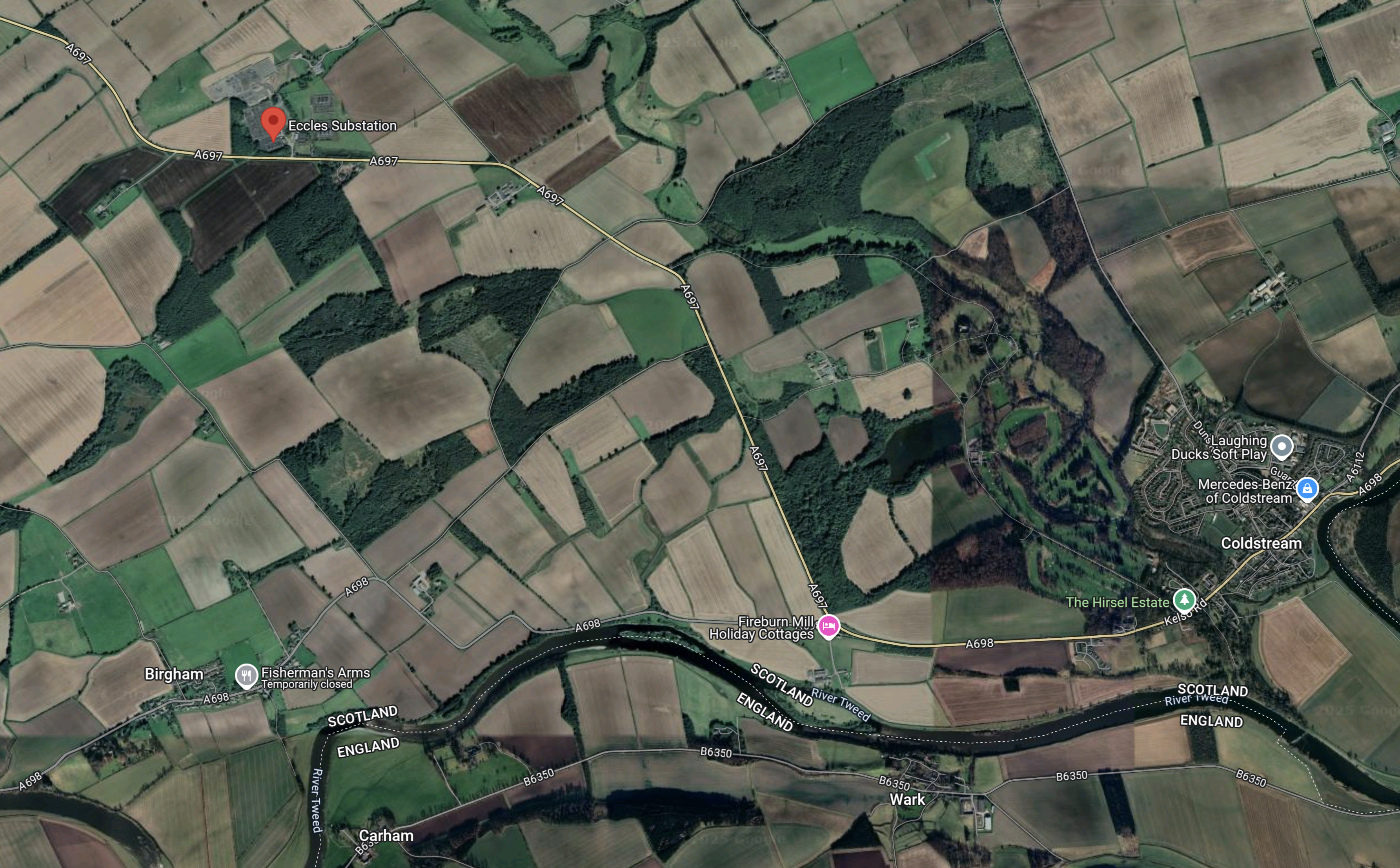
Note.
- The Eccles substation is marked by the red arrow.
- The town at the East edge of the map is Coldstream.
- The England-Scotland border is clearly marked.
This second Google Map shows a closer view of the Eccles substation.
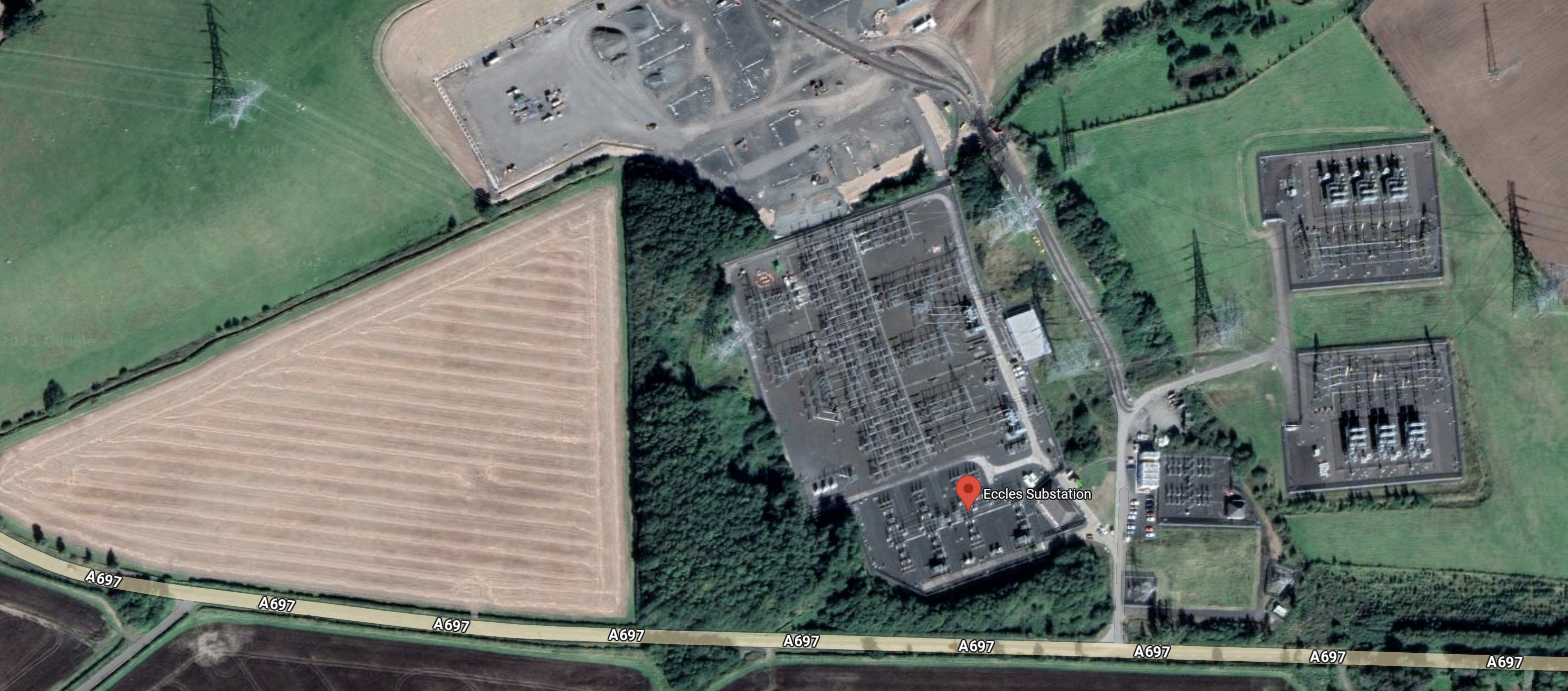
Note.
- t looks to be a substantial substation.
- There would appear to be plenty of space for a large battery.
- It is close to the A 597 road for the delivery of heavy equipment.
I suspect this substation could be the location of the battery.
It’s also right in the heart of Scottish onshore wind territory.
It is also according to the Solar Power Portal a £220 million project.
A project of this size will deliver substantial benefits in terms of work to the local community.
It will likely have a community benefit fund or something similar.
So you would expect the project would be welcomed into the local area.
But you would be wrong, if this article on the BBC, which is entitled Village ‘Heart Ripped Out’ By Battery Site Plans, is typical of the feeling about the batteries.
This is the sub-heading.
A rural community in the Borders is warning that Scotland’s renewable energy revolution is coming at a cost.
These three paragraphs add more detail.
Residents of Leitholm – a village between Coldstream and Greenlaw – claim the heart is being ripped out of their community with the arrival of battery storage facilities.
If all six proposed facilities are approved, more than 200 acres of farmland will be turned over to concreted compounds within a three-kilometre radius of their village.
Retired nursery owner Seonaid Blackie said: “This is not the place it used to be – people are worried sick.”
The residents view is balanced by industry expert Professor John Irvine, from St Andrew’s University, believes energy storage has a vital role to play in reaching net-zero targets.
My view is what is needed is an energy storage system, that can be built substantially underground.
If you look at large Battery Energy Storage Systems (BESS), they are best described as container parks.
We need energy storage systems, that fit in a single tennis court, rather than thirty football pitches.
Gravitricity is one possibility, who are also Scottish, who store energy using weights in disused mine shafts.
The French system; DELPHY is also a vertical system for storing hydrogen in a custom-built hole.
Practically, I believe the solution adopted will be to spread the batteries out and spend money on surrounding them with trees and other camouflage.
The Areas Where Labour Wants To Build Onshore Wind Farms, Mapped
The title of this post, is the same as that of this article on inews.
This is the sub-heading.
Ten onshore wind projects have been proposed to help keep UK on track to have at least 95 per cent clean power by 2030.
This is the first paragraph.
The Government is bracing for its biggest nimby battle yet as onshore wind farm companies work on a flurry of proposals after an effective ban on development was lifted in England.
I suggest you take the time to read the well-written informative article, if you are worried about onshore wind farms being parked on the hill behind your house.
The first ten are provocative and there is a map of their locations, which are mainly in Scotland and Wales, on the Pennines and in Lincolnshire.
This paragraph in the article, quotes government data on the cost of various forms of energy.
They estimate that over the entire course of a project’s life, onshore wind costs £38 per mega watt hour of energy, compared to £44 for offshore and £41 for solar. Gas, meanwhile, is £114, while nuclear is £128.
I don’t have any other real data, but it does appear that floating offshore wind farms have a higher capacity factor, which should tip the cost comparison back in its favour.
But I do suspect that Ed Miliband will use these figures to increase the amount of onshore wind in the ?UK and especially n England.
As larger turbines are being tested by the Chinese and Siemens, I suspect too, that we’ll see larger turbines installed onshore.
I also believe as a Control Engineer, that as the number of large turbines increases, we will see more energy storage built alongside wind farms.

