Decarbonising The Mid-Cornwall Metro
Although the Mid-Cornwall Metro will probably run initially using what diesel multiple units, after a year or so, the route will be converted to zero-carbon operation.
Newquay To Falmouth Docks
This map shows the Mid-Cornwall Metro.

These are current timings.
- By train can take almost three hours with changes at Par and Truro.
- By car should take 45 minutes to drive the 24.4 miles according to Google.
Note.
- The train timings are for a typical British Rail-era Diesel Multiple Unit on the branches and something smarter between Truro and Par.
- A Day Return ticket would cost £8.90 without a Railcard.
- If there was a through train, that meant you didn’t have to change trains, I estimate that the time could be as low as one hour and 35 minutes.
I feel that most travellers, who had access to a car, would use that to travel between Newquay and Truro.
Newquay To Falmouth Docks By Electric Train
I have ridden in three battery-electric trains.
- Class 379 train – Manningtree and Harwich in passenger service.
- Class 230 train – Vivarail demonstration
- Class 777 train- Liverpool Central and Headbolt Lane in passenger service.
Note.
- All were mouse-quiet.
- There was no detectable difference, when running on battery power in the trains.
It is my view that battery-electric trains are no second-class solution.
Consider.
- Newquay and Par is 20.8 miles.
- Falmouth Docks and Par is 30.8 miles.
- Newquay and Falmouth Docks is 51.6 miles.
- The maximum speed between Par and Newquay is around 30 mph
- The maximum speed between Par and Falmouth Docks is around 50-70 mph
- There are twelve intermediate stations.
- There is a reverse at Par station.
- Charging would be easy to install at Falmouth Docks, Newquay and Par.
- In Par Station – 10th February 2024, I suggested that Par station could be fully-electrified, so that expresses could have a Splash-and-Dash on their way to London and Penzance. If all platforms at Par were electrified the Mid-Cornwall Metro trains could charge from the electrification, as they reversed.
There are two main ways that the Mid-Cornwall Metro might operate.
- There would be chargers at Newquay and Falmouth Docks and trains would shuttle the 51.6 miles between the two stations.
- There would only be charging at Par and trains would after charging at Par go alternatively to Newquay and Falmouth Docks.
The first might need smaller batteries and the second would only need one charger.
Newquay To Falmouth Docks By Hydrogen-Powered Train
There is only one hydrogen-powered train in service and that is the Alstom Coradia iLint, which is running in Germany.

I feel it is very much an interim design, as Alstom has taken a diesel-mechanical Lint train and swapped the diesel for a hydrogen-powered electricity generator and an electric motor.
But Alstom are putting together a hydrogen-powered train based on an Aventra.
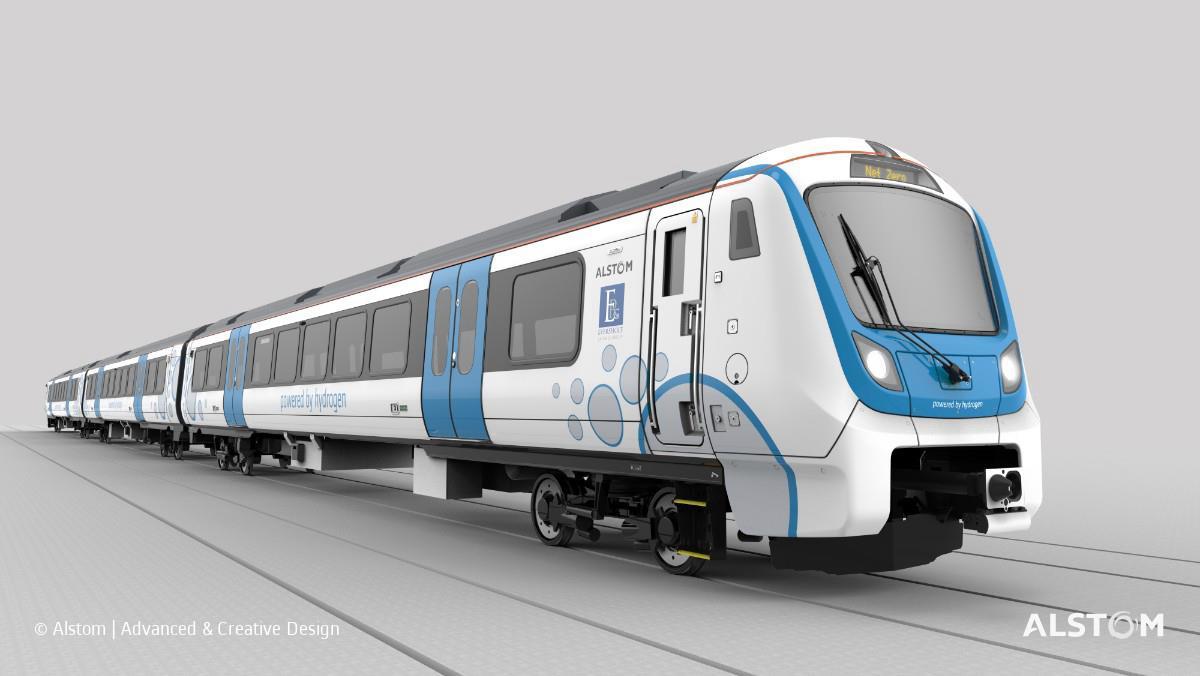
Note.
- The train is three cars.
- I would envisage performance of the hydrogen train would be very similar to that of a similar battery-electric train.
- I wouldn’t be surprised that refuelling of the train would not be a problem, as with all the china clay working nearby, there may well be developments to use hydrogen in the industry to decarbonise the mining.
The Mid-Cornwall Metro and Alstom’s Hydrogen Aventra could be ideal for each other.
Conclusion
I believe, that although the Mid-Cornwall Metro will start operation with diesel multiple units, it will be running in a zero-carbon mode within a few years.
 The Anonymous Widower
Outside summer months you would be better going by road but right thing to do in this busy tourist area
Comment by Nicholas Lewis | February 16, 2024 |
Probably!
I was surprised how much, the cutting out of the two changes saved on the journey.
I part-grew up in Felixstowe and a decent train service to Ipswich would have made my life a lot better.
My father bought me an old banger as soon as I could drive. I don’t think that would happen today and electric cars are so expensive.
Comment by AnonW | February 16, 2024 |
[…] Decarbonising The Mid-Cornwall Metro, I talked about using the Vivarail/GWR Fast Charge system or hydrogen to decarbonise the […]
Pingback by Newquay Station – 9/10th February 2024 « The Anonymous Widower | February 17, 2024 |