Eurozone Agrees Financial Transaction Tax
Well not quite, if you read the report on RTE, the Irish national broadcaster.
The Irish Finance Minister, Michael Noonan, said the following.
We have stamp duty on share transactions at 1% – we don’t want to go beyond that at present. The British aren’t prepared to go beyond that, Luxembourg isn’t prepared to go beyond that.
“The risk of the activities in financial services moving from Ireland to other centres, particularly London, Luxembourg, the Netherlands is quite high.
One idea behind the financial transaction tax, which is also supported by France, is that it could create a fund to cushion taxpayers from having to bailout banks.
Reading what he said in full, seems to indicate that Ireland, the UK, Luxembourg and perhaps The Netherlands won’t have anything to do with it.
I don’t think any sensible person, would join a club, that would fine you every time you invested anything, especially if you paid all your taxes.
I see a personal problem with it, in that London is going to attract many more rich people, who will want to clog the city with their cars.
The Return of NatWorst
Some years ago, I used to do the programming and processing for a company called PressWatch, that rated the coverage of major companies in the UK printed media.
Some time before I programmed the system, NatWest had a string of bottom places and were labelled NatWorst by some financial journalists.
It would appear from its current computer problems, that along with other banks in the RBS Group, it is attempting to claim the bottom place again. Read about it here.
The article says it is a computer glitch. I would describe it as a computer disaster.
A computer glitch is what I’ve just suffered from Nationwide. They said my credit card statement would be ready online on Wednesday. It didn’t arrive until today. But at least, it didn’t cost me any money, although I did worry, that there might have been some illegal transactions, they were sorting out. Especially, as it’s the VISA card, I use for Olympic tickets. But all is now fine.
A Sandwich Board in Islington
This guy was selling pensions in Islington yesterday.
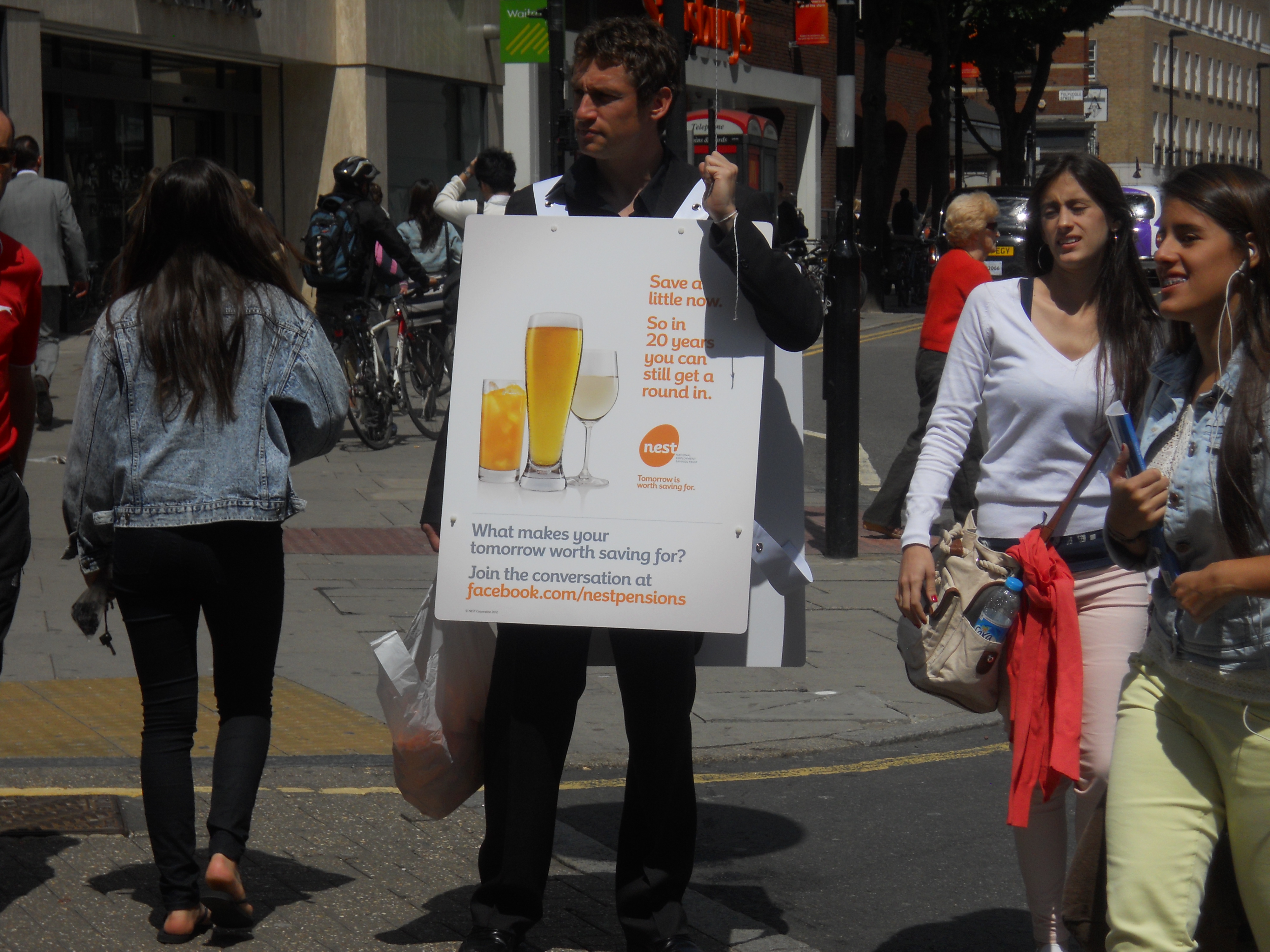
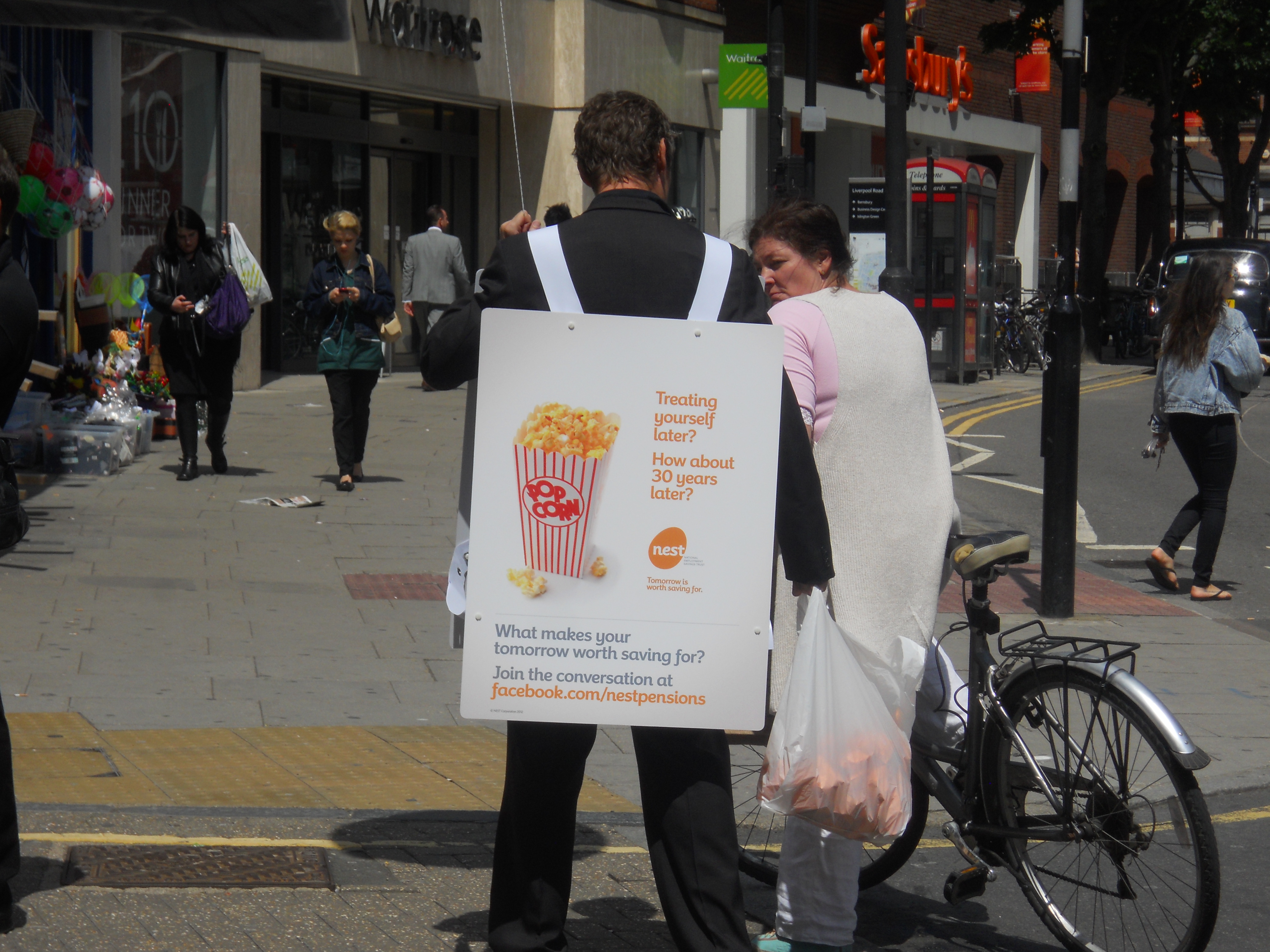
I admire his methods, but I wouldn’t be sure about his products.
But saying that, trying to sell pensions to most people is very difficult.
My First Time on Stage
Surprisingly, a few weeks from my 65th birthday, I went on a theatrical stage for the first time last night.

On Stage at the Hackney Empire
It was a fundraising event for the Hackney Empire. The picture doesn’t really do justice to the interior of the theatre.
Peer-To-Peer Lending Gets a Plug in the Scotsman
The Scots like to think they are canny and one even thought he was prudent, so this article from the premier Scottish newspaper, the Scotsman should be very much welcomed by the peer-to-peer lending industry or at least its three major players; Zopa, Funding Circle and Ratesetter.
She’ll Regret That Photo
The Times has an awful picture on the front page of Angela Merkel.
She looks in a terrible mood and if it wasn’t for her age, you might think that she was pregnant.
But then she has a lot of problems to solve!
The Spanish Bailout and Gibraltar
Spain makes two sets of headlines today; it has got a massive loan to sort out its banks and it is expected to protest loudly at the Wessexes visit to Gibraltar. Although, we are not directly effected by the Spanish bailout, we could be in future, through the London market or the IMF.
Spain remember has a row going with Argentina over the nationalisation of Repsol’s assets in that country.
And then there’s the Falklands! Where Spain has usually supported Argentina.
There are reasons to believe that relations between Spain and the UK are going to be difficult in the next few months.
The Simon Gompertz Effect
Yesterday, the BBC published a well-researched article on its web site, by its Personal Finance Correspondent, Simon Gompertz, about peer-to-peer lending. I commented on it here.
It was the only article on the subject picked up by Google yesterday and featured on the BBC’s most read list of articles on its web site for most of the day.
As a member of Zopa, I follow their figures closely, which are easily accessible to any borrower or lender. The amount of money that lenders have demanded from the site has risen significantly.
At 09:00 on Saturday, the money demanded by prospective borrowers was £9.4million, whereas at the same time today the figure was £14million. Over the same period, the amount of money made available by lenders was £18.2million on Saturday and £12.1 today.
Doing a crude calculation means that £6.1million of lenders money has been allocated to borrowers and there are another £5million or so that could be lent. Zopa’s team of credit experts will be kept busy on Monday, checking all these new borrowers. And probably rustling up some more funds to lend.
Is this all the effect of one well-written article by Simon Gompertz on the BBC?
There’s another good article in the Observer today. I suspect that Zopa’s figures will be just as interesting tomorrow.
Update on 11th June 2012 at 08:00
Total demand is now £15.8million up and funds available are £11million. This works out as a swing of £13.6million over the weekend.
It did look at a few other weekends and typically, there is a swing between £2.5million and £4.5million.
Whatever the truth is, something extraordinary happened! And it is all good! Unless of course you’re a banker!
BBC Discusses Peer-to-Peer Networking
It does at last seem that personal finance correspondents like the BBC’s Simon Gompertz, are getting the hang and idea of peer-to-peer lending. He has just written this article about it. Here’s the first three paragraphs of the piece.
Lending via three websites that link savers with borrowers – bypassing the banking system – has topped £250m.
The “new age” finance carries no protection for deposits, but is being tipped as a serious threat to traditional banks.
The peer-to-peer sites are led by Zopa, which has lent more than £200m since it started in 2005.
I’ve been using Zopa since 2008 and would say that anybody who uses the Internet competently, has a basic knowledge of finance and is prepared to research how they handle their money, should consider Zopa or one of its competitors. So if you can’t be bothered to read Simon Gompertz’s article, then peer-to-peer lending is not for you.
On the other side of the coin, if you have a good credit record and need to borrow a few thousand pounds for say a new car or a house extension, get a quote from one of peer-to-peer lenders and compare it with what your bank offers.
Always ask a lender what happens, if I want to settle up early. Many lenders make their money by imposing extra charges at this point.
Wonga Bad, Zopa Good?
This question was asked in an article in Finextra.
It’s a good read.
One thing Zopa has proved, is that when dealing with finance, you can work a sort of co-operative or Big-Society idea, using the standard techniques of the Internet. So in some ways the good thing about Zopa, is the way it has created a comunity around its business, which educates and then brings people to that business.
 The Anonymous Widower