Up And Down On The East London Line
My memories if the East London Line don’t go back very far, as I probably only ever used the line once before I moved to Dalston in 2010. I think it must have been around 2000, when I was travelling from Brighton to my youngest son’s house in Bow. I changed trains at New Cross Gate to get to Whitechapel, from where I must have used the Metropolitan Line to Mile End, near to where he lived.
Comfortable and clean it wasn’t! The trains weren’t as bad as the travelling urinals of the North London Line, but the A Stock were forty years old and very tired.
I posted here about the step-free access improvements on the London Overground, so I thought I’d check them out.

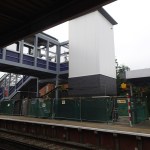
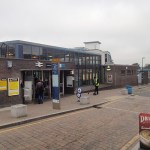

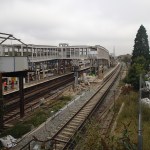

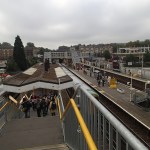
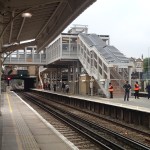
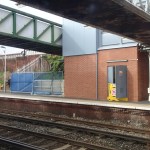
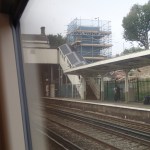
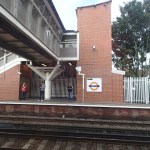
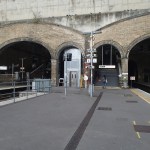
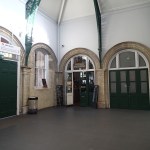

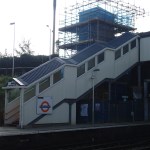

The pictures show my route from Dalston Junction to New Cross, from where I walked to New Cross Gate for a train to Crystal Palace. After a refreshment stop at the excellent Brown and Green cafe at the flagship southern terminus of the East London Line, I retraced my steps stopping to look at the improvements at Honor Oak Park and Brockley.
Of the stations south of Surrey Quays on the New Cross and Crystal Palace branches only Sydenham will not be substantially step-free by early next year. At Sydenham though it is effectively two stations, one for each direction, which means with planning, difficult stairs can be avoided.
Several excellent new cafes and coffee stalls, seem to be setting up in the stations.
The future is definitely looking up on the East London Line.
A good start has definitely been made on bringing some of the stations in South London into the twenty-first century.
Transport for London’s Latest Plot To Get Us To Climb Stairs
London’s buses are effectively computer terminals and displays, that just happen to carry passengers about the city.
These pictures that I took on route 141, show the latest software upgrade.
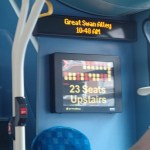

The clock has been shown on the Next Stop display for some time, but the display, showing how many spare seats are on the upper deck, is new.
Will it help to increase the loading of buses? The only problem, is that the system is not as attractive as a comely conductress calling politely for everybody to please move along the bus!
There’s more about the technology here on the IanVisits web site.
More Step Free Access On The Overground
Looking at the London Overground map for 2026, there appear to be additional stations marked for step-free access.
Blackhorse Road – Plans are detailed here. They may be already completed!
Brockley – Improvements in the near future are detailed here.
Honor Oak Park – Improvements in the near future are detailed here.
New Cross – Improvements in the near future are detailed here.
New Cross Gate – This station would appear to be being rebuilt.
South Tottenham – Plans are detailed here in the Haringey Independent.
Watford Junction – I suspect that as everything seems to be happening at Watford Junction, full disabled access will be achieved by 2026.
Whitechapel – This will happen before 2020, as Crossrail will bring step free access between all lines here.
It does seem that all of these schemes seem to be following what appears to be Transport for London’s policy of improving the London Overground on a step-by-step basis as funding allows.
I suppose that with the Overground, putting in lifts and ramps is a lot easier, as the stations except for a few are totally above ground.
London Overground’s 2026 Map
Transport for London (TfL) have published a map of what they feel the London Overground will look like in 2026.
Most of the changes actually will occur next year, so I suspect there will be other things added before 2026.
My money would be on some of these being completed.
- Electrification of the Dudding Hill Line as a westward extension of the Gospel Oak to Barking Line to rejoin the North London Line.
- A More Comprehensive Interchange at West Hampstead station.
- Some developer-led station rebuilds and perhaps additions.
- Reopening Of the Hall Farm Curve to enable services between Chingford and Stratford, with a stop at Lea Bridge.
- Extra Overground branded services in a loop across South London.
With the exception of the electrification of the Dudding Hill Line and the works at West Hampstead, most of the other projects could probably be classed as smallish ones in terms of cost to TfL. But they may have a high return.
At present the Overground is being upgraded to take five-car trains, but judging by this picture taken at Camden Road station, it would appear that where they can fit them in, platforms are being readied for the next upgrade to six cars.
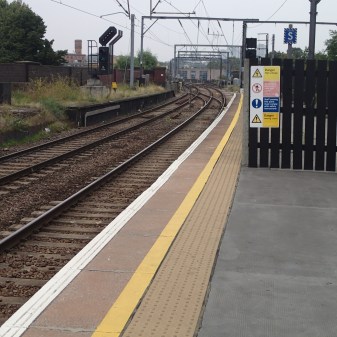
Platform Extension At Camden Road Station
TfL have said, that where stations can’t be extended selective door opening will be used. As the Class 378 trains are walk-through and have a full information system, I’m sure the self-loading cargo, will get used to it.
This afternoon, I travelled along the North London Line and it would also appear that TfL are taking the opportunity presented by the platform lengthening to widen a few of the narrower platforms, like those at West Hampstead. This picture was taken at Brondesbury Park.
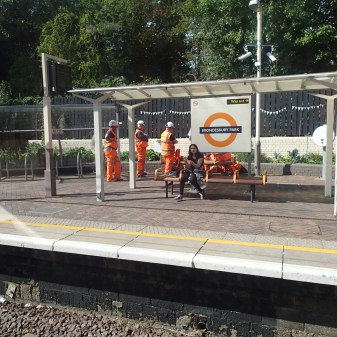
An Oasis At Brondesbury Park
It would appear that they’ve created a much wider platform with a roof and a garden.
TfL also don’t seem to be using a one-size-fits-all at the stations. Too often railway lines seem to be designed to a very limited set of rules to save costs. The London Overground inherited a series of run-down and mismatched stations, which they have almost used to advantage. Some like Hampstead Heath, were probably beyond saving, so they have rebuilt them to a station that befits their location.
In asddition, three external factors will drive the development of the London Overground; freight, the need for the development of more homes and commercial properties of all sorts and Crossrail.
Freight
The Overground gives over a lot of paths to freight, especially on the northern lines. A lot of these trains are still hauled by unfriendly Class 66 diesel locomotives. Alternative electric locomotives or the new Class 88, should be an aspiration for all lines that go through cities.
Bear in mind that once, the Midland Main Line, the Great Western Main Line and the Gospel Oak to Barking Line are electrified, which should all be complete by 2020, the Dudding Hill Line would be the only line, habitually used by freight trains in the northern part of London, not to be electrified.
So for freight reasons alone, I would think electrifying the Dudding Hill Line is a good idea.
But expect a few surprises if Option 1 is implemented, as Transport for London and especially the Overground has a history of doing the unexpected but excellent. Look at the one platform solution at Clapham Junction, where the West and South London Lines of the network meet.
Development of New Homes and Commercial Properties
London may need new railways to cope with the increased population, but it also needs new homes and commercial properties. Land in London is at a premium, but see what was done here in building flats over the new Dalston Junction station.
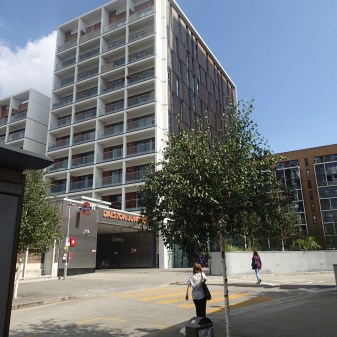
Residential Development Over Dalston Junction
It is not the highest quality of developments, but it was probably the best that could be done at the height of the recession. Small scale development is already taking place at some stations like Highbury and Islington and West Hampstead.
But in this country, we have some very good architects and developers, so I would expect to see some innovative development proposals all round the London Overground.
I must admit, that if I had to live in a modern development, surely one on top of a well-connected railway station is probably best!
Crossrail
London’s new railway; Crossrail, will change a lot of things in London’s transport system.
As a simple example if I go to Heathrow from home, the journey takes about an hour and twenty-two minutes. But after Crossrail is running, the journey will take less than an hour.
But this means, I’ll take the East London Line to Whitechapel to connect with Crossrail.
In addition, Crossrail and the Overground have interchanges at Stratford, Whitechapel and probably by 2026 at Old Oak Common.
So I suspect that many journeys in London will change because of Crossrail.
Predictions made now will be valueless after Crossrail opens in 2019.
No Cars At The School
There are two Primary Schools in my road; one State and the other Roman Catholic.
I walked past them yesterday just before nine and was surprised to see that there were no children being brought to either school in a car or taxi. There were lots of little scooters and many parents were dragging empty ones back home.
I wonder how few schools are the same as children turn up in the morning!
A Problem At Barking Station
Yesterday, I had a small problem at Barking station, about getting my train back to the centre.
This is what I wrote to London Underground.
I visited Barking and had arrived on an H&C. So when I went back, the signs directed me to the sane platform, but there was no information there and no trains. So in the end I gave up and walked to the Westbound District Line platform, where I found a distressed elderly lady looking for a train to Paddington. Eventually, I shepherded her on a District Line train and I found a H&C at West Ham. The lady went off to try her luck on the Jubilee Line.
Not only was there no signs to the H&C and no trains, but there were no staff on the platform directing people to the trains that were running.
It wasn’t the standard I usually get at Dalston Junction or Barbican say!
It is very unusual that this happens on the Underground.
Should The Gospel Oak To Barking Line Be Extended To Barking Riverside?
There is no doubt in my mind, that the Barking Riverside area needs better transport links. I was there mid-morning and the buses were busy. One lady told me that buses in the area weren’t reliable.
So either the Gospel Oak To Barking Line or the Docklands Light Railway must be extended.
It would appear that TfL has chosen the heavy rail solution and they have started a consultation and published this map.
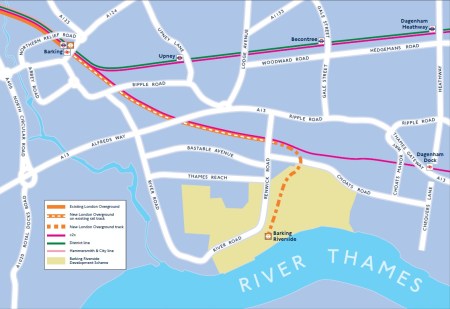
GOBlin Extension To Barking Riverside
The housing looked to be of good quality, although there are reports that some of the first houses weren’t.
When I see housing like this, I am reminded of our first and only house, where I took the car to work and C was stuck in all day with a baby, in a place with no public transport.
It didn’t do much good for our relationship!
Barking Riverside could have in the future a population of around 26,000. This makes it all the more essential that something is added to the two bus routes with a frequency of five buses an hour.
I actually think, that when the area is fully developed, this extension to the Gospel Oak To Barking Line, will need to be augmented. Especially, if the line is extended again under the river to Abbey Wood.
But before we go to Abbey Wood, wouldn’t it be a good idea to follow the electrification of the Gospel Oak To Barking Line with electrification of the Dudding Hill Line, so that trains could go all the way to West Hampstead, Acton and ultimately to Hounslow, as is proposed in Transport for London’s Tranpost Plan for 2050.
Is Essex Road Station Ripe For Redevelopment?
Essex Road station in London, is architecturally-challenged to say the least. if you venture underground to the trains, there are a couple of large clean lifts and dimly-lit passages to stations, that still have echoes of Network South East.
Essex Road Station
But things are looking up on the trains front, in that the new Govia Thameslink franchise has committed to running more trains through the station, including later on weekday nights and at weekends. It also looks like Crossrail 2 has decided on its route and it would appear that the chances are, the new line will by-pass Essex Road station.
The station sits on a prominent and quite large corner site as this aerial view from Google shows.

Essex Road Station
So it would appear that a whole lot of reasons exist for the site to be redeveloped as perhaps much-needed quality housing. Transport links, size and location are all good and the deep-level station is in crying need of a refurbishment. The only constraint is that provision might need to be left for a very unlikely new rail or Underground line.
Properly developed it would be an asset to the area.
How Will The New Govia Thameslink Franchise Benefit Me?
Although I don’t live directly on Thameslink, I’ve just looked at the Wikipedia entry for the new Govia Thameslink franchise. The section on franchise commitments is significant and includes the following.
Half hourly King’s Lynn to London services
At present there’s only one train an hour for much of the day.
Increasing Great Northern suburban services to four trains per hour via Enfield Chase and New Barnet
I think it’s just three trains at the moment. As these go into Moorgate, it will make it easier to get to Barnet, Hertford etc
Great Northern suburban services to run to Moorgate on weekends and weekday evenings
This is a big change and it will help spectators get to the Arsenal. Hopefully, it might take a bit of pressure off Highbury and Islington station, when Arsenal are at home.
Working to extend Oyster to Epsom, Gatwick Airport, Luton Airport Parkway, Welwyn Garden City and Hertford North
This will be good for me, as when I travel to any of these stations, I won’t need to buy a specific ticket, provided I touch in and touch out.
I suspect other things will happen, but this is a good start.
Living close to Essex Road station, I would use it more, if it was open for more hours and was a more welcoming station architecturally.
So on balance it’s a good thing!
 The Anonymous Widower