Transport for London’s Two Iconic Brands
I have a Google Alert for the word Overground to pick up any stories about Transport for London’s newest railway system the Overground. The link is to the official site and on a straight Google search, it is number one in the list.
It’s only rarely that the Google Alert picks up a news item, that is not about the Overground.
So how does the Underground fare in Google searches. As with the Overground, the official site for the Underground is first in the search list. On the first page, there are only a couple of pages that are nothing to do with the London Underground.
Even the word Tube typed by itself into Google, produces virtually a complete page of information about the Underground.
I suspect that London’s two iconic brands; Underground and Overground, together with their nickname Tube have one of the best worldwide recognitions.
Frank Pick, who led London Transport in the early days and oversaw the creation of the original corporate branding, will be laughing through history.
Who would have thought that a man from Spalding, who qualified as a solicitor, would have become one of the people with the greatest influence on the look of today’s London? Only Christopher Wren and Joseph Bazalgette come close.
Project Managers Having Fun In The East
A lot of people moan that London and the South East get all of the rail infrastructure investment, but next time you travel up and down the country from Edinburgh or Newcastle to London, moaning why the A1 is such an inferior road or your train seems always to be held up, then you should perhaps be pleased that things might be getting a bit better due to one of the largest rail projects in the UK, that will be commissioned later this year.
The Great Northern and Great Eastern Joint Railway (GNGE) It ran from Doncaster to Cambridge via Lincoln, Sleaford and Spalding a dozen or so miles to the east of the East Coast Main line. It was built primarily as a freight line to get coal from Yorkshire to East Anglia.
Some southern parts of the line and the by-pass around Lincoln have been closed, but the rest of the line was used by passenger trains although gauge limitations meant that moving large freight trains was difficult.
One of the problems of the East Coast Main line is the number of freight trains that need to use the line. Between Peterborough and Doncaster, a lot of the line doesn’t have four tracks, so the fast express passenger trains have to mix it with much slower freight trains, which need to be passed.
This problem could have been solved by just four-tracking the main line, but Network Rail found that it would be cheaper to enable the GNGE to take all the freight traffic.
So a £230m project was started to upgrade the GNGE and provide the line with new track and signalling. As a by-product of the work tens of level crossings on the route will be eliminated.
This may seem a lot of money for essentially creating a freight by-pass from Peterborough to Doncaster, but according to this article in Rail Engineer it is a major project. Here’s what they say about the scope.
The first thing that strikes is the surprising scale of the scheme – some £330 million pounds is being spent on a stretch of railway which does not come across as particularly high profile. The changing pattern of freight has seen the route drop below the horizon and it is the resurgence in the last few years that has brought awareness of its potential to support, and help capacity, on the main East Coast route south of Doncaster. That scale can be summed up as 86 miles of route between Werrington and Doncaster and the renewal of 27% of the track and 53% of the point ends.
On top of the trackwork itself there are 49 underbridges, 19 overbridges and 82 culverts to be dealt with. There is even a tunnel where there is a 66 metre track-lowering job.
By comparison, the Borders Railway south from Edinburgh is a 50 km stretch of reopened railway from Edinburgh to Tweedbank and is budgeted to cost £348m. It should open in 2015.
The completion of the updated GNGE line later this year, should have some major benefits.
As many of the freight trains will be removed from the East Coast Main line between Peterborough and Doncaster, this will mean that passenger trains on the line will have more paths and will be less likely to be slowed. So this should mean more and faster trains up and down from London to Leeds, Newcastle and Edinburgh.
The ease of getting freight trains between Peterborough and Doncaster should mean that more traffic from Felixstowe and London Gateway to the North will be able to go by rail.
In the longer term, will it mean that more passenger services are run from Peterborough to Lincoln and from Lincoln to Doncaster?
The only problem I can see, is that all these freight trains trundling through the level crossing at Lincoln are going to create a lot of congestion. I discussed this infamous crossing in this post. A new footbridge has been approved which could help, but this level crossing really needs to be bypassed and closed.
The Long-Awaited Walthamstow Link Is Nearly Here
It should have been a simple job, but it has grown into an eighteen year saga.
Walthamstow Central and Queen’s Road stations are not far apart and a pedestrian link has been needed for years to make interchange possible. Finally, it will be opening next month, as is reported here in ThisisLocalLondon. In the end despite an agreement the Council had to take the developers to the High Court.
How many other simple links should be created to make travelling by public transport easier?
A Journey Into History At Todmorden
The title of this post is borrowed from this article in the Todmorden News about the opening of the new curve that I wrote about here.
The tone of the article is enthusiastic and it shows how these smaller rail projects are often really useful in their local area. This curve for instance will allow direct Manchester to Burnley trains for the first time in forty years.
All they need to do is rustle up some decent diesel multiple units. Then they’ve got to work out what services will use the curve. Judging by my experience of Burnley Manchester Road station, it couldn’t be used as a terminus. So where will the trains go after that station?
The area of the country that lies between Leeds and Manchester is an area that needs to be given a lift.
Projects like this can only help.
If this one proves to be the success all of its promoters expect, I suspect we’ll be seeing more of this type of project.
Network Rail engineers will hopefully be doing what they like to do most!
Blackpool And Huddersfield May Get Direct Services To London
I’m leaving the may in the title, as nothing is cast in stone yet, but according to this article, Network Rail have found the space to squeeze direct services to Blackpool and Huddersfield from London into the schedule, by a new train operator called Great North Western Railway.
The services won’t be running until 2017 at the earliest, as trains have to be ordered and built.
And who knows what will happen in the negotiations?
The Project Manager’s Lot Is Not An Easy One
I found this article on the Rail Engineer site and it describes in detail how the project managers at Network Rail reinstated the Todmorden Curve.
This paragraph talks about the checks that needed to be done before a level crossing was eliminated.
And then there’s the new footbridge. Sorry, didn’t I mention that? Previous usage surveys suggested that Dobroyd crossing was visited only by occasional dog-walkers; nobody expected any great issue with closing it. But due diligence demanded that another survey was conducted, with the crossing being monitored by CCTV around-the-clock for ten days. Initially the team didn’t believe the results: they suggested peaks of 150 users daily, most of them being children. Only then did it become clear that an activity centre had opened at nearby Dobroyd Castle in 2009 and the chosen route to get groups up there was over the railway. This launched the crossing’s risk assessment score into the north-west’s top ten.
Nothing is as simple as it is first thought!
A Ticket Machine With A Canopy
I saw this ticket machine at Canonbury Road and Barnsbury Station yesterday.
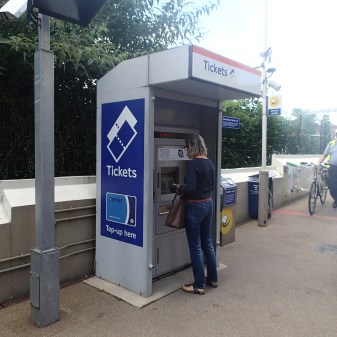
A Ticket Machine With A Canopy
It’s certainly more customer-protective than those on the Edinburgh Tram
Is Molley The Runt Of The Litter?
I don’t know what the collective noun is for tunnel boring machines. But if it is litter, then surely Molley is the runt. According to this article in Construction Index she is the smallest machine used in the construction of Crossrail.
TBM Molley will build a new Thames Water sewer in west London. She is just 1.45m in diameter and 3.3m long. The main TBMs digging the train tunnels, by contrast, are 7.1m diameter and 150m long. Molley is too small to carry workers on board so is controlled remotely from the surface.
Molley is being used to build a new sewer, as the current one will be in the way of construction works for the tracks.
Supper In St. Neots
I went to St. Neots for supper last night.
The ticket I got on First Capital Connect must have had the most bizarre restriction I’ve ever seen. It was an Off Peak return ticket bought with a Senior Railcard for £15.65. When I bought the ticket the machine said that I couldn’t use it out of Paddington.
How do you take a train out of Paddington and end up in St. Neots?
Coming back, I came into Finsbury Park station from where I came home by using the Piccadilly line to Manor House and then a 141 bus.
If there is one station in London that should be loved by a demolition ball it is Finsbury Park. There is a plan mentioned here on Wikipedia, but nothing seems to be happening.
 The Anonymous Widower