The Scottish Borders Have Caught London Overground Syndrome
The Scottish Borders would appear to be suffering from that new benign disease;London Overground Syndrome!
This disease, which is probably a modern version of the Victorian railway mania, was first identified in East London in 2011, when it was found that the newly-refurbished East London Line and North London Line were inadequate due to high passenger satisfaction and much increased usage. It has now spread across other parts of the capital, despite various eradication programs.
- Lengthening the trains from three to five cars.
- Adding step-free access or rebuilding stations like Brondesbury, Hackney Central, Hackney Wick, Hampstead Heath, Kensal Rise, West Hampstead and Whitechapel.
- Extending the system with a new branch to Clapham Junction station.
- Taking over the Lea Valley Lines to Cheshunt, Chingford and Enfield Town.
- Modernising and electrifying the Gospel Oak to Barking Line.
- Extending the Gospel Oak to Barking Line to Barking Riverside.
- Taking over the unwanted Romford to Upminster Line.
The latest pressure would seem to be to take over more of London’s suburban routes.
Londoners can’t seem to get enough of the life-improving orange.
Rail Plans For The Scottish Borders
This article on the BBC is entitled Borders Railway: Future Goals For New Routes Drawn Up.
Reading the article, it would appear that the following are proposed or are possibilities for the Borders Railway to mitigate the effect of London Overground syndrome.
- Building on the current success.
- Extending the railway to Hawick.
- Add some dynamic passing loops to increase service resilience.
- Add some more parking.
- Improve the wi-fi.
- More capacity and especially for tourism-related reasons.
- More steam trains.
- A possible branch to Peebles.
It would appear to be all well-thought out ideas, some of which will happen.
- More car parking at Tweedbank and Stow
- Longer trains with space for bicycles.
- Perhaps a longer passing loop. to enable increased and faster services.
- A turnback facility at Tweedbank to aid the running of stem trains.
- Better wi-fi.
But most of these projects are easily costed and the benefits can be calculated. So they are ones that accountants like and can fund or turn down.
Onward To Hawick
The Wikipedia entry for the Borders Railway, says this about a proposed extension to Hawick and Carlisle.
The Campaign for Borders Rail has called for the continuation of the line to Melrose and Hawick, and eventually to Carlisle. According to the group, Hawick suffered more than any other town in the Borders from the closure of the Waverley Route, and only the return of the railway could halt the area’s economic decline. At the time of the closure of the Waverley Route, Hawick was a 70-minute journey from Edinburgh. At Melrose, the southbound station platform and building exist alongside the Melrose Bypass. Network Rail has confirmed that there is nothing to prevent the extension of the line beyond Tweedbank, although commentators have remarked that the Bypass could pose problems. A major realignment of the road would be required, as well as the reinstatement of embankments and bridges.
I have traced the route of the Waverley Route beyond Tweedbank station on Google Maps and you can see a lot of the original route to Hawick, which only seems to have one viaduct at Ale Water.
Note that there appear to be a succession of viaducts to the South of Hawick, so perhaps Hawick would be a town to take a breather. I’ve also traced this section on Google Maps and if it was ever rebuilt, it would certainly be some railway.
I think that they could spend a lot of money going all the way to Carlisle, but an affordable extension to Hawick via the Borders Hospital and Melrose might be so successful as to get the politicians to allow the engineers to go all the way to Carlisle station, which as I reported in If Manchester Victoria and Birmingham New Street Were The First Two Courses, Is Carlisle The Third?, is being rebuilt to give all friendly visitors a warm welcome.
Power To The Peebles?
I’ve borrowed the corny sub-heading from a section in the BBC report, that prompted me to write this post.
The report says this.
It also recognises the success of the Borders Railway as encouraging hopes of reopening other lines.
It said some might not be suitable for redevelopment but cited the former route between Edinburgh and Peebles as one worth considering.
I think the route to Peebles is the Peebles Railway, which leaves the Borders Railway, just South of Eskbank station, goes South Westerly to Peebles and then Easterly to rejoin the Border Railway North of Galashiels station.
This sudden appearance of a plan for a Peebles Branch of the Border Railway has got my suspicions that a group of engineers have resorted to the methods of Brunel and Stephenson to solve the problem of increasing the double track on the Borders Railway.
I suspect the engineering fag packets and used envelops were produced together with a bottle of Scotland’s finest malt whisky and everybody went to the garden of a suitable hostelry, that overlooked the line and got thinking.
They looked at some of the single track sections like Newbattle Viaduct and thought that rebuilding railways in Syria might be easier.
Then they looked at the route of the Peebles Railway and felt if it was rebuilt, it would kill three birds with one stone.
- Peebles and a few other places would be connected to the rail network.
- The Borders Railway would get a much needed passing loop.
- Various tunnels and viaducts on the Borders Railway would not need to be double-tracked.
The Peebles Branch could be single or double-tracked according to the terrain and the costs.
A Second Borders Railway
It would also appear that because of the success of the Borders Railway, that there are suggestions to add new stations on the East Coast Main Line at Reston and East Linton. This is said under Future in the Wikipedia entry for East Linton station.
Proposals to reopen the station, along with the former station at Reston, have received the backing of John Lamont MSP, who has taken the case to the Scottish Parliament. A study published in 2013 proposed that East Linton and Reston stations be reopened. Since Abellio ScotRail took over the franchise in April 2015, they have now committed to reopening East Linton and Reston Stations as part of the local Berwick service by December 2016 but due to the shortage of rolling stock this will now commence in December 2018.
So it would appear there is a high chance it will happen.
This Google Map shows the location of East Linton between Dunbar and Edinburgh.

East Linton and Dunbar
East Linton is indicated by the red arrow and Dunbar is on the coast to the East.
Dunbar station is on the East Coast Main Line, with services to Edinburgh and Berwick-on-Tweed.
This Google Map shows the proposed location of Reston station, which is between Dunbar and Berwick-on-Tweed.

Reston And Berwick-on-Tweed
Reston is indicated by the red arrow. The river at the bottom is the Tweed, with Berwick on the coast and the border.
This scheme looks to be a very sensible use of an existing main line. It also follows a pattern of adding Parkway stations to main lines and the recent opening of the new Cranbrook station on the West of England Main Line.
There would appear to be a few other closed stations on the line.
As they are not mentioned with respect to East Linton and Reston stations, I would assume that there is not a great deal of pressure for reopening.
If we look at the possible opening of services to East Linton and Reston stations in 2018, when Abellio Scotrail have trains available, this will only be a year before First TransPennine extend their Newcastle services to Edinburgh.
So could this hourly service stop at other places between Newcastle and Edinburgh, other than the proposed Morpeth?
The Berwickshire Railway
When I was looking at the Wikipedia entry for Reston station, I noticed that the Berwickshire Railway linked the station to St. Boswell’s station on the Waverley Route, which could be part of the extension of the Borders Railway to Hawick.
I suspect someone has looked at this line to create a route to Galashiels from the South East via Reston, St. Boswell’s, Melrose and Tweedbank.
But this report of the Storm of 1948 probably told them to forget the idea.
More Steam Up For The Borders Railway Extension To Carlisle
This article on the BBC, which is entitled Call for Borders Railway extension to Carlisle renewed during Lamington work, is typical of many articles in papers like the Glasgow Herald and Scotsman, and on vartious media web sites.
In ‘Encouraging signs’ on Borders Railway Extension to Carlisle, I felt that as Network Rail are creating a hub to connect all the scenic routes in the Borderland together, that the Borders Railway should be extended to Carlisle and other routes should either be electrified or upgraded so that passenger services could be run by four-car electric trains or IPEMUs.
The failure of the Lamington viaduct and its closure until March, illustrates why we need more diversion routes, not just in the Borderlands, but everywhere it is feasible.
‘Encouraging signs’ on Borders Railway Extension to Carlisle
The title of this post is the title of an article on the BBC. This is said.
An MP has said there are “encouraging signs” that the “fantastic vision” of extending the Borders Railway to Carlisle could be realised.
Calum Kerr made the claim in a piece written for the Campaign for Borders Rail newsletter.
This is original article on the Borders Railway! This is said.
The good news is that there are encouraging signs we may be able to win cross party support on this. For instance, I’ve spoken to my neighbouring MP David Mundell, who is the Secretary of State for Scotland in the UK Government. He’s broadly supportive and is planning to speak to the Department of Transport in London to gauge its views.
I’ve also been in discussion with MPs on the English side of the border. They’re also warming to the idea. In particular, I’ve had several discussions with Rory Stewart, who represents the seat of Penrith and the Border, and he’s keen on getting it onto the agenda.
I think the involvement of Rory Stewart is significant. I remember him from one of his excellent documentaries called Border Country: The Story of Britain’s Lost Middleland, which was a fascinating history of the lands both sides of the England-Scotland border.
When I wrote If Manchester Victoria And Birmingham New Street Were The First Two Courses, Is Carlisle The Third?, I wrote this.
I just wonder, if whilst they are rebuilding the platforms, they will electrify some of the bay platforms. Or at least do the preparation work!
This would enable IPEMUs to be able to be recharged, if they were serving routes out of Carlisle, like the Tyne Valley Line, Settle to Carlisle and possibly an extended Borders Railway.
Incidentally, I think that by the time Carlisle station is updated in 2019, IPEMUs or battery trains, would have enough range to reach Edinburgh. You can see the headlines in the Sun!
After reading Calum Kerr’s thoughts, I feel even more that Network Rail have a cunning plan to make Carlisle station a hub for IPEMUs, which would serve the following routes.
- The Borders Railway to Edinburgh
- The Glasgow And South Western Railway to Glasgow
- The Tyne Valley Line to Newcastle
- The Settle-Carlisle Line to Leeds
- The Cumbrian Cost Line to Barrow and Lancaster
Note the following.
- The only major infrastructure work would be the completion of the Borders Railway to Carlisle.
- The area is noted for its superb scenery and occasional extreme weather. Not electrifying large sections of remote and exposed rural lines, is an attractive option, in terms of planning, engineering, building and maintenance.
- Technology exists to do all signalling by radio links.
- The last two lines would probably need some limited electrification to charge the trains en route.
- The Cumbrian Coast Line could be electrified between Sellafield and Barrow, where the line is better protected.
- The infrastructure needs of a four-car IPEMU train, is similar to that of a four-car diesel multiple unit.
- The Glasgow and South Western and Tyne Valley Lines could probably accept IPEMUs tomorrow.
- The network has several connections to the major Anglo-Scottish routes, at Edinburgh, Glasgow, Leeds, Newcastle and Preston.
It would be one of the most scenic set of railway routes in the world!
I won’t comment on the commercial, social and tourism aspects of creating such a railway system.
An Excellent First Month For The Borders Railway
According to this article on the BBC, which is entitled Borders Railway journeys top 125,000 in first month of operation, the Borders Railway has started with a high level of usage.
I suspect a lot of the usage in the first month is probably down to the novelty value of the railway and we won’t get a true pattern of usage until a couple of months.
But if this level of usage, is sustained, the following will happen.
- New four-car IPEMU trains will be procured for the railway, as they could handle the route with ease and would double the capacity.
- Planning will start to extend the route to Hawick and Carlisle.
Network Rail will also have to look seriously into how they calculate traffic forecasts.
Where Does The Borders Railway Go Next?
My Borders correspondent, who lives near Selkirk, says that the Borders Railway has been generally well received. Certainly if you search Google News for Borders Railway, you don’t find many problems or complaints, except one about the singing of the National Anthem for the Queen.
A friend in Edinburgh has just told me, that the trains are too crowded at times. So what’s new? New railways are always crowded, especially if they fulfil a need.
The most common articles on the web, are ones like this one from the Border Telegraph, entitled Next Stop Hawick….
So what will effect this line in the next few years and what do I think will happen?
The Me Too Effect
Now that Galashiels has a reliable half-hourly service to Edinburgh, I suspect that the inhabitants South of Tweedbank, will say that if Galashiels and Tweedbank can have this, why can’t Melrose and Hawick?
Cross Border Co-operation
The Borders area of Scotland and the neighbouring area of England are very similar and probably have the same strengths, problems and needs.
In some ways they are very economically linked now.
- Carlisle is economically tied to the Scottish Borders for shopping and transport links.
- Newcastle is a major airport for the area.
- There is even a rail service between Glasgow and Newcastle, that goes via Kilmarnock, Dumfries, Hexham and the Metro Centre.
- Area rail tickets for North West England include Lockerbie.
- Carlisle and Newcastle are the two major places to catch trains to the South, unless you go North to Edinburgh and Glasgow..
Surely this togetherness should be built on to develop the Borderlands, provided the politicians can be kept out of their way, in their offices in London and Edinburgh.
Increasing Railway Capacity Between England And Scotland
At present, the East Coast Main Line and the West Coast Main Line do not provide enough capacity between England and Scotland, for both passengers and freight.
Tourism And Other Economic Effects
I live in the Dalston area of Hackney, which is an area that has been uplifted by the creation of the London Overground from the rather decrepit railways that used to run through the area.
Unless you have lived through the process, most people will not understand how regular trains, running on a frequency of at least two an hour, can bring economic benefits to an area.
The Borderlands, probably have an economic profile not unlike the areas of East Anglia away from the large towns and cities that I know well.
- Both areas are ringed by a series of large towns and cities
- There is a lot of farming.
- There are a lot of tourism-related businesses of all sizes.
- In the summer, visitors take days out into the areas.
- There is a certain amount of specialist manufacture.
- Housing is being developed for those who have retired, who live and work locally and who commute to major towns and cities nearby.
All of these activities will increase the need for better transport links to the major cities that ring the areas.
The latest East Anglian Rail Franchise will mandate the franchisee to provide much better services all over the area and especially on the branch lines.
I can’t believe that the areas on both sides of the Border would not be worth developing in a similar way to that proposed for East Anglia.
Extending The Borders Railway To Melrose, Hawick And Carlisle
Scottish Borders politicians are all in favour of this extension, as are probably the good citizens of the area. My Borders correspondent and his family certainly appear to be.
Just as I have seen an economic uplift in Hackney because of the London Overground, I think it would be unlikely that the Borders Railway running through Melrose and Hawick, would not increase economic activity in the area.
This extension would certainly happen if Scotland stayed in the United Kingdom, as in some ways, this reopening, would help develop tourism in the wider area of the whole Borderlands, the Lake District and North Yorkshire.
Carlisle is probably the big winner in this activity and becomes a city with important or picturesque railway lines going everywhere.
- The West Coast Main Line, links England to Edinburgh and Glasgow.
- The Glasgow And South Western Line to Glasgow via Dumfries and Kilmarnock
- The Settle and Carlisle Line
- The Cumbrian Coast Line around the Lake District to Barrow and Preston
- The Newcastle and Carlisle Line
- The Borders Railway to Edinburgh
The Borders Railway provides the missing link in the railways of the Borderlands.
So when the Scottish politicians discuss the project, they should take into account, the positive affects a complete line would have on England!
Should The Borders Railway Be Electrified?
This question could legitimately by asked about all the other lines meeting at Carlisle, that are not electrified.
But as Carlisle, Edinburgh, Glasgow, Newcastle , Preston and Skipton are all electrified, I suspect all of the Carlisle lines have enough electrification to be run by modern four-car Aventra IPEMU trains, charging their batteries where overhead power is available and running on batteries as needed.
Some of the lines, including possibly the Borders Railway, are probably ready for Aventra IPEMUs now, with a bit of modification to platforms, track and signalling! Some like probably the Cumbria Coast Line would need some electrification or other means to charge the batteries en route.
So the answer to the electrification question must be yes, if Aventra IPEMUs are used.
But it would create a local railway network, as good as any in Europe, in an environmentally-friendly but totally affordable way.
It would be a showpiece of British technology and an attraction to rail enthusiasts from all over the world.
The network also connects to four World Heritage Sites and the Lake District, Hadrian’s Wall and the major cities of Edinburgh, Glasgow and Newcastle.
Would An Extended Borders Railway Provide Extra Capacity Between England And Scotland?
The Borders Railway has a limited number of paths for trains and when a steam special is run, one of the diesel multiple units has to give up its slot. Read various criticisms on Wikipedia.
My scheduling experience, does suggest to me, that if the line was run by the faster and better accelerating electric trains, including Aventra IPEMUs, that this might create some extra capacity on the line.
Unless the line was fully electrified, it wouldn’t be a route for using the electric trains that run up the East and West Coast Main Lines.
But it would be able to take services run by Aventra IPEMUs or any diesel-hauled passenger or freight trains.
These capacity arguments would also apply to the Glasgow and South Western Line, so with a bit of selective electrification and Aventra IPEMUs, some extra capacity might be squeezed in.
I certainly think that a railway time-tabling expert could certainly find some extra capacity.
But it might be overnight freight trains?
Are There Any Branches To The Borders Railway That Could Be Created?
The original Waverley route had several branches including to Peebles and Hexham.
Midlothian Council have also thought about a branch to Penicuik.
Extra branches are up to the economics and the politicians.
Conclusion
In my view, not to extend the Borders Railway to Carlisle by way of Melrose and Hawick, would be total stupidity.
The problem is that despite being totally in Scotland, extending the Borders Railway to Carlisle, has substantial benefits for England too!
What will Nicola think?
Where Now For The Borders Railway?
On Monday I took a trip down the new Borders Railway to Tweedbank station.
It has been put together with care and no-one can say it will be falling apart in a couple of years.
Criticism
According to Wikipedia, there have been three major criticisms of the new line.
- Infrastructure Capability – It’s just a basic railway.
- Timetabling – Critics think they can do it better.
- Failure to continue to Melrose – New lines always have the wrong route.
I think though that you have to allow the line to bed down and allow the operator to overcome any problems that might be thrown up.
My thoughts on the three areas will now be given.
Infrastructure Capability
It is a railway that is designed to handle two trains an hour in each direction taking just under the hour for the whole journey.
Critics have said, that it should be double-tracked and electrified. But if it was, this would probably double the capacity of the line and will there be enough passengers to fill an enhanced service?
If in the future, the line suffers from overcrowded trains, to which new lines in the UK seem to be prone, there is a simple way to increase the capacity of the line. And that is to run longer trains!
I suspect that as the line has been built to take steam specials, the line will have the capability of taking diesel multiple units of four carriages.
Hopefully, there’s enough platform capacity at Waverley. But I do have a feeling that Waverley will need to be given some extra capacity, as more and more trains go to the Scottish capital, of which the Borders Railway is just one of several planned new services.
Timetabling
In a few years time, the timetable will be very different, as the current one is only an initial estimate of what is needed.
Failure To Continue To Melrose
In my view they have done something much better by creating an integrated train-bus interchange at Galashiels, which serves the whole Border region.
It may be in the future, they need to extend the line to Melrose, but if any bus route from Galashiels gets overcrowded, it is a lot easier to add a few more buses, than build a new railway line. At least if you catch the bus from Galashiels you wait in a nice comfortable bus station, rather than on top of the North Bridge in the wind and rain.
Possible Improvements
Much of the improvement to the line will be organic and small.
- Shops and kiosks will appear in and around stations, driven by the needs of passengers creating business opportunities.
- If passenger numbers increase, then the trains will gain extra carriages. Electrification of other routes in the UK, may help this, as it will release some longer trains.
- Operational problems may show up limitations in the track and signalling and small changes may improve reliability, time-keeping and may even reduce the journey time.
I am basing these conclusions on what I have seen on other new and much improved lines in the country.
But bigger improvements will be possible.
Extension To Melrose
This will only happen, if indications are positive that the service will pay for itself. But it could be an expensive line to rebuild, as the Melrose by-pass has been built over part of the line.
A positive could be that any extension to Melrose, might serve the Borders General Hospital,
Extension To Carlisle
Strangely, I think this will be more likely than an extension to just Melrose, as it will be an English project as well as it opens up a new route up the West Coast to Edinburgh, which could be used by freight trains in addition to passenger ones.
When the equivalent rail lines in the North of England are modernised, a Borders Railway to Carlisle, would open up a large area bordered by Edinburgh, Carlisle and Newcastle for rail-based tourism, with excellent links to the large centres of population in the UK.
But until we see how successful, the Borders Railway will be, extension to Carlisle is a remote possibility.
Extension To Penicuik
The creation of a branch to Penicuik is raised in Proposed Extensions in the Wikipedia entry for the Borders Railway.
At present Heriot-Watt University is looking into the proposal for Midlothian Council.
Changes At Edinburgh
There could be changes to the line at the Waverley end of the line, as Network Rail and Scotrail improve services in the capital.
At present services from Dunbar and North Berwick go across the city to destinations in the West. There must be a very small chance that services on the Borders Railway might be extended past Waverley to at least Haymarket.
Trains or trams might also run on the Edinburgh Suburban and Southside Junction Railway in a loop across the South of the City. Although this will not directly affect the Borders Railway, train times may be adjusted so they connect better.
New Stations On the Current Route
Passenger numbers and patterns of use, property development, jobs and other factors will create a need for new stations on the route.
These could be totally new or opened up at places where stations used to exist in the past. If you look at the diagram of the old Waverley Route, there are several places, where stations have not been rebuilt.
If built these will add to the passenger numbers on the line and this could create the need for other improvements, like longer trains.
Remember too, that this line was designed down to a price in the mid-2000s, based on the assumptions of the time. Since then, there has been a big change in our attitude to railways with big projects like the London Overground being created from terrible lines and being tremendous successes and smaller ones in Birmingham, Lancashire and Scotland showing good returns, Government is much more likely to fund a properly costed rail project.
So I wouldnt be surprised to see a couple of new stations in the next few years on the Borders Railway.
Electric Trains
For the last few years, electric trains don’t necessarily mean those taking current continuously from overhead lines. Bombardier’s new Aventra electric multiple unit, has a battery variant called an IPEMU. Provided it can charge the battery on a convenient overhead line, it can then run for sixty miles on the battery.
As Edinburgh to Tweedbank is about thirty-five miles, I would suspect that an IPEMU would be able to manage the journey, charging the battery on the short section of the East Coast Main Line at Edinburgh, before the train turns off onto the Borders Railway.
These IPEMU trains are modern, environmentally-friendly four-car trains, that can run on lines that are partially electrified without any modification to the lines, if they can handle diesel multiple units, like those currently running on the Borders Railway.
They may be the best way of providing a higher-capacity service, that run the route slightly faster, due to their faster acceleration.
Knock-On Effects On Other Lines
If the Borders Railway is a rip-roaring success, this will add to pressure to reopen or substantially improve rail lines all over the country.
Don’t Underestimate Engineers!
Because of the unique status of Scotland in the UK and the good publicity the new Borders Railway has received, I have a feeling that as the ultimate objective of the Scottish Government to connect to Carlisle will be fulfilled, as so many other parties like Councils in the North of England, freight companies and Network Rail will give their support for all sorts of reasons,
And a lot of engineers, architects, engineering companies and train manufacturers will come up with innovative solutions for those dreams.
After all what better showcase is there for your new construction technique, train or rail-related product?
Is Waverley Station Good Enough For Edinburgh?
If you arrive in London Kings Cross station, the experience has been transformed over the last few years. Instead of entering a dark concourse crowded with tired retail outlets in a wood and asbestos shed designed in the 1960s, you now have two choices. You can walk to the front of the train, through the barriers and doors and into a large square with seats, buses and entrances to the Underground. Or if the weather isn’t good, you can take an escalator or a lift to the footbridge that spans all of the platforms and enter the covered Western concourse to make your way to onward transport or to one of many cafes, most of which are upmarket.
Other stations that I know well, like Birmingham New Street, Liverpool Lime Street, Manchester Victoria, Newcastle Central and Nottingham have also been transformed into impressive gateways for their cities. Next in line for substantial upgrading are London Euston and Waterloo, Glasgow Queen Street and Cardiff.
Edinburgh Waverley station has had a bit of a tidy up and it now has a set of escalators to get you up to Princes Street, but it is still a dark, cramped station, with no quality cafes in the station.
If I was to give Kings Cross five stars, Newcastle and Nottingham would get four and Waverley scarcely deserves one.
So to answer my original question. The answer is a definite No!
Waverley And The New Borders Railway
In some ways the new Borders Railway is going to make matters worse, as if it is successful, there will be pressure for more services on the line and there may not be enough terminating platforms at the East end of the station. But at least according to the Layout section in the station’s Wikipedia entry, things are being reorganised. This is said.
Former Platforms 8 and 9, which were substantially shortened for use as a Motorail terminus, the infilled area becoming a car park; since the demise of Motorail services these platforms are used only for locomotive stabling, although the numbers 5/6 were reserved for them in the 2006 renumbering. These are to be extended as full length platforms to accommodate terminating CrossCountry and Virgin Trains East Coast services with the taxi rank closed in June 2014 to make way for these works.
On the other hand, the Borders Railway has removed the need to use one of the worst train/bus connections in the UK.
Currently, if you arrive on a train from London and want to get an express bus to the South or the Borders, this necessitates a climb up flights of steps onto the North Bridge, which with heavy bags is impossible, unless you’re stronger and fitter than most.
Now you walk to the bay platform at the East end of the station and get one of the half-hourly trains to Galahiels, where there is a short walk to the bus station to get a convenient bus to all over the Borders and even to Carlisle.
But it is still a long walk from the bay platforms at the East (3 to 6) to the platforms that go West (12 to 18). And the tram is even further to walk.
Buses And Trams At Waverley
Like many main stations in the UK, no thought has been given at Edinburgh to how to efficiently organise the interface between trains and the buses.
I would have thought that when Edinburgh trams were built that they would have reorganised public transport in the city, so that the trams served the station properly. After all in Manchester, Croydon, Sheffield, Nottingham, Liverpool and Newcastle, local light rail, underground or trams serve the main train stations. Only in Blackpool is a walk needed, but that is being remedied.
In my view there are three places for tram stops at Waverley station.
- At the top of the escalators that take you between the station and Princes Street. But would this get in the way of the posh cars taking people to and from the Balmoral Hotel?
- On Waverley Bridge in front of the station. But where would the tourist buses go to clog up next?
- There also could be a Nottingham-style solution, where the trams cross over the station on a bridge at right angles to the train lines. But this would probably be an impossibly difficult project to design and implement.
The trams do serve Haymarket station and I wonder how many visitors to Edinburgh, use that station instead.
Waverley And Princes Street Gardens
After my trip to the Borders Railway, my friend and I went for lunch in a restaurant by the Royal Scottish Academy facing out onto Princes Street Gardens.
It was not an easy walk from the station as once we’d climbed up the escalators, it took several minutes to get across the busy Waverley Bridge in front of the station to get into the civility of the Gardens. This Google Map shows where we walked.
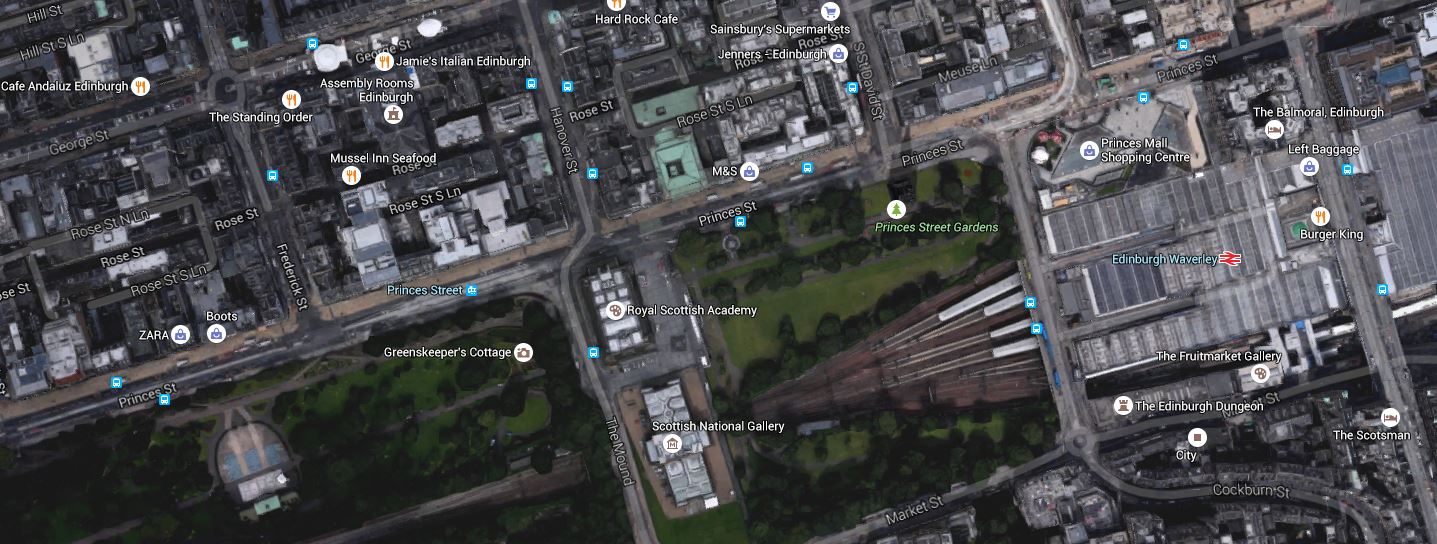
Waverley Station And Princes Street Gardens
Over lunch, I asked my friend, who’d lived in Edinburgh nearly all her life, , why there wasn’t a subway between the gardens and the station. She didn’t know and said there never had been! So as I walked back to the station, I took some pictures.



They show no evidence of a subway that might have been closed.
But they do show that if a subway could be built, then Edinburgh could have a World Class meeting place for when the weather was good.
Sorting The Trams
Seeing the map of Waverley station and the Princes Street Gardens, I have a feeling that if they were designing the Edinburgh trams now, they would be very different.
The difference is that in the last few years, tram-trains have come into general use in Germany. The Germans are getting enthusiastic about their use and large systems are being developed in cities like Karlsruhe, Kassel and Chemnitz.
In the UK, a test line is being added to the Sheffield Supertram, but how could tram-trains help solve the problems of Waverley station?
Trams coming from Edinburgh Airport and the West stop at Murrayfield Stadium tram stop and then move onto the street to call at Haymarket before going down Princes Street. New Class 399 tram-trains, as will be used in Sheffield, would follow the same route as the trams until Murrayfield. Passengers would find the only real difference would be that they had somewhere else on the destination board.
But at Murrayfield they would join the main railway lines and running as trains, they would call at Haymarket and Waverley stations.
The tram-trains could end their journey at Waverley or they could pass through the station and perhaps go on to further destinations like Dunbar or North Berwick. There would be no infrastructure modifications needed East of Waverley station, as the tram-trains would just appear to everything to be just another type of electric train.
If you look at the map in the Proposals for the Edinburgh tram network in Wikipedia, you’ll see this map.
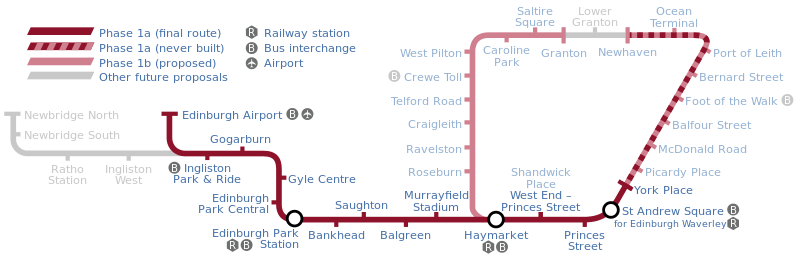
Edinburgh Tram Map
Note there is another Western destinations in addition to the airport and a loop to Newhaven and the Port of Leith. All come together at Haymarket. So services from the West could be run by trams or tram-trains as appropriate and those on the loop would probably be run by trams.
It should also be said, that the tram-trains could go anywhere to the East or West of the City, where there are electrified lines. Even Glasgow!
Edinburgh could have a lot of fun, without digging up the streets too much. Although, they’d probably need to do this, if they were going to extend the tram to Newhaven and the Port of Leith.
Riding The Borders Railway
My main reason for going to Scotland was to ride on the New Borders Railway.




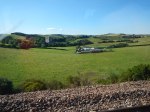


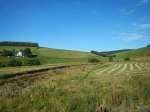


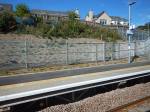







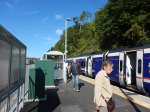





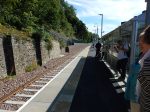
It looks like any new railway should, although it’s a bit stark at the moment, as all new railways and stations do.
In some ways, the most impressive features are the related new developments along the line.
There has already been a lot of new house-building, which is probably needed in Scotland as much as elsewhere in the UK.
But the most significant development is Galashiels station and the related bus station, from where you can get buses all over the Borders. Before the railway arrived to get between say Peebles and Edinburgh was an hour on the bus and then a difficult walk between Waverley station and the North Bridge, where the buses stopped. Now it’s a flat walk at either end of the journey to continue your journey.
It will be interesting to see the number of passengers, who transfer between bus and train at Galashiels.
The next developments along the line will be tourism related. The Great Tapestry of Scotland is coming to Tweedbank and I would not pass any comments on what else will be developed, other than to say that the new railway will provide masses of opportunities.
Yet again, it looks like a new rail or tram development is giving an area a lift up the scale of prosperity.
Where Now For Rail In The Border Country?
In this post I use the term Border Country to describe the Scottish Borders and the area of England that adjoins the actual border. The two sides of the border have a long association with fighting on the one hand and co-operation on the other.
But whatever happens on one side has a direct effect on the other. It has been thus, ever since England and Scotland first became nations.
So you understand what area I’m talking about let’s define the Border country as any part of Scotland South of a line drawn south of the Greater Edinburgh and Glasgow areas and in England anything North of say a line from Middlesbrough to Penrith. Apart from the main north-south, East Coast Main Line and West Coast Main Line, there are not many major railways, except for.
!. The Waverley Line, from Edinburgh to Carlisle, the Northern part of which is being rebuilt at the Borders Railway.
2. Carlisle to Newcastle, which has recently been prioritised for electrification and is very much a scenic line.
3. Settle to Carlisle is another down for electrification, which is also an important diversion for freight from the West Coast Main Line.
4. Cumbrian Coast Line that encircles the Lake District is another line on the electrification list.
5. The various lines linking Newcastle, Sunderland, Middlesbrough, Saltburn, Whitby and Darlington are a set of lines that will be electrified to create the Tees Valley Metro.
Most of them are scenic lines, with lots of Listed structures, good walking country and excellent food and drink.
So what factors will effect how the railway network develops in the Border country?
1. The Success Of The Borders Railway
I can’t see the new Borders Railway between Edinburgh and Tweedbank, being anything other than a big success. Virtually, every new train or tram line built in the UK and the wider world in the last few years except for the Dutch High Speed Line; HSL-Zuid has been a rip-roaring success.
My only worry about the Borders Railway is that they have decided to open on September 6, which was the day chosen by HSL-Zuid.
This success will lead to demands to extend the railway all the way to Carlisle. Some politicians have stated this is an aim. This extract is from Wikipedia.
In April 2014, Alex Salmond said the Scottish government would consider reopening the entire length of the Waverley Line to Carlisle; he said, “the success of the 30-mile stretch to just south of Galashiels would ‘calibrate’ a feasibility study into rebuilding the remaining 70 miles”
It could also lead to pressure for the reopening of other lines in the Border country.
2.Increase In Anglo-Scottish Traffic
Last week,according to this report in Modern Railways, First Group have applied to run a one-class rail service between London and Edinburgh to compete with the budget airlines.
If more services are sanctioned it will put pressure on both the East and West Coast Main Lines and it is unlikely that HS2 will be built within a few years. More likely this will only happen in a few decades!
And it won’t just be passenger trains, as when the economy gets better on both sides of the border, freight trains will increase too!
The only hope to increase capacity in the short term is to get passenger services on the two current main lines running at 140 mph, selectively add another track and hope by the use of ERTMS you can create a enough paths for the extra trains.
Somewhere there is an ambition to run trains between the English and Scottish capitals in four hours. When this happens, I suspect it will further increase the number of Anglo-Scottish passengers.
At a pinch, I suppose you could move freight trains to an uprated and fully-rebuilt Waverley Line, which could reach the English Midlands, via the Settle and Carlisle Line, to further eke out capacity, but it just goes to show how much HS2 will be needed all the way to Scotland.
3. Electrification In The North Of England
If this goes as far as the report of the North of England Electrification Task Force suggest, this could increase the number of lines in the Border country that get electrified. According to the Borders Railway web site, the new railway is being created so that electrification could be added reasonably easily.
You would hope that as they do more electrification, the engineers will get better at putting up the wires and keeping costs down. They may also come up with less obtrusive ways of electrification.
4. Improvements In Central Scotland
It seems that the railways between Edinburgh and Glasgow are very much like the railways between Liverpool and Manchester. There are several routes and they should have been electrified forty years ago.
In Glasgow too, you have the problem that trains can’t run between the West Coast Main Line and Perth, Aberdeen and Inverness. Passengers have to take a bus, taxi or walk across the city centre.
Hopefully, with the completion of the Edinburgh Glasgow Improvement Programme and the final implementation of Glasgow Crossrail, things will get better in a few years.
One outcome will be that more tourists will treat Glasgow and Edinburgh as one destination and will perhaps stay longer and explore the area more. So properly marketed they will take trips down into the Border country.
5. Track And Station Innovation
When I traced the Borders Railway on Friday and then when I looked up some of the visualisations of the track and stations, I was surprised how different some are to your typical station. Most on the Borders Railway are simple bi-directional stations on a single line, just like James Cook station in Middlesbrough.
As Network Rail and their appointed architects and engineers improve the design, this will mean that more lines can be reopened for an affordable cost.
I suspect too, that the designs will be used to create new stations in new developments all over the UK.
One good thing about the Borders Railway, is that there are no level crossings, with all of their adverse safety implications.
6. Train Innovation
Over the last few weeks, I’ve ridden battery-powered trains in Essex and tram-trains in Germany and France. So could innovation in train design mean that designers come up with a train that offers serious advantages over today’s trains for running on both heavy rail lines and perhaps on-street? And could it use a battery so that it doesn’t need to have fully-electrified lines?
I’m not sure yet, but something less capital intensive than today’s trains will be developed for use off the main electrified network.
Perhaps the ultimate train would be a variant of a Class 379 train or Class 399 tram/train, that could run on any voltage, but had a battery capability giving a range of perhaps sixty miles. Such a train could probably be used on the line between Carlisle and Newcastle with ease, as because both ends are electrified, it could charge the batteries fully at both ends.
The battery option would give all the speed and comfort of an electric train on rural lines, but without the cost and hassle of putting up electric wires.
7. ERTMS
A lot of the lines in the Border country are fairly simple, so ERTMS may make life even simpler as there will be no signals at the track-side to maintain in remote locations. In fact the Cambrian Line in Wales, which is very much a remote line has been working under ERTMS since 2010. This article from ERTMSOnline says that after a couple of teething problems things are going well now.
I don’t know whether the Borders Railway will run under ERTMS, but from what I’ve read, it would be more efficient if it did.
Certainly if you were opening a new line in a few years, ERTMS would be used and there would be no line-side signals.
8. Leisure Opportunities
If the Border country has lots of decent railway lines connecting small towns to major stations on main lines, it can’t help but encourage more people to explore the area.
The Borders Railway may well be opened with a steam train, although the design of Tweedbank station has not been designed with a run-around loop, so the engine can change ends.
Abellio ScotRail, who are the new franchise operator for Scotland are reported under their Wikipedia entry like this.
The franchise agreement requires the introduction of ‘Great Scottish Scenic Railway’ trains on the West Highland, Far North, Kyle, Borders Railway and Glasgow South Western lines. Steam special services will also be promoted by Scotrail.
As Abellio ScotRail are also committed to running shorter InterCity 125s between the major cities in Scotland, could we see a regular service to the Borders using one of these iconic trains?
When the Borders Railway is extended to Carlisle, as it surely will be, I suspect that these trains would take the Settle and Carlisle route all the way to Leeds.
If the trains were given a Chiltern-style spacious refurbishment, the finest and fastest diesel train, the world has ever seen, will have found a mission for a long and happy retirement.
Conclusion
All of these technical developments will mean that in a decade or so, the Border country will be criss-crossed by railways, where modern electric trains and a few heritage trains will speed passengers comfortably about their business.
It can’t but help to secure a prosperous future for the area.
Tracing The New Borders Railway
A friend and I traced the new Borders Railway from it’s terminus at Tweedbank, back into Edinburgh.



















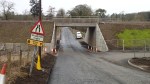



















It certainly looks like the opening date won’t be far off the planned one of September 6th, 2015.
To my untrained eye, it looks like they’ve done a superb design and engineering job to squeeze the new railway through some of the places it serves like Galashiels. Especially, as the railway is being built ready for electrification and with a loading gauge that could take the largest freight. On the Borders Railway web site, they say they have no plans to carry freight at present, but in the future an important project may create a freight need, so it is wise not to rule it out.
In all the pictures you will not see any level crossings. The Borders Railway has been built without them, as they are too much of a safety risk.
 The Anonymous Widower