Technology Behind Siemens Mobility’s British Battery Trains Hits The Tracks
This title of this post is the same as that of this news item from Siemens, which was published in December 2024.
These three bullet points introduce the news item.
- The Mireo Plus B battery train is rolled out in the East Brandenburg network, Germany, using the same technology as the British Desiro Verve project.
- The Desiro Verve would save £3.5 billion and 12 million tonnes in CO2 emissions for Britain’s railways over 35 years.
- The development marks the latest step of this technology’s journey to Britain’s railways.
No-one, including me, seemed to have spotted this news item, especially, since it is significant to both the UK and Germany.
But then parts of Siemens’s home country; Germany and Yorkshire, where they are building, a train factory to build London’s new Piccadilly Line trains have something big in common – There is a distinct shortage of electric trains and the overhead wires to power them.
So did German engineers, egged on by pints of British real ale, realise that their battery-electric technology for the Mireo Plus B battery-electric train, would turn a Desiro City multiple unit, like the Class 700, 707 or 717 into battery-electric trains.
These are three paragraphs from the Siemens news item.
The innovative technology behind Siemens Mobility’s British battery trains has been rolled out in the East Brandenburg network in Germany.
31 of the company’s Mireo Plus B trains are being phased in to the Berlin Brandenburg metropolitan region, beginning on Sunday (15 December) and is the latest proof point of the technology that underpins the Desiro Verve project in Britain. This follows the debut of this technology on 27 new trains in the Ortenau region of Germany in April, with more set to arrive in Denmark in 2025.
The British Desiro Verve trains would be assembled at Siemens Mobility’s new Train Manufacturing Facility in Goole, East Riding of Yorkshire, formally opened by the Transport Secretary and Mayor of London in October.
I’d always wondered, what Siemens would do with this factory, when it had finished making the Piccadilly Line trains.
It also should be noted, that the boss of Siemens UK, when the Goole factory was planned was Jürgen Maier, who according to his Wikipedia entry has Austrian, British and German citizenship and is now the boss of Great British Energy.
I believe that Siemens have big plans for the Goole factory.
One thing it has, that at the present time could be a problem in Germany, is large amounts of renewable electricity and hydrogen, so will energy-intensive components for trains be made at Goole?
It will be interesting to see how the Goole factory develops.
The Desiro Verve Train For The UK and Ireland
In the Siemens news item, their Joint CEO for the UK and Ireland; Sambit Banerjee, says this.
The Desiro Verve would be assembled at our state-of-the-art Goole Rail Village in Yorkshire and offers an integrated solution to replace Britain’s aging diesel trains without having to electrify hundreds of miles of track, saving the country £3.5 billion over 35 years and providing a practical path to decarbonising British railways.”
In June, Siemens Mobility identified how the Desiro Verve could save Britain’s railways £3.5 billion over 35 years compared with using diesel-battery-electric ‘tri-mode’ trains. This would support the Government’s aim of removing diesel-only trains from Britain’s railways by 2040.
The British trains would be powered by overhead wires on already electrified routes, then switch to battery power where there are no wires. That means only small sections of the routes and/or particular stations have to be electrified with overhead line equipment (OLE), making it much quicker and less disruptive to replace diesel trains compared to full electrification.
I agree with his philosophy.
The Rail Charging Converter
When I wrote Cameron Bridge Station – 15th May 2025, I described how a short length of overhead electrification could be erected at the station to charge passing trains, using their pantographs.
Cameron Bridge station is lucky in that there is already a 132,000 KVAC electricity connection to the distillery next door.
But at other places, where there is no connection, you could wait as long as seven years to be connected to the grid.
So Siemens have come up with the Rail Charging Converter, that provides a local electricity supply to support the charger.
It is described in this paragraph from the news item.
This OLE can also be installed much more quickly using Siemens Mobility’s innovative Rail Charging Converter (RCC), which makes it possible to plug directly into the domestic grid – potentially cutting delivery times for OLE from seven years to as little as 18 months.
This Siemens visualisation shows a Verve train and an RCC.
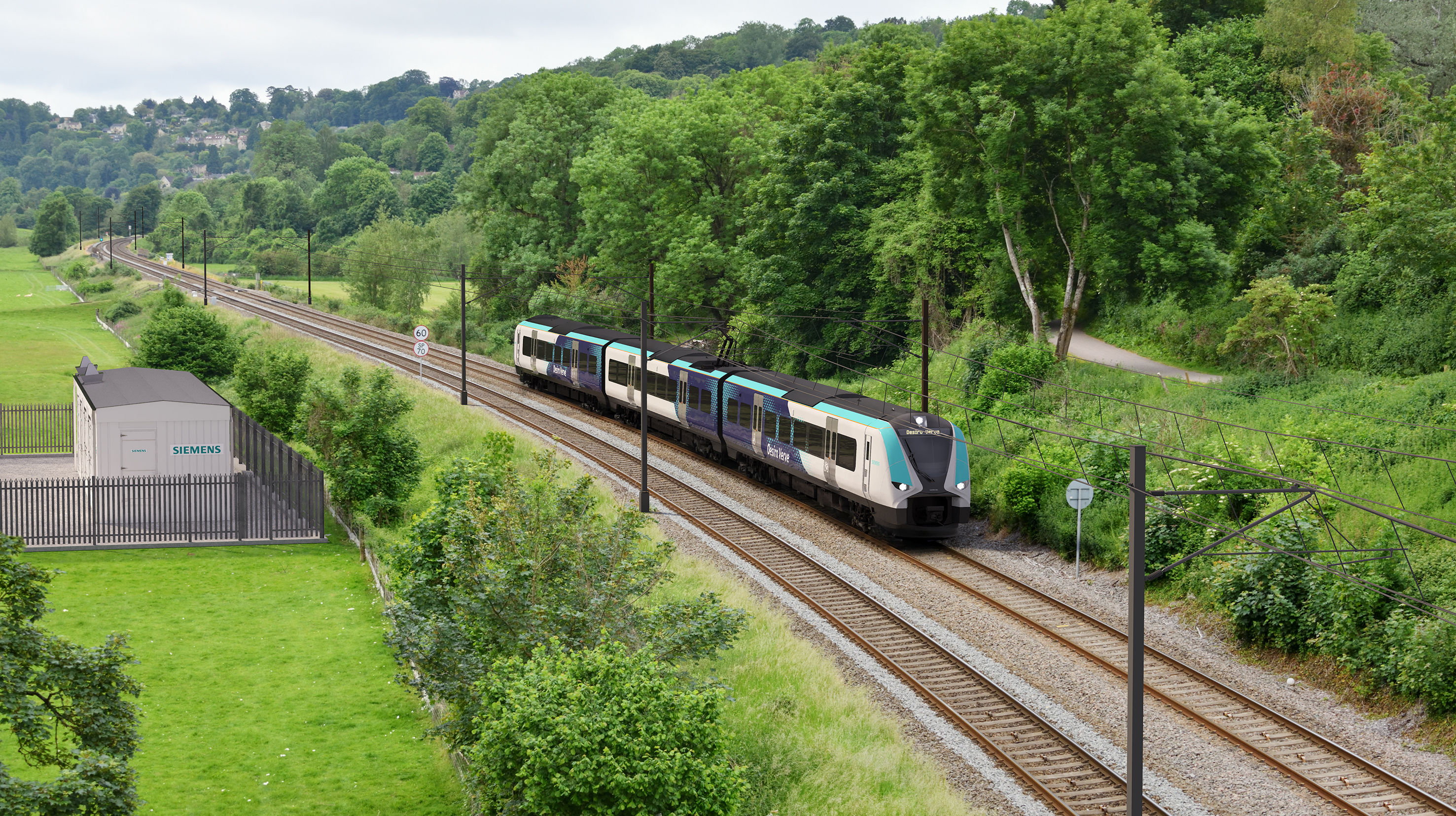
This arrangement could be used in sensitive countryside or close to historic buildings.
Modern Railways – June 2025
There is an article about the Siemens technology in the June 2025 Edition of Modern Railways.
It is called The Battery Revolution Starts In Long Marston for which this is part of the sub-heading.
New technology being installed by Siemens Mobility at Porterbrook’s test facility paves the way for widespread use of battery trains in the UK.
The article is a must-read.
Conclusion
Siemens appear to have the technology with their Rail Charging Converter and battery-electric trains like the Verve and the Mireo Plus B, to be able to decarbonise lines without electrification all over the world.
Would larger gauge trains be delivered from Germany and smaller gauge ones from Goole?
I wouldn’t be surprised that a version for a German S-Bahn could share more characteristics, with a small British train, than a large German one.
I can also see an underground railway, that was built without power in the tunnels. So if you were building the Waterloo and City Line today, would it be battery-electric and charged at each end of the line using a pantograph?
 The Anonymous Widower