The Shape Of Things To Come On The Gospel Oark To Barking Line
Since modernisation in 2010, the service on the Gospel Oak To Barking Line has been run using six two-car diesel Class 172 trains.
Today was the first weekday, when one of the diesel trains had been replaced by a four-car electric Class 378 train.
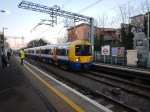
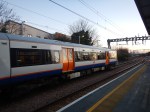
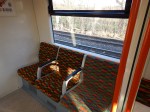
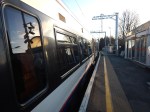
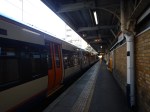
I was able to ride on a Class 378 train between Harringay Green Lanes and Gospel Oak stations. I then doubled back and travelled all the way East to Barking station.
These are a few observations.
Electric Trains
Riding the electric Class 378 trains is a very different experience to riding the diesel Class 172 trains.
- There is a lot less noise and vibration.
- You sit longitudinally in London Undergound fashion, as opposed to transversely.
- There was more capacity in the four cars of the electric train, as opposed to the two-car diesel trains.
I also got the impression that the Class 378 trains accelerated faster and cruised at a higher speed, than the Class 172 trains. I will check this out.
Train Capacity
I said in the previous section, that physical capacity is doubled from two to four cars.
- I actually went from Harringay Green Lanes to Gospel Oak twice in the morning Peak; once in a Class 172 and once in a Class 378.
- The former was jam-packed and the second was very comfortable, with only a few stansdees.
- The Class 172 train has 120 seats in a 47 metre train, which works out as 2.6 seats per metre.
- The Class 378 train has 136 seats in a 80 metre train, which works out at 1.7 seats per metre.
The lower seat density and the wide central isle, probably explains, why the electric train was more comfortable.
Note that in a few months, the Class 378 trains will be replaced with Class 710 trains, which will likely have a similar passenger capacity to the Class 378 trains.
So the capacity and passenger ambience of the Class 378 trains can probably be read across to the internally-similar Class 710 trains.
Platform Length Issues
I did my usual trick of riding in the last car and looking at where the end of the train came on the platform.
The line has been built, so that all platforms fit the standard British Rail four-car length of eighty metres, which applies to both four-car Class 378 and Class 710 trains.
The Possibilities Of Five-Car Trains
London Overground run five-car trains through four-car stations at Shadwell, Wapping, Rotherhithe and Canada Water on the East London Line, by allowing the last car to overhang the platform.
They get away with it without any trouble because.
- The Class 378 trains have selective door opening and a walk-through interior, with large lobbies.
- The announcements on the train are high-quality and advise passengers in the last car to move forward at short platforms.
- East Enders quickly learn how to get in and out of the train with little fuss
So could five-car trains be run the Gospel Oak to Barking Line?
- Barking station has a long platform.
- Some stations like Woodgrange Park, Wanstead Park, Leytonstone High Road, Leyton Midland Road and Upper Holloway originally had longer platforms and these could probably be extended.
- Other stations like Gospel Oak, South Tottenham and Blackhorse Road are probably at maximum length and would use selective door opening.
I suspect that if the demand needed the extra capacity, that the new trains could be lengthened from four to five cars, which would give a twenty-five percent increase in capacity.
Typical Passengers
I have a feeling that the Gospel Oak to Barking Line doesn’t have well-defined typical passengers, like a lot of routes do.
Using the train in the Peak, you notice that many passengers just hopped a couple of stops on the line.
One guy was going from Harringay Green Lanes to Shoreditch High Street, with changes at Gospel Oak and Canonbury.
This journey is probably a reflection on the badly-designed bus routes in the area it serves.
Gospel Oak To Barking Line Connectivity
The line is well-connected to the Underground, especially if you are up for a ten-minute walk.
- District and Hammersmith & City Lines at Barking
- Crossrail at Wanstead Park
- Victoria Line at Blackhorse Road
- Piccadilly Line at Harringay Green Lanes
- Northern Line at Upper Holloway
- North London Line at Gospel Oak
There are also good connections to North-South buses at several stations.
Will Electric Trains Attract More Passengers?
I suspect London Overground will be looking at the passenger statistics on the route with considerable interest, during the period, when some trains are two-car diesels and the others are four-car electrics.
This may well give the answer to my question.
I have a feeling that the reduced crowding on the route will mean that more passengers are attracted.
The new Class 710 trains will have wi-fi and USB charging points, so I wonder how many passengers this will attract.
But as I said earlier, a twenty-five percent increase in capacity may be possible by adding another car to the trains.
Conclusion
I have a very strong feeling that the upgrade to the Gospel Oak to Barking Line and the new electric trains, will change North-East London for the better.
As the London Overground lines to Cheshunt, Chingford and Enfield Town are also getting new trains, I would suspect that the effects will be bigger and more widespread than anybody has predicted.
- Trains will get crowded.
- New stations will be added to the network.
- Existing stations will be upgraded with step-free access
We could even see a serious outbreak of London Overground Syndrome.
Future Additions
These are projects that will or could happen along the Gospel Oak to Barking Line.
- Extension to the new Barking Riverside station.
- Five trains per hour in the Peak
- A new station at Cann Hall.
- A direct link between Walthamstow Queens Road and Walthamsow Central stations, when the latter is upgraded.
- South Tottenham station will be on Crossrail 2 and could be on a future Enfield Town-Stratford service.
- Harringay Green Lanes station could be connected to the Piccadilly Line underneath.
- Reopening of Junction Road station with a link to the Northern Line.
At present only the first two will happen.
How Will Class 710 Trains Access Willesden TMD?
This map from carto.metro.free.fr shows the track layout around Willesden TMD, where the Class 710 trains for the Gospel Oak to Barking Line (GOBLIN) will be stabled.
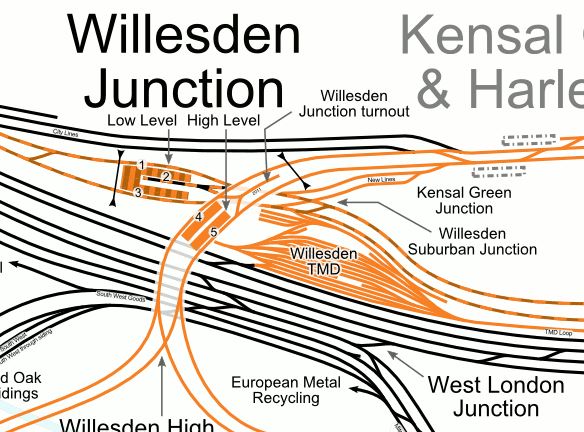
Note the following lines around Willesden TMD.
North London Line
The North London Line goes through platforms 4 and 5 at Willesden Junction station.
South of the station it splits, with the North London Line continuing to Richmond and the West London Line going to Clapham Junction.
North of the station the line continues to the East and at Gospel Oak station, the GOBLIN branches away.
The Bakerloo Line And Watford DC Line
The shared tracks of the Bakerloo Line and the Watford DC Line, which are shown in black/orange go through platforms 1 and 3 at Willesden Junction station.
To the East the tracks go towards Euston and to the West, they go towards Watford.
There is also a bay platform 2 in Willesden Junction station, which is shown in these pictures.

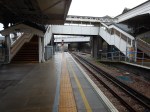
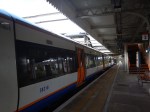
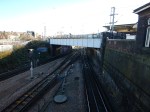
Note that is long enough to take a five-car Class 378 train and that it is also electrified with London Underground’s four-rail electrification.
Platform 2 To The North London Line to the East
Two tracks give a direct route from Platform 2 at Willesden Junction station to the Eastbound North London Line. greatkingrat says they are labelled “New Lines”
Looking from the train this morning, I don’t think this pair of tracks is electrified, so it doesn’t allow Platform 2 to be used to turn electric trains running on the North London Line.
I have seen Platform 2 used as a terminus, but the trains must use the electrified route via Primrose Hill.
After greatkingrat’s comment, I went back and had a second look.
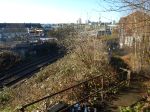
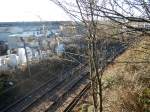
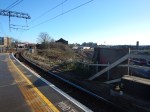
Note.
25 KVAC overhead electrification can be seen at the North London Line end of the tracks.
There is 750 VDC third-rail electrification at the Willesden
This Google Map shows, where the connecting tracks join the Bakerloo/Watford DC Line.
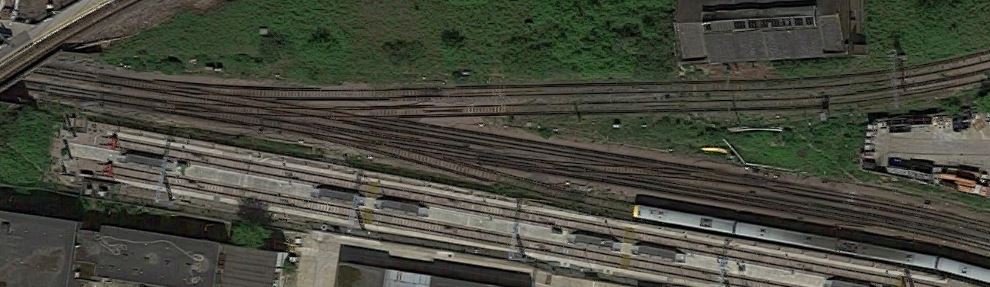
It does appear that the third-rail and a couple of gantries are visible.
- Trains leaving Platform 2 should be able to use third-rail electrification until they are under the overhead wires, when they would change over.
- Trains arriving at Platform 2 would use overhead wires, as far as they could and then swap to third-rail.
If this route is to be used by new Class 710 trains, I’m sure it will get more than adequate testing.
Entering Or Leaving Willesden TMD
I am not sure, how Class 378 trains working the Watford DC Line service transfer to and from Willesden TMD, but it does appear there are some convenient crossovers.
I have looked at Real Time Trains and early in the morning of the 9th of January, these trains called at Platform 2 at Willesden Junction station, that originated at Willesden TMD.
- 05:02 – Willesden TMD to Barking
- 05:15 – Willesden TMD to Upper Holloway
- 05:23 – Willesden TMD to Stratford via Primrose Hill
- 05:56 – Willesden TMD to Kensal Green
- 06:17 – Willesden TMD to Euston
There were also other services, which appeared to be going between Euston and Stratford.
It looks to me that trains were being positioned to start service and that the bay platform 2 at Willesden Junction station is used to reverse trains, coming out of the depot.
It also appears that some trains use the electrified route to the East via Primrose Hill.
The 05:02 and 05:15 are Class 172 trains going to the GOBLIN, and as they are diesel trains, they use the pair of direct tracks, that connect to Platform 2.
How Will Class 710 Trains Go Between the GOBLIN And Willesden TMD?
As the Class 710 trains will be dual voltage trains, they should be able to take the direct route, which has both types of electrification and requires a change at some point.
They can also take a roundabout route possibly via Primrose Hill and using Platform 2 at Willesden Junction station to access the depot.
But I suspect Class 710 trains will have battery power.
This would enable them to take the same short cut, but without using the electrification, between Platform 2 and the North London Line, that the Class 172 trains use currently.
Dual-voltage Class 378 trains should be able to use the short route.
Conclusion
Fitting batteries to Class 710 trains, would make their operation on the GOBLIN, a lot easier, as they could use the batteries to get in and out of Willesden TMD.
Could it be that the software that handles power and charges and uses the batteries, is the unreliable software?
This article on Rail Magazine is entitled Gospel Oak-Barking Fleet Plan Remains Unclear.
This is a paragraph.
London Overground was due to put new Bombardier Class 710 electric multiple units into traffic on the route from March 2018, with a full rollout by May. However, problems with the Train Control Management System (TCMS) has so far prevented this.
I also think that for a train to work the GOBLIN and be stabled at Willesden TMD, it must be a dual-voltage train or have a capability to run on batteries.
Will The New Class 710 Trains Use Selective Door Opening At Gospel Oak Station?
These two pictures were taken of a Class 172 train in Platform 3 of Gospel Oak station.
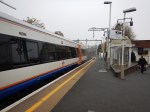
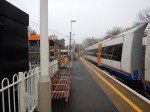
The two-car Class 172 trains are just over 47 metres long.
In The Aventra Car Length Puzzle, I said that the Class 710 trains for the Overground would have twenty metre long cars, which is similar to the 20.4 metres of the Class 378 trains.
For information other four-car electric units, that Aventras are likely to replace have the following car-lengths
- Class 315 trains – 19.80 metres
- Class 317 trains – 19.83 metres
- Class 319/769 trains – 19.83 or 19.92 metres
- Class 321 trains – 19.95 trains
- Class 455 trains 19.83 trains.
So it looks like the Class 710 train, has been sized as a direct replacement foe much of the Mark 3-based electric multiple units.
This would mean, that no platform lengthening work needs to be done, when the many older units are replaced with new Aventras.
It would also mean that as I talked about in Musical Trains On The Overground, that Aventras could share routes with Class 378 trains without too much trouble on the North and West London Lines.
So will a four-car Class 710 train, which will be about eighty metres long fit Platform 3 at Gospel Oak station?
This Google Map shows the station.
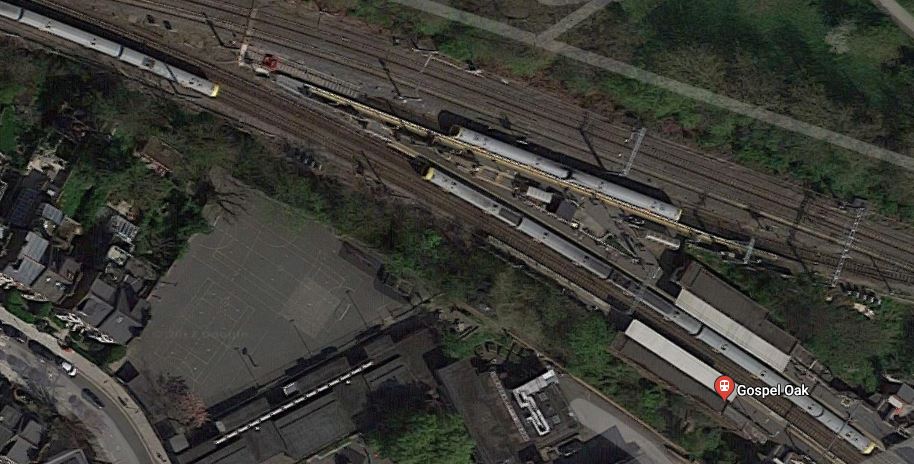
Note that a Class 172 train is in Platform 3 and in Platform 2 there is a five-car Class 378 train.
The length of Platform 3 can be ascertained and it looks like that Platform 3 is already long enough for an eighty metre train.
If it isn’t Bombardier certainly have fitted Selective Door Opening to the new trains.
Class 172 Trains And The Engine House At Walthamstow Wetlands
The Class 172 trains are running again on the Gospel Oak To Barking Line.

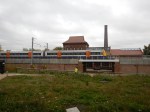

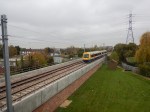

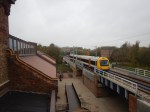
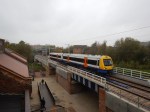

The pictures were taken by or from the Engine House at the Walthamstow Wetlands.
I have a feeling that Network Rail have used techniques to cut down the noise of trains, as when trains passed, they did seem rather quiet.
I have a feeling, when the new Class 710 trains start to run on the Gospel Oak to Barking Line, this will be the place, where the enthusiastic photographers gather.
After all, it’s near to a good cafe!
What Is Happening To The Greenford Branch?
It appears to me, that the Greenford Branch Line has been quietly shunted into a siding, as it has been some months since any statements of any worth have come from the Department of Transport, Transport for London, Great Western Raiiway or Network Rail.
The line now gets a two trains per hour shuttle service between Greenford and West Ealing stations. Trains that use the branch line to don’t go to Paddington any more.
West Ealing station is being rebuilt and looks like it won’t be complete for a couple of years.
This article on City AM is entitled Ealing Council seeks ‘urgent clarity’ over five delayed Crossrail stations as Network Rail retenders contracts to save money, which says a lot and may even explain, why nothing has been decided about the future of this branch line.
Current Speculation And Rumours
Various reports and forums outline solutions that suggest or include the following.
- It is probably not the easiest line operationally, as the train has to be stabled some distance away.
- Four trains per hour.
- Transfer of the line to the Overground.
- Run a shuttle from High Wycombe to West Ealing.
- Use London Overground’s Class 172 trains, when the Gospel Oak to Barking Line is electrified.
But there are a few problems.
- The incomplete West Ealing station.
- The platform at Greenford is rather short.
- Electrification would be difficult.
I hope all the silence is because the DfT, TfL, GWR, Network Rail and perhaps a train manufacturer are working hard to create an innovative solution for short branch lines like the Greenford Branch.
London’s Other Branches
London has two other short branch lines, that currently carry passengers.
Both are electrified and are run by a four-car shuttle using a bog-standard electric multiple unit.
But I doubt, they are some of most profitable routes in London.
In one forum, it was suggested that London Overground might use the Romford to Upminster Line for driving training on the new Class 710 trains.
In addition, there is the Brentford Branch Line, which has been proposed for reopening.
The Marlow Branch Line
I’m including the Marlow Branch Line, as according to the August 2017 Edition of Modern Railways, Network Rail have devised an innovative track layout for Bourne End station, that will allow trains to pass in the station and thus allow at least a two trains per hour service all day.
Modern Railways says this about financing the new track layout at Bourne End.
The LEP has allocated £1.5million to the infrastructure change needed to accommodate this proposal and GWR is seeking to close the funding gap on it.
There is also an informative diagram.
This Google Map shows Bourne End station.
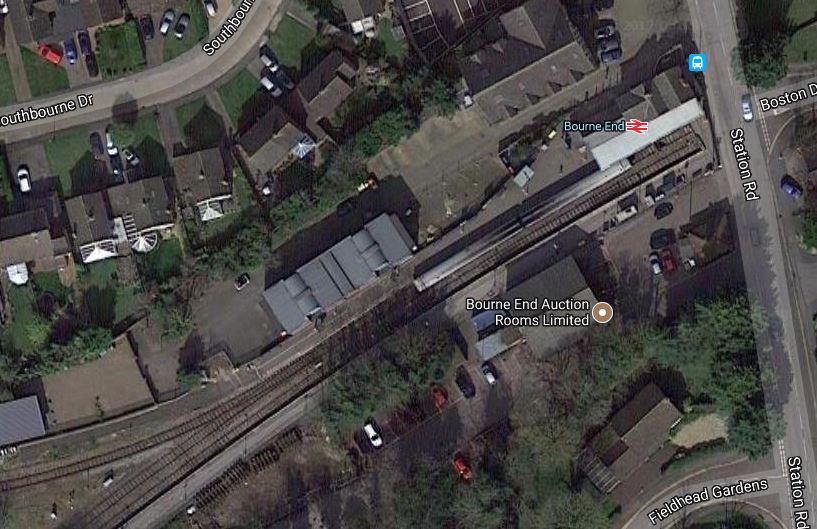
Note how a two-car Class 165 train is parked in the station with lots of space. These trains have two 23 metre long cars, so it would appear that a three-car train with possibly shorter length cars could be accommodated.
I wonder what is the maximum length train that the design team are working with.
Two three-car trains per hour would be a tripling of capacity over the current single two-car train per hour at present.
This innovative proposal certainly looks like one, that has a high chance of realisation.
Other Branch Lines
The UK probably has several short branch lines, with a similar profile to the Bromley North, Greenford and Marlow Lines, where often the service is inadequate or expensive and difficult to provide.
A Train For Branch Lines
Would it be possible to create a train using existing stock, that was ideal for these lines?
Vivarail with their Class 230 train have attempted to do this.
- Two or three cars.
- Diesel-electric or battery power.
- Designed to be serviced remotely.
It may turn out to be a high-class and reliable train, but there may be operational and marketing disadvantages, due to the train’s London Underground history.
But it is certainly a possibility.
Otherwise it is probably necessary to carry on as before with a two-car diesel multiple unit.
But at least, London Overground will be releasing eight Class 172 trains in Spring 2018.
The Unconventional Solution
Although two or three-car diesel multiple units will serve these branches well, I just wonder whether applying the same thinking that led to the Class 319 Flex train could produce a much better solution.
In their brochure for the train, Porterbrook state that they are thinking of adding a battery option to the train. The electrical layout of the Class 319 train leads me to believe it is certainly possible.
These branch lines are not arduous, so why not do the following.
- Replace one diesel power-pack of the Class 319 Flex train with a battery pack.
- Remove the trailer car to create a three-car train.
- Give the trains a good refurbished interior.
Note.
- A three-car train would probably not be a 100 mph train.
- A three-car Class 319 Flex train would only be fourteen metres longer than a two-car Class 165 train.
- Several similar four-car Class 321 trains have been converted to three-car Class 320 trains.
- Being able to run on electrified lines would ease operation, open up new services and charge the batteries.
I feel that having both diesel and battery power for working away from electrified lines would give the trains a high degree of reliability.
These trains could certainly work the Brentford, Greenford, Marlow and Windsor Branches.
The Bombardier Solution
In Will London Overground Fit On-board Energy Storage To Class 378 Trains?, I mused about this statement, after reading this article in Rail Technology Magazine entitled Bombardier enters key analysis phase of IPEMU. Marc Phillips of Bombardier is quoted as saying this in the article.
All Electrostars to some degree can be retrofitted with batteries. We are talking the newer generation EMU as well as the older generation. So, the 387s and 378s are the ones where we have re-gen braking where we can top-up the batteries and use the braking energy to charge the batteries. That gives us the best cost-benefit over operational life.
So it would seem that the Class 378 trains of the London Overground are candidates for fitting with batteries.
These trains started out with just three cars and have grown twice, by adding another motor car and a trailer car. So they are now five-car trains.
London Overground have said that they might lengthen the trains again to six cars.
I would suspect that Bombardier can play musical carriages and create, some six-car trains and a few three-car trains.
Fit batteries to the three-car trains and you have a battery-powered train for a short branch line, that starts in an electrified station.
Services on the Brentford, Greenford and Marlow branches could probably be run by these three-car battery-electric trains.
If the Class 378 train is too spartan, then there is always other Electrostars.
Just remember, that 4 + 4 = 5 + 3!
Conclusion
Don’t be surprised to see an innovative solution at Greenford.
 The Anonymous Widower