c2c Signs The First Deal On Porterbrook’s Class 387 Trains
This article on Global Rail News is entitled C2c signs short-term lease for Class 387 EMUs to cope with “unprecedented” demand, which tells how c2c have decided to go for a stop-gap lease of six of the twenty Class 387/1 trains, that were ordered by Porterbrook, when they saw a gap in the market.
c2c’s Future Fleet Plans
At present c2c has a one-class fleet of seventy-four Class 357 trains, which I think are leased from Porterbrook. These trains, like the Class 387 trains, are Electrostars. Wikipedia, also says this about c2c’s future fleet.
As part of its new franchise, c2c has committed to leasing new trains to cope with rising passenger numbers, which were boosted especially by the opening of the DLR station at West Ham in 2011 and the rise of Canary Wharf as a financial centre, 17 new four-car trains will be introduced by 2019, followed by 4 more by 2022 and 4 more by 2024.
This would bring the fleet up to one short of a hundred four-car trains.
One curiosity about the Class 357 trains is that they are 100 mph units, but the maximum line speed of the London, Tilbury and Southend Railway is only 75 mph. So any new trains will have to be 100 mph units, in case the line speed is increased.
The Global Rail News article says this.
Porterbrook Leasing will supply 24 new Bombardier-built Class 387 carriages on a three-year lease. In November 2015, Porterbrook announced it would be ordering 80 additional Class 387 EMUs to meet the increasing demand for electric rolling stock.
The timing of delivery in the Autumn of this year fits, as Bombardier will have finished building the Class 387/2 trains for Gatwick Express.
The Class 387 trains will certainly do the job in the short term, but running a 110 mph train on a line with a maximum speed of 75 mph in the long term, might not be the best use of resources.
The Crossrail Effect
c2c has a problem in that, when Crossrail opens fully to Shenfield in 2019, this will mean that a lot more places will be easily accessible from South East Essex by changing to Crossrail.
But c2c has no easy connection to the new line.
- At Fenchurch Street, you could walk to Liverpool |Street.
- At West Ham, you could take the Jubilee Line to Stratford or Canary Wharf.
- At Upminster, you could take the Romford and Upminster Line to Romford.
- At Southend Central, you could walk to Southend Victoria and get a train to Shenfield.
To make matters worse, the current time of 65 minutes between Southend Central and Canary Wharf, could possibly be challenged by an improved link from Southend Victoria to Shenfield for Crossrail.
It all depends, where you want to go at the London end.
c2c must be thinking hard about how to improve their services.
I believe they’ll be looking at all or some of these.
- New services to and from new stations.
- Use of London-style contactless ticketing.
- Faster train services, making more use of the 100 mph capability of the trains.
- A viable link to Crossrail.
Whoever, is the operator to Southend Victoria will be doing the same.
It strikes me that the major winners will be passengers going between South East Essex and London.
Electrostar Or Aventra?
I wonder, if the extra train buying for c2c will follow a similar pattern to the London Overground.
The Overground has got a total of 57 Class 378 trains, which like c2c’s are Electrostars, but are ten years younger and five-cars.
I thought, when it was announced that Bombardier had won the order for more trains for the Overground to serve the Lea Valley Lines and Gospel Oak to Barking Line, that it would be more of the same Class 378 trains.
But London Overground added a fleet of Class 710 trains from the new Aventra family.
The Electrostar and the Aventra are both four-card electric multiple units and I suspect once inside, the average passenger won’t notice much difference, but under the skin, the Aventra will be a more efficient train.
Aventra IPEMUs For c2c?
One of the advantages of an Aventra over the Electrostar, is that the trains are wired to be fitted with on-board energy storage. The main reasons for fitting this and making the train an IPEMU include.
- Saving energy by enabling regenerative braking. Not needed as the lines are already enabled.
- Simplifying overhead wiring in depots. Only needed if the existing depots need to be extended.
- Running trains on branch lines without electrification. Not needed unless c2c opens new services to places like London Gateway and Tilbury Riverside.
Running services to London Gateway could be the clincher, as to whether Aventras with an IPEMU-capability are ordered.
I have a feeling that a few miles closer to London, that London Overground will be using similar Aventra IPEMUs to enable the new Barking Riverside Extension to be built without electrification. I wrote about this in Defining The GOBlin Extension To Barking Riverside.
Aventra IPEMUs could run the following route.
- The service would start on the current line to London Gateway, which is not electrified, at a new station, serving the important port and logistics area.
- After calling at East Tilbury, it would serve Tilbury Riverside, by reopening the old branch as a line without electrification.
- It would then use the existing line through Tilbury Town and Grays, before going to Upminster via the line through Chafford Hundred Lakeside.
- After stopping at Upminster, it would use the Romford to Upminster Line, to continue to Romford.
I would estimate that London Gateway to Romford via Tilbury Riverside would take under the hour and four trains could be needed to run a two trains per hour service.
Note the following.
- The Aventra IPEMUs would run normally on the electrified parts of the route, charging their on-board energy storage along the way.
- On the branches without electrification, trains would run on their stored energy.
- This service would connect London Gateway to Heathrow Airport via Crossrail and to Felixstowe via the Great Eastern Main Line.
- A service could be run from Shoeburyness and Southend to Romford, which would not need IPEMUs.
- The service to Romford also give c2c’s network a much-needed link to Crossrail.
- Calling at Tilbury Riverside would be for the cruise ships at the London Cruise Terminal and the Gravesend-Tilbury Ferry
- Calling at Chafford Hundred Lakeside would connect the Lakeside Shopping Centre to Crossrail.
- London Overground would lose responsibility for the Romford to Upminster Line.
- There would be some track adjustments at Upminster, but there would be no need to electrify the two new branches.
Given that the route connects several important commercial, leisure and housing areas, I think it could become a route, that exceeded its expectations, by a long way.
The one problem could be in linking the single track from Romford to Upminster to the single track through Chafford Hundred Lakeside.
Trackwork At Upminster
This Google Map shows Upminster station.
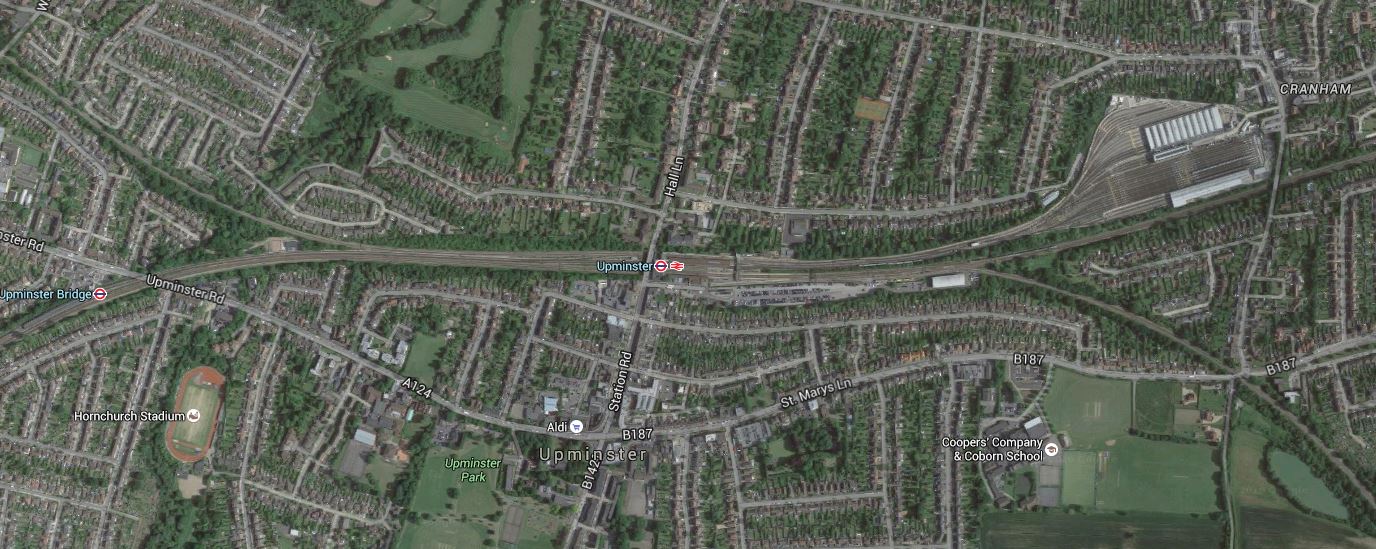
Upminster Station
Note.
- The line to Chafford Hundred Lakeside going off to the South East.
- The line to Romford going off to the North West.
- London Underground’s Upminster Depot to the North East of the station.
- The Romford to Upminster Line comes into a platform at the North side of the station.
I suspect that engineers have methods to get trains across the London Underground lines in a flat junction without building an expensive viaduct.
Conclusions
Obviously c2c have a plan for their new trains and extra services, all over South-East Essex. All will be revealed in the next few years!
But I do think that the Romford to Upminster Line is more use to c2c, than as an isolated single-train outpost for the London Overground.
I also think that the local authorities and the people of the area, would all like to see Crossrail, Lakeside Shopping Centre, London Cruise Terminal, London Gateway, Romford, Southend and Upminster connected together by frequent electric trains.
Aventra IPEMUs would enable the two new branches to London Gateway and Tilbury Riverside, to be added without electrification.
Aventras And The Romford To Upminster Line
The Romford to Upminster Line is probably a line that Transport for London sometimes wishes had been chopped with the Beeching Axe.
I suspect though, that given the railway mania in London and the South East, the arrival of Crossrail at Romford in the next few years and the ambitious expansionist tendencies of both TfL and c2c, that this line won’t remain a simple shuttle in perpetuity.
At present the line is worked by a single four-car Class 317 train, which I found in A Clean Train From Romford To Upminster.
But from May 2018, Aventras in the shape new Class 710 trains, will start to arrive on the London Overground.
I just wonder, if one of the first trains will get allocated to this isolated line in East London.
- It surely would be an ideal test track to get to know the trains and familiarise drivers with their new charges.
- The novelty of new trains in this backwater, but linked to Crossrail, might encourage more passengers to use the line.
- Train-spotters and other anoraks will certainly visit.
The line is also only five kilometres long, but fully electrified, so I do wonder, if TfL will investigate the IPEMU capabilities of the Class 710 trains, if they decide to fit on-board energy storage.
- I suspect, there would be no modifications to track, electrification or signalling needed to run the linewith a train running as an IPEMU.
- Five kilometres or ten if both ways, is well within the capabilities of an IPEMU.
- During testing, if the energy storage should fail, the driver would just swear, put the pantograph up and continue.
- Charging of the energy storage, would happen in one or both of the terminal platforms.
According to Wikipedia, the line is not signalled, so the possibility must exist of running this short line on stored energy to reduce track maintenance costs.
A Trip To Barking
In A Story And A Rumour About The Gospel Oak To Barking Line, I reported on a rumour that an LO staffer had said that the electrification will be complete by June.
I think this is impossible, as according to this document on the TfL web site, the bridge at Upper Holloway station will only be completed before the end of 2017. I don’t think I’m alone in thinking that the bridge must be completed before the electrification.
Surely,if the electrification is to be completed by June, then there will be evidence of construction all along the line.
Today, I went to Barking station and had a look around.
- The GOBlin terminates in Platform 1 at Barking station and there is no evidence of any construction there.
- There was no evidence of piling between Barking station and the short length of electrification between Barking and Woodgrange Park station.
- There was also no evidence of any work tro create supports for the catenary on the elevated section of the line between Woodgrange Park and Leyton Midland Road stations.
On a quick look too, there didn’t appear to be any construction cabins, that would be normal for such an undertaking, as electrifyimg a dozen miles of railway..
I then had a think about the objectives of all the work on the Gospel Oak to Barking Line.
- Replace the two car Class 172 diesel multiple units with four-car Class 710 electric multiple units.
- Allow freight trains to be hauled by electric locomotives.
- Extend the line to Barking Riverside.
This map from carto.metro.free.fr shows the lines at Barking station.
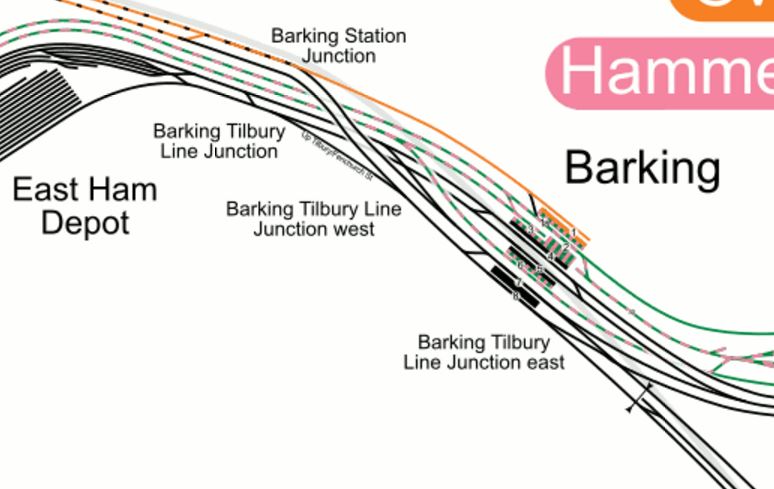
Lines At Barking Station
Note the following.
- The GOBlin (orange) terminates in the bay platform 1, on the North side of the station.
- Freight trains to and from London Gateway, Tilbury and the East, go through the two Barking Tilbury Line junctions and then access the GOBlin using a flyover and the Barking Station junction.
- Barking Riverside station is on a spur off the Tilbury Line to the South East.
So I asked myself, what electrification needs to be done to get electric-hauled freight trains off and on the GOBlin.
As c2c runs electric services in and out of Liverpool Street at certain times, I suspect that the wiring to get electric-hauled freight onto the GOBlin is already there.
So we’re left with the only electrification at Barking being platform 1 and the extension to Barking Riverside. The total length is probably under ten kilometres.
According to Bombardier, all Aventra trains like the Class 710 will have an energy storage capability.
So could we be seeing an extension to Barking Riverside like this?
- Between Barking Station junction and Barking Riverside station, the Class 710 trains run on their batteries.
- Eastbound and westbound services both use Platform 1, so the GOBlin has its own single-platform at Barking. Recently, Network Rail has built several single-platform stations.
- Platform 1 is not electrified.
- The line through Platform 1 is extended under the station to give a direct connection to Barking Riverside. This might need another flyover or some extra points and crossings.
- The branch line to Barking Riverside and the station are not electrified.
Effectively, using the IPEMU capability of the Class 710 trains, has simplified the project and reduced the length of electrification required by a large amount.
Whilst I was at Barking station, I took this picture.
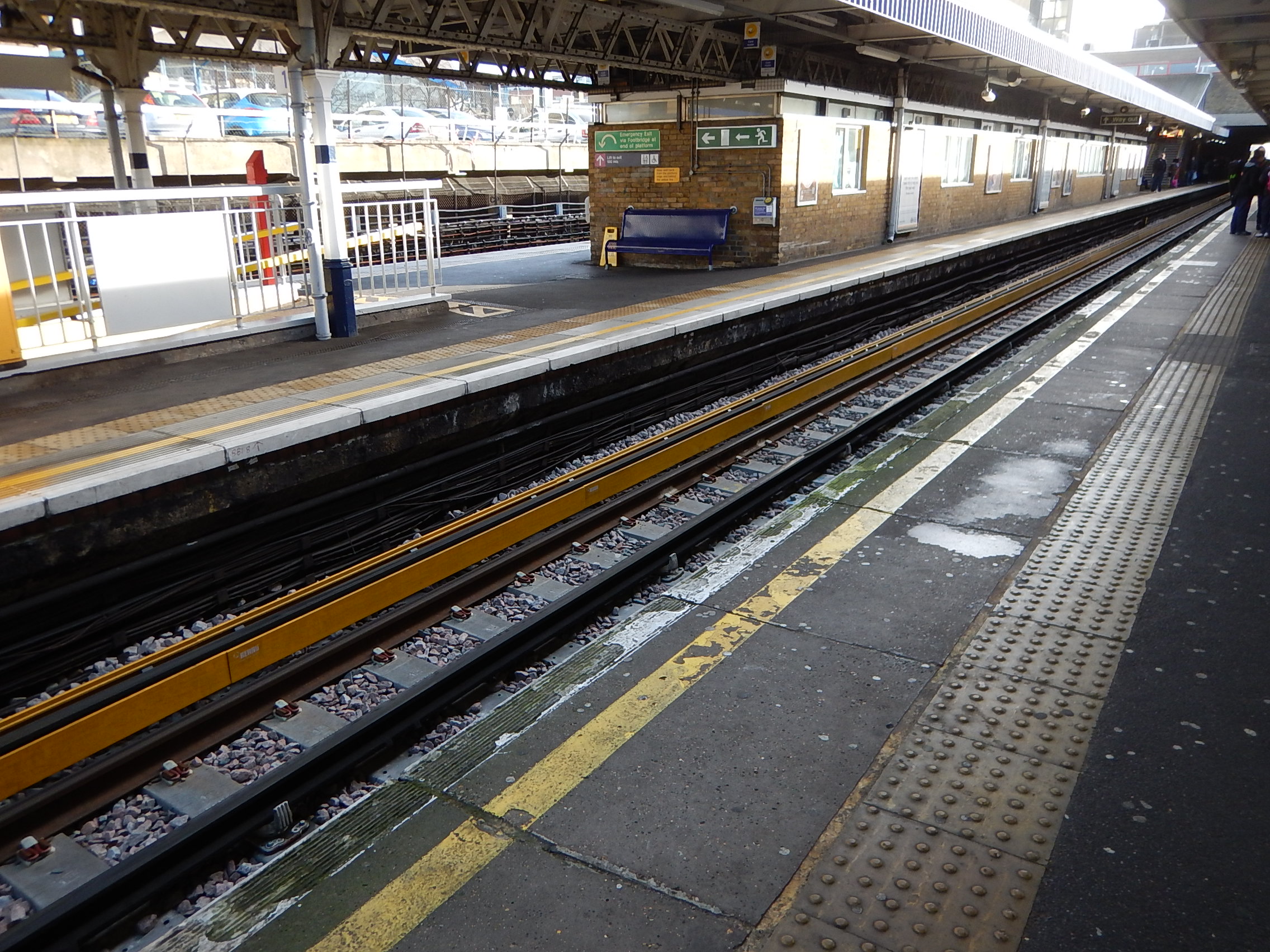
A Protected Conductor Rail At Barking Station
Note how the conductor rail is protected by a yellow wooden shield.
Why?
Is it to protect passengers or the work-force?
Electrification Work Starts At Gospel Oak Station
My Google Alert on the Gospel Oak to Barking Line picked up this article from the Camden New Journal, which is entitled Noisy railway work disturbs Gospel Oak residents on Christmas Day.
So I went to have a look at Gospel Oak station.
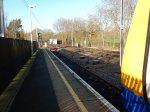
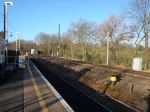

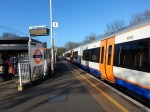
Note the piles in the ground covered by a piece of wood.
That was what all the noise was about!
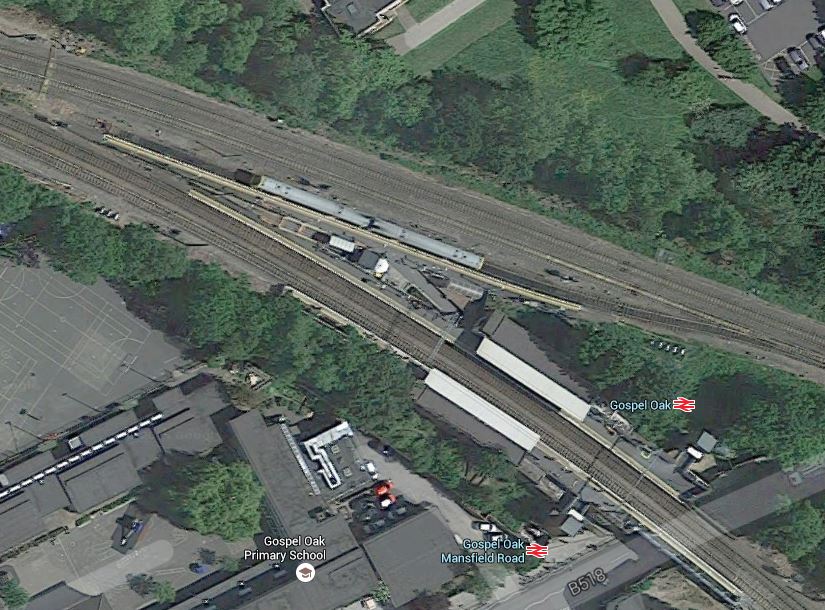
This Google Map shows the station.
Gospel Oak Station
Note that there is a two-car Class 172 train in the station.
From this image, it would appear that the platforms will have to be lengthened for the four-car Class 710 trains.
Giving the map a close scrutiny, I wonder if they ever wanted to install a Platform 4 for future eastbound services on the Gospel Oak to Barking Line, if it would be possible.
I don’t think London Overground have any plans to do this, but services from the GOBlin past Gospel Oak have been suggested in the past.
Note the
London Overground’s New Class 710 Trains
The Aventra trains on order for the London Overground have now been given a number and are now Class 710 trains.
Wikipedia says this about the trains.
The units will be delivered in two sub-classes; an AC only version with longitudinal and transverse seating (very similar to the S8 units on the Metropolitan Line of the London Underground) for use on the West Anglia and Romford-Upminster services, and a dual-voltage version with longitudinal seating for the Watford DC and GOBLIN services. The AC only version will be maintained at Ilford TMD and the dual-voltage units at Willesden TMD.
So it appears that the trains used on the Gospel Oak to Barking Line will be dual voltage, despite there being no existing or planned third-rail electrification on that line.
It did at first strike me as surprising, but then I suspect that it is nothing more sinister than prudent future-proofing, with perhaps some manufacturing and maintenance convenience.
It has to be noted that North London Line services between Stratford and Richmond, use dual-voltage trains.
There has been talk over the years about the extension of the GOBlin at both ends. Only the short extension to Barking Riverside is being taken forward.
For instance, in Transport for London’s London Infrastructure Plan for 2050, this map of lines around Old Oak Common station is shown.
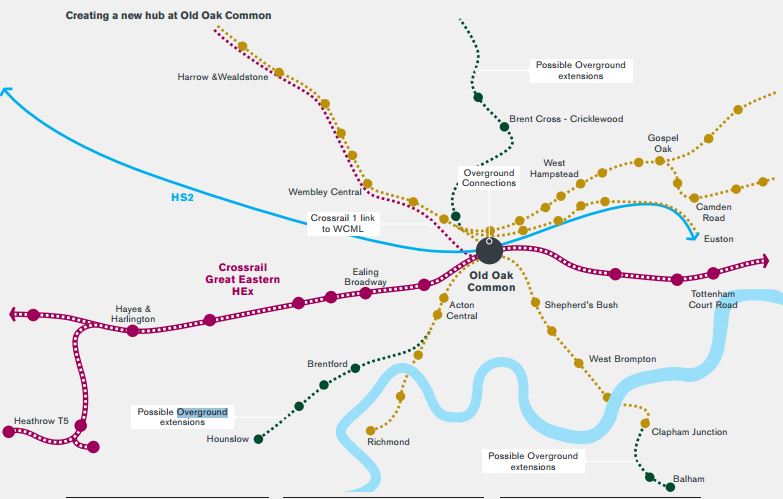
Lines Radiating From Old Oak Common Station
Note the various extensions all centred on the development area of Old Oak Common, that will be even more important if it has an HS2 station.
Could the future-proofing of specifying dual voltage trains, be in case they want to extend services through Gospel Oak onto the North London Line, to Balham, Hounslow and Richmond? All three destinations are deep in third-rail territory.
Dual voltage trains would also be needed, if GOBlin services went to Watford, but not for the extension to Brent Cross – Cricklewood.
In some ways, the interesting extension to the Overground is to Balham, which is a proposed Crossrail 2 station.
At the moment the service on the West London Line is crowded and probably doesn’t have enough capacity. The service is at present.
- Two London Overground serices per hour between Stratford and Clapham Junction
- Two London Overground services per hour between Willesden Junction and Clapham Junction
- One Southern service per hour between Milton Keynes and South Croydon.
Perhaps by running some of the Gospel Oak to Barking Line trains past Gospel Oak through to Clapham Junction or Balham stations, may help to sort out a few problems.
Richmond would probably be an unlikely destination, as the Class 710 trains have a car less than the Class 378 trains and getting there from any station on the GOBlin would anyway be a single change at Gospel Oak.
As Hounslow lacks the connectivity of Balham, if there is any extension of the GOBlin, Balham could be the most likely destination.
I think the only thing we can say with certainty, is that having dual-voltage trains on the GOBlin avoids the need to add the capability later, if it is decided to extend the line past Gospel Oak station.
 The Anonymous Widower