Would Batteries Help Voltage Change-over In A Dual Voltage Train Or Tram-Train?
Battery Power And Tram-Trains
Consider.
- The Class 399 tram-trains in Sheffield can work on both 25 KVAC and 750 VDC overhead electrification.
- Their German cousins in Karlsruhe can work on both 15 KVAC and 750 VDC overhead electrification.
In Karlsruhe, there is a ceramic rod between the two overhead cables with different voltages and the pantograph rides across. I suspect that clever power electronics on the tram-train measures the voltage and converts it automatically to that needed to power the tram-train.
I haven’t been able to see how Sheffield connects the two different voltages, but I wouldn’t be surprised if a similar system with a ceramic rod is used.
Look at this picture, I took of a Class 399 tram-train in Sheffield.
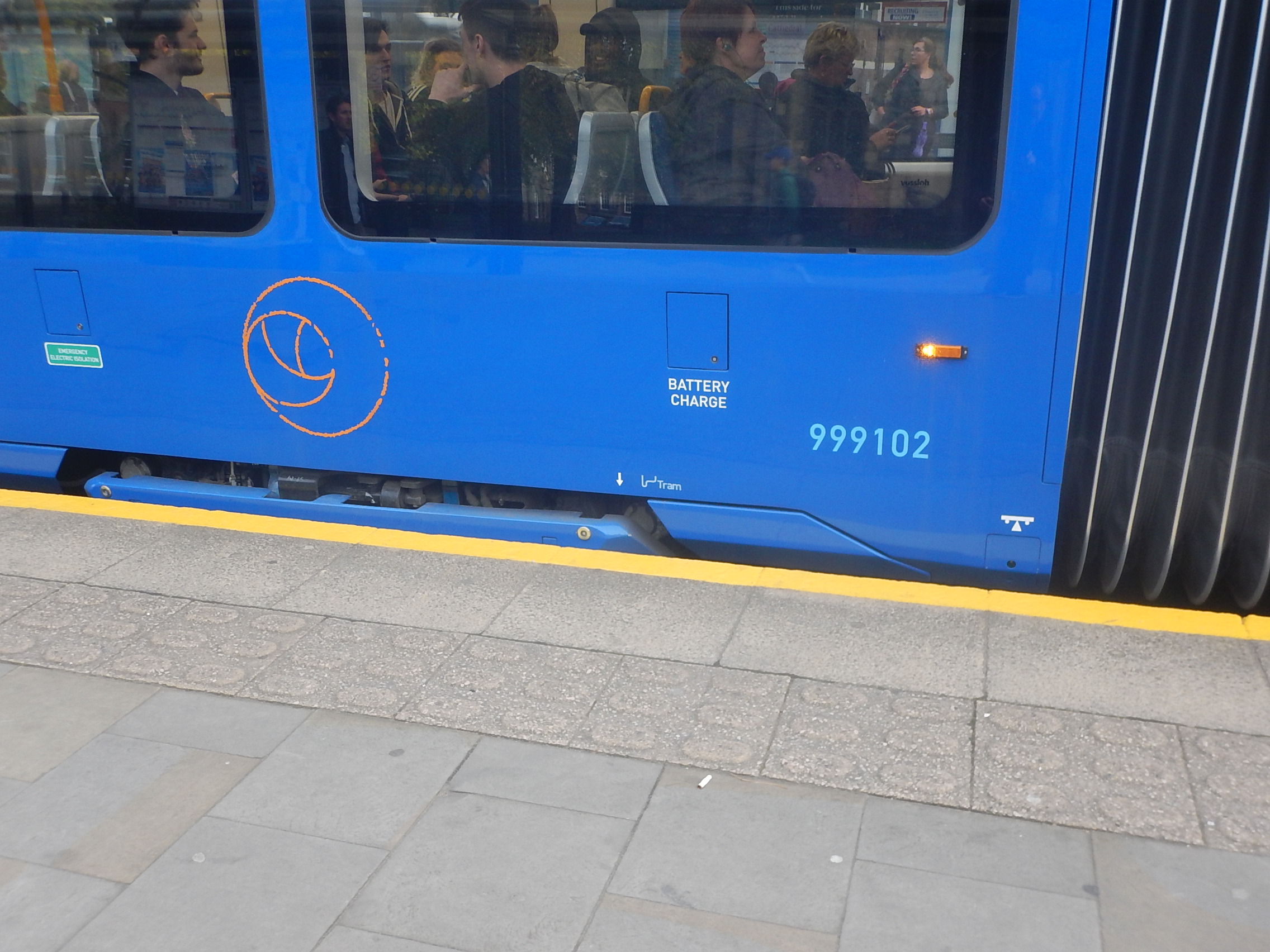
Note the BATTERY CHARGE socket to the left of the car number.
Why would an electrically-powered vehicle need a battery?
I suppose it could be to start up the tram-train in the morning and raise the pantograph.
But could it also be for emergency power, to move the tram-train short distances, such as in depots or to assist the vehicle through the dead sections, where the power supply changes from one voltage to another?
The Class 399 tram-trains ordered for the South Wales Metro will also have to cope with discontinuous electrification. So is the technology needed for this already installed in the tram-trains in Sheffield?
Battery Power And Dual Voltage Trains
Suppose you have a train like a Class 378 or Class 700 train, that can run on both 25 KVAC overhead and 750 VDC third-rail electrification.
Third-rail trains with contact shoes deal with discontinuous electrification all the time.
If a dual-voltage train had a battery that could take it say two hundred metres, then I believe that voltage changeover could be simplified and speeded up.
I have watched Class 717 trains change voltage at Drayton Park station and what changes would a limited battery capability make.
The third-rail electrification would stop several metres short of the station and would be removed in the station itself.
Going towards Moorgate, this would be the procedure.
- The train would stop in the station as it does now.
- The driver would drop the pantograph, whilst passengers unloaded and loaded.
- The driver would close the doors.
- The train would accelerate away on battery power.
- After a few metres the train would contact the third-rail and the train’s computer would change from battery to third-rail power.
Going away from Moorgate, this would be the procedure.
- The train would automatically disconnect from third-rail power, where that stopped to the South of the station.
- The train would automatically switch to battery power.
- The train would stop in the station as it does now.
- The driver would raise the pantograph, whilst passengers unloaded and loaded.
- The driver would close the doors.
- The train would accelerate away on overhead power.
The stops should be no longer, than a normal station stop without power changeover.
Conclusion
Batteries may well reduce the time taken to change voltage
A Class 313 Train In Not Bad Condition
On Friday, I took a train between Moorgate and Essex Road stations.
It was not in bad condition.
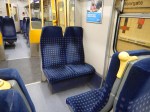
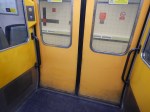
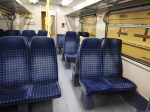
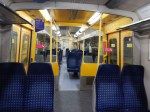
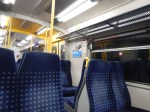
These trains are three-car trains and run in pairs as six-cars.
These trains used to run on the Watford DC Line, so I wonder if when they get to be released by the new Class 717 trains, some could be put back on that line to release some more Class 378 trains for the Gospel Oak to Barking Line.
Anybody like a game of Musical Trains?
Pan Up And Pan Down At Drayton Park Station
The years and decades go by and the new Class 717 trains, just like their predecessors; the Class 313 trains, continue to change between 25 KVAC overhead and 750 VDC third rail electrification at Drayton Park station.

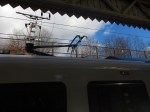
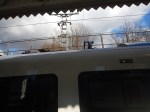


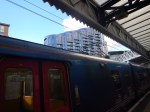

There appears to have been little noticeable development in the forty years since the Class 313 reains were introduced. But the operation of the Class 717 trains appears smoother and quieter.
I would have thought, that for safety reasons, the new trains would have used battery power between Drayton Park and Moorgate stations.
After all it’s only two and a half miles, that is run using third-rail electrification.
I’d be very interested to see how much power is used by the new Class 717 trains South of Drayton Park.
In Weight And Configuration Of A Class 717 Train, I showed that the kinetic energy of a jam-packed Class 717 train at 85 mph is 56.15 kWh.
- I doubt that this sort of speed is achieved in the tunnels.
- At 60 mph, the energy would be 28 kWh
- At 40 mph, the energy would be just 12 kWh.
Obviously, hotel power for air-conditioning and lights will be needed for the train, but even at 5 kWh per car per mile, that would only be 150 kWh.
To carry 200 kWh of batteries on a six-car train is a very practical proposition.
- Vivarail have done it in a three-car train.
- There could be a short length of third-rail electrification to top up the batteries at Moorgate station, if required.
- Battery power could be used in depots to move trains, which would mean depots could have less electrification.
- Trains could be moved to the next station, if the electrification should fail.
The route between Moorgate and Drayton Park stations, is probably one of the best and easiest in the UK for battery operation.
Wi-Fi And Power Sockets On A Class 717 Train
In A First Ride In A Class 717 Train, I didn’t take any pictures of the power sockets, as I didn’t see them.
This picture from a second trip, rectified the error.

There is one 13 amp socket under a pair of seats and you will need a plug.
It is my belief that a USB socket is better, as this armrest installation on a Class 230 train shows.
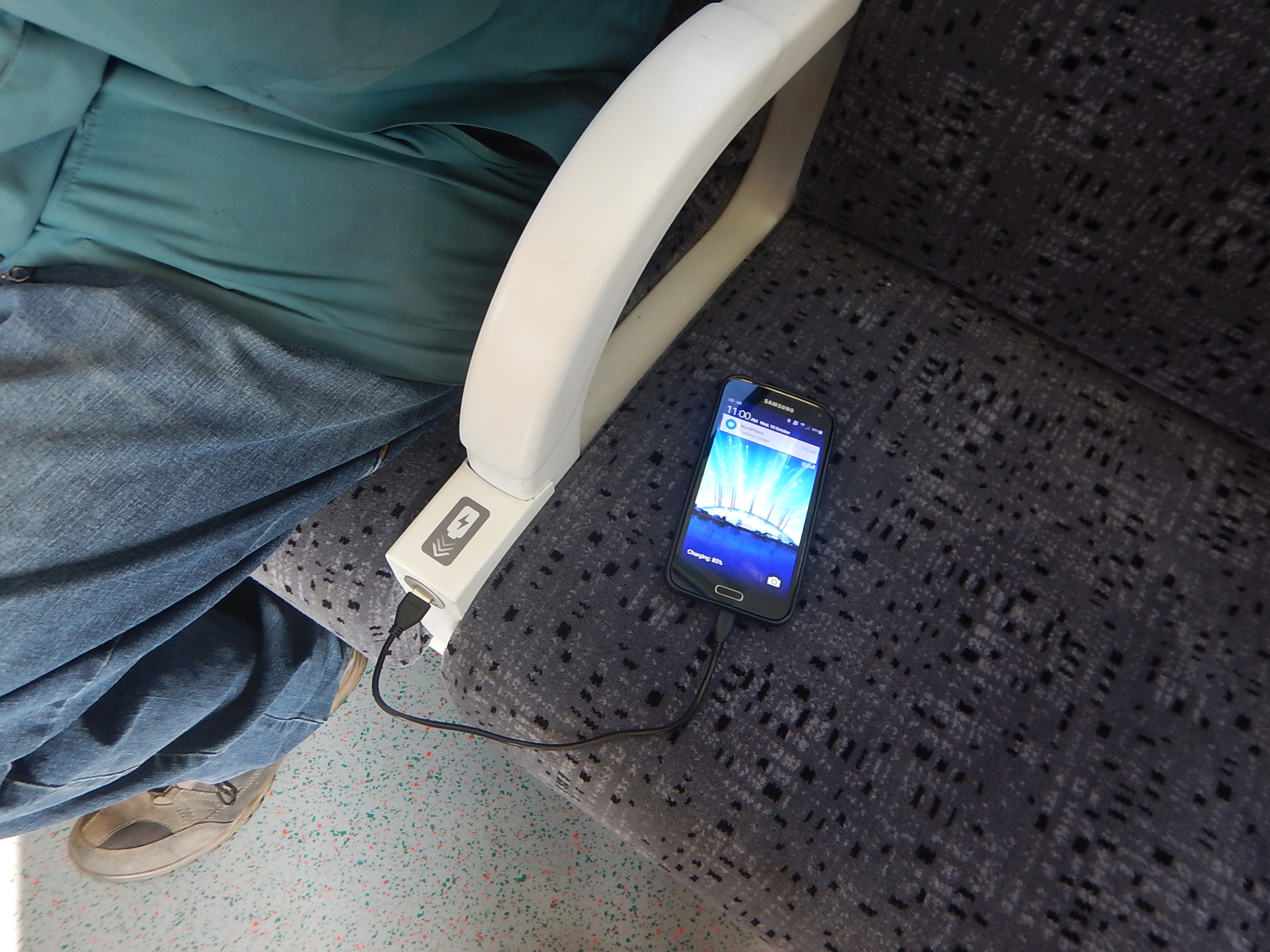
It is certainly a better place, as the wires can be short and can be kept out of the way.
The wi-fi performed well, but Great Northern seemed to want me to register. I never do, as it just gives them an excuse to send you junk mail.
Conclusion
The wi-fi installation can be improved.
It has to, as according to this article on Rail Magazine, Class 710 trains have USB sockets.
My ideal train would have.
- Free wi-fi with no registration.
- USB sockets in the armrests.
- 4G booster, so if the train has a signal, you do.
The current systems can be greatly improved.
Weight And Configuration Of A Class 717 Train
I walked the length of a Class 717 train and noted the various plates.
The formation was as follows.
- DMOSB – Weight – 38.8 tonnes – Seats – 52
- TOS – Weight – 28.8 tonnes – Seats – 68
- TOS(L)W – Weight – 28.7 tonnes – Seats – 61
- MOS – Weight – 35.5 tonnes – Seats – 68
- PTOSB – Weight – 33.9 tonnes – Seats – 61
- DMOSB – Weight – 38.8 tonnes – Seats – 52
Totalling these up and adding other details gives.
- Length – 121.674 metres
- Width 2.80 metres
- Speed – 85 mph
- Seats – 362
- Weight – 204.5 tonnes
This article on Rail Magazine has this paragraph.
Each ‘717’ has capacity for 943 passengers, for which there are 362 seats (including 64 priority seats and 15 tip-ups).
Assuming that each passenger weight 80 Kg with bags and buggies, this gives the following.
- A passenger weight of 75.4 tonnes.
- A train weight of 280 tonnes.
- At a speed of 85 mph the kinetic energy of the train will be 56.15 kWh
This figure would probably mean that batteries could be fitted to these trains to handle regenerative braking.
A First Ride In A Class 717 Train
I took my first ride in a Class 717 train today, between Moorgate and Finsbury Park stations.

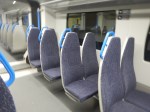
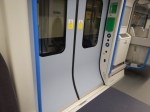

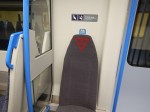
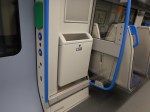


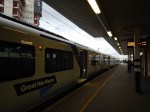
The interior of the train is very like the Class 700 train.
- Seating is 2 + 2, as opposed to 2 + 3 in the current Class 313 trains.
- A walkthrough interior with a wide aisle
- There is wi-fi and power sockets.
- The colour scheme is rather grey.
They are a functional train, rather than a design classic.
I think that some will not like the seats.
- One Class 717 train has 362 seats, whereas two current Class 313 trains will have 462 seats.
- The seats are hard and not particularly comfortable.
- There are no seat-back tables or cup holders.
On the other hand, there is a lot of standing space, so those with sensitive bottoms can easily stand.
Competition From Greater Anglia And The London Overground
Some of Great Northern’s passengers have a choice of route to the centre of London.
Greater Anglia also has a service to the other side of Hertford and this year, the company will be introducing new Class 720 trains.
This article on Railway Gazette is entitled No ‘Ironing Board’ Seats, Greater Anglia Promises.
If they keep their promises, will those that can, change their route to London?
London Overground is also running new Class 710 trains, through Enfield. These trains use longitudinal seating, so won’t be to everyone’s taste, but it will be interesting to see if they increase ridership when they replace the elderly Class 315 trains.
The Class 710 trains will be Transport for London’s fourth train with longitudinal seating, following the S Stock for the Sub-Surface Lines, the Class 345 train for Crossrail and the Class 378 trains for the Overground, so hopefully the new trains will be well-designed.
I travel regularly in S Stock, Class 345 and Class 378 trains and find them preferable to both the Class 700 and Class 717 trains.
Could it be because?
- You can stretch your legs into the aisle.
- You have arm-rests.
- The seat backs have a better profile.
- TfL use jollier colours.
- TfL always uses quality seat covers and has done for decades. I’ve never seen plastic seats on a tube train or bus in London.,
- Passengers opposite are some distance away, so you have your own space.
- London’s deep Underground lines have persuaded passengers that longitudinal seating is OK
To try to solve the problem, I went for a ride in a Class 378 train between Harringay Green Lanes and Barking stations. Passengers were observed to do the following, when sitting in the longitudinal seats..
- Put their bags on the floor between their legs or on their laps.
- Slump back in the seats , often with their head resting on the window or the frame of the train.
- Put their legs out in front, although several had their legs crossed.
All looked to be comfortable.
One thing that is missing is a USB charging point in the armrest.
Shown is the seat on a Class 230 train.
Uncomfortable seats are to my mind, a good way to upset customers.
These are longitudinal seats on a Class 378 train on the Overground.
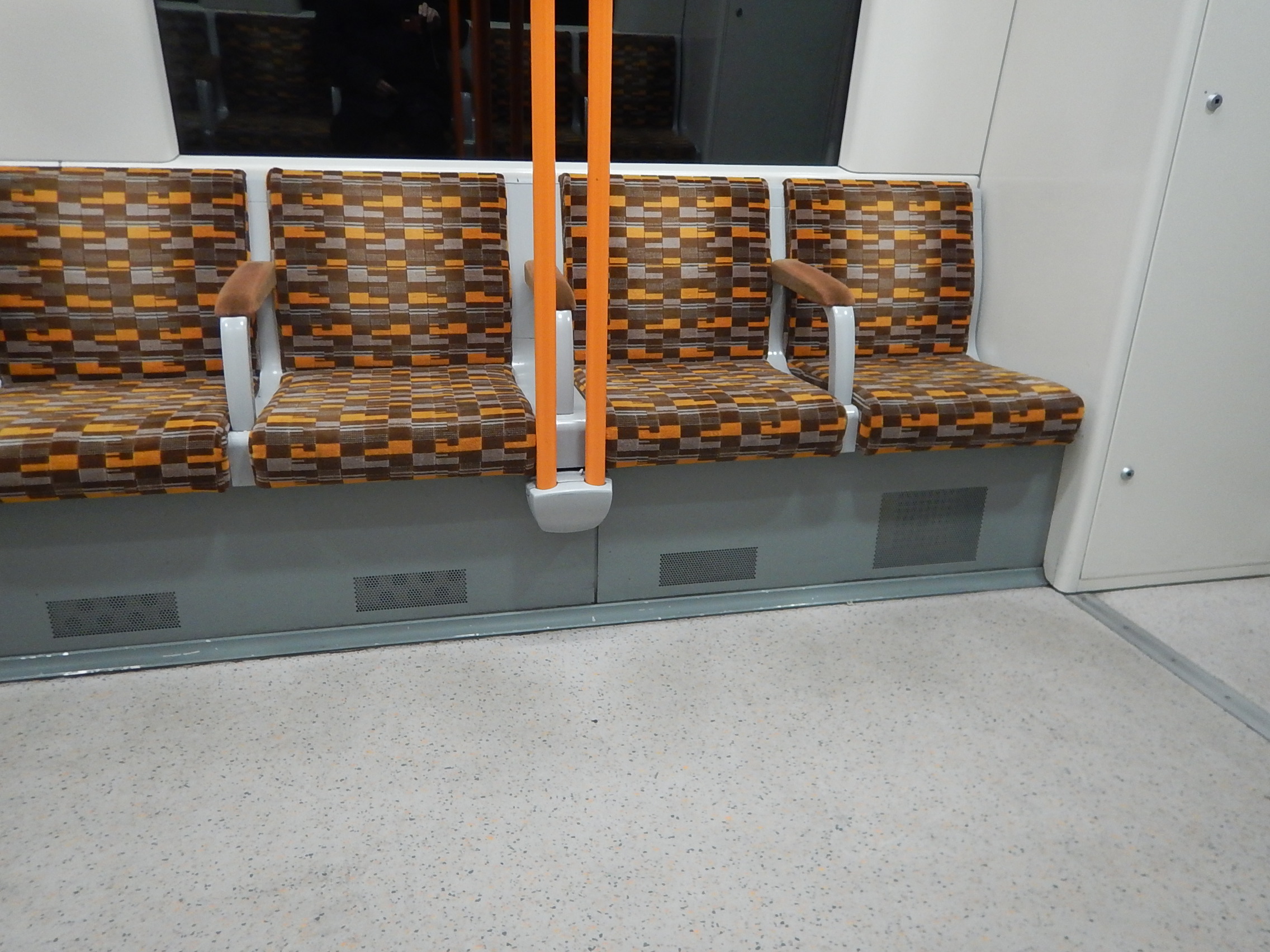
The Class 230 train charging points could surely be added.
How would London’s bottoms respond to these seats on a similar route in Valencia?

They make the seats on Class 700 and 717 trains appear soft!
Conclusion
I used to commute from Kings Cross to Welwyn Garden City. I wouldn’t want to do it every day in these trains.
At Least One Class 717 Train Has Arrived
I was passing Ferme Park Sidings in a Great Northern service between Kings Cross and Welwyn Garden City stations, when I took these pictures of what looked to be a Class 717 train.


Note that the front is white not yellow, as is shown in this article on on Railway Gazette International.
According to Wikipedia, twelve trains have been built and I couldn’t be sure if it was a single train in the siding or two trains parked close together.
The Railway Gazette International article says the trains will have these features.
- Air-conditioning
- 2+2 seating with wide aisles
- Wide doors for rapid boarding and alighting
- 262 seats per unit
- One power socket per seat.
- No toilets
- No First Class
- No seat back tables
- Wi-fi, but with only limited coverage in the Moorgate tunnels.
Each six-car unit will have a capacity of 943 passengers.
Should The Moorgate Lines Be Transferred To Transport for London?
This article in Rail Magazine, is entitled TfL Targets Transfer Of Govia Thameslink Services.
One of the services, targeted by Transport for London (TfL) are the Great Northern services into Moorgate station from Hertford North, Stevenage and Welwyn Garden City stations.
I know the line into Moorgate and the various branches well, as I’ve used them in different forms, since I was about eleven.
The section between Moorgate and Finsbury Park stations is often referred to as the Northern City Line.
I wrote about these lines in a series of posts linked to A North London Metro.
The biggest problem, I find with the lines, is the quality of the trains and the stations. But there are other issues that will also effect these services, which I detail in the following sections.
Trains
The current Class 313 trains are some of the oldest on the UK rail network, as they were built around 1976, which makes them only a couple of years older than London Overground’s Class 315 trains.
I ride in both fleets regularly and although both show their age, those on the Overground appear to have had a lot more TLC.
It’s almost as if GTR doesn’t care about the Northern reaches of their Network.
In some ways, when the Lea Valley Lines were managed by Greater Anglia from Norwich, it was the same Out-Of-Site-Out-Of Mind attitude.
Both operators are changing these elderly fleets by the end of next year.
- London Overground’s Class 315 trains with new Class 710 trains.
- GTR’s Class 313 trains with new Class 717 trains.
My worry about moving the Moorgate services to the London Overground would be about the transfer of the new trains, although TfL do have some cards in their favour.
- The Class 717 trains are designed for the rather unusual operating conditions of the Northern City Line.
- Siemens have a contract to build and maintain the Class 717 trains.
- TfL have recently signed a big deal with Siemens, for the New Tube for London.
- The current Class 313 trains are single-manned.
I would hope that the trains and their crews would not be too difficult to transfer to the London Overground.
Stations
Many of the stations like Essex Road are tired and need serious work, which would start with a good deep clean. Is it the same Out-Of-Site-Out-Of Mind attitude?
Highbury & Islington Station
These pictures show Highbury & Islington station.
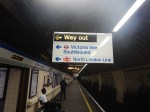
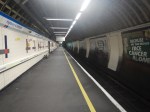



The decor needs a serious refresh.
If I want to go to say Hertford North or Welwyn Garden City, the easiest way is to go via Highbury & Islington station and get a direct train.
Until a few months ago, there used to be no way to buy a ticket at the station.
- The destination is outside my Freedom Pass area.
- I can’t use Oyster or contactless card at the destination.
- There is no ticket machine to buy a ticket.
- There is no ticket office.
However, the latest Underground ticket machines have solved the problem
When you consider that Highbury & Islington station is the fourteenth busiest station in the UK and that it handles more passengers in a year, than Cannon Street, Charing Cross, Edinburgh Waverley and Manchester Piccadilly, the station is a disgrace.
Are other stations as passenger unfriendly?
Crossrail
Crossrail will seriously affect the services into Moorgate station.
Consider the following.
- Changing to and from Crossrail at Moorgate will become a preferred route for many passengers.
- Moorgate is a short walk to much of the City of London.
- Moorgate and Liverpool Street will be one massive interconnected station.
- The new Class 717 trains will attract passengers, if they are better than Thameslink’s terrible Class 700 trains.
- Between Moorgate and Alexandra Palace stations could have a frequency as high as twelve trains per hour (tph), that runs all day.
- The Victoria Line doesn’t connect to Crossrail, but it does have a cross-platform interchange at Highbury & Islington station with the Northern City Line.
- The Piccadilly Line doesn’t connect to Crossrail or serve the City of London, but it will soon have a much-improved connection to the Northern City Line at Finsbury Park station.
Predicting the number of passengers on the services into Moorgate will become one of those classic extremely-difficult multi-variable problems.
Journeys Will Change
As an example of a changed journey take the case of someone living in Walthamstow wanting to go to Heathrow.
Currently, the easy route is.
- Victoria Line to Finsbury Park – 9 minutes
- Piccadilly Line to Heathrow Central – 64 minutes.
This is a total time of 73 minutes.
After Crossrail opens the high-frequency route will be.
- Victoria Line to Highbury & Islington – 12 minutes.
- Northern City Line to Moorgate – 10 minutes.
- Crossrail to Heathrow Central – 33 minutes
This is a total time of 55 minutes.
Thameslink
Thameslink hasn’t been designed with improving the local services on the East Coast Main Line in mind and GTR are hoping that the new trains to and from Moorgate, will provide enough capacity.
As it might be hoped that the new trains on the Moorgate services will be an improvement on the dreadful Thameslink Class 700 trains, with ironing board seats and no wifi, power sockets or tables, will passengers be swapping their London terminal to Moorgate with its better trains and connections?
Hertfordshire
Thirteen of the thirty-one stations served from Moorgate are in Hertsfordshire.
What will that County Council’s reaction be to a transfer of the Moorgate routes to the London Overground?
Relationship With The Underground And Overground
The route between Finsbury Park and Mootgate stations used to be part of the Underground and there are several interchanges between the route and the Underground and Overground.
- Bowes Park station is an out-of-station interchange with Bounds Green station on the Piccadilly Line.
- Harringay station is an out-of-station interchange with with Harringay Green Lanes station on the Gospel Oak to Barking Line.
- Finsbury Park station is an interchange with the Piccadilly and Victoria Lines.
- Highbury & Islington station is an interchange with East London, North London and Victoria Lines.
- Old Street is an interchange with the Northern Line.
- Moorgate is an interchange with the Circle, Hammersmith & City, Metropolitan and Northern Lines, in addition to Crossrail from the end of this year.
When the new Class 717 trains, with their increased frequency of at least four tph, start running, it will be a new high frequency Metro for the London boroughs of Barnet, Enfield, Haringey and Islington.
Future
I can see various changes adn additions to this line in the future.
ETCS On The East Coast Main Line
ETCS is being installed on the East Coast Main Line to increase capacity. It would appear that trains running to Welwyn Garden City station, will need to have ETCS installed.
As the new Class 717 trains are similar to the Class 700 trains, which use ETCS in the Thameslink core between St. Pancras and Blackfriars stations, fitting the system to the trains, shouldn’t be a problem.
But fitting ETCS to all the Class 717 trains, would mean that installing and using ETCS on the routes into Moorgate station would not be a difficult enterprise.
If this were to be done, would trains between Moorgate and Finsbury Park stations be able to attain the Thameslink frequency of twenty-four tph?
I can’t see why not!
Faster Running On The East Coast Main Line
In Call For ETCS On King’s Lynn Route, I talked about an article in Edition 849 of Rail Magazine, with the same title, where I said this.
In addition to ETCS, which could improve capacity on the East Coast Main Line, they would also like to see journey time reductions using trains capable of running at 125 mph or faster on the King’s Lynn to Kings Cross route.
Faster limited-stop 125 mph trains from Cambridge, Kings Lynn and perhaps, Peterborough to King Cross would surely increase capacity and might even help with the double-track bottleneck of the Digswell Viaduct.
One of the problems is that Thameslink’s Class 700 trains are only capable of 100 mph.
They are just not fast enough.
With 125 mph running limited stop into Kings Cross or Thameslink, will this free up capacity on the slow line and perhaps allow extra services from London to Welwyn Garden City station. They can’t go further North because of the Digswell Viaduct, unless the trains use the Hertford Loop Line.
I’m pretty certain that introducing 125 mph trains to Cambridge, Kings Lynn and Peterborough could open up more csapacity for services on the Great Northern route.
Increased Capacity At Moorgate
Crossrail will connect to the routes into and through a rebuilt Moorgate station.
- This connection will attract more passengers.
- Crossrail provides connection to Canary Wharf, the West End, Paddington station and Heathrow.
- The rebuilt station will also provide high-capacity step-free connections to the Central, Circle, Hammersith & City and Northern Lines.
- There will hopefully be better access to walking routes through the City of London.
Looking at the plans for the massive double-ended Liverpool Street-Moorgate station on Crossrail, it would appear that, the station complex is being rebuilt for a large increase in passengers.
Currently, the frequency to and from Moorgate station is around ten tph, which is handled on two platforms.
Consider.
- Brixton and Walthamstow Central stations on the Victoria Line, handle 36 tph with two platforms and Automatic Train Operation (ATO).
- The East London Line will be handling twenty tph Between Dalston Junction and Surrey Quays stations, by the end of next year.
- The Class 717 trains will have a better performance than the current Class 313 trains.
- The signalling could probably be updated and ATO added as I indicated earlier
I would suspect that a frequency upwards of at least sixteen tph to and from Moorgate could be possible.
I’d like to know, what capacity was assumed in the design of the rebuilt Moorgate station, to make sure, the station was future-proofed for all possible services.
Increased Frequencies
All stations between Liverpool Street and Shenfield have had a frequency of ten tph, as long as I can remember and this frequency will be increased to twelve tph, when Crossrail opens.
Alongside this, the frequencies of four tph to and from Hertford North and Welwyn Garden City look measly!
The Hertford Loop Line has three possible terminals; Gordon Hill, Hertford North and Stevenage, all of which could handle four tph. If all were used, this would give these frequencies.
- 12 tph – Finsbury Park to Gordon Hill
- 8 tph – Gordon Hill to Hertford North
- 4 tph – Hertford North to Stevenage.
If what I said earlier is correct and that sixteen tph is possible into Moorgate, then this would still allow the current frequency of four tph to Welwyn Garden City.
Twenty tph into Moorgate would allow an increased frequency of eight tph to Welwyn Garden City, which would match the frequency to Hertford North.
Park-And-Ride
There is a need for at least one parkway station on the Great Northern route.
GNER were intending to provide one at Hadley Wood station.
Parliament held a debate in January 2000 about this and you can read the debate here on the Parliament web site. Generally, MPs were not in favour.
Stevenage has also been proposed for a parkway station and I think this is much more likely.
Incorporation Into The Tube Map
There will soon be calls for the Southern part of the route to be shown on the Tube Map.
Conclusion
I can see serious investment will be needed at stations on the Great Northern route and especially on the deep-level Northern City Line.
It is also likely, that more trains could be needed. Especially, if twenty tph were run through to moorgate.
Do GTR have the will and the resources to invest in this line?
I doubt it, as it is probably seen as an irrelevant backwater, by GTR’s so-called management.
Given the close connection of this route to Crossrail and the Underground and that fifty-eight percent of the stations are in Greater London, then Transport for London would seem to be an ideal owner for this route.
 The Anonymous Widower