Discontinuous Electrification For Valley Lines?
The title of this post, is the same as that of an article in the May 2018 Edition of Modern Railways.
The Valley Lines in question are the Cardiff Valley Lines, that fan out from Cardiff Central and Cardiff Queen Street stations in various directions.
- Some of the lines into the valleys are quite steep.
- The lines in the Cardiff area seem to be typical coastal lines and fairly flat.
- The lines are a mixture of single and double track.
- There are various plans to extend some of the branches.
According to the article, it would appear that the current diesel system would be replaced with a system, with these characteristics.
- Light rail vehicles
- Discontinuous electrification
- Use of stored energy.
- Street running is expected to be in the specification for the vehicles to be used, to allow extension in the Cardiff Bay area and perhaps other places.
The proposal would save costs against full electrification and heavy rail.
My observations follow.
Batteries
Batteries will be an integral part of the design of the new rail vehicles.
Powering The Trains
The article states that battery power will be used to power the trains on sections that are difficult to electrify, like the mile-long Caerphilly Tunnel.
Battery power could also be used on level and downhill sections of track up to a few miles, but I suspect on steep uphill sections, electrification will be needed.
Handling Regenerative Braking
I believe that regenerative braking will be employed on the rail vehicles and the energy generated will be stored in the batteries.
The main advantage of this is that it simplifies the power supply to the electrification, as it only has to handle power going to the train.
This less complex electrical system, saves construction costs.
Recovering The Train’s Potential Energy
A train travelling from Cardiff to one of the terminal stations at the heads of the valleys, will need to acquire an amount of potential energy, based on the train’s mass and the height involved. This will be provided by the train’s traction system powered by the electrification and the energy in the batteries.
Coming down the hill, the regenerative braking will control the speed of the train and store any energy generated in the batteries.
This will save on the cost of energy to operate the system.
Charging The Batteries
The batteries will be charged from both the overhead electrification and the regenerative braking.
Extensive simulations of the route on computers would be able to calculate the following, for a wide range of scenarios.
- The size of the batteries.
- The power of the traction motors.
- Where the electrification needs to be installed.
- The maximum power output of the electrification system.
These calculations could also lead to an energy-saving operating philosophy, that could be programmed into the train’s computer system.
I suspect the worst case scenario, would be a train full of the heaviest Welshmen after an important rugby match at the Millennium Stadium.
Electrification
My thoughts on how various sections of track would be electrified follow.
Tracks With A Significant Uphill Gradient
These would need to be electrified, as I doubt battery power on the steepest gradients, would be enough to take a fully-loaded train to the top of the hill.
Electrification would be lighter-weight 750 VDC overhead wires.
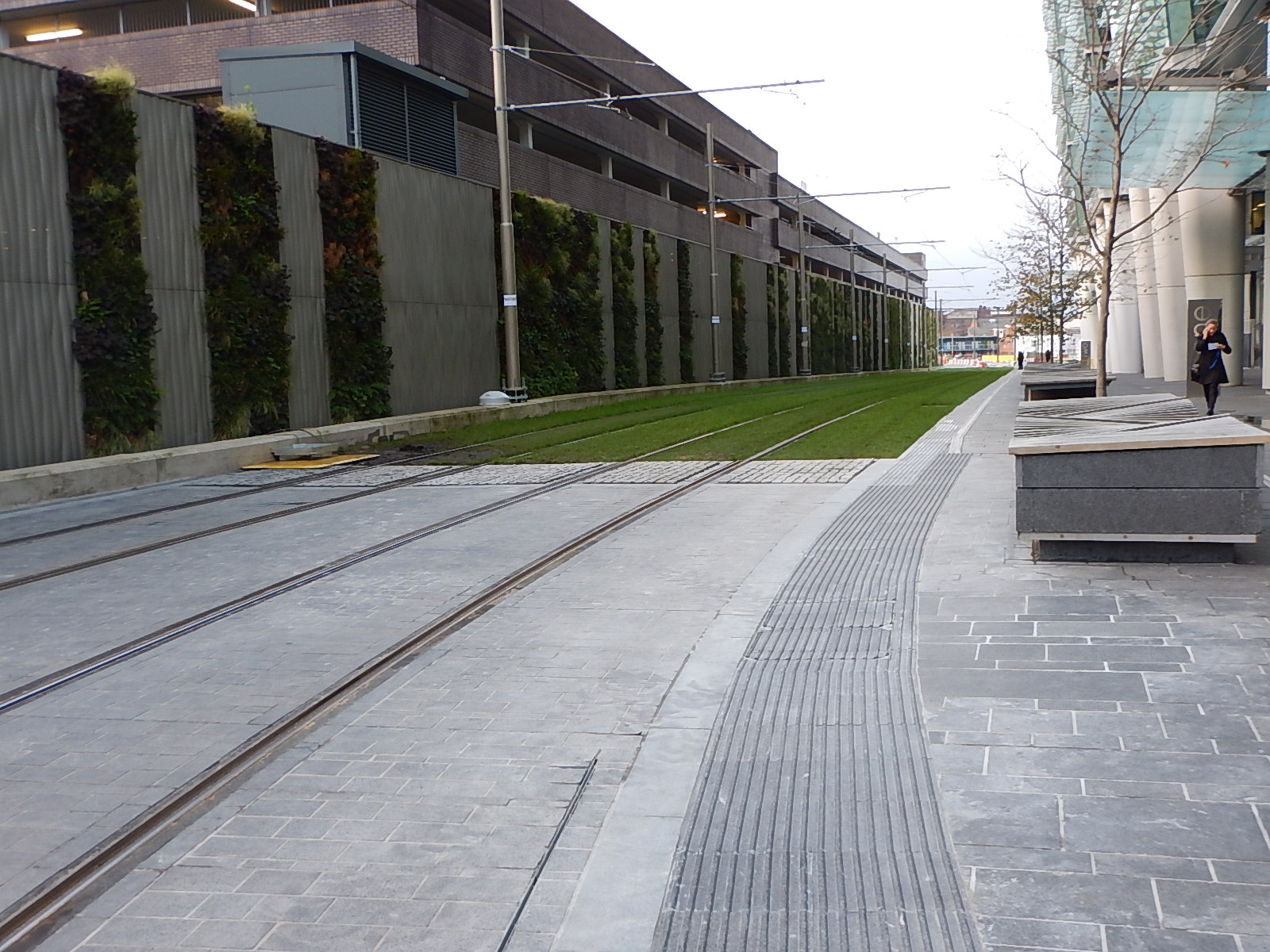
The picture shows some of the overhead wires in Birmingham, that are used by the Midland Metro’s Urbos 3 trams.
Tracks With A Downhill Gradient
These would not need to be electrified, as Newton’s friend gravity would do most of the work.
However, as batteries will be fitted, these can have three important functions on downhill stretches of track.
- Give the tram a nudge if needed.
- Restart the train after a stop at a station.
- Store any energy created by regenerative braking.
Note that we could have the unusual situation on a double-track section of line, where the uphill track was electrified and the downhill track was left without electrification.
Level Tracks
These would not need to be electrified, as battery power would be used to propel the train.
Selected Stations
Some stations could need to be electrified to ensure that the service was reliable. These might include terminal stations or those with tricky gradients on either side.
Tracks With 25 KVAC Electrification
Some of the tracks used by the trains on the Cardiff Valley Lines should be electrified with 25 KVAC, by the end of December 2018.
Class 399 tram-trains, that are used in Sheffield can use either 750 VDC and 25 KVAC overhead electrification.
it would probably be a good idea, if the new vehicles on the Cardiff Valley Lines could also use both voltages.
Automatic Pantographs
The pantographs on the vehicles would be raised and lowered automatically to access the electrification. This could even be GPS-controlled and able to be carried out at line speed.
Tram-Trains?
I very much feel, that tram-trains could be used to advantage.
- Some of the Valley Lines are also used by freight trains, so couldn’t be converted to trams-only.
- Tram-trains like the Class 399 tram-train, under test in Sheffield can work on both 750 VDC and 25 KVAC overhead wires.
- Tram-trains can use conventional railway signalling.
- Tram-trains could work on the South Wales Main Line to Newport.
- Modern tram-trains like the Class 399 tram-train have performance, that is about the same as a Class 142 train, which is a Pacer, that works the Cardiff Valley Lines, in large numbers.
- Tram-trains could run on the streets as trams, as they do in Sheffield.
Several manufacturers make tram-trains, which I believe could be suitablefor the Cardiff Valley Lines.
Stadler’s Class 399 Tram-Trains
Nothing is said about the vehicles, that would be used, but I think they need the following characteristics.
- Ability to climb the steepest section of the routes using 750 VDC overhead electrification.
- Ability to store energy.
- Regenerative braking to charge the batteries coming down the hills into Cardiff.
- A similar capacity to a Class 150 train, which is around 150 seats.
- It would be a bonus if they could use 25 KVAC overhead electrification, which will be available on part of some of the routes.
- Ability to raise and lower the pantograph quickly and automatically.
- Ability to run on the National Rail network.
- Ability to run on the street.
This specification is virtually the same as a Class 399 tram-train with the following additions.
- More seats and possibly an extra car.
- Batteries.
Class 399 tram-trains are a UK version of the Stadler Citylink tram-train. The German version is used in Karlsruhe to climb into the hills surrounding the city, on routes that are as challenging as the Cardiff Valley Lines.
So I have no worries about a version of the Class 399 train handling the Cardiff Valley Lines.
I certainly believe after my experience in Karlsruhe, and looking at other Citylink variants, that Stadler can come up with a tram-train for Cardiff based on the Class 399 tram-train.
And Then There’s CAF!
CAF have provided the Urbos 3 trams for Edinburgh Trams and the Midland Metro.
These are modern trams, that will be doing the following in a few years in the Midlands.
- Running on stored energy in the centre of Birmingham and to Wolverhampton station.
- Sharing the South Staffordshire Line with heavy freight on a new route to Merry Hill Shopping Centre.
This sounds like a tram-train with stored energy.
Wikipedia also lists a version of the Urbos family, called an Urbos TT, which is described like this.
The Urbos TT series is built with tram-train technology, connecting existing heavy rail infrastructure directly to urban tramway systems.
This document on the CAF web site, gives more details of Urbos variants, including the Urbos TT.
Looking at the modular nature of the design, you could have a custom-built tram-train tailored to the rail network.
But surely, the major factor with CAF, is that they have recently opened a factory at Newport.
If CAF get the order for the Cardiff Valley Lines, they could do a substantial part of the train building in a factory connected directly to the lines.
Converting The Valley Lines
I think that there are advantages and cost savings to be had, by good design in this area.
Could The Rail Vehicles Be Designed To Fit The Existing Platforms?
The first thing to do would be to design, build and fully test the rail vehicles.
Could the tram-trains be built, so that they fitted all the existing platforms?
- Class 150 trains are 2.82 metres wide.
- Urbos 3 trams on the Midland Metro are 2.65 wide.
If the tram-trains could run without platform modifications, this would be a big cost saving and still allow diesel units to use the lines, at the same time.
Testing The Trains
If the tram-trains were being given a 25 KVAC capability, they could even be tested on the quadruple-track the South Wales Main Line after the line is electrified through Newport.
Electrifying The Lines
It could be that the only sections of the valley lines that will need electrification, are the steep lines into the hills, as all other sections could use stored power or the 25 KVAC, where it exists.
- It would probably be possible to put up the simpler 750 VDC overhead lines during weekend and perhaps longer possessions.
- The electrification could be designed so that it doesn’t interfere with existing services.
- The lines would be converted one at a time.
- ,Note that tram-trains could share track and platform with the current diesel trains working the lines.
If CAF were to get the order surely the Ebbw Valley Line, which could be connected easily to the factory would be the first to be converted.
Conclusion
Obviously, the devil will be in the detail, but it does look like a viable plan will emerge.
I think that if CAF get the order, that they could be big winners.
The Cardiff Valley Lines could demonstrate the following.
- Running on main lines with 25 KVAC electrification.
- Running on 750 VDC electrification.
- Running on batteries.
- Running on lines with steep hills.
- Street running.
- Sharing tracks with freight trains and other passenger services.
- The tram-trains could also connect to Cardiff Airport.
It is a world-class demonstration and test track for innovative tram-trains, designed to cope with challenging rail networks.
With a factory close by at Newport, the selling of the tram-trains to other operators would be a salesman’s dream.
I think there’s more to CAF coming to Newport, than was apparent, when the deal for the factory was signed.
Discontinuous Electrification Using IPEMUs
In Basingstoke To Exeter By Electric Train, I started to work through, how short lengths of third-rail electrification could be used to power an electric train with an IPEMU-capability.
Third-Rail Electrification
This picture shows typical third-rail electrification at Kidbrooke station in South East London.
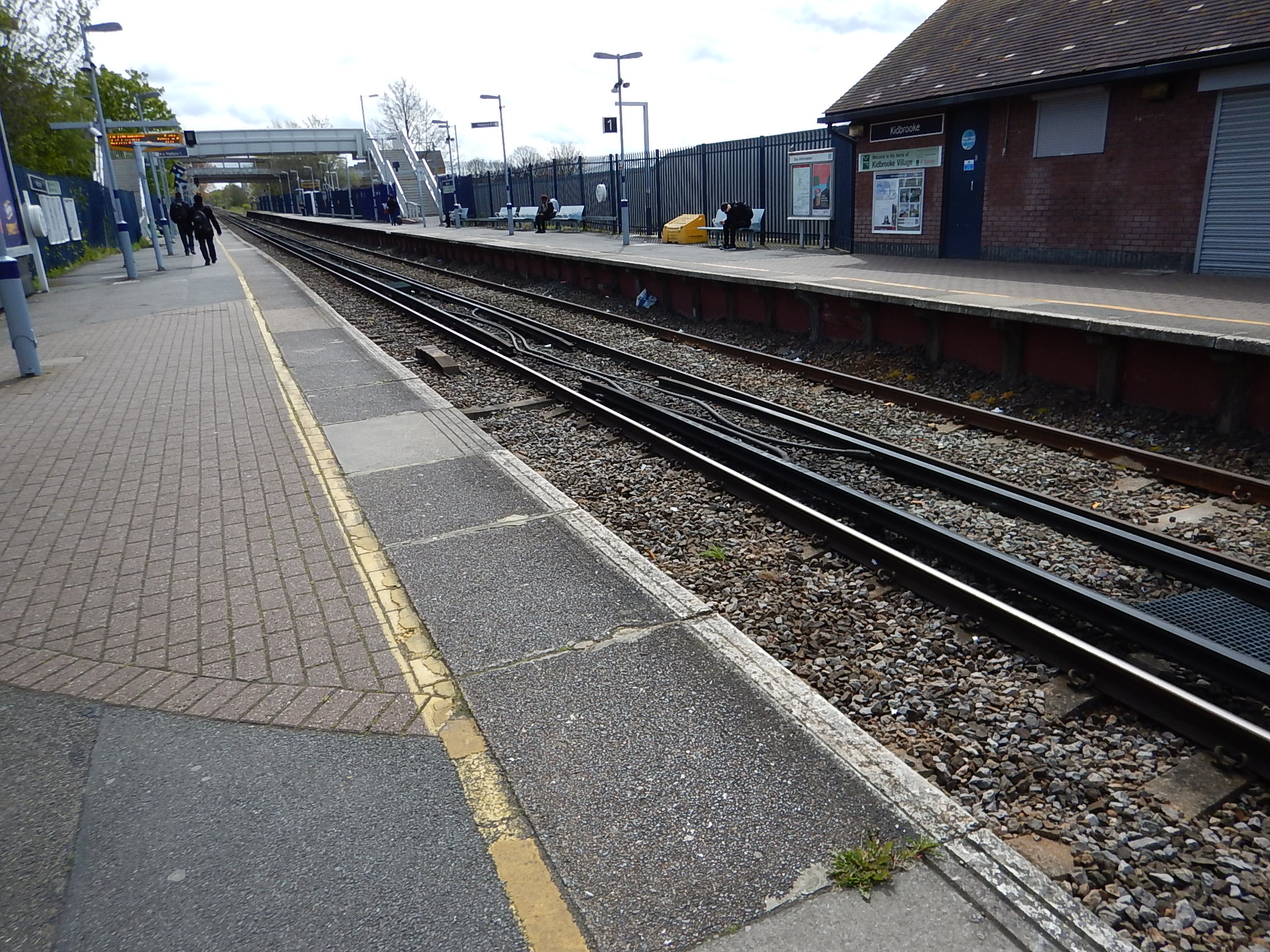
Note the following about the station and the electrification.
- The two tracks are between two platforms connected by a footbridge, which is a typical layout for hundreds of stations. Some stations might use a subway for connection.
- The two 750 VDC conductor rails are placed together in the middle of the track, well away from the passengers.
- There is a gap in the third rail, which I assume is for staff or emergency services personnel to cross the track in an emergency.
It is a simple and very safe layout.
With many years of installing third-rail systems in stations, Network Rail has the expertise to create safe systems in stations with island or just a single platform.
A Typical Electrical Multiple Unit
The Class 377 train is a typical modern electrical multiple unit common on third-rail routes.
- There are a total of 239 trainsets in service with lengths of three, four and five cars.
- The trains can work in combinations of two and three trainsets.
- The trains are a member of Bombardier’s Electrostar family.
- The slightly older Class 375 trains can be converted into Class 377 trains.
- The first trains entered service in 2003, so they still have many years of life.
- Some of the trains are dual-voltage and all could be equipped to use 25 kVAC overhead line equipment.
- They have a top speed of 90 mph.
- Bombardier have stated that these trains can be given an IPEMU-capability.
In addition everything said about the Class 377, can also be said about the later Class 379 and Class 387 trains, although these trains are faster.
The traction current supply to the trains has a very comprehensive design, that ensures trains get the electricity they need. Wikipedia says this.
All units can receive power via third-rail pick-up which provides 750 V DC. There are eight pick-up shoes per unit (twice the number of previous generation 4-car Electric multiple units), and this enables them to ride smoothly over most third-rail gaps. The units in the 377/2, 377/5 and 377/7 sub-classes are dual-voltage, and are fitted with a pantograph to pick up 25 kV AC from overhead lines. On these units the shoe mechanism is air-operated so that when powered down, or working on AC overhead lines, they are raised out of the way.
You don’t hear many reports of trains being gapped these days, when they are unable to pick-up electricity at somewhere like a level crossing.
So there could be a large number of electrical multiple units available with an IPEMU capability, which could be ostensibly 25 kVAC units, but could also pick up electricity from a 750 VDC third-rail.
A Charging Station At Oxted
I feel that Network Rail has the expertise to fit short lengths of third-rail electrification into stations, so that IPEMUs could pick up power, when they are stopped in the station.
These pictures show the recent installation of third-rail in the bay Platform 3 at Oxted station.
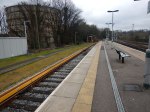

Note how the conductor rail is enclosed in a yellow shield.
Could this installation at Oxted, have been done, so that IPEMUs can run a shuttle to Uckfield?
Staff at the station didn’t know, but said the platform is used to terminate or park the occasional train from East Grinstea
d
IPEMUs To Lowestoft
Imagine such an installation at a station like Lowestoft, which has been suggested as a destination for trains with an IPEMU-capability.
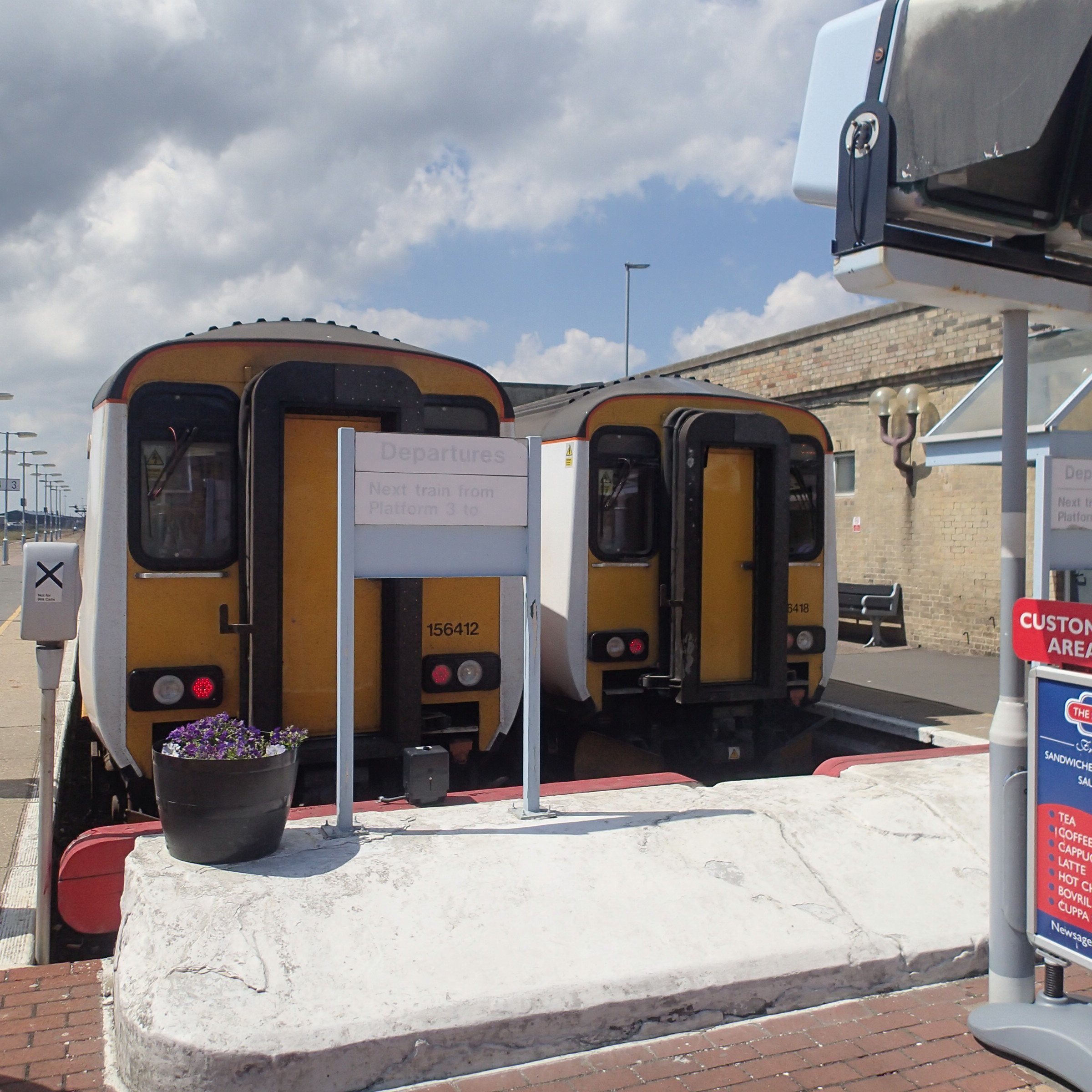
The picture shows two Class 156 trains at Lowestoft station.
Surely, two lengths of 750 VDC third-rail can be fitted between the tracks.
- The electrified lines would be no closer to passengers, than the third-rail installation at Oxted.
- The power supply would only be needed to supply electricity to charge the batteries.
- When no train was in the platform, the electricity supply to that platform would be switched off.
- The waiting time in the station would need to be sufficient to make sure the battery had enough charge to get to the overhead wires at Ipswich or Norwich.
- There would be little or no modification to the structure of the station.
- There would be no electrification needed between Lowestoft and both Ipswich and Norwich.
The biggest problem would be installing the power supply, but it would only be a transformer and rectiofier to provide 750 VDC. It would not have to cope with all the problems of regenerative braking, as the IPEMU capability of the train would take care of that.
It would appear that by using trains with an IPEMU-capability and well-proven simple technology at Lowestoft, the town can be provided with direct electric train services to Ipswich, Norwich and London.
At present the only trains with sufficient speed to not be a restriction on the Great Eastern Main Line, that can be given an IPEMU-capability are Class 379 and Class 387 trains. But Bombardier told Modern Railways, that a 125 mph Aventra is possible.
It would appear that the infrastructure modifications could be very affordable too!
The major cost would be the extra trains, but hopefully an increase in passenger numbers because of the better service would create the cash flow to lease them!
Perhaps the biggest advantage of using IPEMU trains to Lowestoft, is that electrification of the tracks through a beautiful part of East Anglia will not need to be performed.
It should also be said, that what works for Lowestoft, would also work for services to Sheringham and Great Yarmouth.
The technique would also work for branch lines from an electrified main line, where the out and back distance was more than the range of an IPEMU running on batteries. Examples would include.
- York to Scarborough
- Doncaster to Hull
- Edinburgh to Tweedbank
- Peterborough to Lincoln
- Manchester to Sheffield
But there are many more lines, where a charging station would bring much-needed electric trains to all over the UK.
Longer Lines
Some longer lines, where both ends are electrified and the distance is less than sixty miles, like Norwich to Cambridge and Carlisle to Newcastle, could be served by an IPEMU with sufficient range, that was charged at both ends of the line.
So that leaves longer lines over sixty miles, with no electrification at either end or just one electrified end.
Many, but not all, are through beautiful countryside and would the heritage lobby accept miles of overhead line gantries, marching through the hills and valleys.
I believe that on some longer lines, by using short lengths of third-rail electrification in selected stations, services could be run by electric trains with an IPEMU-capability.
Imagine an electric train an IPEMU-capability, approaching a station on a typical fast line with perhaps a 90 mph speed limit, like say the West of England Main Line, which is not electrified past Basingstoke.
- As the IPEMU applies its brakes, all of the energy generated by the regenerative braking would be stored in the train’s on-board energy storage, ready to be used to accelerate the train back up to line speed after the station.
- When the train makes contact with the third rail in the station, if the battery is not full, it can start to charge the battery from the rail.
- Once the battery is full, the charging would stop.
- On starting away from the station, the train could use power from the third rail, until it lost contact, after which it would use the energy stored on the train.
I think it should be possible that the train would leave the station with a full battery.
I would suspect that Bombardier and Network Rail are doing all sorts of calculations to find the best strategy, so that IPEMUs can be used to avoid the problems and costs of electrification.
Lines that could be electrified in this way would be ones, where trains stop at several stations along the route. Electricity supply at the stations, is no problem these days, as it could be connected to the mains or to some form of local generation.
It could be a very green concept!
Lines that could be electrified in this way would include.
- Cumbrian Coast Line
- Far North Line
- North Wales Coast Line
- Settle To Carlisle
- West of England Main Line
Selected stations would be fitted with charging and the trains would stop accordingly.
I’ve included the Far North Line because I believe it is possible to electrify the line in this way provided you could get a good enough electricity supply to the required number of stations. Obviously, you may decide not to do it, as you may have enough quality diesel trains.
Conclusion
If you could run electric trains on the Far North Line using charging at stations, you could run electric trains on any line in the UK.
 The Anonymous Widower