Could We Just Double The Width Of The Digswell Viaduct?
The Digswell Viaduct and the associated double-track railway through Welwyn North station at its northern end, on the East Coast Main Line is probably one of the biggest bottlenecks on railways in the UK. Wikipedia says this about the Grade II* Listed viaduct.
The viaduct carries the East Coast Main Line, which has to narrow from four tracks to two to cross the viaduct, making it a bottleneck restraining capacity over this strategic transport route. This problem is exacerbated by Welwyn North railway station situated at the northern end of the viaduct, which blocks the line while trains are stationary and two tunnels to the north. Several ideas to overcome the limitations of the viaduct and station without damaging the viaduct’s essential historic character and rhythmic design are periodically discussed. The line was electrified in the 1970s.
Various plans have been put forward to remove the bottleneck cause by this masterpiece of Victorian engineering.
The Current Capacity
Network Rail have published this report, which is entitled The Capacity Of The Welwyn Viaduct. This is said about the capacity of the twin-track section.
The two track section between Woolmer Green Junction and Digswell contains both Welwyn Viaduct and Welwyn Tunnel and is approximately 2.5 miles in length.
In pure theoretical terms the capacity of the viaduct is dictated by the headway over the section.
There is a planning headway of 3 minutes over the two track section which therefore results in a theoretical maximum capacity of 20 trains per hour. To achieve this capacity would require a fully homogeneous service (for example same rolling stock and calling patterns) and 100% use of planning capacity.
The usable capacity is below the theoretical and is determined by the service specification which needs to use the capacity. The current and future specifications for the section require calls at Welwyn North Station which is on the two track section. This reduces the number of paths that can be achieved in a single hour over the viaduct. The usable capacity is also determined by the fast line capacity between Finsbury Park and Digswell and the difference in speed of rolling stock approaching the two track section which will determine whether trains can be flighted over the viaduct at 3 minute slots to achieve the theoretical capacity.
There is no defined permitted number of paths on the viaduct as the capacity available is a function of demand and therefore the type and number of services which need to use it.
Network Rail concludes that eighteen trains per hour is a theoretical maximum on the current track layout.
Reason For Removal Of The Bottleneck
Whether or not HS2 is built, the East Coast Main Line must be improved to handle the large and ever growing traffic between London and Leeds, Newcastle and Edinburgh.
If more of the line was four-track, it would make the train companies aim of a frequent four-hour service to Edinburgh achievable. It could be even faster, if a lot of the line could handle trains at one hundred and forty mph, rather than the current one hundred and twenty-five.
Proposed developments are detailed in Wikpedia.
One of the most important is removing the bottleneck at Welwyn.
One Problem Or Two?
I think that when outsiders look at this bottleneck, they see one problem, but I think it is fair to describe it as two.
- Welwyn North station and the tunnels to the North.
- The Digswell Viaduct itself
In my view both problems need their own solutions.
We shouldn’t also forget other smaller changes, that can take the pressure of the area.
- More and better use of an upgraded Hertford Loop Line.
- More precise and better timetabling of trains.
- As Thameslink beds down, we’ll see other improvements.
I also wonder, if a fully-electrified freight route could be created between Peterborough and London, through March, Ely and Cambridge, that used the extra capacity of a four-tracked West Anglia Main Line.
Welwyn North Station
In some ways the station is as big a bottleneck as the viaduct, as the two trains an hour that stop in the station, effectively block the line for a few minutes.
It is also one of those heritage problems, that Network Rail love so much. This is said in the Wikipedia entry for the station.
The station is a rare survival of architecture from the early days of the GNR and this is now recognised with listed building status. The main station building, the footbridge, the tunnel portal to the north and Welwyn Viaduct to the south are all Grade 2 listed.
So I doubt that modifying the station will be easy.
This Google Map shows the lines through the station.
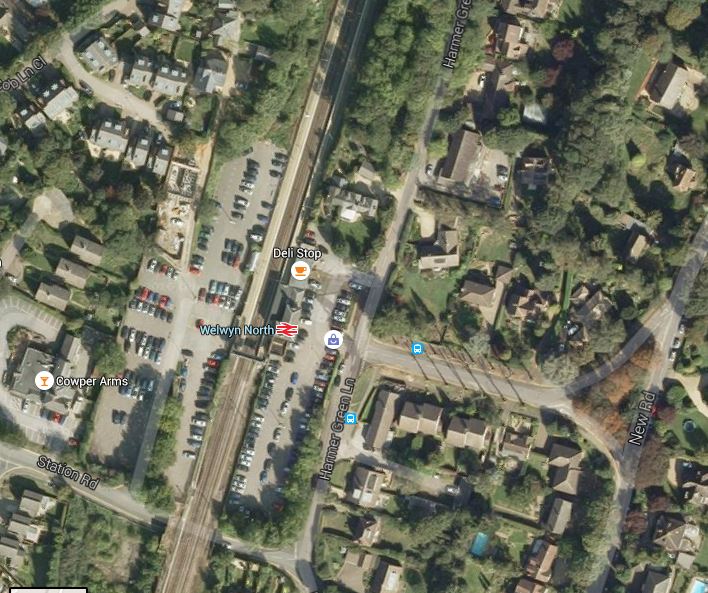
Welwyn North Station
These are some pictures of Welwyn North station taken on another day.


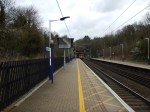


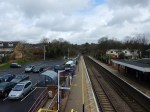
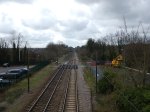


The images, probably shows another problem in that four-tracking the line through Welwyn North station would probably close the car parks.
The Digswell Viaduct
The Digswell Viaduct is an iconic structure and if the views of the viaduct and the valley it crosses were to be altered in any negative way, there would be a battle that would make the protests over HS2 look like a child’s tea party.
Around 1890, they had a similar capacity problem at the Stockport Viaduct, which was successfully widened from two tracks to four.
It is my view, that with major advances in structural engineering and construction methods, that widening the viaduct would be one of the better methods to improving the capacity through the area, without changing the look of the viaduct.
Intriguingly, if the East Coast Main Line was not already electrified, with the recent development of IPEMU-technology, I suspect now that Network Rail would think seriously about not electrifying the viaduct.
Trains would cross using their on-board energy storage, raising and lowering their pantographs appropriately.
Knebworth Station
This Google Map shows Knebworth station, a few miles to the North of Welwyn North.
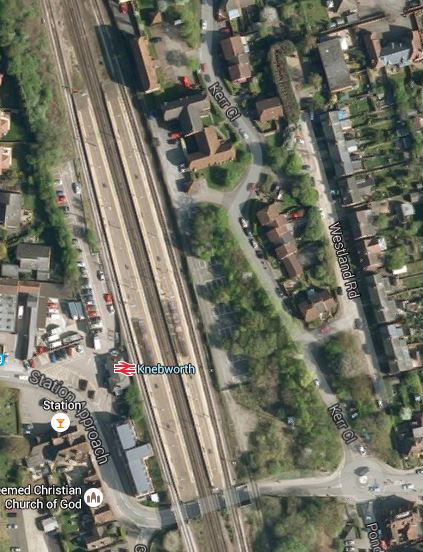
This station has four platforms arranged on two islands.
For comparison, this is an image of Welwyn North station to the same scale.
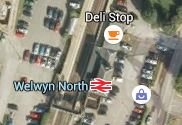
I think that four-tracking Welwyn North station will be a tight fit.
Comclusion
At some point, I feel that Network Rail will bite the bullet on four-tracking this section of line and the fight will be a big one.
One of North London’s Forgotten Lines Is Awakening
Four of the nearest stations to my house are Moorgate, Old Street, Essex Road and Highbury and Islington. which all lie in an arc on the Northern City Line to Finsbury Park and on to North London and Hertfordshire, where it terminates at Hertford North, Letchworth, Stevenage and Welwyn Garden City.
Traditionally, the line has always only run on a five day-a-week basis, with no service at weekends. As it serves Arsenal’s past and future stadia, I’ve always thought this was a bit short-sighted.
But then I’ve always felt that British Rail considered it was a railway, that they didn’t really want after they acquired it from London Underground following the Moorgate Tube Crash.
So when this month, when they decided to run a weekend service and the weekday service until 23:59, I did not notice any announcement. I use Highbury and Islington station several times a week and I certainly didn’t see a poster.
This is one of those things that should be filed under At Last! Especially, as the southern end of the line in a few years time will connect a large number of lines together.
- Moorgate – Northern, Metropolitan and District Lines and Crossrail (2019)
- Old Street – Northern Line
- Essex Road
- Highbury and Islington – East London, North London and Victoria Lines
- Drayton Park
- Finsbury Park – Piccadilly and Victoria Lines and Thameslink (2019)
If Crossrail 2 ever gets built, it will connect to this line too!
The forgotten nature of the Northern City Line is illustrated, by the elderly Class 313 trains on the line. There are currently forty-four three-car sets on the line, usually working as six car services, so giving effectively twenty-two trains.
But the days of the Class 313 are numbered as according to this article on Rail Magazine, the operator; Govia Thameslink Railway has just ordered twenty-five six car Class 700 trains from Siemens. This is said about the trains.
The new trains will be Class 700s, and will be a variant of the 1,140 vehicles currently being delivered by Siemens to GTR for Thameslink. They will run on routes from Moorgate and London King’s Cross to Welwyn, Hertford, Stevenage and Letchworth. They will be fixed length with full width inter-vehicle gangways, air-conditioning, real time information and power points.
Of all the lines in London that could benefit from a fleet of new trains, this must be one of those routes, where they will give the greatest improvement.
Especially, as for the operator, it is just more of the same trains, they will be using on Thameslink.
But will they be exactly the same?
This is said in the Wikipedia entry for Class 313 trains.
Since they were designed for use on Great Northern Suburban Inner Suburban services from Moorgate to Welwyn Garden City or Hertford North, Letchworth Garden City which included a section of ‘tube’ line built to take standard size trains between Drayton Park and Moorgate, they are built to a slightly smaller loading gauge than conventional trains. They are standard length and width, but the roof is lower, most noticeable due to the lack of a “well” for the Stone Faiveley AMBR pantograph on the centre coach. They have to comply with regulations for underground trains, such as having doors at each end of the train for evacuation onto the tracks, and when on 750 V DC supply the traction supply for each motor coach is separate, whereas on conventional 750 V DC trains each coach in a unit is linked by a 750 V bus line. Due to this, each motor coach has shoe gear on both bogies, whereas normally it would only be on the leading bogie. They are fitted with trip-cocks that are struck by a raised train-stop arm at red signals and will apply the brakes if the train passes one.
I suspect there will be some intensive work to make the Class 700 trains meet the regulations for underground trains.
To say some of the stations at the southern end of the route are tired and/or difficult for those who need step-free access, would be an understatement.
Moorgate is getting improved for Crossrail and Finsbury Park is getting a much-needed redevelopment. This will only increase the pressure to rebuild stations like Old Street, Essex Road, Highbury and Islington and Drayton Park.
As it goes further north, I do wonder if we’ll see new stations to serve future housing developments, especially on the Hertford Loop Line.
The other possibility of improving services from Moorgate is that the top speed of the new Class 700 trains is 100 mph, whereas the speed limit on the Hertford Loop is only 75 mph.
So will we see the extra three trains available used to move services off the crowded section of the East Coast Main Line over the Digswell Viaduct onto the Hertford Loop Line.
With some clever rescheduling, this might create a path or two on the East Coast Main Line.
The operator is not going to spend those millions on a new set of trains and not make them sweat!
I certainly think, that we’ll see good connectivity between trains on the Northern City and Hertford Loop Lines with Thameslink services to Peterborough and Cambridge.
It will be interesting to see their plans, when they are revealed.
My one worry is that all those new trains will tempt a lot of passengers out of the woodwork!
But one of London’s railways will not be forgotten for very long!
From Nottingham To Peterborough
I took an East Midlands Trains service to Norwich to get to Peterborough. I wanted to look at the Allington Chord. Wikipedia says this about the chord under its entry for the East Coast Main Line.
The Allington Chord was constructed near Grantham in 2006, allowing services between Nottingham and Skegness to call at Grantham without having to use the ECML, trains now passing under the line. This provided sufficient extra capacity for 12 additional services between Leeds and London each day.
This certainly illustrates the improvements gained, when these crossings of the East Coast Main Line are sorted. Could similar improvements be gained when the Newark Crossing is eliminated.
I took these pictures on the journey.










My problems then started as I reported here in The Curse of the Coeliac Traveller.
The Problems Of Upgrading Railways
The East Coast Main Line from Kings Cross to Newcastle and Edinburgh via Peterborough, Doncaster and York may be a High Speed Line that allows trains to run at 200 kph. The trouble with the line is that it doesn’t have enough capacity for all the passenger and freight trains that want to use the line.
The French or Spanish would have probably built a new line, but we don’t have the space they do, and it is questionable in this country, if high speed trains are popular with the general public.
But on the East Coast Main Line, there was already a decrepit bypass called the Great Northern Great Eastern Joint Line from Peterborough to Doncaster. I’ve talked about this line before in Project Managers Have Fun In The East.
This article in the Rail Engineer is the story of upgrading that line, so that in particular freight trains can be diverted to free up space on the East Coast Main Line.
The line has been virtually rebuilt, resignalled, level crossing have been removed and stations have been improved, at a cost of around three hundred million pounds.
There is still work to do and in a few years time, the following could have happened.
1. A better connection at the Northern end at Doncaster.
2. A diveunder or flyover at Werrington Junction near Peterborough, to remove a bottleneck.
3. There might even be a direct link across the Fens from Spalding to March. This would allow freight trains between Felixstowe and the North to join or cross the East Coast Main Line at Doncaster.
4. The line might even be electrified, in part to cut the noise of the dreaded Class 66 diesel locomotives.
George Osborne Sets Out His Vision Of Yorkshire
This article in the Huddersfield Examiner is entitled Chancellor George Osborne to set out long term economic plan for Yorkshire during visit to West Yorkshire.
Read it and there are some interesting snippets, that he believes will be part of a long term plan for Yorkshire.
One of them is this.
We will also increase speeds on the East Coast Mainline to 140 mph
It is already planned and if and when it happens it will significantly reduce journey times all the way up the line between London and Edinburgh.
George is not actually promising anything for which funds have not been allocated, but his words show he understands the value of infrastructure, something that can’t be said for all Chancellors of the Exchequer since the Second World War.
The one thing that George or any future Chancellor can ensure, is that by not cutting funds they will get this valuable project carried out!
London To Edinburgh In Four Hours
In the February edition of Modern Railways, details of the new Virgin Trains East Coast franchise are beginning to emerge.
One of the details is that there will be a half-hourly four-hour service between the two capitals.
Anybody with any marketing nous will reckon that this alone will give the service a tremendous boost.
As there are a considerable number of improvements that could be implemented in the next few years, I think that by the end of the decade several minutes under four hours will become the norm.
The new Hitachi Class 800 and 801 trains arriving from around the end of the decade, won’t be any faster than the twenty-five years old InterCity 225, that currently work the route.
In fact, Modern Railways says that these trains may live on as a Golden Stud on the flagship services between London and Edinburgh.
But by 2020, if all goes well with ERTMS, both the InterCity 225s and the new Hitachi trains will be cleared to run at their top speed of 225 kph.
Could we see times reduced between the capitals to around three and a half hours?
I certainly think that the train company will be looking to see how fast they can run a capital-to-capital service!.
The line is 632 kilometres long, so three hours would need an average speed of 210 kph, which the current and proposed trains could probably attain over a straight railway line with no other traffic for perhaps an hour or so.
This illustrates that although trains get all the headlines, the real improvements in timings over the next few years will come with improvements to track and signalling.
The engineers of the East Coast Main Line have plenty of work to do, but they may bring a bigger service improvement than those building the new Hitachi trains.

