Step-Free Interchanges In East London
This map from carto.metro.free,fr shows the lines around where I live, which can be best described as a post code of N1.
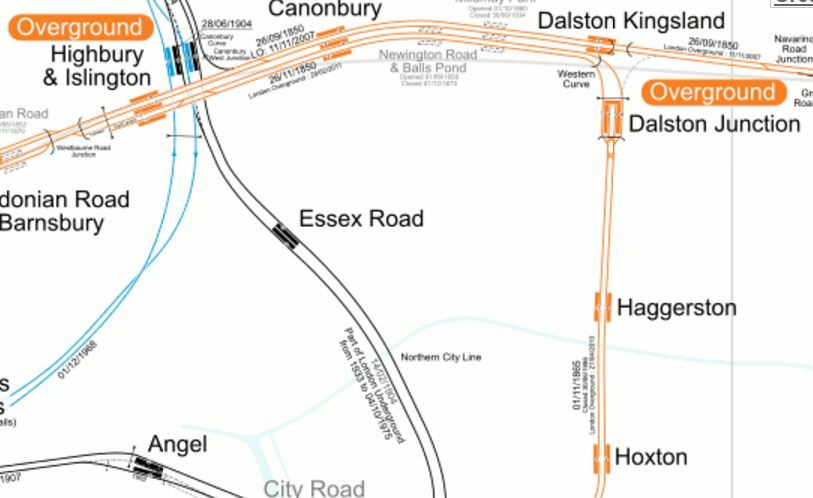
Lines Around N1
I live halfway on the diagonal line between Dalston Kingsland and Essex Road stations. Years ago, there used to be a station at Mildmay Park, between Dalston Kingsland and Csnonbury, which if it still existed would be very useful for me, as it would be about a hundred and fifty metres away.
So my journeys often start from one of the half dozen bus routes, that have stops within fifty metres or so of where I live.
- I’ll take a 38, 30, 56 or 277 to Dalston Kingsland or Dalston Junction stations for the North London Line and East London Line respectively.
- I’ll take a 141 to Manor House station for the Piccadilly Line.
- I’ll take a 38 or 56 bus to Essex Road station for the Northern City Line
- I’ll take a 38 or 56 bus to Angel station for the Northern Line.
- I’ll take a 21 or 141 bus to Moorgate for the Metropolitan and Circle Lines
- I’ll take a 21 or 141 bus to London Bridge for main line trains.
- I’ll take a 21 or 141 bus to Bank for the Central and Waterloo and City Lines
- I’ll take a 56 bus to St. Paul’s for the Central Line
- I’ll take 30 bus to Kings Cross, St. Pancras and Euston for main line trains.
Who said the three most important things when buying a house, are location, location and location?
Strangely, I rarely go directly to Highbury and Islington station, as the station is one of the worst in London for passenger convenience, with long and crowded tunnels and no step-free access to the deep tunnels.
If I need to go North on the Victoria Line, I will sometimes go to Essex Road and then take the Northern City Line for one stop to Highbury and Islington station, where there is a step-free level interchange to the Victoria Line.
There are several of these interchanges in East London, making train and tube travel easier.
Northern City And Victoria Lines At Highbury And Islington Station
This map from carto.metro.free.fr, shows the layout of lines at the station.
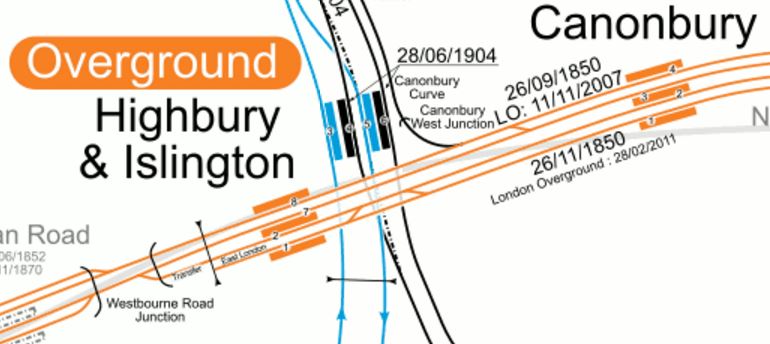
Note how the two Northbound lines and the two Southbound lines of the Victoria and Northern City Lines are paired, so that passengers can just walk through one of several short tunnels that connect the two platforms.
This connection will get more important in the future, as improvements will bring more passengers through the interchange.
- Highbuty and Islington station will be rebuilt, with access to the deep level platforms much improved.
- If traffic said it was needed, the Southbound and Northbound deep-level platforms, which are not far apart might even be connected together and to a second entrance on the other side of Holloway Road.
- The Northern City Line is getting new Class 717 trains, which will give an increase in capacity and I believe that the frequency on the Northern City Line will improve to 6, 8 or even 10 trains per hour (tph), thus making my ducking and diving easier.
- The Northern City Line will connect to Crossrail and for the first time N1 to lots of places, will be one change at Moorgate from the Northern City Line to Crossrail.
- The Victoria Line will increase in frequency to possibly 40 tph and benefit from station improvements at stations like Tottenham Hale, Blackhorse Road and Walthamstow Central.
It should also be noted how the Crossrail connection at Moorgate will help me.
When going to football at Ipswich, I may walk to Essex Road and then get a train to Moorgate, where I will take Crossrail to perhaps Shenfield for a fast train to Ipswich.
But who knows what I’ll do, as there will be several different routes, all of which will have their advantages?
East London Line To North London Line At Highbury And Islington Station
This is only from the East London Line trains arriving from West Croydon in Platform 2 at Highbury and Islington station to Westbound trains on the North London Line in Platform 7.
Although not as powerful as the double interchange at Highbury and Islington station between the Victoria and Northern City Lines, it is typical of well-thought out connections all over the Overground.
Piccadilly And Victoria Lines At Finsbury Park Station
This is a cross-platform interchange, that is heavily used as effectively it gives a simple choice of route through Central London for passengers from the Northern ends of the Piccadilly and Northern Lines. It’s a pity that the interchange between the two lines at Kings Cross St Pancras and Green Park aren’t as simple.
Metropolitan/District And Central Lines At Mile End Station
This picture gives a flavour of the interchange at Mile End station.
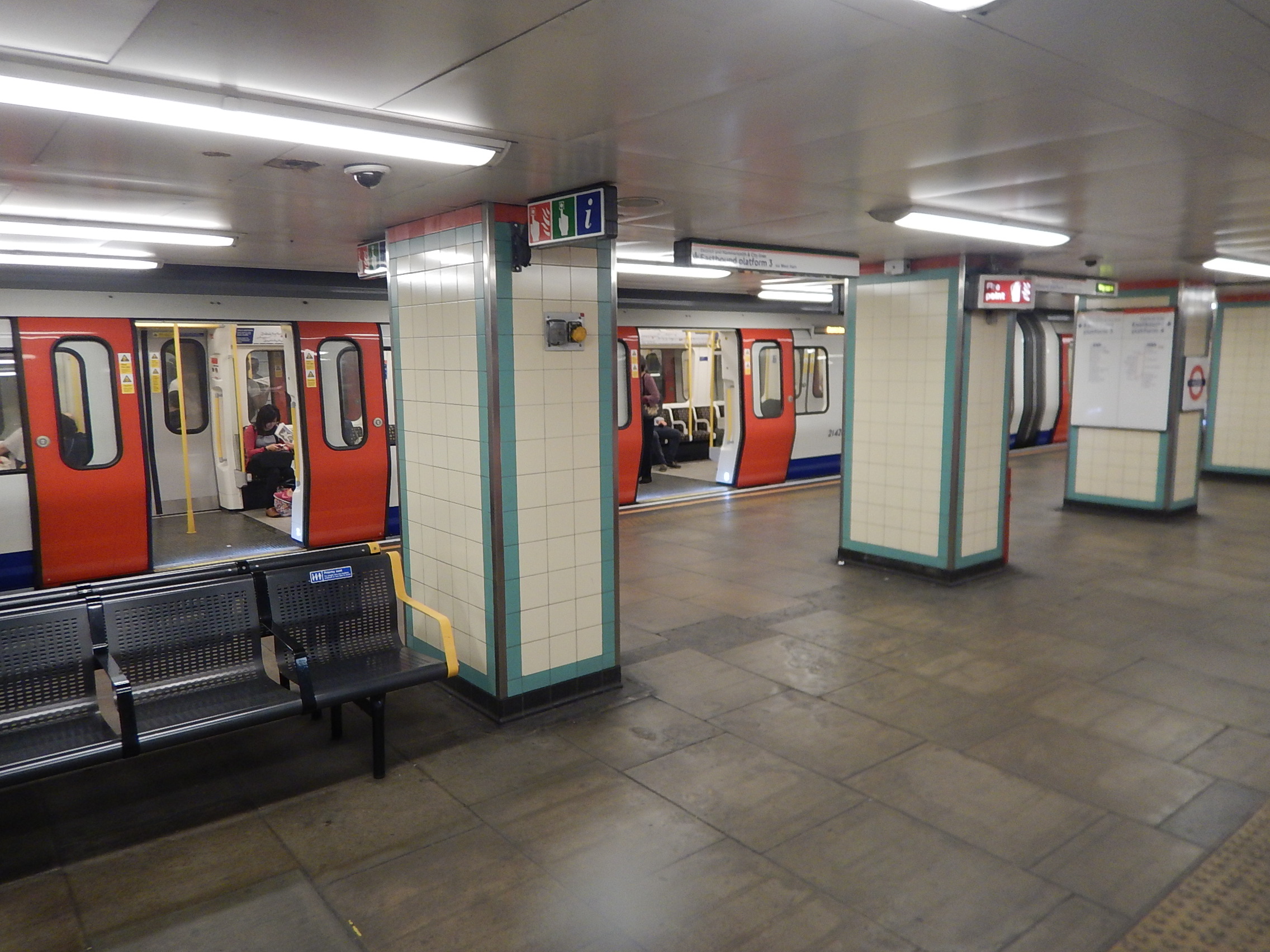
Cross-Platform Interchange At Mile End Station
It is a cross-platform interchange, that I use more and more, to go to the East on the Central Line. I usually arrive on a Metropolitan/District Line train from Whitechapel station, which is just a few stops down the East London Line.
Central Line And Shenfield Metro/Crossrail At Stratford Station
This interchange at Stratford station is going to be an integral part of Crossrail, as it will firmly connect the new line to the Central Line, with advantages to both.
This picture shows the interchange on the Eastbound platform.
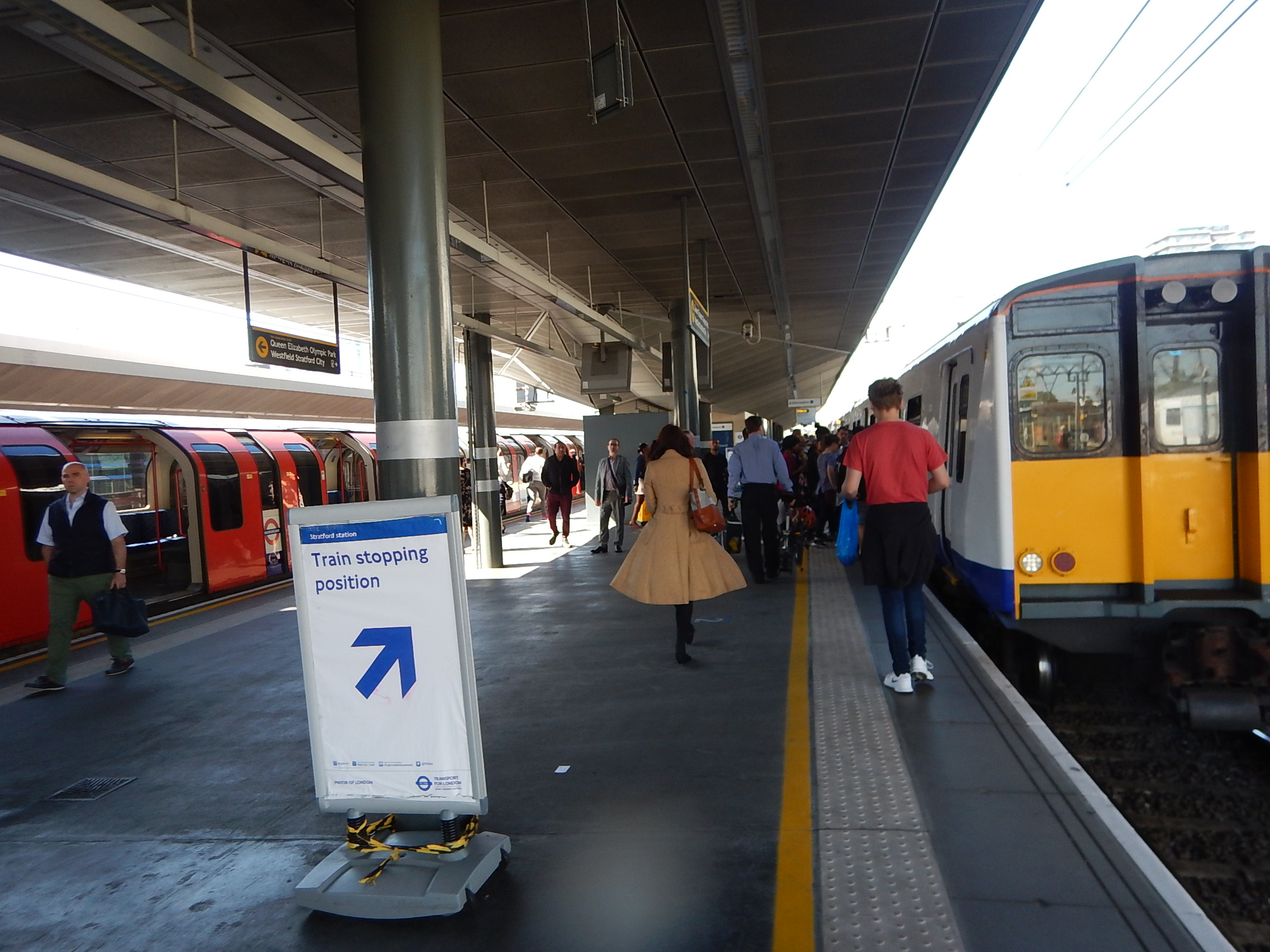
Central Line To Shenfield Metro/Crossrail Interchange
This interchange is certainly well-used and Crossrail will only increase that use.
Why Is This Not Done More Often?
These interchanges seem to work well!
But what always puzzles me, is why this layout is not used more often. And I don’t just mean in London. In all my travels, I can’t remember getting off a train in Europe and just walking across the platform to get a metro or a tram.
I suspect it could be because to get this type of interchange, you need to build some expensive railway infrastructure.
All of the examples I have given concern where a new line is being added to an existing network.
I am surprised that Crossrail doesn’t use a similar interchange anywhere else on its route.
Look at the Crossrail stations I documented in How Are Crossrail’s Eastern Stations Progressing?
In all stations, the Crossrail and fast lines are in pairs, whereas to get Cross-platform interchange between fast and stopping services, probably needs a different layout. That is not the fault of Crossrail, but the way the Great Eastern Main Line was built decades ago.
At the London end of the East Coast Main Line, the two slow lines are on either side of the two fast lines. At Stevenage, they have put two island platforms between the slow and fast lines, so that passengers have a cross-platform interchange between trains.

Stevenage Station
The Google Map clearly shows the layout.
What Will Be The Service On The Great Northern Lines After Thameslink Opens?
When I did the short trip from Essex Road station on the Northern City Line, that I wrote about in Never On Sunday, I was surprised to see that the frequency of the service was Transport for London’s turn-up-and-go frequency of 4 trains per hour (tph), with 2 tph to going to Hertford North, with 1 tph extended to Stevenage and 2 tph to Welwyn Garden City.
The services at Essex Road station in the Off Peak include these trains.
- 6tph to London Moorgate
- 3tph to Welwyn Garden City via Potters Bar
- 3tph to Hertford North (1tph extended to Letchworth Garden City)
It is interesting to note that between 0800 and 0900 on a weekday morning, thirteen trains arrive at Moorgate.
From 2018, the new Class 717 trains will start to run on the Northern City Line. The number of passengers on this line will surely grow as the Southern terminus of Moorgate station will be on Crossrail from December 2018.
Assuming these six-car Class 717 trains can carry about half that of a 12-car Class 700 train, then in that hour they could bring 4,329 passengers into Moorgate station.
Will the low-level platforms at Moorgate station be able to cope?
Probably easily, if there is a direct tunnel and escalator access to Crossrail.
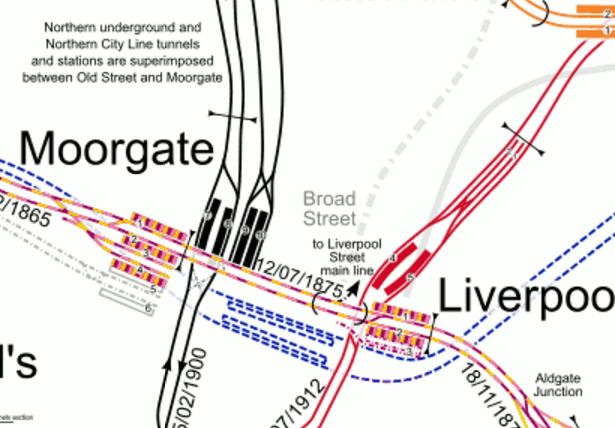
This map from carto.metro.free.fr shows the various lines at Moorgate.
Note.
- The Northern City Line is superimposed on top of the Northern Line at Moorgate station.
- The 200 m. long Crossrail platforms almost stretch between Moorgate and Liverpool Street stations.
- Interchange between the Northern Line at Moorgate and the Central Line will probably be a three hundred metre walk.
- Crossrail should mean that all Liverpool Street to Moorgate interchanges will be desert dry in the wettest weather.
If this massive interchange doesn’t create a need for more capacity on the Northern City Line, I’ll be very surprised.
As there have been improvements to the lines on the Great Northern Route, between Finsbury Park and Alexandra Palace stations, I wouldn’t be surprised that when Crossrail opens, this Cinderella line, that nobody wanted is running eight, ten or even more tph between Moorgate and Finsbury Park stations and further up the route.
The services on the Great Northern Route are intense, but despite that, the route has some of the most crowded trains in the UK..
Thameslink is coming and that will change everything dramatically.
At present Cambridge has 4 tph to Kings Cross in the Off Peak, of which two tph are non-stop Cambridge Cruisers.
When Thameslink connects to Cambridge, the provisional timetable says it will add 4 tph semi-fast trains between St. Pancras Thameslink and Cambridge.
Thameslink haven’t said what services they will retain between Kings Cross and Cambridge, but I did read somewhere that they want to hold on to the Class 387 trains to run the Cambridge Cruisers.
At present, Peterborough has 2 tph Great Northern services to Kings Cross, in addition to several non-stop expresses.
As with Cambridge, Peterborough will get an additional 4 tph, when Thameslink opens.
I think the outcome will be lots of direct services between Cambridge or Peterborough in the North and Kings Cross or St. Pancras Thameslink in the South.
If you are prepared to change just once, you’ll be able to travel between any station North of Finsbury Park to any of the three London terminals; Kings Cross, Moorgate and St. Pancras Thameslink.
I believe that because Thameslink has such a large number of stations and connections, that many passengers will have a wide choice of route.
There is also the performance and quality of the various trains on the routes to consider.
- The current Class 365 trains are 100 mph trains built in the 1990s. They are starting to look dated as I wrote in The Class 365 Trains Are Looking Dated.
- The Class 387 trains are 110 mph trains built in the last few years. They are a quality long-distance commuter train.
- The Class 700 trains are 100 mph trains, that are being delivered at the present time.
- The Class 717 trains could have a similar performance to the Class 700 trains. I will be very surprised if they are not 100 mph trains.
A succession of 100 mph plus trains speeding up and down the Great Northern Route won’t be a slower service than is currently offered.
There would probably be four semi-fast trains to and from both Northern destinsations, stopping at all major stations, with well-connected stopping trains serving the intermediate stations.
There might even be service patterns like say four tph between Moorgate and Welwyn Garden City stopping at all stations, which have a same platform interchange with four tph stopping services to Cambridge and Peterborough. So from say Foxton to New Barnet, you’d always change at Welwyn Garden City.
As an example of how the new improved Thanmeslink will help passengers, look at the routes from my home to Cambridge.
I could.
- Take a 277 bus to Highbury and Islington station and get a Victoria Line train to St. Pancras for a Thameslink train to Cambridge.
- Take a 38 bus or walk to Essex Road station and get a Northern City Line train to Finsbury Park for a Thameslink train to Cambridge.
- Take a 141 bus to Moorgate station and get a Northern City Line train to Finsbury Park for a Thameslink train to Cambridge.
- Take a 277 bus or walk to Highbury and Islington station and get a Northern City Line train to Finsbury Park for a Thameslink train to Cambridge.
- Take a 30 bus to Kings Cross station and get a Cambridge Cruiser to Cambridge.
The possibilities will be endless.
I wouldn’t take the first option, as St. Pancras is A Fur Coat And No Knicker Station, with a long walk between the Victoria Line and Thameslink.
My choice of route, will probably be decided by the first bus that arrives and the quality of the smile on the driver’s face.
Never On Sunday
There have always been things that were banned on Sundays or because of personal reasons, you never did on that day.
- A Welsh friend at Liverpool University called David Roberts didn’t use to drink on Sundays when I first met him. But we soon cured him of that!
- My late wife, who had been a Sunday school teacher in her time, wouldn’t go to the cinema on Sunday, as her mother thought it ungodly.
- For myself, I don’t think I went to a football match on a Sunday until I was about forty, as they were never staged on Sundays.
I also remember the first day, that C and myself went to the first 1000 Guineas at Newmarket on a Sunday. Now horse racing and most other sport on a Sunday is considered normal, just as it is in the rest of the world.
It also used to be that the Northern City Line didn’t run at weekends, despite having three stations that served The Emirates Stadium.
This morning before it rained, I took a trip to Harringay station to view the Wightman Road Bridge, by taking a 38 bus to Essex Road station and then going three stops to the North.




The line is getting new Class 717 trains, but I do feel that some work to improve the stations might not be a bad idea.
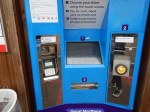
I actually wanted to buy a ticket on that dreadful machine from the Zone 6 boundary to Guildford, but unlike London Overground and some other companies ticket machines, it doesn’t sell such a useful ticket, which I wrote about in The Price Of Freedom.
More details of the Class 717 trains are given in this article in Rail Magazine, which is entitled New Govia Thameslink Railway trains to be Class 717s. This is said.
They are similar to the Class 700s being built by Siemens for GTR (of which 16 are in the UK), but they must have end doors as per safety regulations due to their operation in the Moorgate Tunnels. The design of this is at an advanced stage, with construction due to start this year.
I have felt that the Northern City Line, would be a classic application for an IPEMU for some time, as this would enable the Moorgate tunnels to be electrically-dead, as the trains would use batteries between Drayton Park and Moorgate stations. This would have the following effects.
- The third-rail electrification could be deactivated or even removed.
- The trains could also be 25 VAC only, if they wouldn’t be going into any other third-rail territory.
How would this impact tunnel safety regulations?
Whatever happens to this line, running a seven day a week service, will make the Northern City Line a valuable rail line in my part of London.
On a personal note, the line and Essex Road station in particular, will help me cut-out the dreaded Highbury and Islington station, with its long passageways and lack of lifts.
Improvements Needed At Essex Road Station
Travelling to Liverpool Street, because of the rush hour, I had to use Essex Road station.
What a dump!
The lifts weren’t working and everybody was having to walk down a deep spiral staircase , which very much felt of Kafka.
The Class 313 trains despite approaching their forties are nowhere near as bad as the station.
Is Essex Road Station Ripe For Redevelopment?
Essex Road station in London, is architecturally-challenged to say the least. if you venture underground to the trains, there are a couple of large clean lifts and dimly-lit passages to stations, that still have echoes of Network South East.
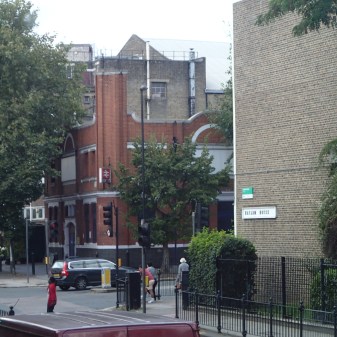
Essex Road Station
But things are looking up on the trains front, in that the new Govia Thameslink franchise has committed to running more trains through the station, including later on weekday nights and at weekends. It also looks like Crossrail 2 has decided on its route and it would appear that the chances are, the new line will by-pass Essex Road station.
The station sits on a prominent and quite large corner site as this aerial view from Google shows.

Essex Road Station
So it would appear that a whole lot of reasons exist for the site to be redeveloped as perhaps much-needed quality housing. Transport links, size and location are all good and the deep-level station is in crying need of a refurbishment. The only constraint is that provision might need to be left for a very unlikely new rail or Underground line.
Properly developed it would be an asset to the area.
 The Anonymous Widower