A Branch To Penicuik From The Borders Railway
I started this post as part of Extending The Borders Railway To Carlisle, but as I research it more and talk to my correspondent in the Borders, I feel it needs to be a separate post.
There is an article in the Scotsman from 2013, which is entitled Borders rail link: £150m plan for Penicuik spur. This is the first paragraph.
A vital £150 million rail line connecting Penicuik to central Edinburgh could be reopened for the first time in half a century.
The article then gives a lot of favourable comments about the possibility of the link. My correspondent, grew up in the town and feels that a rail link is needed, especially, as when he was a boy, the town had three rail lines.
In the Wikipedia entry for the Borders Railway, this is a paragraph about a future branch to Penicuik.
In May 2013, it was reported that Heriot-Watt University had been asked by Midlothian Council to carry out a feasibility study on a 10-mile (16 km) rail link connecting Penicuik with the Borders Railway. At least 6 miles (9.7 km) of the new line would follow the Edinburgh, Loanhead and Roslin Railway, the alignment of which is generally intact between Millerhill and Straiton.
This proposal is not mentioned in the recent CBR report, which is entitled A Summary Case For A New Cross-Border Rail Link, that can be downloaded in PDF form from this location.
Newcraighall Station And Park-And-Ride
Newcraighall station will be North of where the proposed branch to Penicuik joins the Borders Railway.
This Google Map shows the station and the surrounding area.
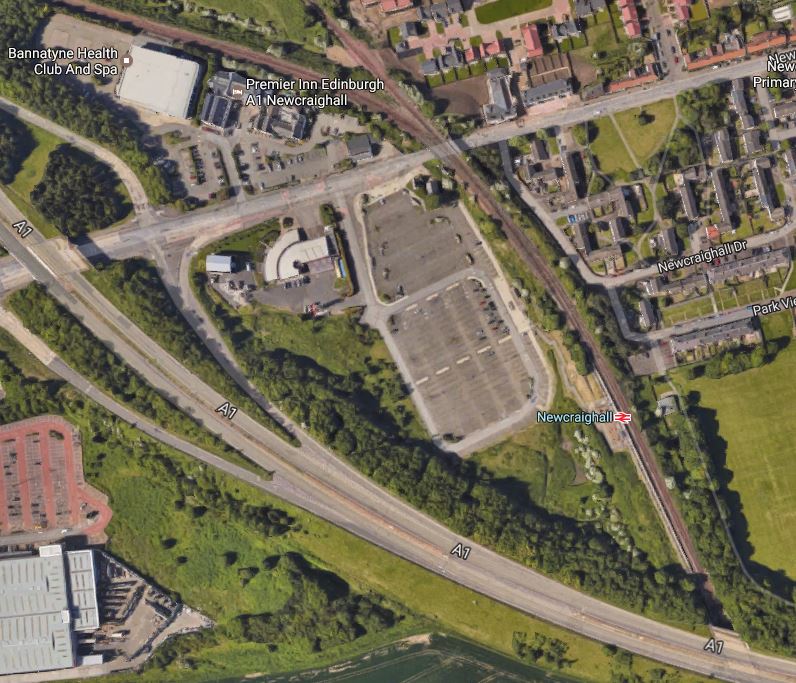
Note the A1 and the convenient Park-and-Ride.
Wikipedia says this about Services from Newcraighall station.
Monday to Saturday daytimes there is a half-hourly service to Edinburgh and to Tweedbank, and an hourly evening and Sunday service. Four weekday morning peak services run beyond Edinburgh to Glenrothes with Thornton via Kirkcaldy and a similar number run in the opposite direction in the evening. When the station was a terminus, many services ran through to/from the Fife Circle Line but this practice ended prior to the reopening of the full route to Tweedbank.
I believe that a Park-and-Ride of this size, location and probable importance needs at least four trains per hour (tph) all day.
Currently, two tph between Edinburgh and Tweedbank call at Newcraighall. As it takes two hours for a train to do the round trip, this means that four trains are needed to provide a two tph service.
Four tph all the way to Tweedbank would need eight trains, but due to limitations in the design of the Borders Railway would probably be very difficult to operate.
Terminating them at Newcraighall and perhaps running beyond Edinburgh to Fife is obviously a possibility, but Newcraighall station only has one bi-directional platform.
Two Trains Per Hour To Penicuik
Opening a branch to Penicuik and running two tph would give Newcraighall station and the Park-and-Ride the four tph train service it needs, when combined with the two tph along the Borders Railway.
The Edinburgh, Loanhead and Roslin Railway
Wikipedia says the route would probably follow the route of the Edinburgh, Loanhead and Roslin Railway.
- Much of the route is visible on Google Maps.
- The original line closed in the 1960s.
- There were stations at Gilmerton, Loanhead, Roslin and Glencourse.
- The major engineering feature of the line was a visduct over Bilston Glen.
Penicuik was served by a freight-only line.
Shawfair Station
It would appear that the Northbound and Southbound trains on the Borders Railway seem to call at Shawfair station around the same time.
This must make operation of the line much simpler and it probably meant that Newcraighall station only needed one platform.
This Google Map shows the Borders Railway passing through Shawfair station.
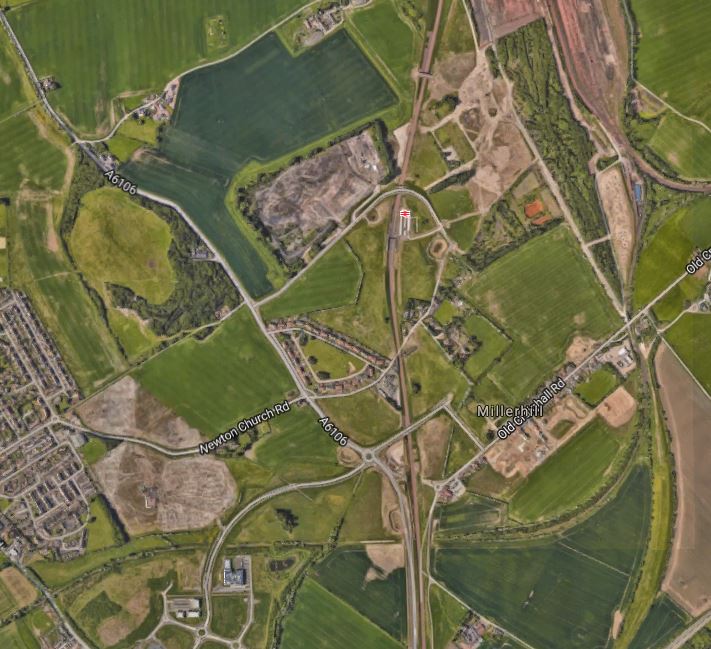
Note the disused track of the Edinburgh, Loanhead and Roslin Railway crossing the Borders Railway at right-angles and then curving Northwards to the freight yard at Millerhill.
Trains could go via Millerhill, to join the Borders Railway South of Newcraighall station, but surely, it would be better if the branch to Penicuik, joined the Borders Railway South of Shawfair station.
This would allow trains to and from Penicuik to pass at Shawfair station.
As trains to and from Tweedbank station seem to call between
- XX:08 to XX:10
- and XX 38 to XX:40
So Penicuik trains could use times of perhaps .
- XX:23 to XX:25
- and XX 53 to XX:55
Which would mean a train would have thirty minutes to go from Shawfair to and from Penicuik.
The way Shawfair station is used also means the following for the Borders Railway.
- A convenient spacing is imposed for trains to call at the single platform at Newcraighall station, as that is just four minutes towards Edinburgh.
- Effectively, the Borders Railway to Tweedbank station runs a two tph service with two widely-seperated trains South of Shawfair station at any one time.
- Two widely-separated trains, South of Shawfair station enables the use of single-platform stations at all stations except Stow and Tweedbank.
- Shawfair station is the only station with an expensive footbridge.
I also suspect that four tph is possible, with trains passing at Shawfair and Stow stations, perhaps with faster trains and improvements to the signalling.
By clever design and selective use of two-platform stations and double-track, it would appear that the engineers have designed an efficient affordable railway, that is mainly single track and has only one footbridge.
The Junction Of The Borders Railway And The Penicuik Branch
This Google Map shows where the track-bed of the Edinburgh, Loanhead and Roslin Railway passes under the Borders Railway to the South of Shawfair station.
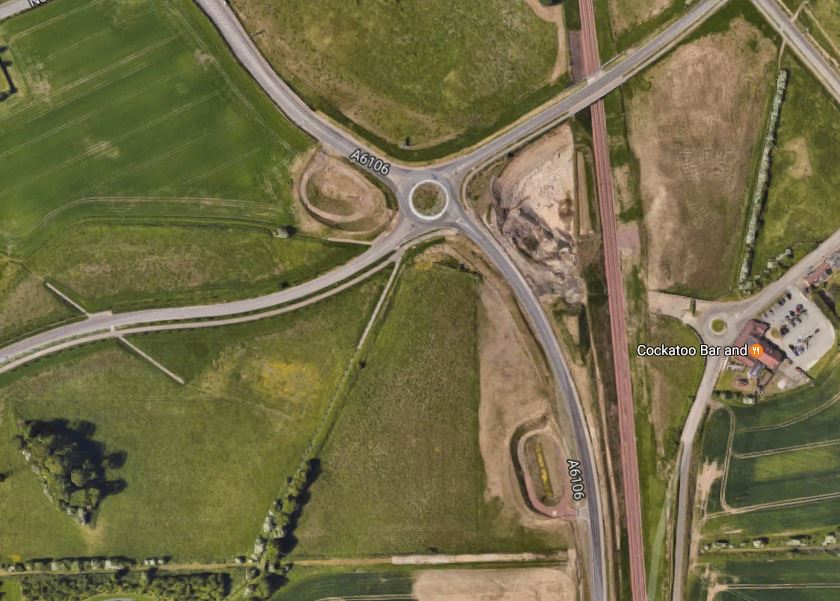
Note the old track-bed of the Edinburgh, Loanhead and Roslin Railway running East-West across the bottom of the map.
The roads in the area don’t appear to have been built with a suitable space for a chord to connect.
But even so, I suspect it would be a practical proposition for a single-track chord to be built between the Borders Railway and the Edinburgh, Loanhead and Roslin Railway.
The only difficult construction would be crossing the A6106 road to the South-East of the roundabout.
A cross-over would be needed South of Shawfair station to allow Southbound trains to access the branch to Penicuik. But as there would only be no more than four tph South of Shawfair station, this wouldn’t be a large operational problem.
Single-Track To Penicuik
Wikipedia says that the proposed Penicuik branch is ten miles in length.
Surely, if it were a single-track branch, trains could go from Shawfair to Penicuik station and return within thirty minutes.
Consider.
- It would take five minutes for the driver to change ends at Penicuik
- Two stops each way with a modern train could take a total of just five minutes.
- The train would be the only one on the branch.
- A well-designed line could have an operating speed of at least 75 mph and possibly 90 mph.
All this would mean that there would be ten minutes for each leg of the journey between Shawfair and Penicuik.
Should A Future Penicuik Branch Be Electrified?
Electrification of a future Penicuik Branch would not be difficult.
- Electrification would need to be extended from Newcraighall station.
- Electrification would be easier, if the branch were single-track with single-platform stations.
- Electrification of a new railway must be easier than electrifying an existing line.
Electrifying between Newcraighall and Penicuik may give advantages.
- There will be a fairly plentiful supply of cascaded electric trains, that could be suitable for the route.
- Electrifying may allow electric trains to access the Millerhill TMD.
- Electrifying would help in running bi-mode trains on the Borders Railway, if that were thought necessary.
- Electrifying may save a few minutes between Shawfair and Penicuik.
Obviously, electrification would allow politicians to boast about their green credentials.
The only disadvantage of electrification is that some bridges may need to be raised.
Surely, if the ten-mile branch was well-designed as mostly single-track, perhaps with electrification, and run by modern trains, two tph would be possible, even with one or more intermediate stops.
Could A Future Penicuik Branch Be Worked By Bi-Mode Trains?
A bi-mode train like a Class 319 Flex train could certainly work the route and as they have lots of power, they could probably achieve the Shawfair to Penicuik and return time of thirty minutes.
Could A Future Penicuik Branch Be Worked By Battery Trains?
As it is only ten miles between Shawfair and Penicuik, I suspect that in the future,, trains with onboard energy storage will be able to work the branch.
Single-Platform Stations
If the future Penicuik Branch could be a single-track railway, where only one train was on the branch at any one time, all stations could be built with a single-platform and no expensive footbridge, as most stations were built on the existing Borders Railway.
As five-cars seems to be becoming the new standard train length, I would build all platforms to accept five-car trains.,
A North-South Service Across Edinbugh
Peak Hour services link Tweedbank and Newcraighall beyond Edinburgh to Glenrothes with Thornton via Kirkcaldy.
There is obviously a need for a service in the Peak, but if there was a second Southern terminus at Penicuik would it be sensible that if a total of four tph were running from Newcraighall to Edinburgh, that a proportion cross the Forth.
Note that Cross-Forth services.
- Call at both Edinburgh and Haymarket stations in the City Centre.
- Have an easy interchange with the Edinburgh trams at Haymarket and Edinburgh Gatway station.
- Probably have an easier route to Edinburgh Airport.
There are certainly lots of possibilities.
Could A Future Penicuik Branch Be Worked By Tram-Trains?
The Germans would probably use tram-trains in a city the size of Edinburgh.
Compared to the tram networks in Nottingham and Birmingham, Edinburgh trams always strike me that it was a network designed without ambition and that doesn’t provide the maximum benefit to the largest number of residents and visitors.
If you look at Edinburgh Gateway station, it could have been modified to allow tram-trains like the Class 399 tram-train to come from the Airport and then go straight onto the Fife Circle Line to South Gyle, Haymarket and Edinburgh stations.
At present this line is not electrified, but doing that is probably in Scotrail’s wish-list.
Once at Edinburgh station, the tram-trains could take any of the electrified routes to North Berwick, Dunbar or perhaps Penicuik.
Passengers would finally get a proper interchange between trains on the East Coast Main Line and the Edinburgh tram.
I also think that the Germans would run tram-trains on the Fife Circle Line and its proposed extension to Leven.
Currently, the frequency of trains on the Fife Circle Line is low and tram-trains could probably give a four tph service to all stations, if electrification was put in place.
Conclusion
I believe that it would be possible to open a single-track branch to Penicuik with single-platform stations and these objectives.
- Provide a two tph service between Penicuik and Edinburgh.
- Boost the service between the Park-and-Ride at Newcraighall and Edinburgh to four tph.
- Provide an alternative Southern terminal for a North-South service across Edinburgh.
Electrification of the line might give operational advantages to Millerhill TMD, the Borders Railway and the branch itself.
A Reopened Levenmouth Rail Link
This article in Global Rail News has a title a title of Levenmouth – Scotland’s next railway?.
According to the article, the figures look good, for the reopening of the Levenouth Rail Link, with a Benefit Cost Ration of 1.3, which compares well with a figure of 0.96 for the successful Borders Railway.
It would be a five mile extension from the Fife Circle Line and would serve a station at Leven and a large Disgeo distillery.
Is The Levenmouth Rail Link Going To Be Scotland’s Next New Railway?
I ask this question as this article in Global Rail News was asking the same question, with a title of Levenmouth – Scotland’s next railway?.
According to the article, the figures look good, for the reopening of the Levenouth Rail Link, with a Benefit Cost Ration of 1.3, which compares well with the figure of 0.96 for the successful Borders Railway.
This is also said in the Wikipedia entry for the Fife Circle Line under Future Services.
A Leven rail link would provide better services to support major industrial sites at Fife Energy Park, Methil Docks, the Low Carbon Park (under construction), Diageo, the businesses along the Leven Valley (including Donaldsons) and major retailers in Leven located close to the line (Sainsbury, B&Q, Argos, etc.). Levenmouth is an area of high deprivation and Fife Council estimates that an hourly train link (using the Fife Circle services)to Edinburgh would increase job vacancies by 500% since commuting for work would become possible.
There is one big difference between the Borders Railway and the Levenmouth Rail Link.
On a journey to Scotland’s capital from Leven, the travellers have to cross the large water.barrier of the Firth of Forth.
Is The Firth Of Forth A Psychological Barrier?
Does the Forth act as both a psychological batter, as well as a physical barrier to travel?
I don’t know for sure, but I hear the same sort of comments from my friends in Edinburgh about Fife, as North Londoners make about South London and probably South Londoners make about the North.
The much larger Thameslink project may get all the publicity and criticism, but London’s most modern cross-river link just keeps on giving.
The East London Line And The Levenmouth Rail Link
You might argue, what has the East London Line got to do with the Levenmouth Rail Link?
I believe that because of the geography of the two areas, with a major waterway between two centres of population, that the massive underestimation of passenger numbers, that occurred in East London could also happen across the Forth.
Luckily, that just as Marc Brunel provided a high-quality crossing under the Thames, the Victorians did this for the Firth of Forth.
Although, it could be argued that the Scottish crossing is more iconic and you get a better view.
As an aside, if the Forth Bridge, which opened in 1890 is a UNESCO World Heritage Site, surely Marc Brunel’s much older Thames Tunnel, should be similarly acknowledged.
Local Rail Services Across The Firth Of Forth
At present the local services across the bridge are four trains per hour on the Fife Circle Line.
That is not a high capacity service, given the line is not electrified.
If the Levenmouth Rail Link were to be rebuilt, it would connect to the Fife Circle and surely, it would mean that more trains could be timetabled to and from Edinburgh, via the new station at Edinburgh Gateway, which gives access to Edinburgh’s trams, the Airport and services to Glasgow and the West of Scotland.
Would those along the Levenmouth Rail Link respond to a new railway, as those who live in Hackney did to the East London Line?
I would be very surprised if they didn’t!
Rebuilding The Levenmouth Rail Link
The Levenmouth Rail Link is a classic branch line, with not much complication. Published plans show the following.
- It would be about five miles long.
- It would branch off the main Edinburgh to Aberdeen Line to the North-East of Glenrothes with Thornton station.
- It would terminate at Leven station.
- A branch would serve the large Diageo distillery.
This Google Map shows the junction with the main line.

Glenrothes with Thornton station is in the South-West corner of the map on the Fife Circle Line.
- Trains go West from the station to Edinburgh on the Fife Circle Line via Cowdenbeath and Dunfermline.
- There is a triangular junction to the East of the station.
- Trains go South from this junction to Edinburgh via Kirkcaldy.
- Trains go North from this junction to Perth, Dundee and Aberdeen.
To the North of this junction, the line splits, with trains for Leven, branching off to the East.
This map from Wikipedia shows the stations on the Fife Circle Line
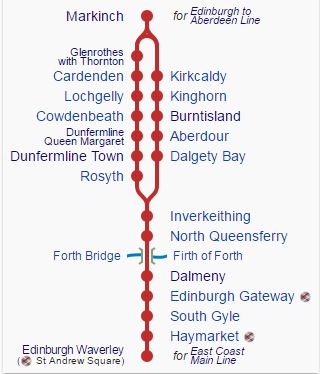
Note that the junction where the Fife Circle Line splits South of Markinch station, is the one shown in the Google Map.
Electrification
The Fife Circle and the Edinburgh to Aberdeen Line are not electrified and there are no scheduled plans to do so, other than the aspiration of having more lines with electric services.
But various factors will effect the types of trains between Edinburgh and Perth, Dundee and Aberdeen.
- Distances are not hundreds of miles.
- Virgin’s electro-diesel Class 800 trains will be working between Edinburgh and Aberdeen.
- Could Hitachi build electro-diesel versions of their Class 385 trains, as they share design features with the Class 800 trains?
- Will Hitachi add energy storage to Class 385 trains?
- Abellio are rumoured to be introducing trains with energy storage in East Anglia. Would this expertise be used by Abellio ScotRail?
I think we could see a cost-effective strategy implemented, that included electric trains, but a limited amount of overhead wiring.
- Edinburgh to Dalmeny – Electrified
- The Forth Bridge could be left without wires, if it were thought too sensitive for the Heritage Taliban.
- North Queensferry to Perth – Electrified
- Ladybank to Dundee – Not electrified
- Fife Circle via Cowdenbeath and Dunfermline – Electrified
- Levenmouth Rail Link – Not electrified
Note.
- As Stirling and/or Dunblane will be electrified, will Stirling to Perth be electrified?
- Between Dalmeny and North Queensferry, diesel or battery power would be used on local services.
- I have flown my virtual helicopter round the Fife Circle and it doesn’t look that electrification would be a nightmare.
- The Levenmouth Rail Link could be run by battery trains, with a charging station, like a Railbaar, at Leven station.
Appropriate trains would provide all services.
Services
Obviously, what services are introduced depends on passenger traffic.
But after a quick look at the lines, I suspect that the Levenmouth Rail Link fits well with current services on the Fife Circle.
Bear in mind too, that reopening the St. Andrews Rail Link , could be a possibility.
Conclusion
The railways North from the Forth Bridge in the East and Stirling and Dunblane in the West to Perth and Dundee could be much improved. I would do the following.
- Some short lengths of electrification.
- Bi-mode or battery versions of Class 385 trains.
All trains going over the Forth Bridge, should have large windows. The Bridge Visitor Centre must also have easy access with perhaps a free shuttle bus from Dalmeny station.
One of Scotland’s major assets, must be made to work for its living.
Could Tram-Trains Be Used To Advantage In Edinburgh?
This might be design by hindsight but after viewing the tram-trains of Kassel, Karlsruhe and Mulhouse, I do wonder if tram-trains could be used to advantage in Edinburgh, alongside the new tram system.
To the west of Haymarket station, the trams and rail lines share a corridor, with the tram tracks to the north. So as the Edinburgh trams run on standard gauge tracks, any tram-trains coming or going to the west could just cross over between the two sets of tracks. This Google Earth image shows the tram stop and the train station at Haymarket.
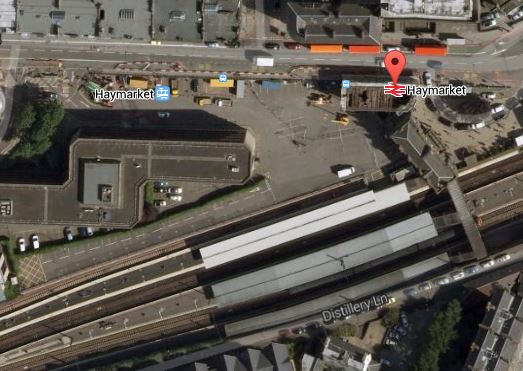
Trams And Trains At Haymarket
Unfortunately, I think the image pre-dates the operation of the trams, but compared to some of the complicated layouts and tunnels in Germany, it should be very simple. As was shown in Paris, tram-trains can be built that run on both the 750 V DC used by Edinburgh trams and the 25 kV AC used on the electrified main line to both Glasgow and London from Edinburgh.
The Edinburgh trams run every 8-10 minutes during the week, so there should be capacity to run some train-trains through the city centre section, without much modification.
But where would they go at the eastern end?
The obvious place would be to go straight on past Waverley station and the Balmoral Hotel and then return to the rail lines to the east of the station, if that was possible. This is a Google Earth image of the area.

Edinburgh Waverley
If they ever extend the tram to Leith and Newhaven, that may or may not be a possibility. The Edinburgh trams are built to a very tight specification, which is designed to go round sharp corners and not make too much noise. Running straight between Haymarket and Waverley may be an easier task, than turning sharply on and off Princes Street.
As with Crossrail and Thameslink in London, where tunnels link two railways lines together, thus saving terminal platforms in the city centre, an east-west tram-train across Edinburgh, would reduce the needed platform capacity in both Waverley and Haymarket stations.
I have been looking at Google Earth images of Edinburgh and there are more railways than those that run passenger trains. I would assume they take freight from up the East Coast Main Line through the city. So could some of these lines be used by tram-trains to create much needed public transport routes in the city?
There is one interesting possibility. The Edinburgh Suburban and Southside Junction Railway, runs across the south of the city and is used by freight trains, but no passenger services. According to Wikipedia there is a campaign to reopen the line to Passenger services and also a proposal by Network Rail to electrify the line. Tram-trains could be a possibility for providing the service, as the line links to the main railway across Edinburgh at both ends.
It would probably be more affordable to provide the passenger services using tram-train technology, as the stops would be simpler and you could use an off-the-shelf Class 399 tram-train, if they have been proven to work in Sheffield.
In the Wikipedia for Edinburgh trams, they also talk about a new stop called Edinburgh Gateway, which would link to trains on the Fife Circle Line.
It has been proposed that the Fife Circle Line be extended to Leven by creating the Levenmouth Rail Link.
I’m pretty certain that in Karlsruhe or Kassel, the Germans, would run tram-trains on the Fife Circle and the extension to Leven, probably using 750 DC electrification all the way.
1. The station at Edinburgh Gateway could be a simpler affair, which would only need to accommodate compatible tram-trains and trams which could share platforms. Obviously, if longer distance trains to Glasgow or Aberdeen were stopping at the station, these would probably need their own platforms.
2. Creating a 750 DC tram line between Thornton and Leven, even if parts of the line carried freight trains, must be more affordable, than heavy rail.
3. Edinburgh would have the iconic images of tram-trains going over the Forth Rail bridge, which could be electrified to either system, as the tram-trains won’t care.
4. Operation of the tram-train would be a bit like the proposed tram-train test in Sheffield, where both ends of the line operate as trams, with a section of heavy rail in the middle.
5. Battery technology could also be used between Edinburgh Gateway and Thornton.
I’ve seen everything, I’m proposing here, in the last few weeks.
This musing of a Saasenach, does illustrate the importance of the tram-train trial between Sheffield and Rotherham.
 The Anonymous Widower