Removing Fence Posts
I have always been an inveterate inventor. At school some of my poorly drawn efforts actually won prizes.
On the stud, we had a lot of what is known as Keepsafe fencing. Unfortunately, the idiots who put the fencing in used poor quality posts that were always rotting. So I developed a device for getting the post out of the ground without too much hard work. I’ve never been a great one for hard phyical work, although the mental stuff is a bit different. Luckily I’ve usually been able to earn enough money to afford to get a man in. Perhaps that’s the Jewish side of my mind, as one of my friends always tells me!
What follows is copy of a post from the stud blog, which shows C using the device to remove a fence by the side of the house. I’m posting it, as one of the photos is one of my favourite ones of my late wife as it sums her up so well.
We had a fence by the side of the house that needed to be removed. The fence was typical post and rail, with the posts buried half a metre into the ground. Luckily they were not embedded into concrete.
At this time, the tool was a few months old and the use had developed so thatyou could use with a high lift jack to remove fence posts without any great fuss or danger. Health and Safety fanatics please note!
As an aside here, just try the normal method of wrapping a chain round the post and then using a tractor to pull the post. This method makes a lot of mess and is very dangerous if the chain breaks.
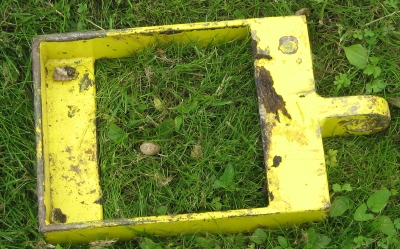
Fence Post Removal Tool
You start by just dropping the tool over the post, making sure that when it is lifted, it will bite into the post.
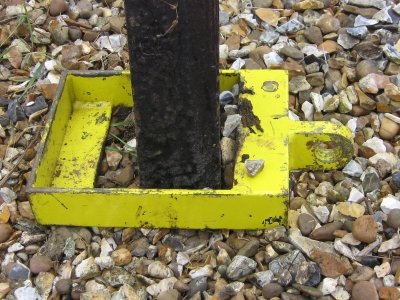
Positioning the Tool
Note that there are no moving parts in the tool and it doesn’t need to be adjusted.
Note too, that the post in this example is in pretty good condition. If the post has broken off at the ground as they often do, then all you need to do is dig a perhaps ten centimetres into the ground so that the tool can grip the good part of the post.
The tool is linked to the jack using a shackle with a breaking strain of about a tonne and a half.
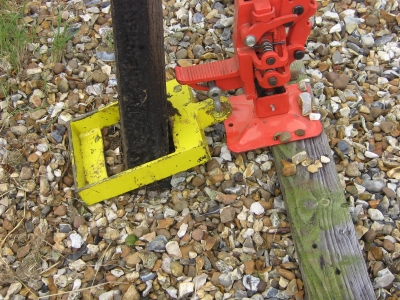
Attaching the Jack
Note that the high lift jack is stood on a fence rail to equalise the ground pressure.
The jack is now lifted to pull the post out of the ground.
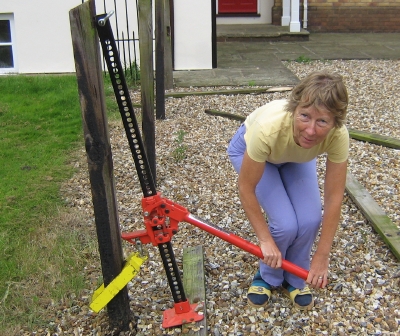
Lifting the Post
This pull took about a minute and the post came quickly out of the ground. Note C’s ever present Scholl sandals. How Health and Safety!
C did most of the pulling for these posts as it’s actually quicker if someone else (me) holds the post vertically. This just shows how powerful the jack/puller combination is. Even a wimp can pull well over three tonnes!
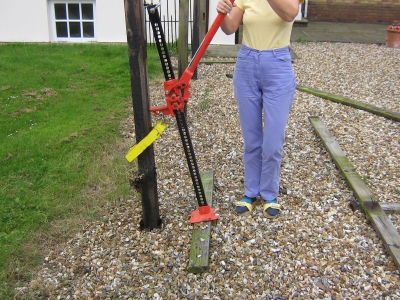
Virtually Done
Note that little damage is done to the ground and in many cases a new post could be driven firmly into the old hole.
The jack can also be used to lift the heavy gate off its hinges.
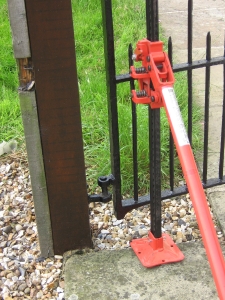
Lifting a Gate
This picture shows how easy it is to pull a post in a restricted space.
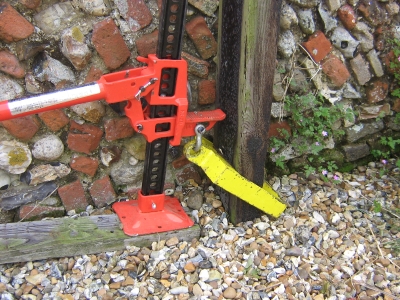
Pulling in a Restricted Space
The wall wasn’t damaged or even touched.
In the end five fence posts and one gate post were pulled in about half an hour.
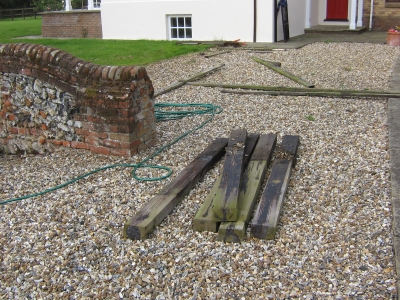
A Job Well Done
I will be taking the tool to London, not that I will have any use for it, but surprisingly, the old page gets a few hits and I’m always being asked for drawings or a tool.
So I’m going to publish the drawings on this blog, so that if you want to create one, you can do it. There will only be two conditions.
You must say thank you, if you like what you create.
And as C died of cancer of the heart just a few months after these pictures were taken, with our youngest dying of pancreatic cancer just a few months ago, the next time that a cancer charity tries to tap you for a few pounds, dollars, euros, yen or whatever, then contribute, especially if it is to do with pancreatic cancer research.
I don’t mind if you don’t contribute, because if you don’t, I suspect the Devil who has been haunting me these last few years, might have found another victim and might leave me alone!
The basic drawing is shown and don’t complain about the quality, as it is rather poorly drawn.

Fence Post Removal Tool
Perhaps one day, I’ll get a proper drawing done. There are also some notes to the forge who made the original.
- I haven’t put any dimensions on the side pieces as I will assume that you will use something close to 5 cm. L-section steel. One is upo one way and one the other to give a cutting and leverage effect.
- The endplates can be either flat or L-section. Whichever is easier and/or stronger.
- The only dimensions are that there must be 14 cm. between the ends and the width must be sufficient to allow a post of just under 18 cm. to be lifted.
- The attachment point on the front will have to be pretty strong as the jack can pull up to 3.5 tonnes.
Happy lifting!
Spider-Man has Trouble with Health and Safety
Apparently the Broadway musucal about Spider-Man is in trouble with Health and Safety according to the Daily Mail.
He’s obviously not a real superhero! Now Dan Dare wouldn’t have had that sort of problem!
Health and Safety at the Tate Modern
The Tate Modern exhibition of porcelain sunflower seeds has had to be closed because of a possible health risk. This is not the first time, that these issues have occurred at the museum according to The Guardian. A friend actually got stuck in Doris Salcedo‘s crack in the floor.
A Load of Old Conkers
I thought that we’d seen the death of Health and Safety warnings over conkers. But we haven’t according to this story.
Surely, St. Edmundsbury Council have been things to do, with my Council Tax.
A Sensible Approach To Health and Safety
It is reported today that Lord Young is close to delivering his report on the health and excessive culture in the UK.
Some of the stories I’ve read lately are so silly it’s not true.
I should say that I grew up in my father’s print works, with lots of printing machines, guillotines, paper drillers and noxious substances like printing ink, solvents and of course lead-based type. My father gave me a lot of guidance, but I suspect many of the things I did, would never be allowed now!
Did I have any accidents at the time?
Yes!
I was using a wood-turning lathe at school and got a splinter in my eye, which meant I had to go to Highlands hospital to have it removed. I should have been wearing goggles, but there weren’t any! That was typical of schools at the time! Nowadays, I would never do something like that without protective goggles.
But it was only when I worked in industry that I got any training. At Enfield Rolling Mills it was minimal and was basically a walk round the factory, pointing out what was dangerous. It may seem silly to say that you learned on the job, but then they expected you to observe what you saw and take appropriate precautions to avoid trouble.
At ICI in 1969, I went on a safety course, but the most valuable lesson, I had was a walk round a BCF plant with the foreman, Charlie Akers. To illustrate the dangers of HF dust, he took a speck and placed it on my thumb. It burned, so after that I made sure that I didn’t touch any. I still climb industrial staircases without putting my hands on the top, as that is where all the noxious substances are!
In my view Health and Safety training should begin in schools, as what you need to instill is a simple threat recognition and avoidance culture into children, that they will carry with them all of their lives. How many children have broken arms at five or six in simple situations like getting off a slide or a swing? A researcher into accidents once told me, that he felt there was now a common child accident, where kids were trained to get into their house quickly for their protection and had all sorts of problems, when the car wasn’t parked outside the house, so they ran across the road to get to safety. I once drove up from Cornwall and was suprised to see so many overloaded 4x4s in accidents, because their idiot drivers had not properly understood the problems of excess speed and weight. A proper health and safety education and a bit more practical understanding of Newton’s Laws would have alerted them to the problem before they set out.
The report on Lord Young makes some interesting points.
Launching the review in December, Mr Cameron cited cases of children being told to wear goggles to play conkers, restaurants being banned from handing out toothpicks and trainee hairdressers being banned from using scissors as examples of silly practice.
The Young report says local authorities, in future, should explain their decisions to ban events on health and safety grounds in writing.
The public should be able to refer decisions to an ombudsman and, if deemed to be unfair, they should be overturned within two weeks.
The idea of an ombudsman seems very sensible, especially, as they would affectively lay down good practice.
Lord Young also says flaws in existing legislation have fuelled the number of personal injury lawsuits and pushed up the fees charged by lawyers.
The growth of claims management firms – which are paid referral fees by solicitors to assess whether there are grounds for a claim – has led to a glut of advertising, he says, and resulted in a market in fees where claimants are directed to firms which pay the most not those which are most suitable.
“Many adverts entice potential claimants with promises of an instant cheque as a non-refundable bonus once their claim is accepted – a high pressure inducement to bring a claim if ever there was one,” his report argues.
A culture has developed in which businesses, the public sector and voluntary organisations “fear litigation for the smallest of accidents and manage risk in accordance with this fear,” he adds.
When I was in Middlesborough, there were adverts everywhere for solicitors, who would make a claim for you. In my view where there’s a greedy and unscrupulous lawyer, there’s a claim. I’d ban all forms of advertising by lawyers. You always get the best lawyers by talking to a good friend or someone who really knows what to do, not by phoning a company which then have a vested interest in your claim.
He also is suggesting a Good Samaritan law.
His report also suggests that a “good samaritan” law may be necessary to make it clear that people will not be sued for voluntary actions – such as clearing snow from a driveway – which may inadvertently contribute to accidents.
This is another good idea! But in the driveway example, we should remember good common sense, when we do things like that. In a related example, if we see a loose paving-slab outside our house, which we feel could be dangerous to some people, then coucils must have a reporting system that gets it fixed.
Health and Safety is just one area, where we must rescue our country from the barmy, scientifically-incorrect excesses of Nulabor.
Since my strokes, it is not stretching things to say that my Health and Safety training has been one of the things that has helped me get around and get my life back on track.
Bumping My Way Back To Civilisation
My friend had to go to see his MP near the Horniman Museum (Worth a visit I’m told!), so about three we took a bus, that would both drop him at the museum and take me to a station, that would allow me to get to hopefully Charing Cross, as I wanted to visit the National Gallery.
I got off the bus at Forest Hill, crossed the road and tried to find the station entrance. It was confusing and not very well signed. But it did have a brick flower bed in front, which I bumped into, as it was about knee-height and obscured by the other people in front of the station. If there had been flowers in the bed, I would have seen it. Luckily no harm was done! I then found the door, opened it and used my ticket to open the barrier and get myself on the platform. My friend had told me that I should take a London Bridge train and then walk over the bridge to get a bus or a tube train, as the Jubilee Line wasn’t running.
I didn’t wait long for a London Bridge train and before long I could see the familiar sights of the City.
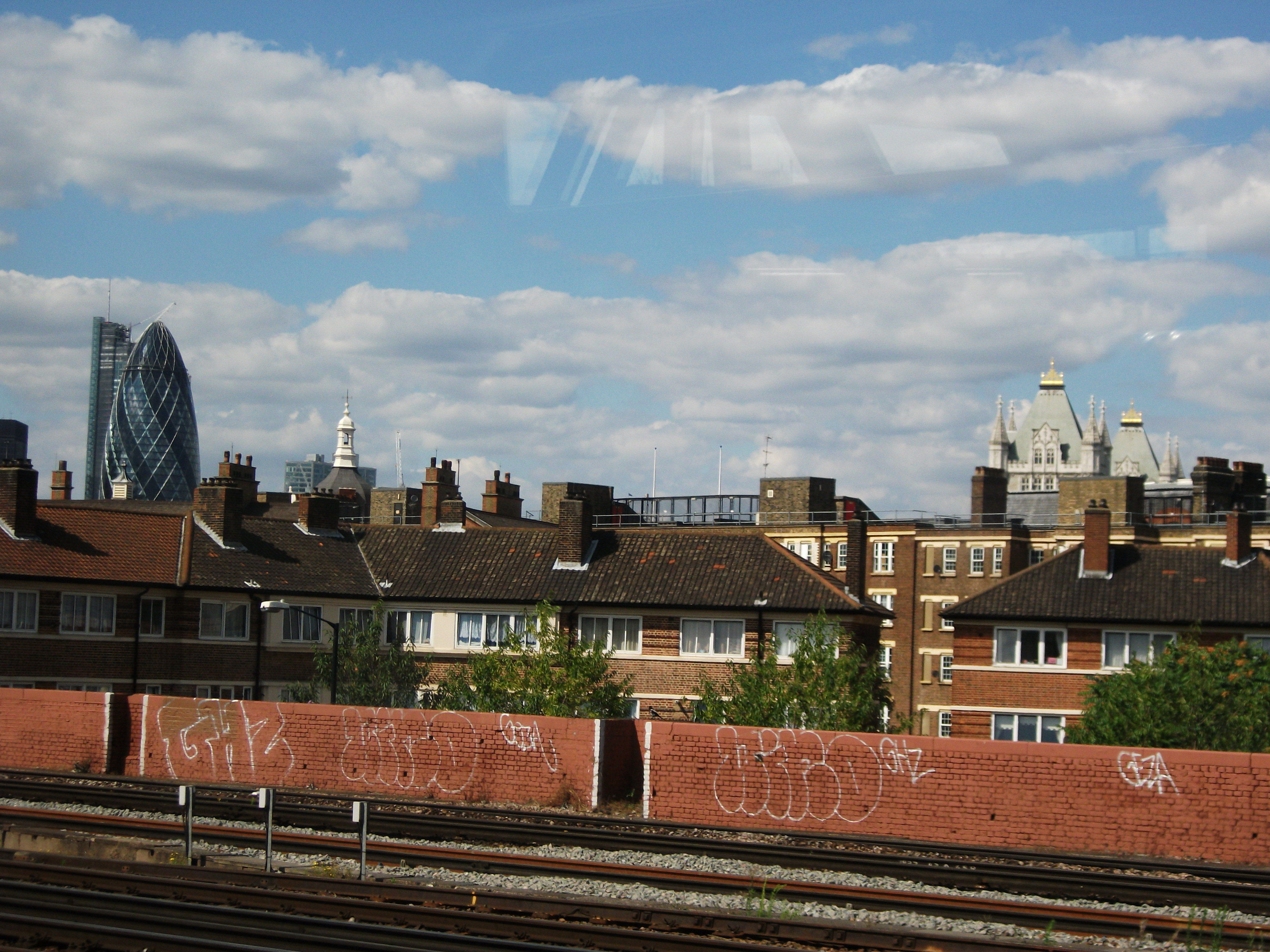
Approaching The City
Note Tower Bridge peeping over the buildings in front.
I got out at London Bridge when the train terminated and started to look for someone who might know where I could get a train to Charing Cross. I couldn’t find anyone, but I did see this obstacle kindly placed in the middle of the platform.
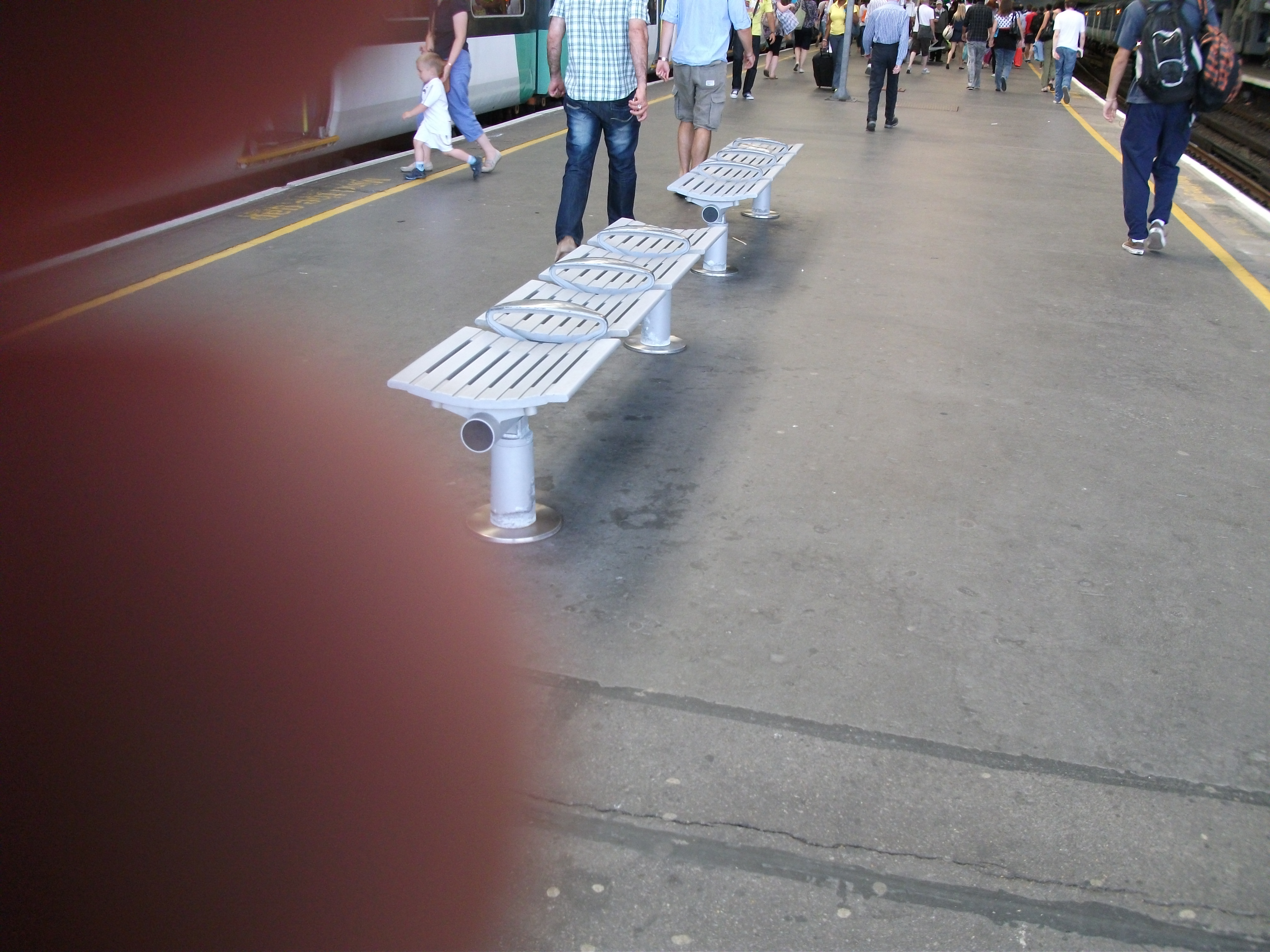
Seats on London Bridge Station
Luckily I saw them and had time to get the camera out to photograph them. But to illustrate my hand problems, note the finger in front of the lens.
What idiot decided to put seats like that in a place where someone with limited visibility might miss them? If they had had seat backs or hand been occupied, then they would have been easier to see. As they would have been if they had yellow arms, like London Underground ones do!
When I found the platform for Charing Cross, I asked a helpful stationman and he said that the seats don’t have backs because of health and safety issues. Obviously not mine or others with limited visibility.
I suppose that yellow or orange arms, as that would break corporate colour-scheme rules!
Health and Safety
Health and Safety is in the news today, with the government announcing a review by Lord Young.
Strangely, all the Health and Safety training that I got at ICI in Runcorn in the late 1960s, is kicking in to help me protect myself from my weak left side. You have to assess threats in just the way you walked around chemical plants with noxious substances like HF dust all over the place. I still remember the charming and sensible Charlie Akers, who showed me over the BCF plant at Rocksavage Works and still follow his rules on climbing ladders and metal stairs. But Rocksavage in those far-off days had an impeccable safety record and it was all down to everybody working to a sensible philosophy not hard and fast silly rules dreamed up by bureaucrats.
Thank you, Charlie!
Lord Young’s investigation needs to have input from people like you, who are at the sharp end and get hurt when accidents happen.
Health and Safety Ruins Pancake Race
This story from the Daily Mail takes the biscuit. Or should I say the pancake!
Further down they also have pictures from the pancake races at Olney in Buckinghamshire, which don’t have a speed restriction. They have been taking place since 1445. Perhaps the Mayor of Olney should appraise his opposite number at St. Albans.
Two Lemons for Asda
This must be one of the silliest health and safety stories in recent years.
Chris Pether, a retired oil-worker from Aberdeen, was refused permission to buy two loose lemons, because it was felt that he might throw them at others.
In the end he made two separate purchases.
 The Anonymous Widower