West Anglia Route Improvement – The High Meads Loop
This map from carto.metro.free.fr shows the lines at Stratford.
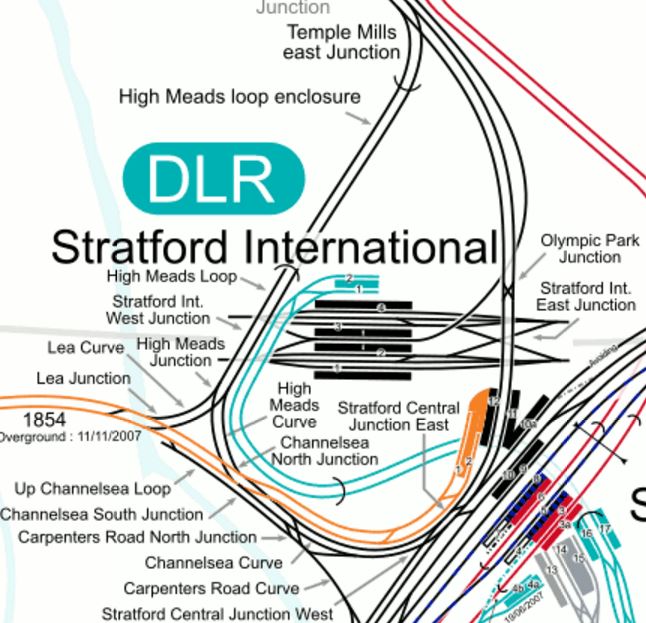
Note Temple Mills East Junction at the Northern (top) end of the map.
If you go North from here, you are on the Temple Mills Branch of the West Anglia Main Line and you will pass through Lea Bridge station and Coppermill Junction before you reach Tottenham Hale station.
Go South from that Junction and you pass the crossover of Olympic Park Junction, cross over the Eastern End of Stratford International station and then arrive in Platforms 11 and 12 at Stratford station.
Platform 11 is used for the current two trains per hour (tph) that go up and down the West Anglia Main Line, but Platform 12 is currently just giving out messages saying “I’m Free!”
Platforms like these can generally handle four tph, as they do at stations like Highbury and Islington or Dalston Junction. But is a capacity of eight tph enough if some Stansted and Cambridge services are added to the mix at Stratford?
But there may be other possibilities!
On the map in this post, look at the lines to the North-West of Platform 11 and 12 at Stratford station and how they curve round the Eastfield Shopping Centre and Stratford International station.
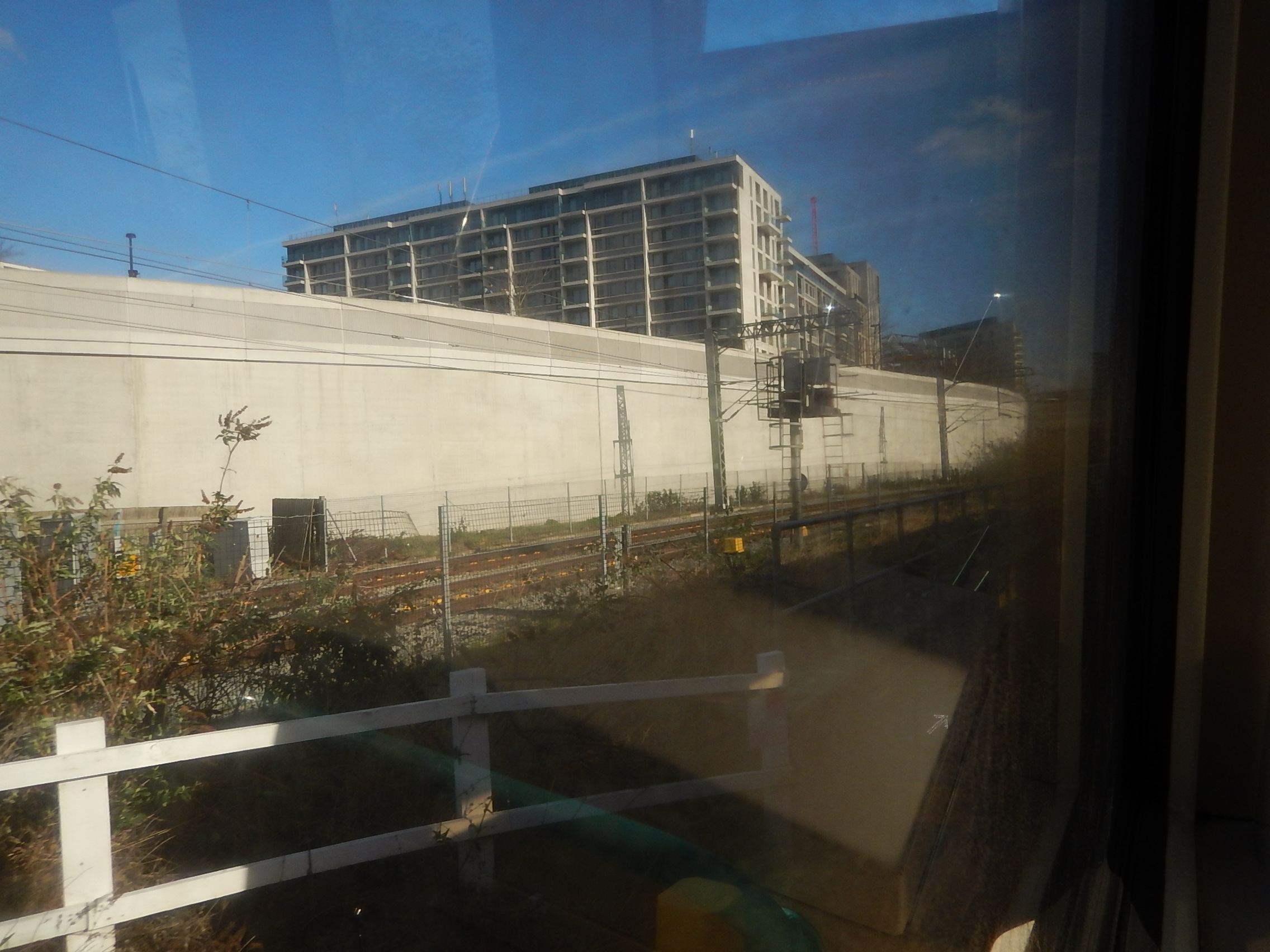
The main route is called the High Meads Loop and this picture taken from a Docklands Light Railway train to Stratford Internation station, shows the twin-track loop.
Southbound trains from Tottenham Hale could do the following.
- Call at Platform 1 in Lea Bridge station.
- Call in Plastform 11 at Stratford station.
- Go round the High Meads Loop and past the Stratford International DLR station.
- Rejoin the Temple Mills Branch on the Down Line at Temple Mills East Junction.
- Call at Platform 2 in Lea Bridge station.
The train has been turned round using the High Meads Loop, after a stop at Platform 11 in Stratford station.
So do trains currently take this route?
On this page in RailForums, this was said in a post made in 2006.
Another option is the use of Channelsea Junction and the High Meads loop to turn trains at Stratford. I’ve managed to go from Stansted Airport to Stratford and back again without changing ends using that particular route before now.
I would assume from the words, the poster of the information is a driver. So they should know!
Channelsea Junction is clearly shown on the map in this post.
I have a few questions, that should be answered.
Is The Route Bi-Directional?
I suspect it is and trains would call in the unused Platform 12 at Stratford station. As I said in Platforms 11 and 12 At Stratford,
Trains stopping in Platform 12, will have a very simple step-free access to the London Overground services in Platforms 1 and 2.
My personal view, would be that services using the loop called in Platform 12, as that would give me easy access from the North London Line from where I live.
But going round this way through Platform 12 at Stratford would mean that trains would have to cross on the flat at Temple Mills East Junction.
How Long Are Platforms 11 and 12 at Stratford?
They certainly accept an eight-car train as they do now, but would they accept a twelve-car one?
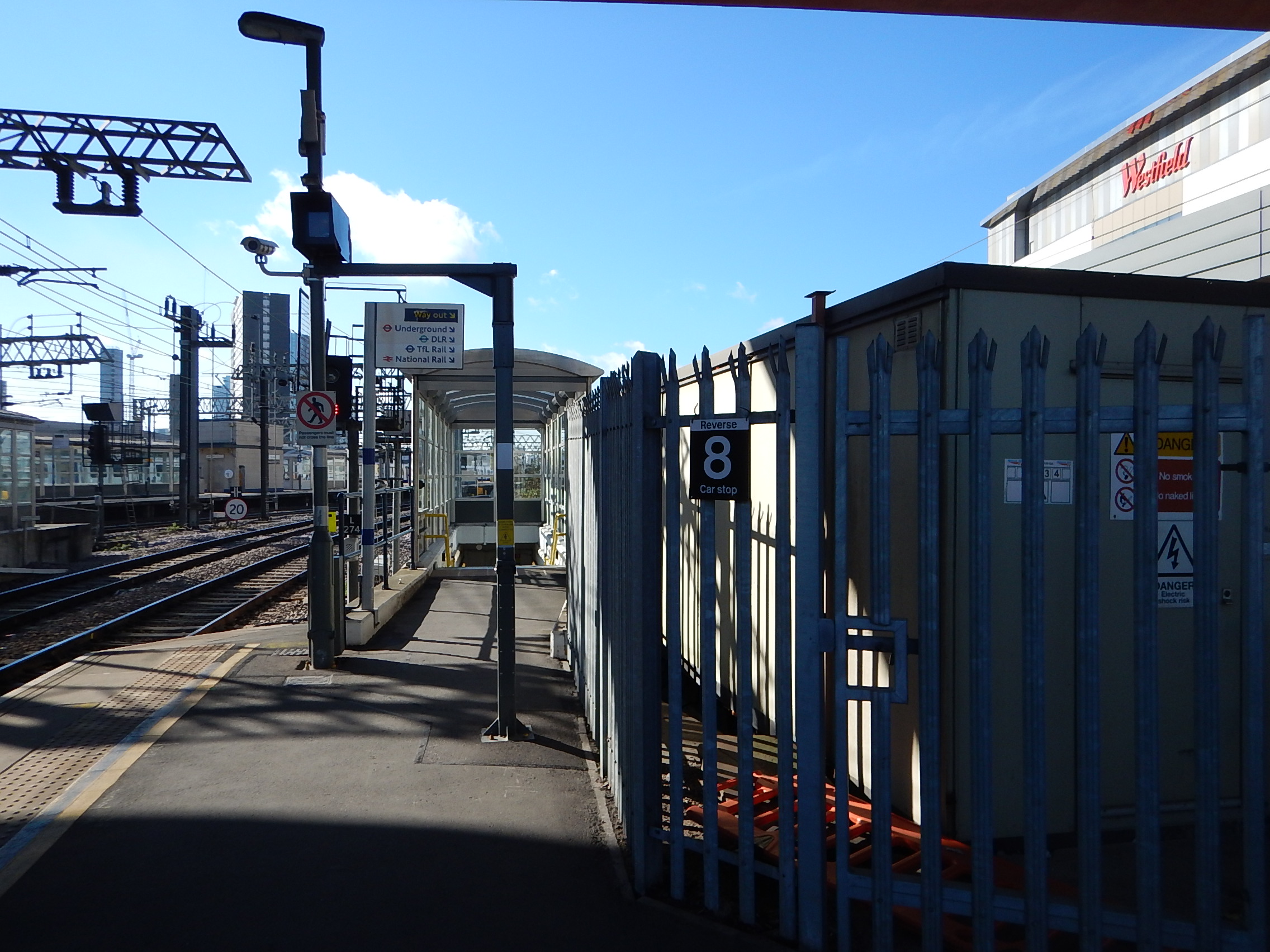
The Picture Says 8
If they can’t and it would be needed to accept Greater Anglia’s new Stadler Flirts for the Stansted Express, there would appear to be space to lengthen the platforms, at the Temple Mills End.
It has to be asked if Platforms 11 and 12 have enough capacity.


I would appear that they have been built reasonably wide to accept high passenger numbers.
What Services Could Use This Loop?
I suspect any service arriving at Stratford from the West Anglia Main Line, that needed to be turned back, could use this route.
- Angel Road using the new STAR service.
- Bishops Stortford
- Broxbourne
- Cambridge
- Chingford using the Hall Farm Curve.
- Hertford East
- Stansted Airport
That is a very comprehensive list.
How Many Trains Per Hour Could Use The Loop?
The capacity of the loop could be at least as high as the similar Wirral Loop in Liverpool, which handles 12 tph or just one train every five minutes.
Modern signalling with a measure of Automatic Train Control could probably raise this figure substantially.
In addition, Platform 11 could probably handle four tph as it does now.
Could A Station Be Built On The High Meads Loop To Serve Stratford International?
If it could, it would ease one of London’s truly dreadful transport issues. How do you get to Stratford International station without walking a long way or going through Eastfield?
Can Services Using Platforms 11 and 12 At Stratford Access The North London Line?
As there is a triangular junction connecting the North London Line, the High Meads Loop and Platforms 11 and 12 at Stratford, a lot of services are possible, if they are needed.
But for the time being a good step-free interchange between Angel Road, Chingford and other services from the West Anglia Main Line to the North London Line services at Stratford is all that could be needed.
If High Meads Loop services called in Platform 12 at Stratford, that would be an ideal solution.
A short walk would connect North London Line services to Stanstead Airport services and local trains up and down the West Anglia Main Line.
Note the sign in this pictuire.

It directs passengers to Platform 12 for Stansted Airport services.
How Many Trains Per Hour Could Use The Loop?
The capacity of the loop could be at least as high as the similar Wirral Loop in Liverpool, which handles 12 tph or just one train every five minutes.
Modern trains and signalling with a measure of Automatic Train Control could probably rise this figure substantially.
So perhaps there could be twelve to fifteen tph through platform 12.
In addition, Platform 11 could probably handle four tph as a traditional terminal platform.
Do Any Other Services Use The Temple Mills Branch?
I’m not saying they don’t, but I’ve never a freight train go through Platform 11 or 12 at |Stratford or Tottenham Hale or Lea Bridge station.
But I have seen an engineering train at Coppermill Junction and empty stock needs to get in and out of Temple Mills Depot.
Conclusion
Trains arriving at Stratford station on the Temple Mills Branch of the West Anglia Main Line can call at Stratford station and go straight back from whence they came using the High Meads Loop.
One positive effect would be that however many trains went round the High Meads Loop, all could call at the following stations.
- Platform 1 at Lea Bridge station
- Platform 11 or 12 at Stratford station
- A platform at Stratford International station, if it were to be built.
- Platform 2 at Lea Bridge station
Look at the service that Lea Bridge station gets to and from Stratford.
West Anglia Route Improvement – What Is STAR?
STAR stands for Stratford-Tottenham-Angel Road and is a proposed four trains per hour (tph) service between Stratford and Angel Road stations, calling at the following stations.
The main purpose is to provide a service to the new £3.5billion housing and commercial development project at Meridian Water, the developers of which will be rebuilding Angel Road station and renaming it to Meridian Water.
Brief details of the project are given in the March 2017 Edition of Modern Railways.
- STAR will involve laying a third track between Stratford and Angel Road, alongside the West Anglia Main Line and the Temple Mills Branch to Stratford.
- STAR will be completed at the end of 2018.
- STAR will run at a frequency of four trans per hour (tph)
- STAR will help in the four-tracking of the West Anglia Main Line.
More will certainly emerge in the next few months.
But I have a few questions about STAR.
Will STAR Services Go Beyond Angel Road Station?
The only STAR service at present is the two tph service to either ?Hertford East or Bishops Stortford stations that call at Lea Bridge, then in a rather haphazard pattern up the Lea Valley.
It is not a passenger-friendly service, as you turn up for the half-hourly train and find the destination you want is served on the alternate service.
I have a feeling the service pattern is designed by history, rather than a train planner with a brain.
What Type Of Train Will Be Used?
I think the route STAR will take, has a possible headroom problem at Tottenham Hale.
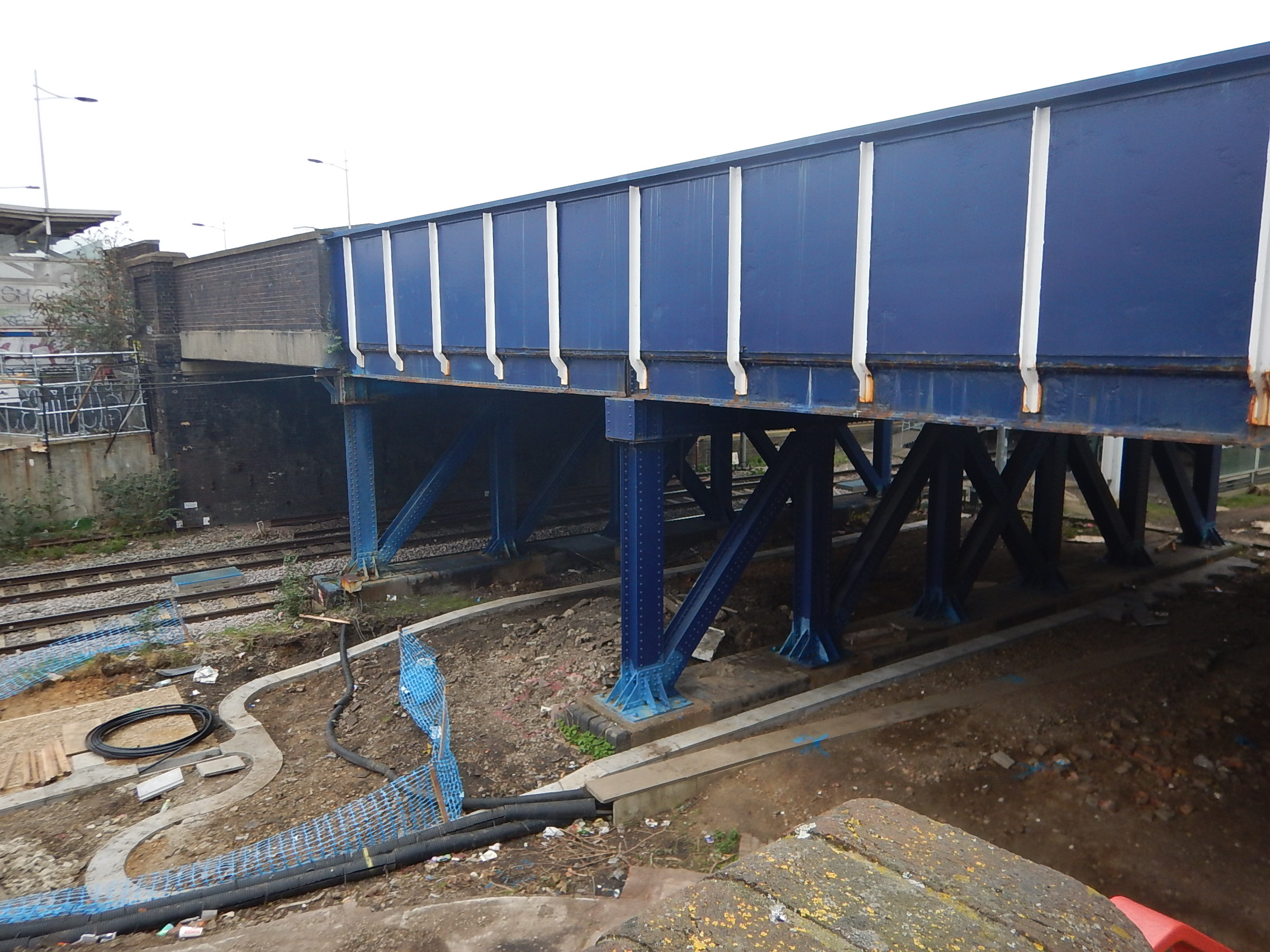
Ferry Lane Bridge At Tottenham Hale Station
When I first saw this bridge and saw the height of the overhead electrification on the existing West Anglia Main Line under the far span, I immediately questioned if they could fit the electrification under either of the blue steel bridges, where STAR might pass, in a manner that would meet all the Health and Safety regulations.
Read this article on the Rail Engineer web site, which is entitled EGIP – electrification clearance woes, to learn more about how regulations are making electrification not just an engineering problem.
So will this mean that STAR will be built without wires?
Diesel trains would work, but wouldn’t fit the profile of Meridian Water as an ecologically-sound development.
I think we could see IPEMUs or electric multiple units with onboard energy storage working the route.
Will STAR Share Platforms With The West Anglia Up Line?
The space for putting the third track for STAR is narrow as this picture at Tottenham Hale shows.
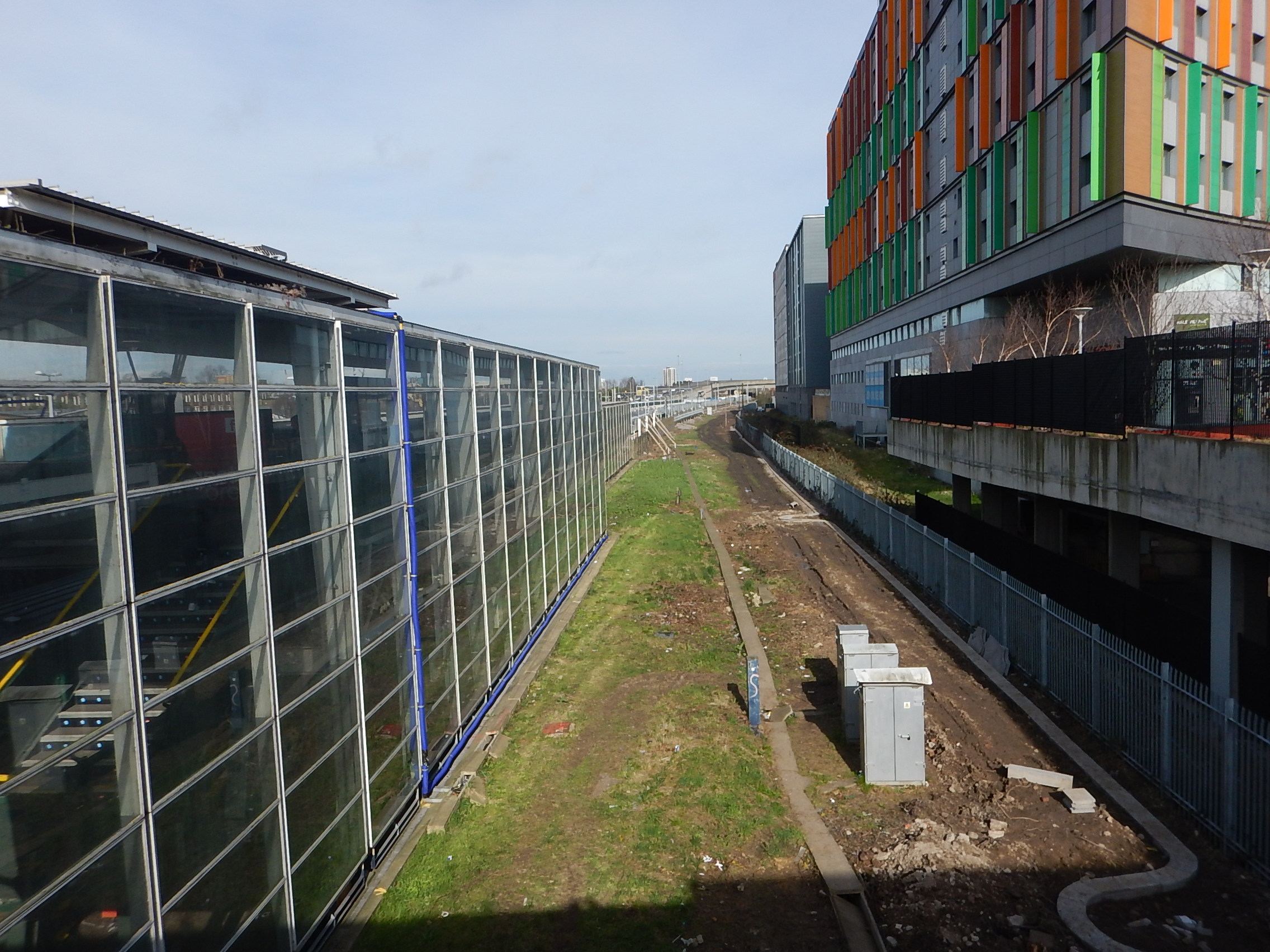
STAR Will Go Through Here At Tottenham Hale Station
If STAR goes through in the space conveniently marked by green grass, the easiest way to create a platform would be to add a second face on the existing Platform 1.
- A step-free bridge is being built linking Hale Village to a new station building with step-free access to the existing Platforms 1 and 2.
- If STAR used the other face of Platform 1, it would share the step-free access of that platform.
- STAR would have cross-platform access with services to Liverpool Street.
- There would be step-free access between STAR and the Victoria Line.
It could be a very simple and affordable way of creating a new platform and interchange with full step-free access.
The technique could also be used at Northumberland Park station.
Could STAR Call At Stratford International Station?
One of the many proposals for the Docklands Light Railway was to extend the Stratford International Branch along the Lea Valley. This seems to have been dropped.
But there is a line called the High Meads Loop, that would appear to allow trains to call at Lea Bridge station and Platform 11 at Stratford station, before looping round Eastfield and Stratford International station and returning through Lea Bridge station. In a forum, a claim is made by I assume a driver, that he’s done this.
If a platform could be built on the High Meads Loop to serve Stratford International station, then STAR services could go round the High Meads Loop and call at the platform.
But if the loop could be used to turnback trains, then it would allow a lot more trains to use Stratford as a destination.
Could A Similar Service To STAR Connect Stratford To Walthamstow And Chingford?
I have been past the work-site between Lea Bridge station and Coppermill Junction several times in the last few days and it would appear that the Hall Farm Curve that would make this service possible is being cleared of fifty-plus years of rubbish.
But, there are other problems in creating this service, like the level crossing at Highams Park station.
Could The Capacity Of STAR Be Increased?
The capacity on the East London Line, which runs a similar 4 tph service on four separate routes, was increased by the simple process of lengthening the trains.
Provided the platforms are built to accept longer trains, this would be the easy way to increase capacity.
What Will Happen To STAR When The Great Anglia Main Line Is Four-Tracked?
STAR will only affect the West Anglia Main Line between Coppermill Junction and Angel Eoad, as this is the only section, where the STAR and the new lines will co-exist.
In How Many Fast Services Will Go Through Tottenham Hale Station?, I concluded that there will be between ten and twelve fast trains per hour in both directions between Tottenham Hale and Broxbourne stations.
I also think, that these trains will go non-stop along the new lines only stopping at Broxbourne, as the timings of the new slow trains could be the same as the current fast ones. See Timings Between Tottenham Hale And Broxbourne Stations for full details.
As the four-tracking will not take place for a few years, I think it is likely that Stadler and Bombardier will be able to fit onboard storage to their trains, so could we see the two new lines squeezed into the small space between STAR and the development at Tottenham Hale without electrification?
Signalling technology would also probably allow such a line to be bi-directional, with trains running alternatively in both directions.
It would certainly save space to have a single bi-directional line without electrification handling the fast trains through Tottenham Hale!
The fast line would revert to a normal double track at Coppermill Junction and Angel Road station.
As closing a rail route is often a difficult process, even after Crossrail 2 is providing a high frquency service between Tottenham Hale and Angel Road, STAR will continue into the future.
Conclusion
STAR is putting down some interesting markers for the future.
West Anglia Route Improvement – Modern Railways March 2017
The March 2017 Edition of Modern Railways sheds some more light on what is happening at the between Angel Road and Tottenham Hale stations.
They state the following about the current works.
- The Stratford area and its station is growing in importance.
- The line is slated for improvement under the Stratford-Tottenham-Angel Road (STAR) project.
- STAR will involve laying a third track between Stratford and Angel Road, alongside the West Anglia Main Line and the Temple Mills Branch to Stratford.
- STAR will be completed at the end of 2018.
- STAR will run at a frequency of four trans per hour (tph)
A picture in the magazine taken from a footbridge shows very much what my pictures show.
They also state this about Crossrail 2
- Crossrail 2 would be overlaid on the existing network serving both Liverpool Street and Stratford stations.
- Coppermill junction could be converted to a grade-separated rather than a flat junction.
- Crossrail 2 would emerge from the tunnel South of Tottenham Hale.
- The project would quadruple the West Anglia Main Line from the tunnel portal to Broxbourne.
- STAR would be built to facilitate this.
- A turnback platform is being considered at Tottenham Hale
- A turnback platform is being considered at Enfield Lock
- Turnback platforms and stabling sidings are considered at Broxbourne.
So how does all this fit with my observations?
STAR
I very much feel that STAR could be only a stop-gap development until Crossrail 2 arrives. In What Is STAR?, I give a few basic details.
After all will it still be needed to run just four tph between Angel Road and Stratford, when there could be upwards of 10-15 tph on Crossrail 2 and other services between Tottenham Hale and Stratford?
Something is needed immediately to serve Angel Road station and the massive Meridian Water development, which will result in the renaming of Angel Road station to Meridian Water,
The timings from Tottenham Hale are currently as follows.
- Stratford – 14 minutes
- Lea Bridge – 4 minutes
- Northumberland Park – 2 ,minutes
- |Angel Road – 4 minutes
Modern Railways states STAR will use a third track between Stratford and Angel Road. So if it was designed to be straight and flat and if it is running new Aventra trains from either London Overground or Greater Anglia with a fast stop capability, I wonder if timings could be achieved, which would enable just two trains to run the required service.
But I also suspect that STAR would provide a valuable service to link Meridian Water to Tottenham Hale and Stratford stations, even after Crossrail 2 opens.
STAR At Tottenham Hale
This picture shows the available space at Tottenham Hale station, which doesn’t appear to be enough for two lines.
Note the newly-installed cable ducts.
Modern Railways states STAR will use a third track between Stratford and Angel Road. A single track would certainly fit through here.
Suppose the current platform 1 on the left, was made an island platform for the existing London-bound line and the track for STAR going along the route that now almost looks like freshly-mowed grass.
- The new platform could be Platform 0
- STAR would be worked in a bi-directional manner, always calling at Platform 0
- When Tottenham Hale station is re-built in the near future, Platform 0 will have full step-free access to the Victoria Line, courtesy of Platform 1.
- It would have cross-platform access to Liverpool Street services on Platform 1.
- Moving some Stansted or Cambridge service from Liverpool Street to Stratford might be operationally worthwhile after Crossrail opens.
Platform usage at Tottenham Hale would be as follows.
- 0 – All STAR services.
- 1 – Services to Liverpool Street
- 2 – Northbound services except STAR.
That would be very logical for passengers and not the most complicated of construction projects.
STAR At Angel Road
If the third track continued to Angel Road station as seems to be proposed, then a single bay platform could handle the four tph.
Space would have to be left for the two future new lines that will be installed, when the full West Anglia four-tracking takes place.
The STAR track could be close to the current West Anglia Up Line, as it will be at Tottenham Hale with the two new lines on the Eastern side of the station.
If the STAR track was on the outside, there would have to be a flat junction, where the STAR track crossed the two extra lines.
Until Crossrail 2 is built, I also suspect that STAR could be only service calling at Angel Road.
So there will be a lot of flexibility on how the station is built.
STAR At Northumberland Park
This picture shows the current works at Northumberland Park station.
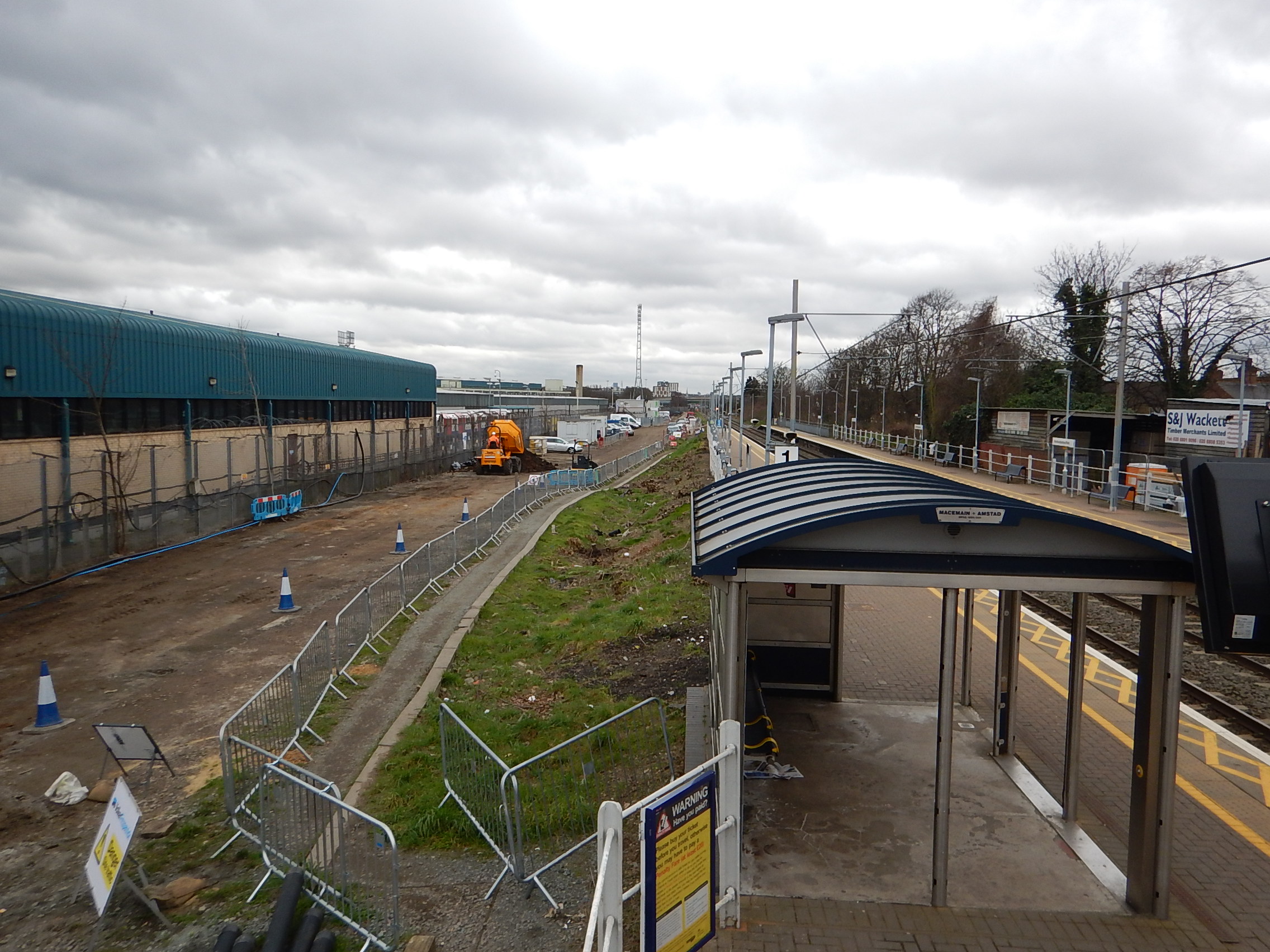
This picture was taken from the footbridge in the station.
Could the current platform 1 at the station be converted into an island platform between the current West Anglia Up Line and a STAR track between the West Anglia Main Line and the Northumberland Park Depot for the Victoria Line?
I suspect the answer is in the affirmative.
There might even be space for more lines through the area, when the West Anglia Main Line is four-tracked.
STAR At Lea Bridge Station
Lea Bridge station is a recently-opened station on the Temple Mills Branch between Tottenham Hale and Stratford and I doubt there is sufficient space for a separate track for STAR with its own platform through the station.
This picture is from A Look At Lea Bridge Station, which shows the station in detail.

The STAR track would have to go through here and would probably mean substantial rebuilding of a brand-new station.
So all services to Stratford will call at Platform 1 and all services from Stratford will call at Platform 2.
This will mean a junction North of Lea Bridge station, so that services can get themselves to the right lines for Tottenham Hale or in future the Chingford Branch along a rebuilt Hall Farm Curve.
- Southbound STAR, Chingford Branch Line and other services to Stratford will merge before Lea Bridge station to pass through Platform 1.
- Northbound STAR and Chingford Branch Line services will pass through Platform 2 and then cross over the Temple Mills Branch Up Line to the bi-directional STAR track alongside the main lines to Tottenham Hale.
- Northbound Chingford Branch Line services will take the Hall Farm Curve to get to St. James station and the Chingford Branch Line.
- Other Northbound services from Stratford will stay on the Temple Mills Branch Down Line and go straight to Platform 2 at Tottenham Hale.
Traffic crossing from the Temple Mills Branch Down Line over the Up Line to get to the STAR track would include.
- STAR services of four tph.
- Services from Stratford to Walthamstow and Chingford, which could be between two and four tph.
Due to restrictions on capacity caused by the level crossing at Highams Park station on the Chingford Branch Line, I suspect this could initially be just 2 tph, until a solution for the restriction is found.
STAR at Stratford
One possible problem is the capacity at Stratford station, which only has two possible terminal platforms 11 and 12.
Platform 11 is used for the current two tph that go up and down the West Anglia Main Line, but Platform 12 is currently just giving out messages saying “I’m Free!”
Platforms like these can generally handle four tph, as they do at stations like Highbury and Islington or Dalston Junction. But is a capacity of eight tph enough if some Stansted and Cambridge services are added to the mix.
But there may be other possibilities!
In High Meads Loop, I look at how an existing loop around Eastfield and Stratford International station could be used to turn trains.
This map from carto.metro.free.fr , shows the High Meads Loop.
Use of the High Meads Loop would enable the following.
- Probably upwards of 10-12 tph to be turned back at Stratford.
- Trains would call in either Platform 11 or 12 at Stratford station.
- Trains could call at Stratford International station.
Currently Platforms 11 and 12 can only handle eight-car trains, but they could be lengthened for the the new 12-car Stadler Flirts, that will work the London to Cambridge and Stansted services in a couple of years.
Cambridge, Stansted and Lea Valley services would have simple changes to the following services at Stratford.
- Central Line
- Crossrail for City and East London, Essex, Heathrow, Paddington and the West End.
- DLR for Docklands and South East London.
- European services, if they were to call at Stratford International. As they should!
- Greater Anglia for Chelmsford, Colchester, Ipswich, Norwich and all the branches.
- Jubilee Line for Canary Wharf, London Bridge, Waterloo and Westminster.
- North London Line for Clapham Junction, Old Oak Common and West and South West London.
- Southeastern Highspeed to Ebbsfleet, Kent and East Sussex.
I suspect that London Overground and/or Greater Anglia have a cunning plan to collect all of these services and platforms together in an optimal manner for the benefit of all stakeholders.
But it’s really just the East End of London asserting its true place in London’s hierarchy.
The Stratford/High Meads Advantage
Using the High Meads Loop at Stratford to turn trains from the West Anglia Main Line could be a big advantage in the next few years.
All of these construction projects need to be carried out.
- Rebuilding of Tottenham Hale station.
- Updating of Coppermill Junction.
- Four-tracking of the West Anglia Main Line.
- Lengthening of platforms at Liverpool Street station.
- Connection of Crossrail 2 to the West Anglia Main Line.
If a connection between Tottenham Hale and Stratford via Lea Bridge can be maintained at all times during this massive amount of construction, which given the space available is very possible, then Stratford could be an alternative destination for diverted West Anglia Main Line and local services, that are unable to connect to Liverpool Street.
STAR And Electrification
This picture shows where the single STAR track will pass under the Ferry Lane Bridge at Tottenham Hale station
When I first looked at this bridge and saw the height of the overhead electrification on the existing West Anglia Main Line under the far span, I immediately questioned if they could fit the electrification under either of the blue steel bridges, where STAR might pass, in a manner that would meet all the Health and Safety regulations.
The only way to electrify and be certain of the safety would be to replace the bridge with a modern structure. But this would take a couple of years and can it be built without closing an important route to and from London for a couple of months?
So I come to the conclusion that the STAR line will not be electrified and the line will use electric trains with onboard energy storage or IPEMUs.
- I have been told by the manufacturer that all Aventra trains are wired for onboard energy storage.
- Both possible operators of the star service; Greater Anglia and London Overground are obtaining sizeable fleets of suitable Aventra trains,
- Greater Anglia’s Aventras are five-car trains.
- London Overground’s Class 710 trains are four-car trains.
- Delivery of London Overground’s trains is scheduled to start in 2018, so they are a just-in-time delivery.
- The route between Lea Bridge and Stratford is fully electrified, so trains could charge the batteries South of Lea Bridge station.
- Diesel trains would be an alternative, but probably not appropriate in the Lea Valley.
For added safety, the well-proven method of slab track will be used under the bridge to ensure the train stays stable.
The outcome will be the ecologically sustainable development of Meridian Water gets appropriate electric trains to shuttle residents to Crossrail and the Eastfield Shopping Centre at Stratford.
Crossrail 2
I shall make a few comments about what the article says about Crossrail 2.
Crossrail 2 Would Be Overlaid On The Existing Network
How else is there to do it without building a whole new line on a different route up the Lea Valley?
Incidentally, plans used to exist for extending the Chingford Branch Line to Stansted Airport through Epping Forest. I doubt that will ever happen, especially as Queen Victoria is supposed to have said no!
Coppermill Junction Could Be Converted To A Grade-Separated Rather Than A Flat Junction
These pictures were taken from a train, that was going from Lea Bridge to Tottenham Hale, through the area of Coppermill Junction.
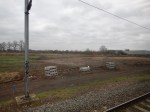

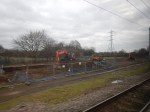
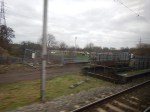
At present the following happens at Coppermill Junction.
- Trains between Liverpool Street and Chingford pass straight over the junction.
- Trains from Liverpool Street to Tottenham Hale curve left from the Chingford Branch Line to join the West Anglia Main Line.
- Trains from Tottenham Hale to Liverpool Street cross in a flat junction over the West Anglia Down Line and the Chingford Branch Down Line to get on track for Liverpool Street.
When the West Anglia Main Line has been four-tracked and the STAR track has been inserted alongside the current tracks, the fast tracks will probably be the two most Easterly tracks through Tottenham Hale.
This will mean that the West Anglia Up Fast will have to cross the following lines to get on the Chingford Up Line.
- The bi-directional STAR line.
- The double-track of the Temple Mills Branch to Stratford.
- The Chingford Down Line.
In the opposite direction, the following tracks will have to be crossed.
- The double-track of the Temple Mills Branch to Stratford.
- The bi-directional STAR line.
These movements will need a very complicated Coppermill Junction.
As four-tracking is all about faster services between Liverpool Street and Cambridge and Stansted, it would be detrimental to not have an efficient Coppermill Junction, with some grade separation.
I think we probably need flyovers or dive-unders on the following routes.
- West Anglia Up Fast to Chingford Branch Up.
- Chingford Branch Down to West Anglia Down Fast.
Routes would probably need to be provided so that the trains could go between the West Anglia Slow Lines and the Chingford Branch towards London.
In addition, I’ve heard rumours that trains will be able to go both ways between Tottenham Hale and Walthamstow/Chingford.
There is certainly lots of space to build a complicated junction, as the pictures show.
Crossrail 2 Would Emerge From The Tunnel South of Tottenham Hale
I think that has been known for some time and the possible site is full of London’s demolition rubble.
However, the junction with the West Anglia Slow Lines would probably need to be grade separated and integrated with the spaghetti that Coppermill Junction will probably have become.
The Project Would Quadruple The West Anglia Main Line From The Tunnel Portal To Broxbourne
If fast services to Cambridge and Stansted are to be retained, surely this must be done.
Just imagine 10-15 Crossrail 2 trains and ten fast trains, every hour sharing a pair of lines up the Lea Valley.
In my view the fast lines would be the two most Easterly lines and they probably wouldn’t stop very often, if at all between Liverpool Street or Stratford and Broxbourne.
,
STAR Would Be Built To Facilitate Four-Tracking
Everything I’ve seen leads me to think, that the single STAR track will be next to the West Anglia and Temple Mills Branch Up Line, with the two new lines outside to the East.
I also feel that these new lines will be the fast ones and possibly will have few if any platforms between Tottenham Hale and Broxbourne.
STAR could be an independent line, well out of the way operationally of other lines.
- STAR will be bi-directional North of Lea Bridge station.
- STAR could share island platforms with the West Anglia Up Line at Angel Road, Northumberland Park and Tottenham Hale stations.
- There could be no points on the route once it separates North of Lea Bridge station.
- The fast lines between Liverpool Street and Tottenham Hale could cross the Temple Mills Branch and the STAR line at Coppermill Junction using a flyover.
The last point probably explains the grade-separated junction, I mentioned earlier.
I said earlier that it could be difficult to put extra tracks through Tottenham Hale station. These pictures show the area, where the STAR line and the two new lines will go and also what lies on the other side in the new housing development of Hale Village.
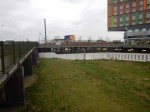
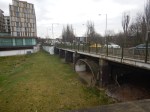
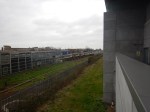
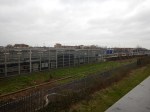
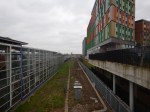
There is more space than I thought earlier. As some of the concrete decking will probably be demolished or modified to build the new entrance and pedestrian bridge for the station, I suspect that the space between the current station and Hale Village can be made wide enough for at least the new lines needed to four-track the West Anglia Main Line.
But I suspect that a way will be found to get the STAR line and the two other lines in what space can be created.
This would mean.
- The STAR service can continue, as long as it’s needed.
- There certainly wouldn’t be space for platforms on the two other lines between the current station and Hale Village.
- So as the slow lines will need platforms, the two new lines will be the fast lines.
North from Tottenham Hale, there is slightly more space, as my picture at Northumberland Park station showed.
As the STAR line is currently planned to terminate at Angel Road station, North from there, the requirement is only the easier one of two tracks and not three.
But if the requirement for three tracks should prove too difficult, as the four-tracking will see Crossrail 2 implemented, I’m sure that the STAR line can be sacrificed to make space. But that would create difficulty in maintaining an adequate service between Angel Road and Stratford whilst the four-tracjing is being carried out.
In some ways STAR has the feel of one of those temporary diversions you get in road works to keep the traffic moving.
- Tottenham Hale station is going to be rebuilt.
- Transport is needed urgently for Meridian Water.
- STAR connects Angel Road to Stratford with all its connections and Crossrail from 2018.
- When Crossrail 2 is opened, Angel Road, Northumberland Park and Tottenham Hale stations will have a frequent high capacity service.
- Greater Anglia might move some Cambridge and Stansted services from Liverpool Street to Stratford.
I wouldn’t be sure that STAR would still exist after Crossrail 2 opens.
- There will be well upwards of ten tph Crossrail 2 trains in both directions calling at Angel Road station.
- STAR connects Meridian Water with Stratford.
- STAR gives a four tph connection between Crossrail 2 at Tottenham Hale and Crossrail at Stratford.
Passenger numbers and patterns will decide.
A Turnback Platform Is Being Considered At Tottenham Hale
Tottenham Hale station is being rebuilt and I suspect that if a turnback platform is being considered the station will have provision for the extra platform to be built.
This picture shows the Southern end of Platform 2 at the station with the Ferry Lane Bridge behind.
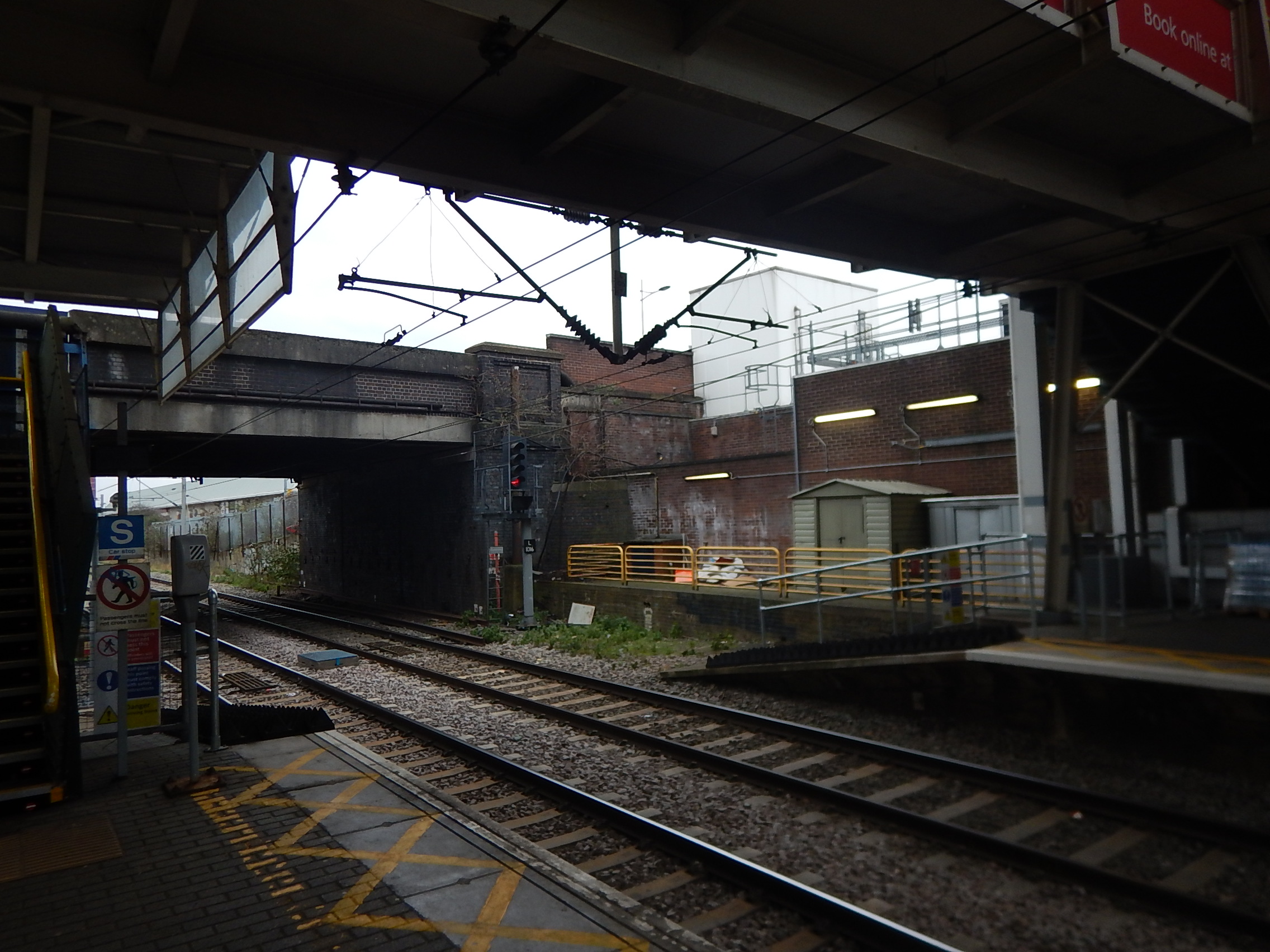
It certainly couldn’t be described as good engineering.
Connecting the two current platforms is a 1960s bridge, which has steps at both end and a single escalator to bring passengers arriving from the North onto the bridge to walk to the Victoria Line.
Plans for the station envisage a lot of work being done before the end of next year. Future in the Wikipedia entry for the station includes these plans.
- creating a new landmark entrance to the Station;
- increasing the capacity of the Station concourse, by doubling the size of the current ticket hall;
- improving interchange by relocating the Greater Anglia and London Underground gatelines;
- providing new access to platforms via the new Access for All (AfA) bridge being delivered separately by Network Rail;
- removing the existing subway which links the south side of Ferry Lane with the Station;
- extending the existing bridge to form a new Station entrance from Hale Village, providing improved access from the east to Tottenham Hale transport interchange;
- re-routing the London Underground escape route and relocating the vent shaft;
- providing a new, upgraded Station control facility; and
- retail units.
Nothing is said about a turnback platform.
But I think if the Ferry Lane Bridge was to be rebuilt and the new station was modified appropriately, the turnback platform could be positioned behind and alongside the current platform 2.
- It would share step-free access with that provided for platform 2.
- There would be cross-platform for passengers arriving in the turnback platform, with services going further down the line.
- The current waiting room would be demolished.
- There would be space for the platform.
Current works at the station are moving the taxi rank, which would help the provision of a turnback platform and other features.
A Turnback Platform Is Being Considered At Enfield Lock
When I looked at Enfield Lock station, I showed this Google Map of Enfield Lock station.
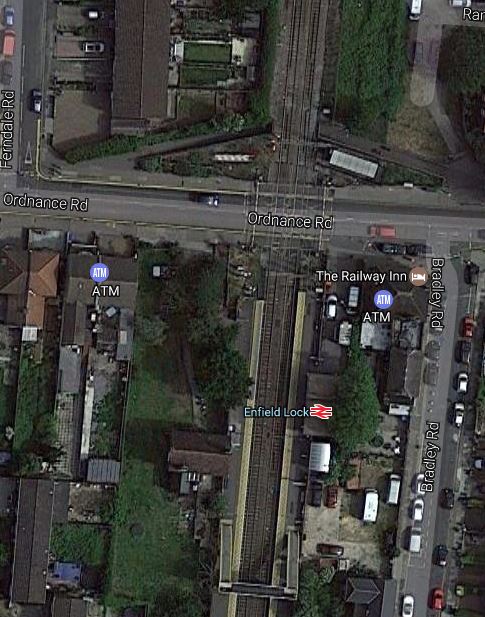
Given that there will be two extra lines through the area, will there be any space for a turnback platform?
In Level Crossing Issues, I said this.
The Southernmost three of these crossings; Enfield Lock, Brimsdown and Northumberland Park, are close to the A1055 which is variously called Meridian Way or Mollison Avenue, which was built to serve the various industrial and residential sites between Tottenham Hale and Waltham Cross.
This road should obviously be improved, but look at this Google Map of the Northern End of the road.
Note the West Anglia Main Line crossing the map, in a North-South direction. Waltham Cross station is on the other side of the M25.
Surely this could be a site for a new Park-and-Ride station for Crossrail 2!
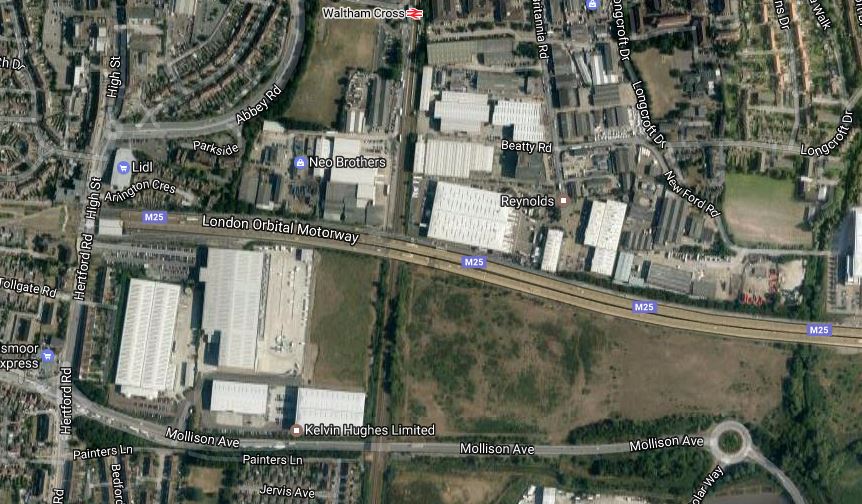
Could this be where the turnback platform at Enfield Lock will be located in a new station?
Turnback Platforms And Stabling Sidings Are Considered At Broxbourne
Broxborne station has everything needed to be turned into a superb Northern terminus for Crossrail 2.
- The station has four platforms; two fast and two slow, with cross-platform change.
- The station is step-free.
- There is space to add extra through and turnback platforms.
- There is space for stabling sidings.
- There is space for masses amounts of parking.
- The station has a large water feature including the River Lea and the New River.
The station is even Grade II Listed.
I said more in this post called Broxbourne Station. The final paragraph is.
It would not need a massive amount of money to be spent at Broxbourne to make the station a superb Northern terminus for Crossrail 2. It makes Shenfield and Abbey Wood look decidedly second-class now.
It is not often that the terminus of a new rail line is so easy to develop.
Other Questions And Issues
As I have written this post, several questions and issues have suggested themselves.
- What will be done about the noise of 100 mph plus trains every few minutes on some parts of the route, like through Enfield Lock and Waltham Cross?
- Could the two new fast lines be placed in a cut-and-cover tunnel through Tottenham Hale?
- Do any plans exist for the replacement of the Ferry Lane Bridge at Tottenham Hale?
- Could the High Meads Loop be used to turn trains at Stratford?
- Will a station be built on the High Meads Loop to serve Stratford International station?
Like Coppermill Junction, it will all get very complicated.
Conclusion
STAR, Crossrail 2 and four-tracking the West Anglia Main Line will probably bring a lot of benefits, but it is not a simple project.
How Will Crossrail Affect The Docklands Light Railway?
When Crossrail opens, there will be a simple step-free walking link between Canary Wharf station and and Poplar DLR station.
As Poplar is the station on the DLR, where the North-South and the East-West routes cross, this is one of the better connectivity features of Crossrail.
Poplar serves a junction in four directions:
- Eastbound towards Beckton and Woolwich Arsenal.
- Northbound towards Stratford and Stratford International.
- Southbound towards the Isle of Dogs, Greenwich and Lewisham.
- Westbound towards Bank and Tower Gateway.
At present to get to Greenwich and Lewisham, you need to change at Canary Wharf DLR station, but as there is a reasonable walking route between Canary Wharf station and Canary Wharf DLR station, passengers for Lewisham could use that route.
As Crossrail will also have a reasonable link to the DLR at both Stratford and Woolwich, I wonder if we’ll see some reorganisation of services on the North-South DLR route between Lewishan and Stratford International.
Will some services go all the way between Lewisham and Stratford International?
Obviously, this will be determined by the routes travellers take after Crossrail opens.
There will also be affects due to the Law of Unexpected Consequences.
I am fairly sure, that Crossrail trains on the two Eastern branches will interface well at Whitechapel station, so passengers going between a station on the Abbey Wood branch to one on the Shenfield branch may prefer to go via Whitechapel, as it will be a simple cross-platform interchange.
How will this affect passenger numbers on the Jubilee Line and the DLR?
I suspect that passengers will use the route that is best for them and this can only mean spare capacity on the two historic routes.
As Crossrail will also be a bypass for the Central Line with connections between the two lines at Stratford, Liverpool Street, Tottenham Court Road, Bond Street and Ealing Broadway, the Greater East London area will be a big beneficiary from Crossrail.
We’ll have to wait and see how passenger numbers work out, but I think that the North-South route of the DLR could be blessed with spare capacity because of Crossrail, so there may be scope to extend the route past Stratford International and Lewisham.
Two possible extensions from Lewisham are detailed on Wikipedia.
But there is nothing past Stratford International. The DLR Horizon 2020 Study, does propose an extension up the Lea Valley to Tottenham Hale. This is the report’s summary of this route.
A DLR extension to Tottenham Hale via the Lea Valley was tested extending all services (15tph) onwards from Stratford International. The route would run alongside the Lea Valley rail route. The DLR extension is seen as serving intermediate markets (heavy rail would only stop at Tottenham Hale and Stratford) and would serve the Olympic site(s) and the Olympic legacy with additional stops at Lea Bridge and Walthamstow Marshes. Potential drawbacks are largely environmental, covering concerns over Hackney Marshes and the Lea Valley reservoirs.
I talked about it in a sub-section of The High Meads Loop At Stratford. This is a summary of what I said.
Extension of the DLR to Tottenham Hale was mooted a few years ago and a document called DLR Horizon 2020 talked about extending the system from Stratford International up alongside the Lea Valley Lines to Tottenham Hale station
It may be a worthy idea, but does it really make economic sense, when according to what you believe a lot of things may be happening in the area.
- A new Lea Bridge station has been created.
- A new Hall Farm Curve will happen.
- A rebuilt Hackney Wick station is being constructed.
- Crossrail 2 is being promoted and will serve Tottenham Hale and to the North.
- Transport for London have taken over the Lea Valley Lines.
- There will be a a major upgrade in the Tottenham Hale area, which is described in this document on the Haringey Council web site.
- Four-tracking will happen through Tottenham Hale station.
When the heavy rail expansion is sorted and the area between Tottenham and Walthamstow is developed as housing and a very large wetland and leisure area, the case for a Lea Valley Light Railway may be stronger and in need of reassessment.
What happens to the North-South route will be driven by the consequences of Crossrail and the massive need for housing in London and the transport links to serve it.
The Mayor’s Plan For A Gallions Reach Extension
The latest plan is to extend the DLR from Gallions Reach station across the Thames to Thamesmead and Abbey Wood.
I wrote about this plan in The Mayor’s Plans For East London River Crossings.
I shall repeat what I said, as I think this is a plan with legs.
A BBC article says this about this proposal.
A DLR crossing at Gallions Reach, helping support the development of around 17,000 new homes across Newham and the Royal Borough of Greenwich
It is different to the original proposal of a Docklands Light Railway extension to Dagenham Dock, which stayed on the North bank of the Thames.
This map shows the area of London from Gallions Reach to Abbey Wood.
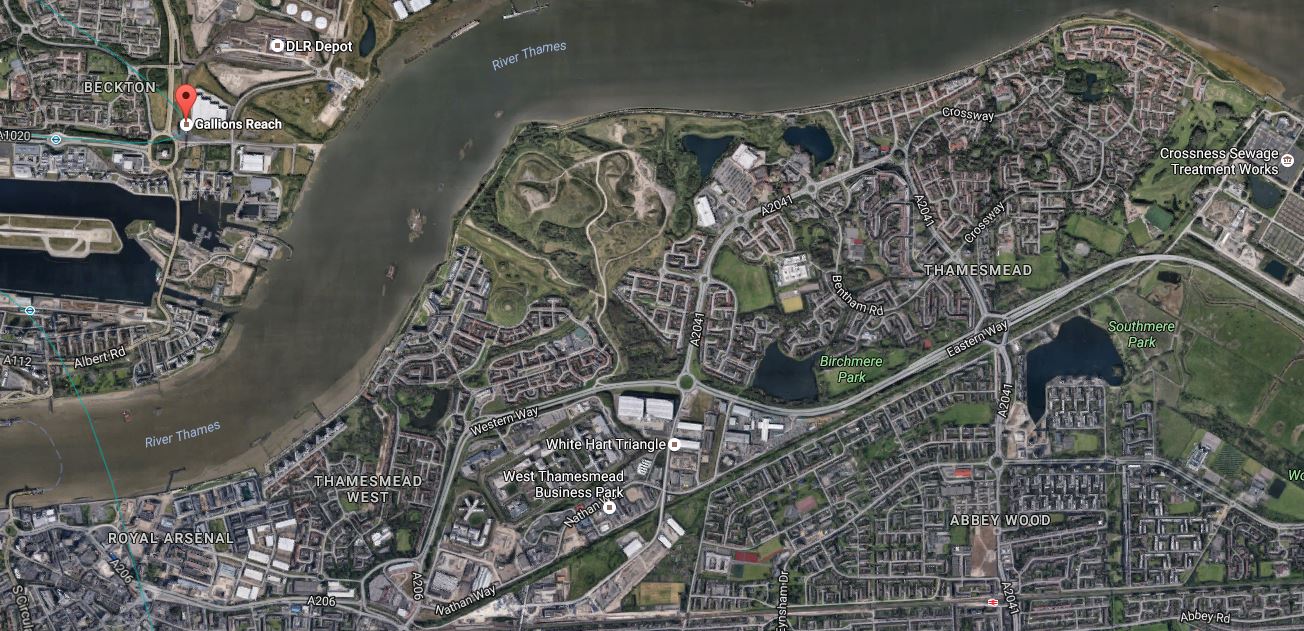
Gallions Reach To Abbey Wood
Note.
- Gallions Reach DLR station is marked with the red arrow.
- Just to the North of Gallions Reach station is the main DLR depot, which would probably be an excellent site to start a tunnel.
- The tunnel would probably emerge on the South bank of the Thames to the West of Thamesmead.
- It could then weave its way along the side of the main road.
- The North Kent Line with Abbey Wood and Belvedere stations runs along the bottom of the map.
- Crossrail could be extended to Gravesend.
- Crossrail should also be extended Ebbsfleet International for European rail services.
If the DLR extension went from Gallions Reach DLR station to Abbey Wood station it will be a loop on Crossrail serving a lot of areas ripe for quality housing and commercial development.
It certainly looks a feasible area to think about taking the DLR.
I also think if more destinations are created in the East, then this will need other developments.
- More capacity in the new trains, that are being ordered.
- Extra destinations in the West
- Expansion of the North-South route t balance the network.
The North and South extensions were covered earlier.
Extension To The West
I have written about this in Extending The Docklands Light Railway West From Bank Station.
Conclusion
The Docklands Light Railway must be one of the best stop-gap transport projects ever created.
Crossrail’s effects on the DLR will be more about providing opportunities, than creating problems.
We also shouldn’t underestimate the role of the DLR in bringing passengers to Crossrail.
The High Meads Loop At Stratford
This piece started life as an investigation into a rail line connecting the North London and Lea Valley Lines at Stratford, but it ended up as more of an index to what is happening to trains around Stratford and up the Lea Valley.
If you travel on the North London Line from Hackney Wick station to Stratford station, you’ll see a rail line going off to the North side of the line under the Olympic Village.
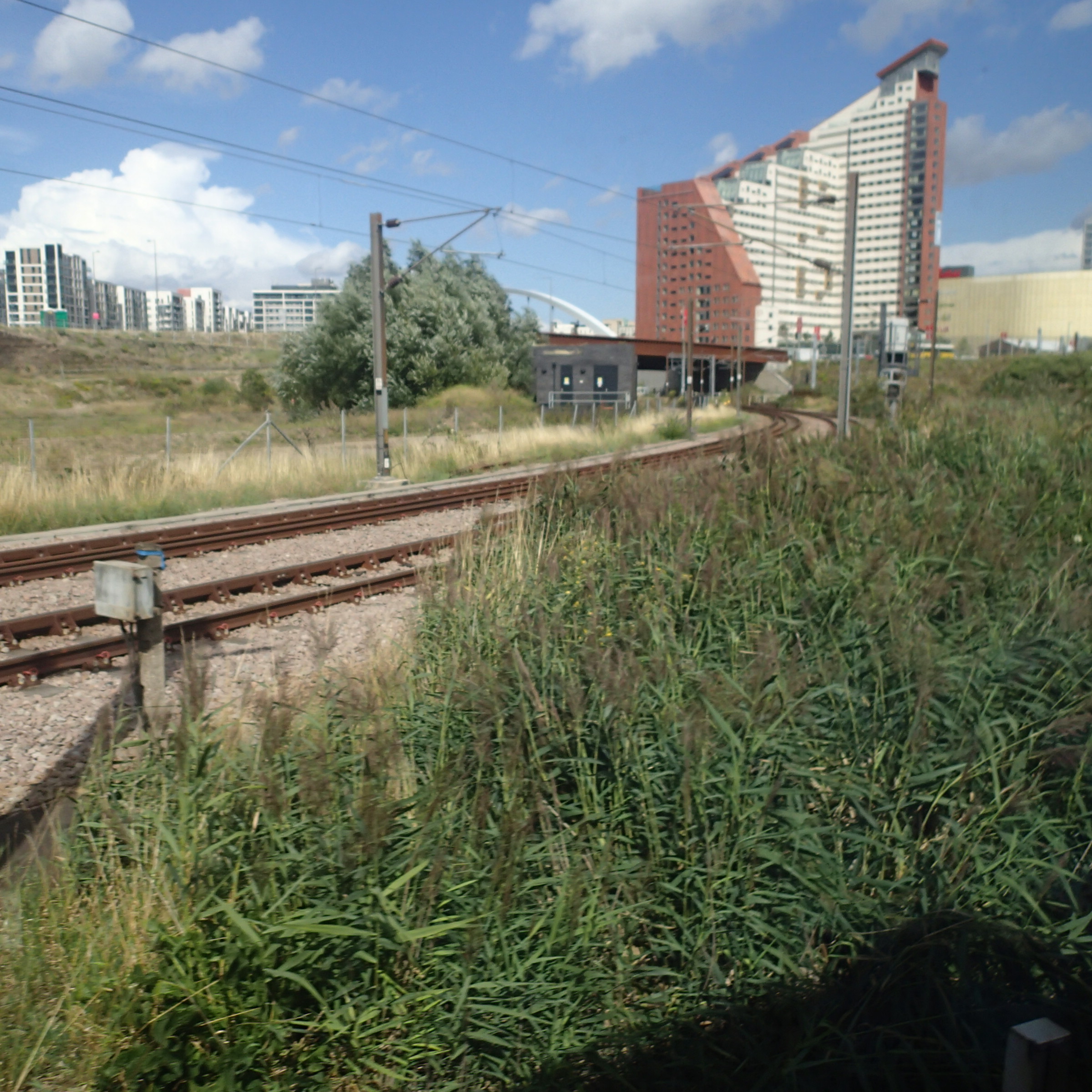
High Meads Loop At Stratford Joins North London Line
If you travel up the Lea Valley Line, you’ll see the other end of the line.
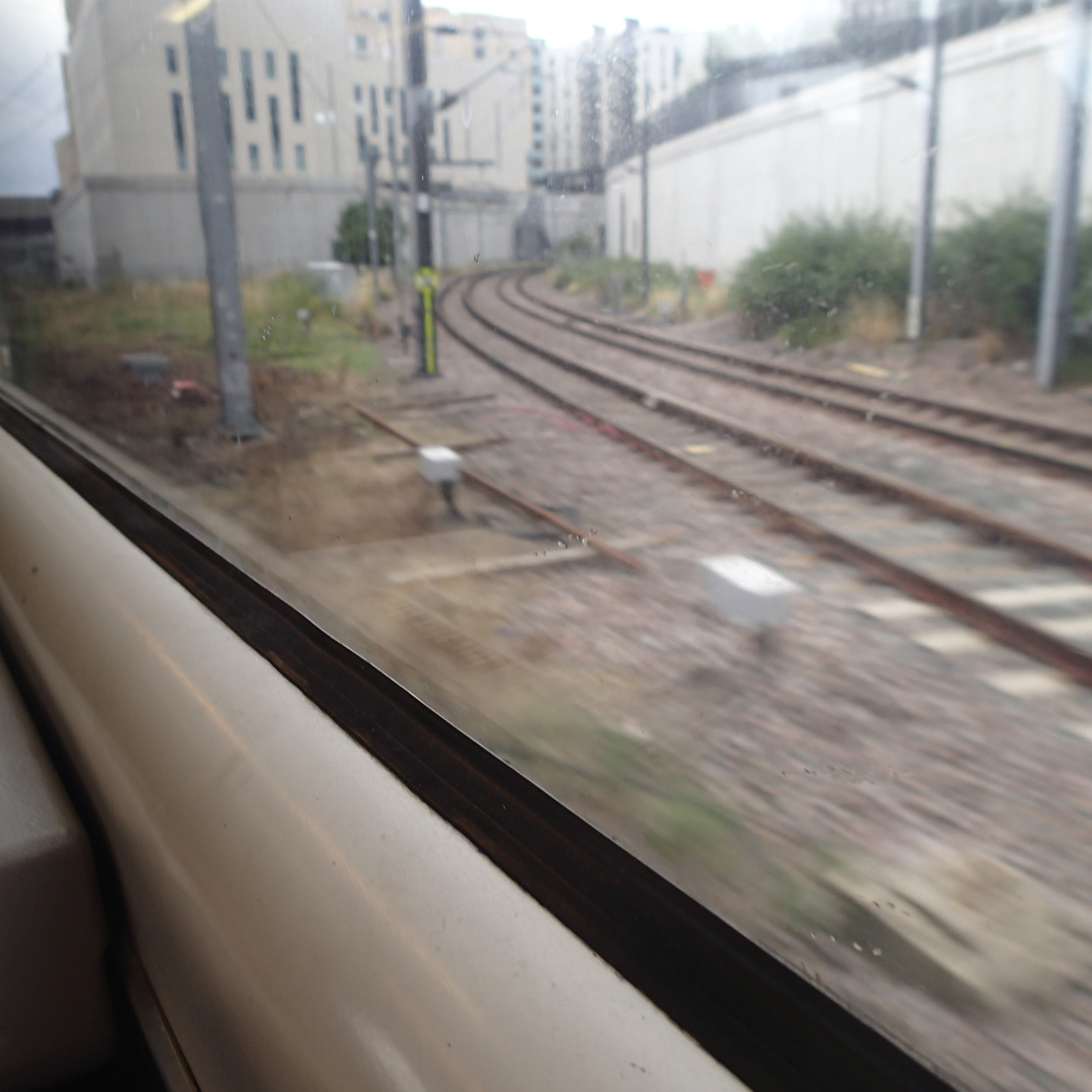
High Meads Loop At Stratford Joins Lea Valley Line
This is the High Meads Loop and it is generally used to move freight trains. You can see it on this Google Earth image, as it curls round the western side of Stratford International station, starting from the triangular junction to the east of Hackney Wick station and the River Lea and eventually joining the Lea Valley Line between Stratford and the under-construction Lea Bridge station.
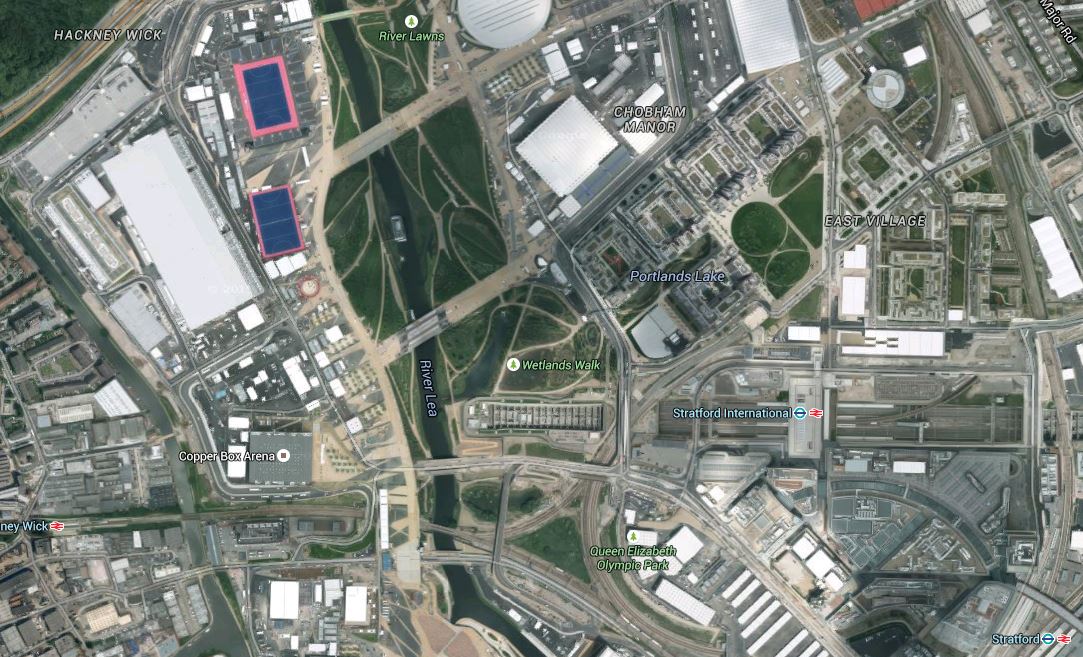
High Meads Loop
I walked around the area today starting from Stratford International DLR station and much of it is hidden under concrete in East Village.
What has always surprised me, is that this line doesn’t appear to have provision for a station, especially as it could connect to so many important places in the area.
But then it does seem to me that the design of the rail system in the area of the Olympic Park and Village didn’t put getting an efficient railway first. These questions must be answered.
1. Why was a fully-functional International station, built at Stratford International and has then never been used to run services to the Continent through the Channel Tunnel? This is answered partially in this section in Wikipedia about International services at the station. If Kent gets two stations at Ebbsfleet and Ashford International, then surely East London and Essex deserves one too!
2. Why too, is the link between the two Stratford stations, so much of an afterthought? Today, when I came back from my walk, there was the inevitable lost soul, who’d taken a train to Stratford International and needed to get a train to Romford. And his Narional Rail ticket wasn’t valid for the one-stop hop on the Docklands Light Railway. But this is East London and the Train Captain told him to ride Don’t get me wrong, I like the DLR, but surely for the Olympics we could have put a more spectacular or at least a better link between the two stations?
3. In some ways too, I often think that they used the high-speed service from St. Pancras to Stratford, just to give it something to do. For a start foreign day-trippers to the Olympics should have come straight into Stratford International on Eurostar. Why wasn’t this arranged?
4. I am pretty local to the Olympic Park and can get a train from Dalston Kingsland to Stratford. I went to the Olympic Park that way a couple of times, but to get home, the powers-that-be either sent you to Stratford International or West Ham. In one instance I walked to Clapton and got a bus home as everything was congested. The arrangements might have worked for getting to Central London, but they weren’t good for locals, who like me wanted to walk out of the Olympic Park and then probably get a bus home. One solution would have been to put more capacity on the North London Line, by extending the Class 378 trains to five cars, as is now being done. Why wasn’t this done on the North London Line in time for the Olympics? Especially, as the line has always been overcrowded compared to the East London Line.
5. Soon after the Olympics, I met a big cheese in the Docklands Light Railway on a train. He felt and I probably will agree with him, that the DLR overperformed in the Olympics and dear old Cinderella didn’t miss a beat. I suspect though that to many she has more than a touch of Minnie Mouse, but to East Londoners and knowledgeable visitors, she is the way to travel, where you get a grandstand view much of the time. So why wasn’t more use made of the DLR for the Olympics by designing it into the heart of the Olympic Park?
6. We also had the farce of if you went to the Olympics from St. Pancras, you had to go through the Eastfield shopping centre to get into the Olympic Park. Why? Was the Olympics about sport or shopping?
7. Look at this Google Earth image of the Eastfield shopping centre.
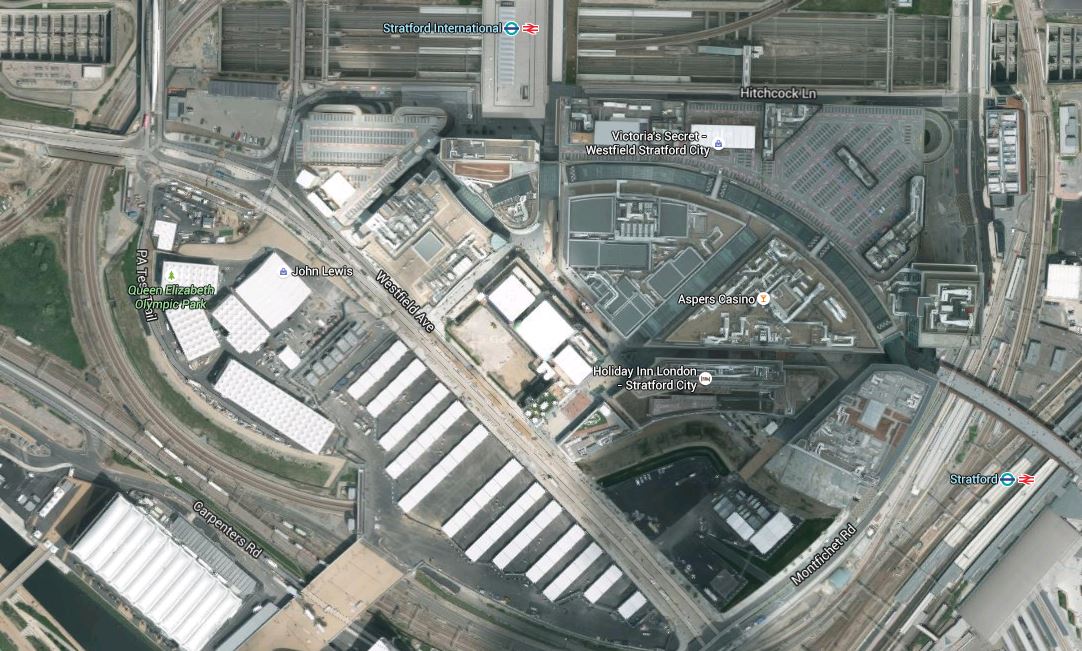
Eastfield
Notice how the DLR goes under the centre and emerges on the west side before curving round to get to the station at Stratford International. It has always puzzled me that no provision has been made for an extra station on this loop. It strikes me that the developers feel most shoppers will bring their cars or not buy anything heavy. I would use the centre more if it was easier to get home from say John Lewis with perhaps something weighing ten or twenty kilos. Why was this extension of the DLR designed to be never more than a timid link?
If I look at some of the rail designs of the last few years, I get the impression, that they are less timid and not designed to be easiest to construct. The London Overground in particular has been innovative in some of its infrastructure to design affordable and efficient railways. Look at the Clapham Kiss as just one example.
In any developments to improve Stratford, there is also a thundering herd of elephants in the room, which will probably have more effect on what happens than any politician.
And that is Crossrail!
What is planned now is only Phase 1 of Crossrail and future developments will give Crossrail a bigger share of London’s passengers and even more influence.
1. Crossrail has been designed to take slightly longer trains and with its massively long platforms, the capacity of the system is quite a bit bigger than what we’ll see when the line opens.
2. Crossrail can also take more trains through the core, so we’ll definitely see extra branches on the line. Ebbsfleet on HS1 is safeguarded and Tring on the West Coast Main Line is being seriously studied.
3. Crossrail lacks an easy and hopefully cross-platform interchange to high speed services to Europe and in the future to the North. An easy interchange to HS1 at St. Pancras and Stratford is impossible, but one at Ebbsfleet could be incorporated with the extension of Crossrail to the station.
So what do I think should be done to sort out the sins of the pre-Olympic rail system development in the Stratford area?
1. A Better Connection Between The Two Stratford Stations And To The Eastfield Shopping Centre.
Look at this Google Earth image of Stratford station.
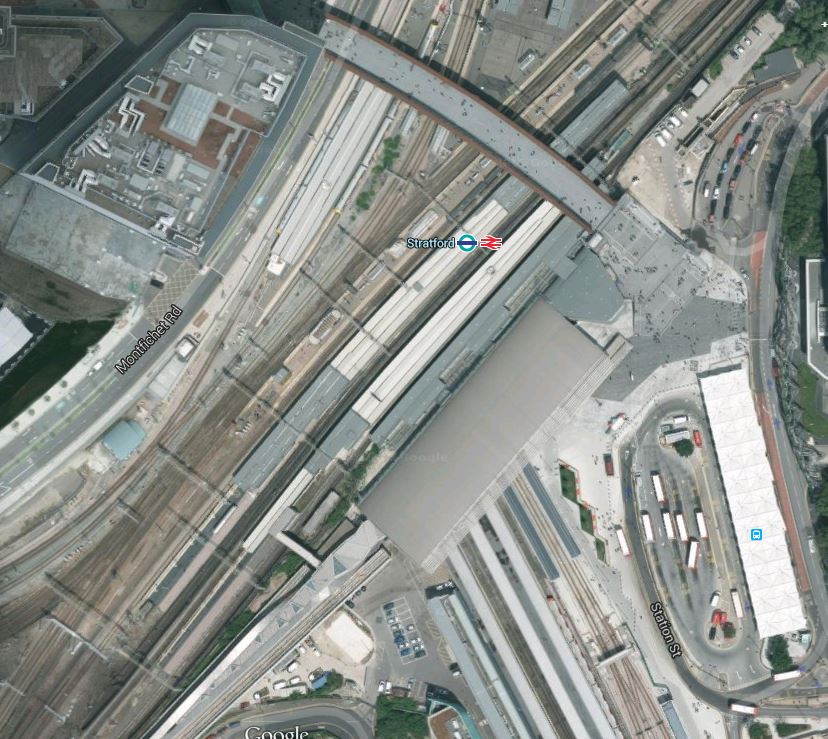
Stratford Layout
The DLR branch between Stratford International and the core system passes underneath the rail lines, including Crossrail and the Overground , and the Central Line, at right angles.
The passenger connection between the DLR and the lines passing through above is not easy, although it is step-free. If you take the wrong tunnel from the rail lines, you end up on the wrong DLR platform.
As the two subways are one each side of the DLR lines, couldn’t something better be done to make this interchange easier? For a start how about a sign saying take these stairs from the through platform to get your DLR service to Stratford International?
I also think that there should have been a station on the DLR line underneath Eastfield. It would be interesting to know what the shopping centre thinks.
2. Will We Ever See International Services From The Station That Has The Word In Its Name?
If Crossrail extends to Ebbsfleet, this will take a big chunk out of High Speed passengers to Stratford and St. Pancras. If say you lived in East Kent and worked in the City or the West End of London, why would you not take a convenient service, High Speed or otherwise, to Ebbsfleet and then change to Crossrail for where you actually needed to go?
Stratford International also lacks an easy link to all of the other services at Stratford and especially to Crossrail, even if the DLR link is improved. But any cross-platform link is impossible!
Passengers will get increasingly fed up with second-rate stations, when they see some of the modern ones that work, like Reading and Kings Cross. St. Pancras may look spectacular, but it is A Fur Coat And No Knickers Station
So Stratford International, which I find an unwelcoming place, could become a massive white elephant, that had its brief moment of fame at the Olympics.
3. The Moans In North East London
Read the various Internet forums and web pages and some of the biggest complaints are about the poor transport links to and from places in North East London and the Lea Valley, like Walthamstow, Leyton and Tottenham.
Things are improving,
The transfer of the Lea Valley Lines to an operator who cares about passengers in London and the uprating of the Victoria Line later this year, can’t be anything but positive.
But more could be done!
4. A Shoreditch High Street Station On The Central Line?
After Crossrail has bedded in, will we finally see a connection between the Central Line and the East London Line at Shoreditch High Street? I think we will as because Crossrail is an effective by-pass for the Central Line from Stratford to Liverpool Street, the Central Line could probably be shut for several months under Shoreditch High Street, whilst the link is created without causing too much inconvenience to passengers, except for those using Bethnal Green. But even those would have the new Whitechapel Crossrail station a couple of bus stops away
5. Extending the DLR to Tottenham Hale
This was mooted a few years ago and a document called DLR Horizon 2020 talked about extending the system from Stratford International up alongside the Lea Valley Lines to Tottenham Hale station. This article on London Reconnections describes the proposal like this.
Extend the DLR from Stratford International to Tottenham Hale via the Lea Valley. The route would run alongside the current Lea Valley rail lines where possible and the line would serve the Olympic site and feature additional stops at Lea Bridge and Walthamstow Marshes.
It may be a worthy idea, but does it really make economic sense, when according to what you believe a lot of things may be happening in the area.
- A new Lea Bridge station and a new Hall Farm Curve are being created.
- A rebuilt Hackney Wick station is being planned.
- Crossrail 2 is being promoted and could serve the area.
- Transport for London will be taking their first bite out of the Lea Valley Lines in the very near future.
- There could be a a major upgrade in the Tottenham Hale area, which is described in this document on the Haringey Council web site.
- According to this Future section in Wikipedia for the Tottenham Hale station, funding is being sought to add extra tracks to the Lea Valley Line so that four trains per hour can be run on the line.
When the heavy rail expansion is sorted and the area between Tottenham and Walthamstow is developed as housing and a very large wetland and leisure area, the case for a Lea Valley Light Railway may be stronger.
6. Using The High Meads Loop For Passengers
Trains can use the High Meads Loop to pass across the northern side of Stratford Intergenerational station. This Google Earth image of the station, shows the lines passing round the North-Western corner.
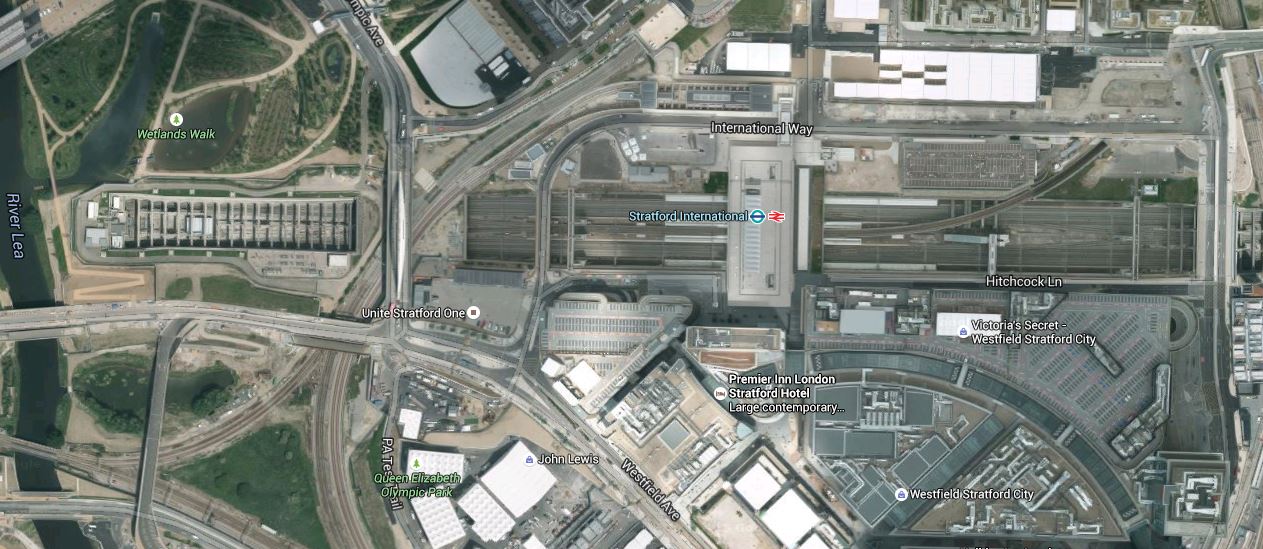
Stratford International Station
Note also the Docklands Light Railway station on the northern side of the deep station box, virtually above the DLR logo.
I think with a will a station could be built on the High Meads Loop just to the north of the DLR station, which would allow trains to travel between the North London Line and the Lea Valley Line calling at a station close to the International station and possibly a station in the East Village.
But as with extending the DLR from Stratford International would it all be worthwhile?
Unless of course some developer wants to do a mega-development and pays for the trains and the infrastructure.
7. Conclusion
I think we should leave well enough alone and accept that Stratford International station is probably a shining white elephant.
In the meantime, we should make it easier to transfer between one station too many at Stratford.
The High Meads Loop is probably best left to sort out the freight that has to travel through the area until someone does the right thing and builds a proper freight line that avoids the North London and the Gospel Oak to Barking Lines.
 The Anonymous Widower