Knock HS2 And It Might Go Away
I’m not a great supporter of HS2, but this story on the BBC, being spun as how it will damage other areas of the UK, is pure scaremongering and very bad journalism.
The areas, they say could be worst affected are Aberdeenshire, Norfolk, Dundee and Cardiff. On the television this morning they’re adding in Bristol and Cambridge.
Putting in Norfolk is a strange one, as obviously HS2 spending will also hurt Devon and Cornwall. These areas though will hopefully get improvement in the next few years, but this will come from using better train technology on upgraded lines.
West Norfolk for instance will be linked into the Thameslink system and electrifying and straightening the main routes across East Anglia and Ely to Norwich, would improve the area a great deal. A lot of this will happen, whether or not HS2 is built.
Devon and Cornwall is more problematical due to the geography and the scenery, but I suspect that Plymouth and Penzance will be a lot closer to London, when the electrification and new trains being planned for the Great Western Main Line are completed and delivered.
The Aberdeen and Dundee areas north of Edinburgh will always be badly served from the Scottish capital, until you build a new bridge or tunnel over the Forth of Firth. I can’t see anybody leading a campaign to replace the iconic Forth Bridge.
Cardiff and Bristol are interesting ones, as courtesy of Brunel, electrification and new trains, they will get their own HSW before HS2 is even started, at the current rate of progress. Once the Severn Tunnel is sorted, it would seem that services between the English and Welsh capitals could be around two and a half hours or even less. Having just been through the very problematic Simplon Tunnel at high speed,which is almost as old as that under the Severn, I’m certain, that a few world class engineers and tunnellers can sort out the bottleneck on the railway to Wales.
To suggest that Cambridge will be hurt by HS2, is like suggesting that the London Underground, will be hurt by Crossrail. Cambridge has recently seen an improvement of the line to London and in a few years, it will be connected to Thameslink, giving it better access to London and areas south of the Thames.
I suspect, that the overpaid BBC hack, who started this story, wants to kill HS2, as he lives in an area affected by the proposed route.
Or could, the journalist be fed-up with having to go from his home in the South East to his place of work in Manchester, so he might be very anti-train.
The BBC article is in any case unattributed.
And of course, remember it’s a much better story, if it destroys something!
Labour Plays Their Scrap HS2 Card
Ed Balls has said that Labour could scrap HS2, if it wins power in 2015. It’s reported here in the Independent.
Is it just a bribe to all those Tory voters in Middle England, who will pay much higher taxes under a Labour government?
On the other hand, this statement may just have killed the project, as will Parliament now pass the HS2 legislation? I think they won’t, as Parliament is a body, that doesn’t do big thinking well!
Will Crossrail Overload The Docklands Light Railway?
After my visit to the new Canary Wharf Crossrail station on Saturday, I got thinking about the effect of the new line on the Docklands Light Railway.
A walkway will take passengers direct from Crossrail to Poplar station on the DLR. So would commuters from Essex and Kent going to the Bank area of the City, change at Canary Wharf for the DLR?
Only real figures, when Crossrail opens in a few years time, will give the answer.
I do think though that in a few years we’ll be talking about extending the DLR from Bank towards the west. These plans are discussed here in Wikipedia, but nothing has been firmed up yet. I suspect that if anything does get built it will be the link from Bank to Euston and St. Pancras, as this will open up a new route from Canary Wharf to the train lines to the north. But the uncertainty over HS2 doesn’t help in making this decision.
A Response To HS2 Sceptics
Alistair Darling and others are right to question the current proposal for HS2.
I have a lot of experience of the history and implementation of large infrastructure projects, as many were built with the help of project management software that I created.
Many of these projects get built in a form, that is very different to first envisaged and in some cases, as with the London end of HS1, they get built twice due to the mistakes and lack of vision of politicians.
Looking at the rail system in the UK, there are some major problems that must be addressed on routes from London and the South East to the North and Scotland.
Some stations like Leeds and Birmingham have been or are being rebuilt to a modern standard, but Euston and Manchester Piccadilly are in urgent need of serious improvement, as they both suffer from severe 1960s short-termism.
Most freight now arrives in the UK through the South East ports and there are no fully-electrified routes to the Midlands and the North. We’ve even worsened this situation by building the new London Gateway superport in East London, which means heavy freight trains must mix it with the London Overground.
North of Warrington and Darlington on the West Coast and East Coast Main Lines, there is a serious lack of capacity.
There are serious bottlenecks on the main routes like the Welwyn viaduct and various crossings and stations could be improved.
As Alistair Darling indicated in his article, politicians haven’t decided on what to do with Heathrow. Anybody who called themselves a project manager would say that is the first decision you must do, as it effectively defines the southern route of HS2.
I believe that the first thing we should do after deciding about the airport, is rectify the mistakes of the Victorians and their successors, and convert the East and West Coast Main Lines into continuous quadruple-tracked railways from London to Scotland. If this was accompanied by modern in-cab signalling and overhead wiring, it would be possible with the existing trains to run services at 225 kph. This could mean that London to both Edinburgh and Glasgow would be under four hours.
This high-speed ladder, would be matched by two or three electrified cross routes like Liverpool to Hull, Manchester to Sheffield and Peterborough To Nuneaton. These would not only provide more passenger capacity, but the last route would help to alleviate the freight problem, by taking all Felixstowe traffic to and from the Midlands.
Hitachi are building a factory to make new 225 kph trains at Newton Aycliffe for the East Coast Main and Great Western Main Lines. Surely, for reasons of economy of scale, these designs should also be deployed on the East Midland Main Line and the East-West routes. We must finally rid ourselves of British Rail’s different train for each route policy.
Obviously, better stations are needed, with Manchester Piccadilly and Euston at the head of the list. Perhaps these new stations could interface a lot better with the local bus routes, which is a particular failing of Piccadilly and many other important stations.
And finally, if more capacity is proven to be needed between London and Birmingham, why not electrify the Chiltern Route from Marylebone? And of course, run new Hitachi trains on the line!
the one thing we should actually do with HS2 is safeguard the route, for when it is eventually needed.
We need more capacity and faster journeys in the near future and not on some vague whim and date conjured from the air by politicians, who want to get elected in 2015.
Do We Need A Rolling HS2?
The report today by the think tank, the Institute of Economic Affairs, which says that HS2 will cost a lot more than is currently budgetted for. It’s all reported here on the BBC.
They make a lot of good points in the report.
Extra infrastructure such as trams and trains, will be needed to link other areas to the route.
Extra tunnels and other infrastructure will be needed to buy off the opposition.
The BBC summarises it like this.
The report said HS2 “and the add-on transport schemes will be heavily loss-making in commercial terms – hence the requirement for massive taxpayer support”.
As someone, who is very familiar with project management, I’ve always felt that the logic of HS2 and the way it is being implemented could and will be improved.
If we look at the current rail network, it has problems that will eventually be solved or helped by HS2.
Euston station is not fit for purpose and should be redeveloped and/or relieved. I favour a second terminus of the West Coast Main Line at Old Oak Common, as I mused here.
There are very severe capacity problems on the northern part of the West Coast Min Line between Wigan and Glasgow. This is not part of the current HS2, so perhaps it should be done to make sure the Scots get their connections to the South improved.
The East Coast Main Line to Leeds and Newcastle, has a notorious bottleneck at the Digswell Viaduct and according to this report on the BBC web site, it could be removed for under half a billion.
One problem that HS2 doesn’t solve is the bad connections across the north of England from Liverpool to Leeds and Hull. This BBC report includes an estimate of a billion plus.
So should we just define the route for HS2 and then break it into a series of manageable projects, that are implemented over the years.
We might design large stretches for say 300 kph, but most of the upgraded network would have limits of around 200 to 250 kph. Effectively large sections of the East and West Coast Main Lines can now handle 225 kph and just need resignalling.
The new Class 800 and Class 801 trains will be built to a design speed of 225 kph.
In some ways these trains may be the key to the whole of the expansion of high-speed services. I suspect, we’ll see them on London to Sheffield and Norwich for a start.
How Not To Plan A High Speed Railway
The farce that is Fyra might have got a bit better as there are now going to be some extra Thalys trains on the line soon, as is reported here.
But this will only partially compensate for the loss of the Fyra V250 trains and capacity will be nowhere near that needed.
It will also do nothing to get round one of the major design faults of the line; the lack of a branch to the Dutch capital, The Hague. A city incidentally, which doesn’t have an airport well-connected to the city centre, unless you count Schipol.
In some ways the design of the line, would be like the UK, creating a high speed line to Scotland, that bypassed Birmingham, Manchester and Leeds.
The Dutch also have a problem in that their tracks aren’t to the European standard of trains on the left, electrified to 25,000 volts AC, so it makes it difficult for high speed trains to run on secondary lines, as they do in most other European countries, The suburban Class 395 run in rural Kent and on HS1. Like the Thalys, they have a multi-voltage capability.
Another problem is that there aren’t enough Thalys trains and you can’t just rustle up some new ones quickly. In fact I suspect there is a large shortage of rolling stock across Europe and I suppose the real problem, is that because every country seems to work to different standards and local politics, manufacturers rely too much on living on the scraps politicians give them. So say if we need say some extra stock on the East Coast Main Line, we can’t generally borrow from the Germans. Saying that though, but for a few years Regional Eurostar trains did run to Leeds. But then that train was designed to run in the UK, France and Belgium.
We also complain in this country about orders for trains going to foreign manufacturers, but this is a Europe wide problem.
What we need is standards for railways that apply across most of Europe. When you have travelled on trains as much as I have you realise what a disconnected design it all is.
Some Sense On HS2
There is a report on the BBC, which says that a new station could be built at Old Oak Common to link HS2 and Crossrail. Here’s the first two paragraphs.
Views are being sought on plans for a High Speed 2 and Crossrail station in west London, as part of a scheme it is claimed could create up to 90,000 jobs.
Greater London Authority is consulting residents on the plan for Old Oak, which it says will generate jobs and see thousands of homes built.
I think it’s a good idea and I suspect many others will too, especially, as it will allow the creation of lots of much needed new homes and jobs in the capital.
Other points include.
- This station would take the pressure off Euston as many passengers coming from or going to the North on HS2 would probably prefer to change to Crossrail for the London end of their journey.
- Would less traffic through Euston mean that the need to rebuild Euston station and its dreadful connections to the Underground, could be sensibly delayed?
- If there is less pressure on Euston, the need for Crossrail 2 is probably less.
- It creates a one change connection between the North and Heathrow Airport.
- If a Thames Estuary Airport is built, then I suspect that would be linked to Crossrail, so that is just one change too.
- This plan creates a link between large areas of West London to long distance rail services, especially if the West London and North London lines were to be improved.
But it does show even more that we need some holistic planning, which sorts out London, its railways and airports for the next thirty years or so.
If you look at the area on a map, you will find that the area is served by several railway lines at present including the Great Western Main Line, the West Coast Main Line, the London Overground and even the Central and Bakerloo Lines of the London Underground. There would also appear to be large areas of industrial land, that would probably be ripe for development.
An Impressive Argument For A Thames Estuary Airport
I’ve just read this article in Airport World, which makes an impressive argument for a new four-runway London Airport in the Thames Estuary.
It just strengthens my belief that before we decide on the route of HS2, we must first decide what we are doing to create more runway capacity in the South East.
Putting The Cart Before The Horse
The Standard is reporting tonight, that Lord Mandelson has changed his mind over the building of HS2. Here’s a flavour.
In an extraordinary public U-turn, he confessed the costings were “almost entirely speculative” when Gordon Brown’s Cabinet backed the idea.
Ministers wanted a “bold commitment to modernisation” after the financial crash, he said, and ignored the potential risks of what now looked like “an expensive mistake”.
But then as Gordon Brown didn’t have the financial acumen to run a whelk stall, what do you expect?
I’ve always been slightly cynical about HS2 and feel if it ever gets built, it won’t be as is now envisaged.
But one thought struck me, as I read the article and it gave rise to the title of this post.
My background is in Project Management, which is all about getting things build the right way and in the correct order. Judging by all the arguments about how Heathrow Airport will link in to HS2, it struck me as strange that we are deciding the route of HS2 before we decide if we’re going to build a new airport for London.
Look at any option, with the possible exception of a third runway at Heathrow and we’ll have to revamp the railways around London, to create links to the North.
Strangely in a few years time, when the Midland Main Line is electrified, Sheffield will have the best links to a London airport, of any northern city. I suspect they’ll be running trains from Sheffield to Brighton, which of course will stop at Gatwick.
That just shows how well politicians plan transport networks.
They haven’t really done anything to solve the North-South problems we currently have and what will happen to construction methods in the near future.
HS2 is initially planned to go from London to Birmingham, but that route has one high speed 200 kph line and a convenient slower one. As I found last week, when I went to Birmingham, it’s a good service and a lot of the problems are on their way to being solved. I wonder what amount of traffic, an upgraded and electrified Chiltern Main Line could carry, thus delaying the need for HS2 to Birmingham!
But go North from Birmingham to Manchester, Liverpool and ultimately Scotland and there is a real lack of capacity. Admittedly, Virgin’s lengthened trains and a few new ones will help, but that line will probably be the first part of the West Coast Main Line to get totally overloaded.
So perhaps we should build it from North to South as some have proposed.
A very real problem is the cess-pit at the London end of the line; Euston. It was built on the cheap in the 1960s and needs a complete rebuild. Rebuilding Euston and building HS2 at the same time, would be a recipe for disaster.
And then there’s the problem of freight capacity, which is going to get worse, as some idiot decided to build the UK’s largest container port at London Gateway, in a place which is difficult to get to by rail,as most trains will have to fight their way through London. You could argue that the proposal to run freight trains on the old Grand Central Line by a company called Central Railway, should have been built as a freight spine first.
Building this line, would probably have taken a lot of the freight off the West Coast Main Line, so giving us the extra passenger capacity we need, at least as far as Manchester and Liverpool for a few years.
As with many things in Project Management, you don’t let politicians be involved in the design or choose the order you do something!
I always remember the building of the Lewisham Extension of the Docklands Light Railway. The contractors were told it had to link various holes in the ground and cost under a certain amount. The politicians then stood back and it was delivered on time at an acceptable price. Not like the Jubilee Line Extension, which was built at a similar time and suffered endless interference from politicians.
One of my laws of project management states that the more political or board level interference in a project, the later and more costly the project will be. If however those at the top lay down a feasible specification with rigid time and cost limits, the project will more likely be delivered successfully.
Birmingham Curzon Street Station
Curzon Street station used to be Birmingham’s main station until the 1850s.
I took this picture, as my train arrived in New Street station.
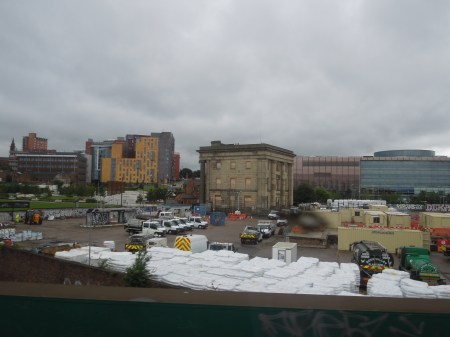
Birmingham Curzon Street Station
If HS2 is built, it will become part of the station for Birmingham. It is after all a Grade 1 Listed Building.
 The Anonymous Widower