Will Rail Baltica Annoy Putin?
Rail Baltica is described like this in Wikipedia.
Rail Baltica (also known as Rail Baltic in Estonia) is an ongoing greenfield railway infrastructure project to link Finland (via ferry or an undersea tunnel), Estonia, Latvia, Lithuania with Poland and through this with the European standard gauge rail line network. Its purpose is to provide passenger and freight service between participating countries and improve rail connections between Central and Northern Europe, specifically the area in the Southeast of the Baltic sea. Furthermore, it is intended to be a catalyst for building the economic corridor in Northeastern Europe. The project envisages a continuous rail link from Tallinn (Estonia) to Warsaw (Poland). It consists of links via Riga (Latvia), Kaunas and Vilnius (Lithuania). Rail Baltica is one of the priority projects of the European Union.
These are a few more details.
- It will be a double-track railway or four tracks if it handles freight.
- Passenger trains will run at up to 250 kph (155 mph)
- Electrification will be either 25 KVAC or 3 KVDC overhead.
- It will be a standard gauge line.
- There will be no level crossings.
- It is planned to open around 2026.
The biggest problem could be that some of the route is shared with the Russian gauge line, that connect Kaliningrad to Vilnius and then from there to the main part of Russia.
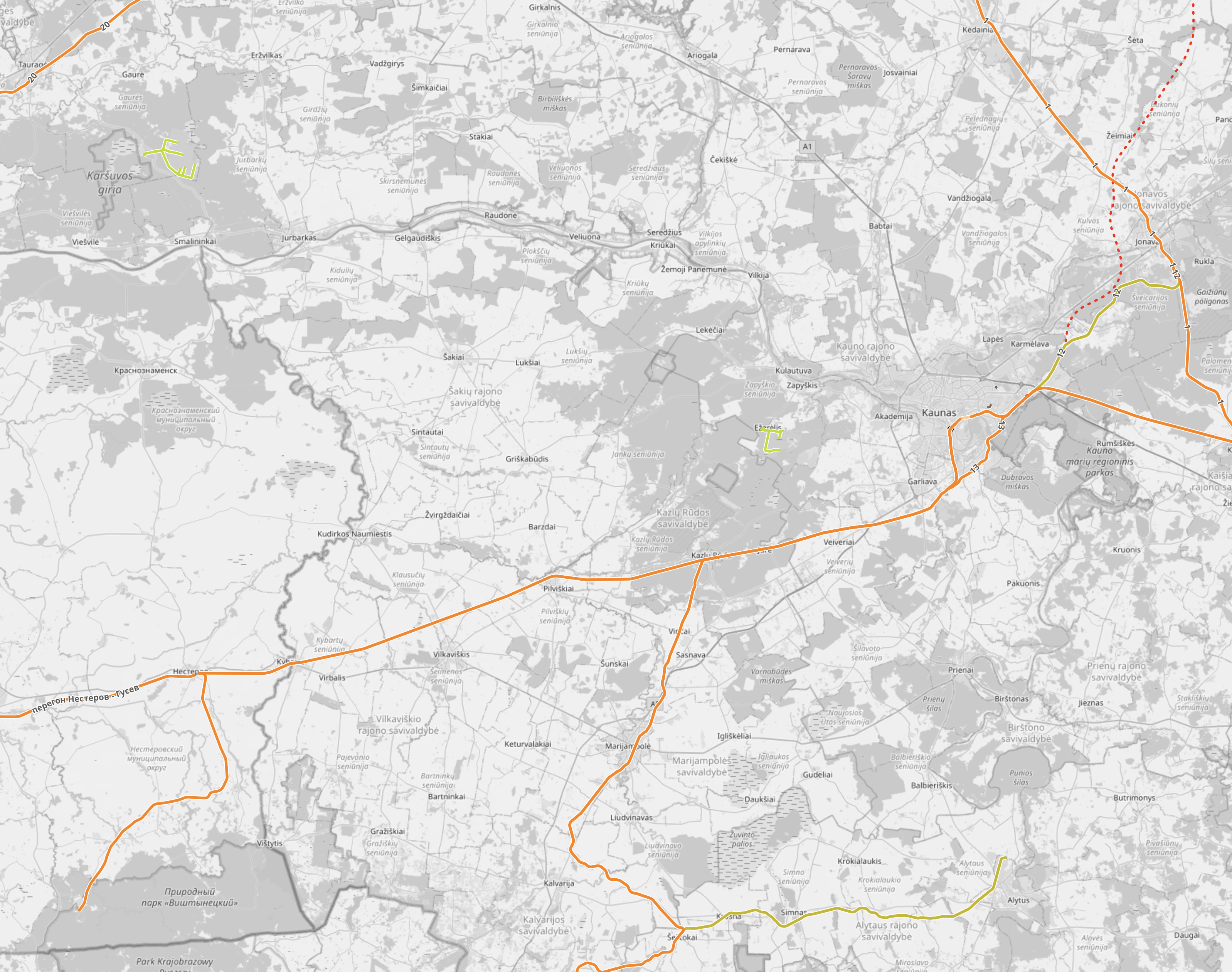
This map from OpenRailwayMap shows the railways between Kaliningrad and Vilnius.
Note.
- The orange lines are main lines.
- The yellow lines are secondary lines.
- The orange line going West goes to Kaliningrad.
- The dark grey line crossing the railway is the border of the Kaliningrad enclave, which was annexed by the Soviet Union in 1945.
- The orange line going South goes to Bialystok, Warsaw and all places to the West.
- The loop in the line is at Kaunus, where there will be an interchange between the two lines.
- The orange lines going East go to Vilnius.
- The dotted red line in the North-East corner of the map, will be new track for Rail Baltica.
The new railway will effectively squeeze itself between Kaliningrad and Kaunus.
Railway Gauges In Poland and the Baltic States
Consider.
- Most, if not all of the railways in the Baltic States are Russian gauge.
- The line between Kaliningrad and Kaunus is Russian gauge.
- Most of the railway lines in Poland are standard gauge.
- The EU likes all new high speed lines like Rail Baltica to be built to standard gauge and have 25 KVAC overhead electrification.
- Kaunus is in Lithuania, so NATO control access to Kaliningrad in sensitive times.
I can’t believe that Vlad likes the current situation and would probably prefer Rail Baltica to be built to Russian gauge, as it would enable the Russian Army to easily move tanks into the Baltic States.
Conclusion
There’s a chance that Vlad will make trouble.
Rail Baltica Concept Trains Inspired By Sun, Sea And Sand
The title of this post, is the same as that of this article on Railway Gazette.
The article shows concept images and I suspect that any of Europe’s train makers could make trains like these.
Rail Baltica will have following route and specification.
- It will eventually run between Helsinki and Warsaw, via Estonia, Latvia and Lithuania.
- There will be a tunnel between Helsinki and Tallinn.
- It will carry both passengers and freight.
- Freight trains will have a maximum length of 1050 metres, as opposed to 775 metres in the UK.
- It will be mainly double-track.
- It will be a standard gauge track with right-hand running, as all countries in the area use right-hand running.
- There will be no level crossings.
- It will have 25 KVAC overhead electrification.
- There will be ERTMS signalling.
- Passenger trains will run at 249 kph (161 mph)
- It is intended to be completed in mid-2026
The specification is similar to High Speed Two, with these exceptions.
- High Speed Two is faster at 205 mph.
- High Speed Two runs on the left.
- High Speed Two will not carry freight.
Phases 1 and 2a of High Speed Two should complete in 2029-2033, with Phase 2b following in 2035.
The bidders to build High Speed Two’s rolling stock include.
- Alstom Transport
- Bombardier Transportation (acquired by Alstom Transport on 29 January 2021) and Hitachi Rail Europe consortium
- Construcciones y Auxiliar de Ferrocarriles
- Patentes Talgo
- Siemens Mobility
I wouldn’t be surprised to see a similar list of companies tendering to build the trains for Rail Baltica.
- Stadler, who have factories in Poland may be added to the list.
- As the trains are being designed at the same time as High Speed Two trains, I wouldn’t be surprised to be similarities.
- They would also have to be designed for both left and right hand running, if there was any chance of a service between Paris and Helsinki.
- Although, they will run under 25 KVAC electrification on Rail Baltica,they may need to be able to run on other voltages.
I very much feel that Rail Baltica will be offered a selection of excellent trains.
Where Will The Trains Be Built?
Consider
- This obviously depends, where winning bidder has factories.
- But there is also the problem of getting trains between the factory and the Baltic.
- This could be difficult for factories in Spain, as there would need to be a gauge change.
- It would be easier, if the route were standard gauge all the way, as it would be from France, Germany, Italy and the UK
- If a Spanish company got the contract, could it build the trains in the UK, as delivery could be easier.
- I puzzle, why Talgo are building a factory in Scotland without any UK orders. But it would be easier to deliver trains to Russia and Eastern Europe by sea from Longannet than Spain.
There are a lot of factors that will define where the trains will be built.
Warszawa – Vilnius Passenger Service To Launch Next Year
The title of this post, is the same as that of this article on Railway Gazette.
This paragraph describes the proposed service.
The service is expected to start in late 2021, offering a journey time between the two capitals of 8 h including a change of trains at the break-of-gauge in Kaunas. Initial ridership is estimated at 35 000 passengers/year. The need to change trains would be removed once the 1 435 mm gauge tracks are extended to Vilnius as part of the Rail Baltica project.
I intend to ride this train, as soon as it starts.
A Big Step For Rail Baltica
This article on Railway Gazette is entitled Rail Baltica procurement agreement signed.
Rail Baltica is a large project to create a standard gauge railway from Tallinn in Estonia to Bialiystok in Poland via Riga in Latvia and Kaunus in Lithuania.
One extra part of the plan is to build a rail tunnel between Helsinki and Tallinn, to connect Finland to the European railway network.
This Google Map shows the Gulf of Finland.

The Gulf Of Finland
Helsinki and Taillinn are in the West on the North and South coasts respectively, with St. Petersburg in the East.
I would think, that a Taillinn to Helsinki Tunnel, would be feasible, but at probably sixty kilometres it would be the longest undersea tunnel in the world.
Now that the various parties have agreed to proceed, we might see some progress on building the main route from Tailinn to Bialystok, which hopefully will be finished in 2025.
 The Anonymous Widower