Where are all the Widowers?
After the last post I searched deeper for widowers blogs and information that might help. There would appear to be very little.
Are we all that low on the radar? Or do we just sit and suffer in silence? I have met one widower, who has decided to enjoy himself with large numbers of young ladies, but I think that he is rather in the minority.
There is I think little research into widowhood and even less where widowers are concerned. One researcher at my old university of Liverpool, does research the subject, but when you consider how many are bereaved in this world, the number involved in this subject is very small.
Surely decent research on identifying the problems and suggesting solutions, might be a very affordable way of improving society.
But it still doesn’t answer the question as to why so few widowers are posting on the web.
Posting helps me! So I suspect it would help others.
Memories of Polythene
My first job on leaving Liverpool University was at ICI Mond Division in Runcorn. I actually worked in Research at Runcorn Heath and like the company itself, I think where I worked no longer exists. Or should I say I couldn’t find it when I returned to the area last year.
The process for making polythene, or more correctly polyethylene, was discovered by ICI at Northwich.
The first industrially practical polyethylene synthesis was discovered (again by accident) in 1933 by Eric Fawcett and Reginald Gibson at the ICI works in Northwich, England. Upon applying extremely high pressure (several hundred atmospheres) to a mixture of ethylene and benzaldehyde they again produced a white, waxy, material. Because the reaction had been initiated by trace oxygen contamination in their apparatus the experiment was, at first, difficult to reproduce. It was not until 1935 that another ICI chemist, Michael Perrin, developed this accident into a reproducible high-pressure synthesis for polyethylene that became the basis for industrial LDPE production beginning in 1939.
For some months in my brief period at Runcorn, I shared an office with L. H. (Bert) Cross, who told me quite a bit of the history of how polythene was made. He would confirm the statement in Wikipedia that it was created by accident, as the researchers were experimenting with high pressures on ethylene gas.
Bert was an infra-red expert and he had analysed the spectrum of the compound to confirm what it was and ascertain his properties. I won’t put all of the story in, as even now many years on, I don’t want to destroy confidences. But let’s say that he found some interesting properties of polythene.
I’m not sure if it was Bert who told me, but at first they had no idea of what to do with their new product. It was very expensive and suggestions that it could be used to stiffen wax candles were probably quickly discounted.
In the end it was Radar, that used polythene because of its unique insulation properties. Even today, you’ll still find polythene as the insulation in the high-frequency cable that connects your television to the aerial.
Later I went on to work at ICI Plastics Division, but strangely I never worked on polythene, its production or properties again.
World Heritage Sites in the UK
Pontcysyllte is the latest UK World Heritage Site and brings the total to 28. The government web site doesn’t include this latest one, but gives a list of all.
I’ve visited about half and would like to visit all.
But one is St. Kilda, so I doubt I’ll get there!
My favourite is Liverpool, as I went to University there and met my wife in the city.
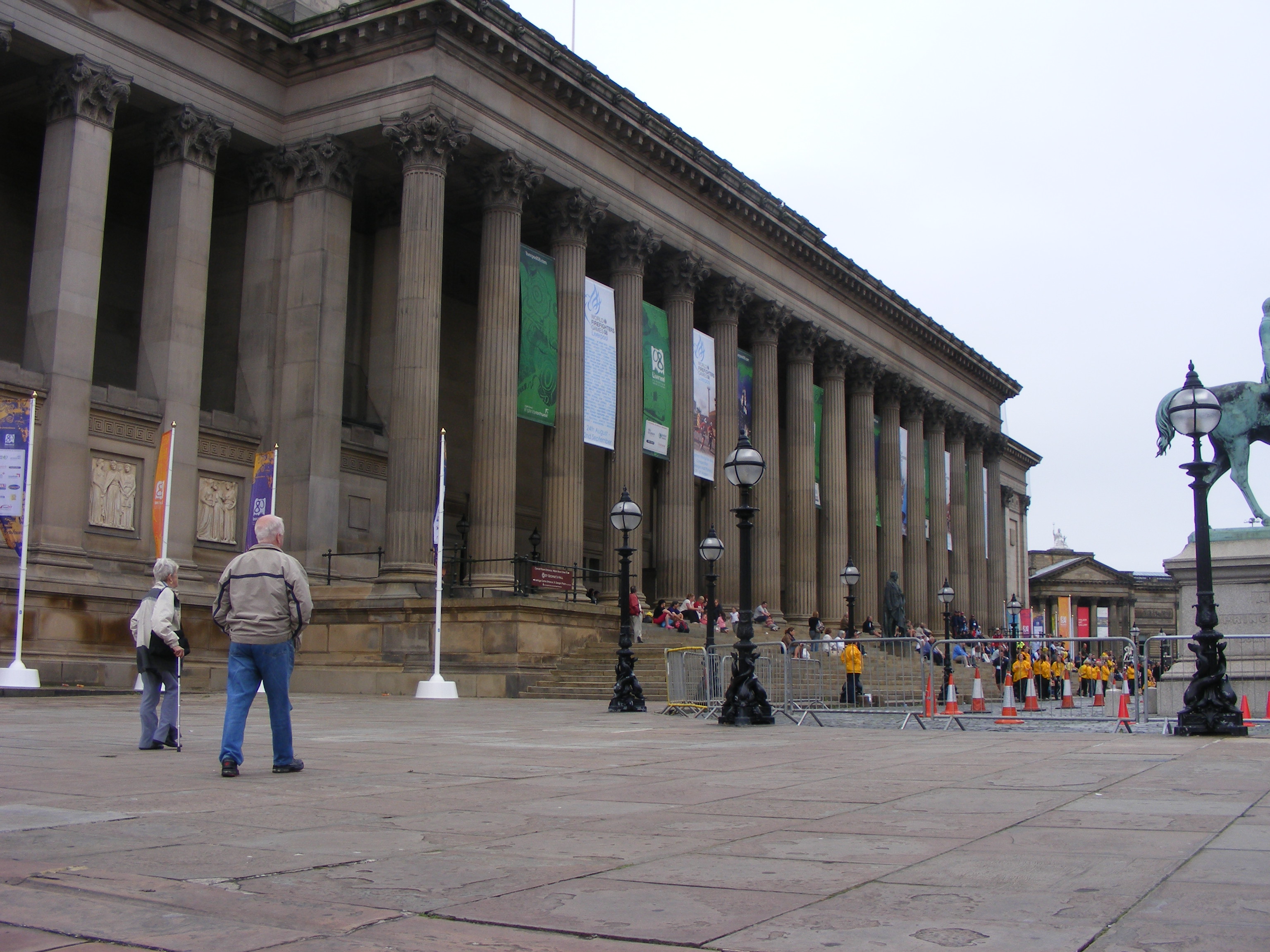
St. Georges Hall, Liverpool
Casualty 1909
Just saw a bit of this on BBC1. When I was at Liverpool University in the 1960’s, the set used in the second series of this program, was actually the main Liverpool hospital.
A friend, who was a medical student, took some growth from underneath a floorboard and created something in a Petrie dish, that nothing could kill!
MRSA? No! But there were some awful bugs in those days.
 The Anonymous Widower