TPE Pledges Capacity Boost With Class 68/Mk 5A Sets
The title of this post is the same as that of an article in Issue 851 of Rail Magazine.
It adds a few extra details to those, that I wrote about in Nova 3 On The Test Track.
This information is revealed.
The Route
The TransPennine Express fleet will run on the Liverpool Lime Street-Manchester Airport-Scarborough/Middlesbrough Routes, replacing three car Class 185 trains.
Train Length
Each Mark 5A car has a length of 22.2 or 22.37 metres.
Adding on the Class 68 locomotive gives a train length of 131.84 metres.
This compares with a train length for the Class 185 train of 71.276 metres.
It means that two Class 185 trains working together, which is current practice, are longer than the new fleet.
This must limit platform and depot modifications.
The Capacity
The number of seats on the two trains are as follows.
- Class 185 train – 15 First Class – 165 Second Class
- Class 68/Mk 5A sets – 30 First Class – 261 Second Class
This gives twice as many seats in First Class and nearly sixty percent more in second.
Both trains seem to have around sixty seats in each car.
Technical Characteristics
The Rail Magazine article gives several technical characteristics.
- Each coach has two passenger doors, except the First Class coach which has one.
- There is Selective Door Opening controlled by GPS.
- Door controls are in the Driver Trailer and Class 68 cans, which the driver controls.
- Two door control panels are in every vehicle for usde by the conductor.
- Wheel Slip Protection is fitted.
- Automatic passenger counting is provided.
- Wi-fi is fitted.
The trains have a high specification.
Nova 3 On The Test Track
The title of this post is the same as that of an article in the May 2018 Edition of Modern Railways.
Nova 3 is the name that TransPennine Express (TPE) have given to their thirteen new rakes of Mark 5A coaches, that are being built by CAF in Spain and will be hauled by Class 68 locomotives.
These are my thoughts on what we know about the trains.
The Test Phase
Testing is being performed on the Velim test track in the Czech Republic.
Increasingly, it seems that a lot of testing of trains is done on this track and I do wonder if one of the problems al our trains seeming to be late, is a lack of the suitable testing facilities in the UK.
Spanish train manufacturer; Talgo, seem to have noticed this gap and I wrote about their plans for a UK test track in Talgo Explores Options For Building UK Test Track.
Modern Railways, states that there was trouble getting the two test locomotives to Velim, because of industrial action in France.
Perhaps in parallel with the ordering of large numbers of trains, we should have built a test track!
Buying New CAF carriages Enabled Faster Deployment, Than Converting Spare Mark 3 carriages
I think that the main problem of converting Mark 3 carriages, which Chiltern have shown is very possible, is that until Greater Anglia release their carriages, after receiving their new Class 745 trains, the fifty-two coaches needed by TPE could be difficult to find. There are plenty of driving van trailers in store, that just need refurbishing.
The Modern Railways article says that most if not all, of the new Mark 5A coaches will be in service by early 2019.
I suspect that Greater Anglia won’t release their Mark 3 carriages until late 2019.
So to get the required number of Mark 3 coaches could be difficult!
I also suspect that going the CAF route means that if any extra sets re needed or the current ones need lengthening, that CAF would oblige. Whereas starching around for spare Mark 3 coaches might be more difficult.
Transpennine’s New Fleet Of Coaches
TPE have ordered the following.
- Fifty-two coaches, of which thirteen are First Class and the rest Second Class
- Fourteen driving van trailers (DVT). A spare seems prudent, as surely train ends are more likely to hit something.
- Fourteen Class 68 locomotives, two of which are spare.
- These are formed into thirteen fixed rakes of four coaches and DVT, which are hauled by a single Class 68 locomotive.
The Modern Railways article says that the idea is to have twelve sets in service and one in maintenance.
Flexible Length
The rakes appear to have been designed, so they can be lengthened to six or seven coaches.
The article also says that extension beyond six would need infrastructure work at some stations.
Changing The Power Unit
These twelve rakes are powered by a Class 68 diesel locomotive.
But I suspect, they could be powered by any suitable locomotive for the route.
I would be interesting to find out how an electro-diesel locomotive live a Class 88 locomotive, performed with a rake of five Mark 5A coaches.
What is probably needed in the future is an electroc-diesel locomotive with the following characteristics.
- Ability to haul a rake of five coaches at 125 mph on electricity.
- Ability to haul a rake of five coaches at 90 mph on diesel.
In a few years time, such a locomotive could handle some of TPE’s routes as electrification progresses.
Wheelchair Users Travel First Class
The First Class vehicle is next to the engine.
- A small kitvhen is provided.
- It seats thirty passengers.
- It has the only accessible toilet on the train.
Because of the last feature, TPE have taken the pragmatic decision, that all wheelchair users will be able to travel in First.
I’m not disabled or a wheelchair user, but that is probably down to luck more than anything else. So there but for luck, go I!
I travel on trains a lot and it is very rare for me to see more than one wheelchair user on a train.
Obviously TPE have statistics and adding everything up, they find that one accessible toilet is enough provided those needing it can sit close.
By not providing a second accessible toilet, but three ordinary toilets, they probably get another six seats they can sell to passengers.
I do wonder, if other train operating comp will adopt a similar philosophy.
Other Orders
The fleet appears to have been designed, so it can be adjusted to a train operating company’s needs.
I would suspect, that after two orders for their Mark 5 coaches, CAF are expecting more, from the next round of franchise renewals.
I also think, that TPE’s concept of a rake of five coaches with a locomotive could appeal to Open Access Operators like Grand Central Trains, especially if a 125 mph electro-diesel locomotive can be built.
One great advantage that CAF have is that once the TPE fleet is operating successfully, there would not be a large testing phase for a new operator.
Conclusion
It appears that CAF and TransPennine Express have thought long and hard about these trains and I’m looking forward to riding in one.
We Should All Think Radically!
In the August 2017 Edition of Modern Railways, Ian Walmsley, who is a writer, that I respect, thinks radically about how to upgrade or replace the High Speed Trains on the Midland Main Line.
He has a lot of experience in the rail industry and his views in this issue, are probably worth the price of the magazine alone.
He feels the InterCity 125s should be replaced as you can only make-do-and-mend for so long and he proposes replacing them with a modern equivalent, which would initially be two diesel locomotives topping and tailing a rake of new coaches, and then if electrification happens, the diesels are replaced with electric units.
Ian’s article comes a few days after this article in Rail Technology Magazine, entitled New bi-mode fleet a requirement for East Midlands as consultation opens, was published.
This is the first paragraph.
The DfT has this week launched its public consultation on the new East Midlands franchise, including specifications for a new bi-mode fleet of intercity trains, whilst at the same time revealing that plans to electrify the Midland Main Line north of Kettering have been abandoned.
There is going to have to be a lot of radical thinking to get a solution for that.
To make the replacement harder, Ian indicates various problems, which I won’t disclose here.
But I do think Ian’s idea is sound and it could be the solution to the problem of running modern 125 mph trains from St. Pancras to Derby, Nottingham and Sheffield.
So How Feasible Is Ian’s Plan?
Maths and physics don’t change. so I suspect that the calculations done by Terry Miller and his team in the 19670s, which led to the iconic InterCity 125 are still valid.
Locomotive Haulage
The power output of each Class 43 power car is 2,250 hp, so to propel an appropriate number of new carriages, you still need a locomotive at each end of the train.
The most modern diesel locomotive in the UK is the Stadler-built Class 68 locomotive, which has a power voutput of 3,800 hp, but a top speed of only 100 mph. The only 125 mph diesel locomotive in the UK is the Class 67 locomotive. To complicate matters, there is also the Stadler-built Class 88 locomotive, which is a 100 mph electro-diesel locomotive, but this locomotive is more a powerful electric locomotive with a sensible-sized last-mile diesel engine.
Ian suggests, that as the Class 68 is a few tonnes lighter than the Class 67, that a 125 mph Class 68/2 locomotive would be possible.
I don’t disagree, but given the quality of railway engineering coming out of companies like Bombardier, CAF and Stadler, that someone will do better.
We should also consider that the UK will need more than a few new freight locomotives in the next few years, as they do seem to be scratching around for motive power, as this picture shows.
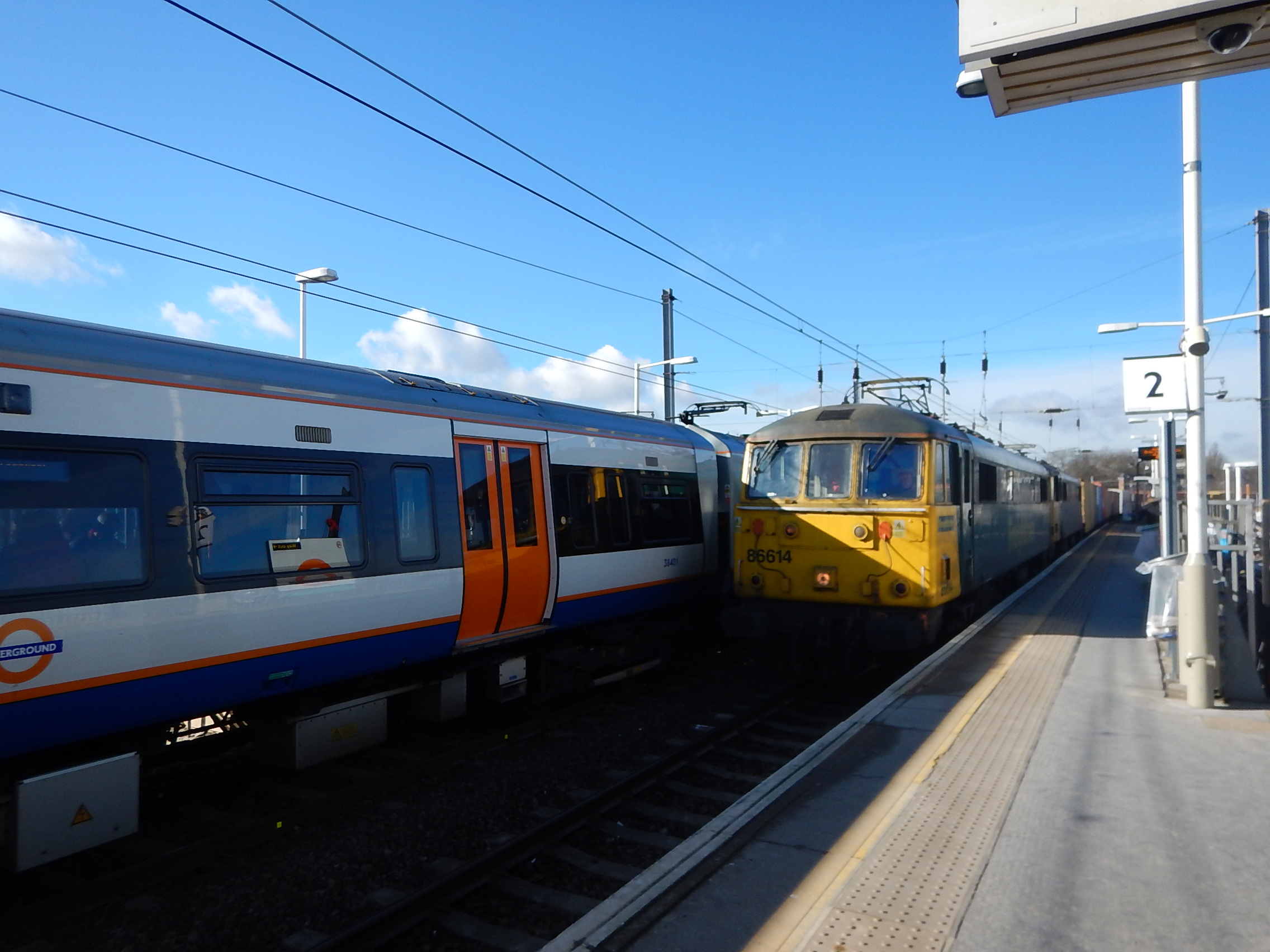
These two Class 86 locomotives date from the mid-1960s. But they do have around 3,600 hp each and a top speed of around 100-110 mph.
I even saw this interesting combination at Shenfield.
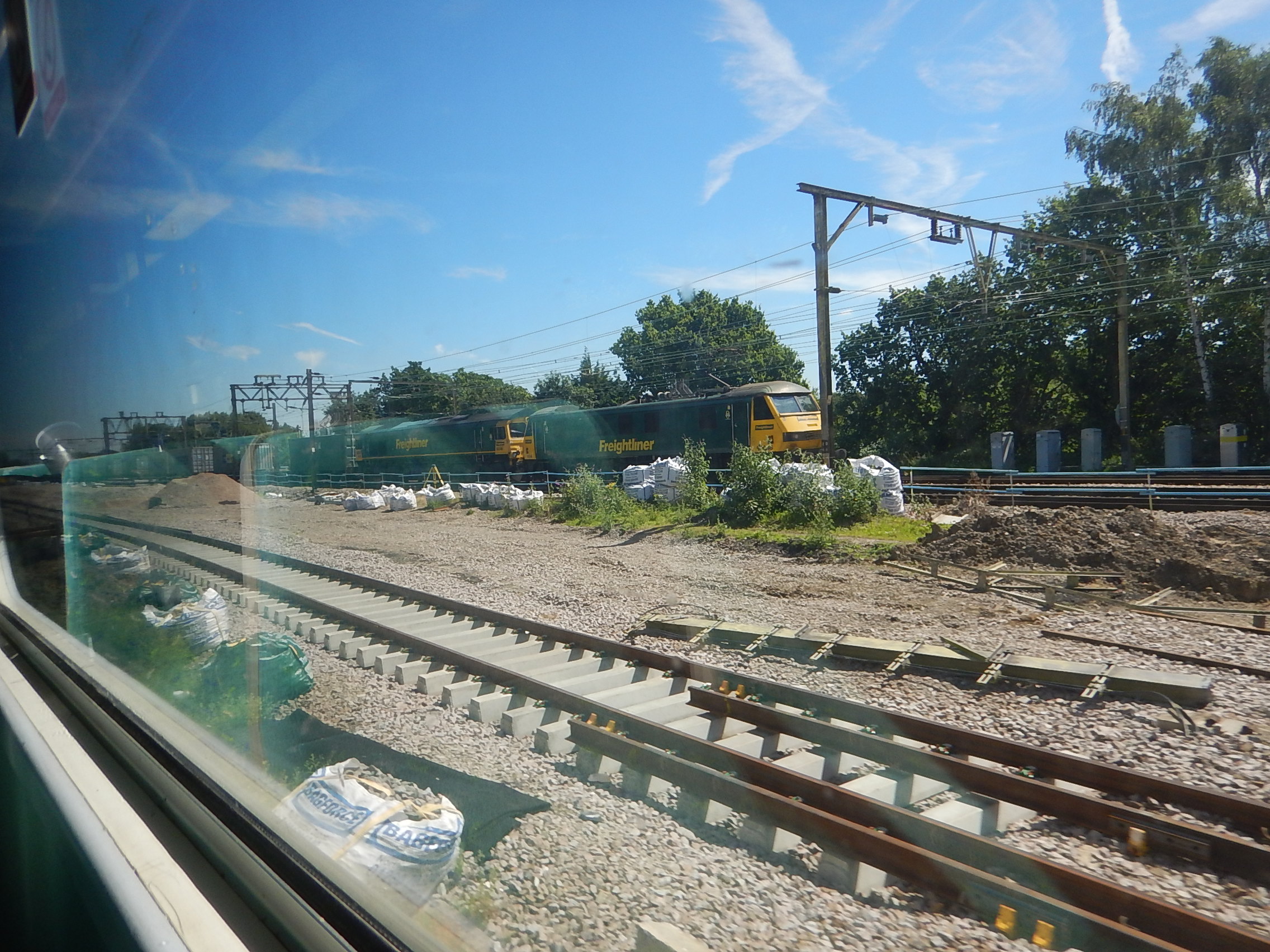
The Class 90 and Class 66 locomotives appear to be double-heading the heavy freight train. The Class 90, of which several will become available soon from Greater Anglia are 5,000 hp units with a top speed of 110 mph, whereas the ubiquitous Class 66 has only 3,300 hp and 75 mph.
With more and more long freight trains appearing on increasingly busy main lines, these freight trains must be becoming unwelcome to the companies running passenger trains and also to those, who live alongside the lines.
So is there another desperate need for a powerful locomotive to pull express freight trains at maximum length and weight around the country?
Some main freight routes like these are electrified with 25 KVAC overhead wires or will be soon.
- East Coast Main Line
- West Coast Main Line
- Greast Eastern Main Line
- Great Western Main Line
- North London Line
- Gospel Oak to Barking Line
But others are not.
- London to Southampton
- Felixstowe to Peterborough and The Midlands
- Peterborough to Doncaster via Lincoln
- Trans-Pennine Routes
And that’s just for starters.
I think it becomes obvious, why Direct Rail Services and Stadler came up with the Class 88 locomotive. The 5,300 hp available under the wires is more than adequate for the heaviest express intermodel freight train and the 1,000 hp under diesel can probably move the train into and out of the docks.
But this amount of diesel power is probably inadequate for hauling a heavy freight train at 100 mph.
A New Electro-Diesel Locomotive
So could we see a new electro-diesel locomotive with the following characteristics?
- The ability of a pair to top-and-tail an express passenger train on both diesel and 25 KVAC overhead electrification.
- The ability to haul the heaviest intermodal freight trains at up to 100 mph on both diesel and 25 KVAC overhead electrification.
- The ability to switch between modes at line speed.
- Regenerative braking underboth elkectricity and diesel.
In a few years time the diesel might be replaced by hydrogen or some other exotic fuel.
Electrification South Of Bedford
It might appear that these locomotives if working the Midland Main Line could switch to electric power South of Bedford or in the near future; Kettering, but the electrification is limited to 100 mph and there is no planned upgrade. This is a familiar story for anybody like me who uses the Great Eastern Main Line, where the inadequate electrification has had to be upgraded over the last couple of years to allow faster services.
The Coaches
The coaches are the least of the problems for Ian’s proposals.
This article on Rail Technology Magazine is entitled First bodyshell completed by CAF for new TPE fleet.
This is the first paragraph.
Pictures of the first bodyshell for new rolling stock to be used by TransPennine Express (TPE) have been unveiled as the operator looks to introduce 13 five-car Mark 5A Coaches – being built by Spanish company CAF – as part of its brand-new fleet.
The Mark 5A coaches, being built by CAF are designed for 125 mph! So all that is needed is to specify the interior!
As the Spanish train manufacturer has just announced the building of a factory at Llanwern in South Wales, that might be an ideal place to build the coaches needed.
Beating The PRM Deadline In 2020
The Mark 5A coaches for TransPennine Express are scheduled for delivery in 2018-2019, so I suspect the coaches for the Midland Main Line could start to be delivered after the TransPennine Express and Caledonian Sleeper orders are complete.
The locomotives might be move problematical, but if they are a derivative of an existing type, then surely this wouldn’t delay fleet introduction.
I suspect that a certain amount of testing can be done in parallel too!
So having some trains in service by the PRM eadline of 2020 could certainly be possible.
Conclusion
Ian Walmsley’s proposal for the next Midland Main Line franchise is possible.
 The Anonymous Widower