Audacious’ Contract To Revive Nancy – Contrexéville Route
The title of this post, is the same as that of this article on Railway Gazette.
These first two paragraphs give more details of the project.
The 89 km route from Nancy to Contrexéville, much of which has been closed to passenger and freight traffic since 2016, is to reopen in December 2027. This follows the award by the Grand Est regional council on May 24 of a contract to a private-sector consortium formed of Transdev SA, NGE Concessions and Caisse des Dépôts et Consignations.
The ‘audacious’ 22-year concession deal is worth €721m and covers both rehabilitation of the line at a cost of €150m plus management of the infrastructure and operations. Following detailed studies, work on the ground is expected to start in April 2025.
This OpenRailwayMap shows the route.

Note.
- Nancy is at the top of the map in the middle.
- Contrexéville is in the South-West corner of the map.
- Vuttel is shown by the blue arrow.
- The distance between Nancy and Contrexéville is 89 kilometres.
- It appears to be a double-track railway.
As the picture in the Railway Gazette article shows, the route needs to be refurbished.
These are my thoughts.
The Route Will Be Operated By An Augmented Form Of Open Access
- An augmented form of open access will seem to be used to run services.
- The infrastructure will be donated to the regional government.
- Upwards of a dozen round trips per day will be run.
Nothing is said about the traction to be used!
Modernised, it could be an interesting route for tourism.
Will It Provide A New Route Between Metz and Dijon?
Consider.
Metz with TGV connections, is not far to the North of Nancy.
Dijon with TGV connections, is not far to the South of Contrexéville.
These connections could be invaluable for tourism and development of the area.
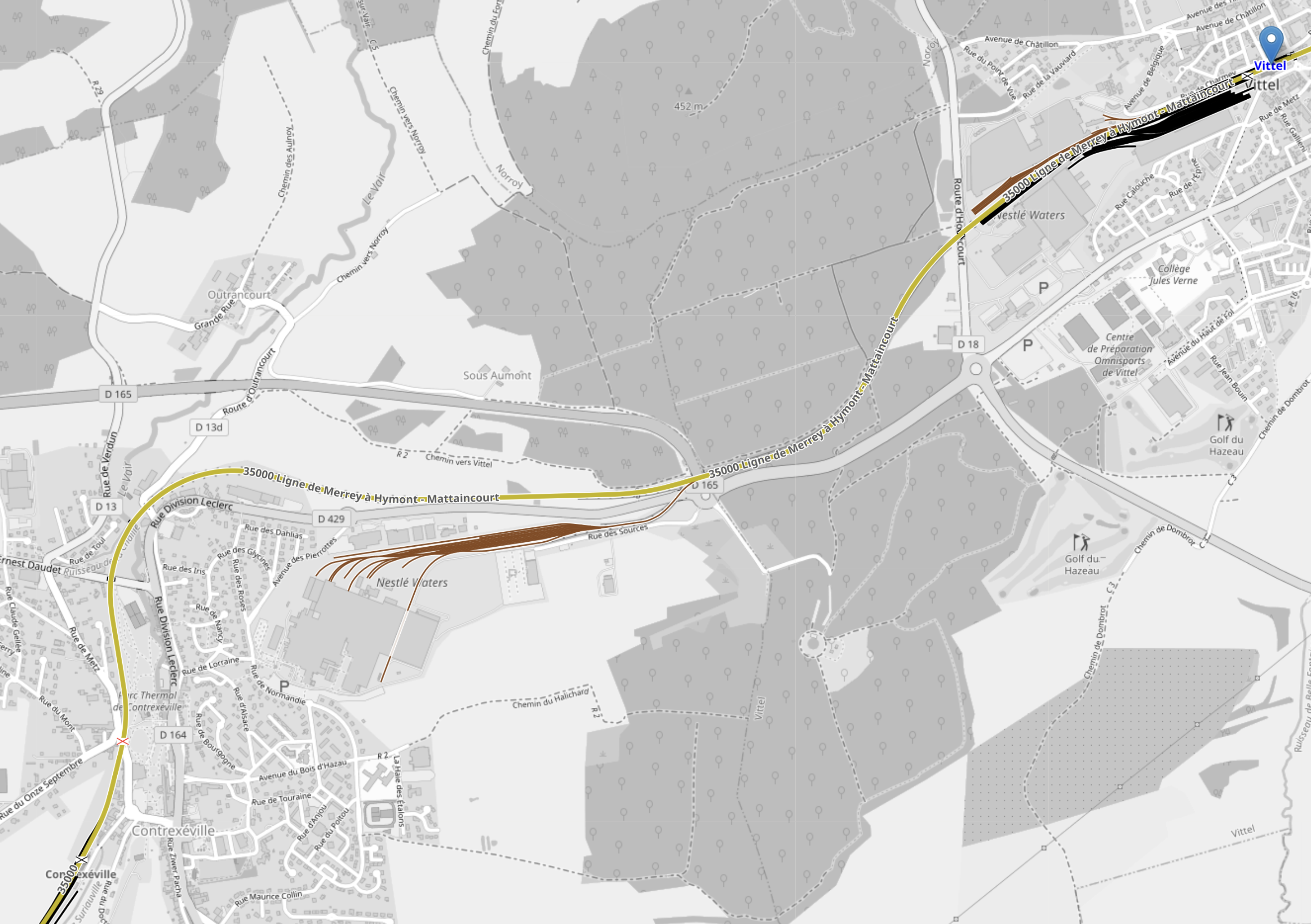
This map shows the South-Western section of the route between Contrexéville and Vittel.
Note.
- Vittel is marked by the blue arrow in the North-East corner of the map.
- Contrexéville is in the South-West corner of the map.
- In the middle of the map are sidings, which are marked Nestlé Waters.
- There appear to be sidings at Contrexéville and Vittel
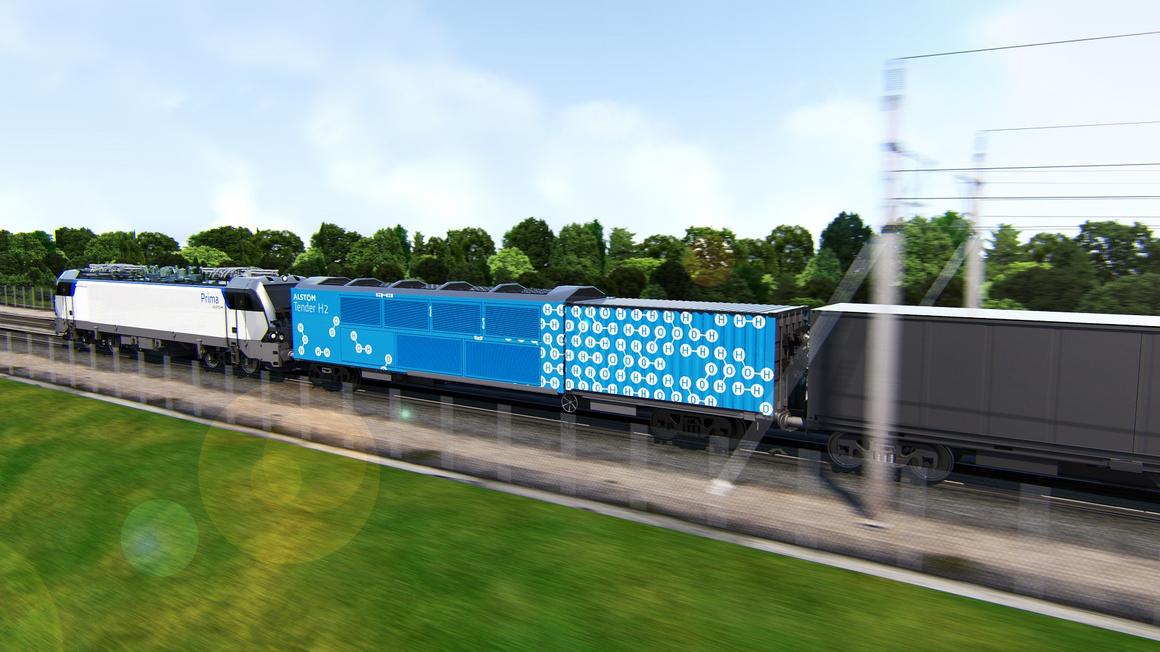
In From 2025, Nestlé Waters France Will Use The First Hydrogen-Powered Freight Train Through An Innovative Solution Developed by Alstom and ENGIE, I talk about how Nestlé will move water from the Vosges, using hydrogen-hybrid locomotives pulling freight trains.
This is a visualisation of the train.
This is said in the original Alstom press release.
From 2025, this freight train powered by electricity from the rail network and from hydrogen in non-electrified sectors will aim to progressively ensure the transport of VITTEL® natural mineral water between the factory located in the Vosges and its various distribution centers in France (i.e Vittel/Arles 600 kms and Vittel/Montreuil-Bellay 760 kms). The dual-mode solution will be composed by a generator wagon incorporating a high-power fuel cell system powered by renewable hydrogen and a line-electric locomotive, all connected by an electrical power cable. The generating wagon will be able to supply the locomotive with electricity in the without the need for any catenary.
It does appear, that within a year or to, freight trains from between Contrexéville and Vittel will be hauled by hydrogen-hybrid locomotives.
- Trains to and from Montreuil-Bellay could go via Nancy or Contrexéville.
- Trains to and from Arles could go via Contrexéville.
I suspect at present all trains have to go via Contrexéville.
If the Nancy and Contrexéville route were to be rebuilt and could take the water trains, this would open up routes to the Channel Ports and Belgium, Luxembourg, Northern France, Northern Germany and The Netherlands.
- Hydrogen trains would certainly advertise the zero-carbon nature of the transport.
- It has to be remembered that a couple of years ago, Highland Spring opened a rail distribution facility in Scotland, with the aim of moving 40 % of their water by rail.
I wonder if Nestlé are building a zero-carbon rail network for the delivery of their bottled waters.
What Traction Would Be Used For Passenger Trains?
Consider.
- The distance between Nancy and Contrexéville is 89 km or 55 miles.
- This distance, is within the range for battery-electric and hydrogen-powered trains.
- There is reason to believe that Nestlé’s water trains will be hydrogen-powered.
I suspect either battery-electric and hydrogen-powered trains could be used.
 The Anonymous Widower