The Flat Crossing At Newark
I took these pictures as we crossed over the Nottingham to Lincoln Line on the flat crossing North of Newark North Gate station.



A few months ago, I took pictures from the other line
The Newark Crossing
To improve services between Lincoln and Nottingham, the Route Utilisation Strategy (RUS) for the East Midlands recommends doing something about the notorious flat junction at Newark, which is best described as a cross roads, where a B-road crosses a motorway. This is said.
Of the remainder, the RUS recommends that the provision of a flyover at Newark is further developed in CP4 to refine the infrastructure costs and potential benefits. It is recognised that the development of the East Coast Main Line Intercity Express Programme service requirements beyond those proposed for LDHS services from May 2011, combined with freight growth beyond 18 freight trains per day on the east – west corridor, may drive the requirement for the flyover in CP5.
I shall now look at this Victorian railway relic.
This Google Map shows the location of the crossing.
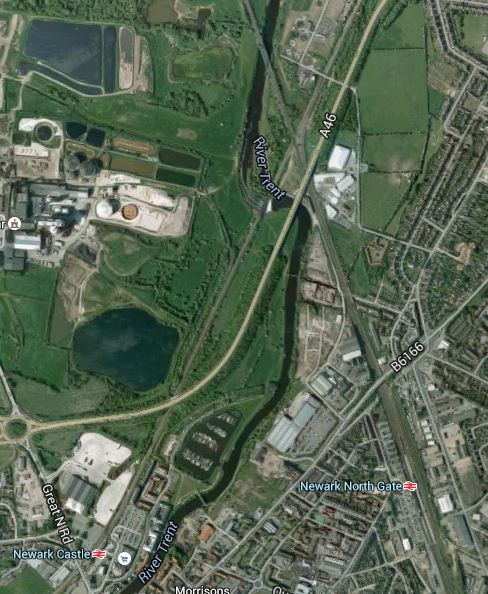
Newark Crossing
Newark Northgate station is on the East Coast Main Line, which runs top to bottom right on the map, whereas Newark Castle station is on the Nottingham to Lincoln line, which runs top to bottom left. To make matters worse the two lines cross by the River Trent and the A46, with the A1 a short distance to the East. These pictures were taken in quick succession from a train going from Lincoln to Nottingham.



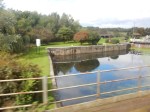
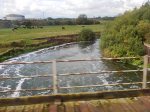
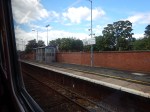
The Civil Servant who signed that the road off, should have the knighthood taken away, that he obviously got for making a decision, which should have included sorting the railway, by building a flyover to take both the railway and the A46.
If this crossing were to be sorted, it would deliver benefits all up the East Coast Main Line and on the routes that use it from Nottingham to Lincolnshire.
I can’t find anything on the Internet, but hopefully some Network Rail engineers have the envelopes and fag packets on the table.
In my view there are two possible solutions to the problem of the Newark Crossing. But whatever solution is chosen, these criteria must apply.
- The new crossing must be able to handle probably twenty long freight trains and upwards of a couple of dozen passenger trains pass every day, that need to cross the East Coast Main Line.
- It must be built without any long closures of the East Coast Main Line.
The first approach is the obvious one, where a flyover or an avoiding line on a different route, is built to allow trains on the Nottingham to Lincoln Line to cross the East Coast Main Line. But if it is so obvious and as I suspect that the place where it would be built has been surveyed and examined in great detail, then Network Rail must have a plan that has a reliable cost and time-scale assigned to it.
As the benefits of eliminating the Newark Crossing must be very well defined, it would therefore appear that the cost of building the flyover is way out of line, as otherwise this important project would be published somewhere on Network Rail’s web site.
This snippet from the RUS suggests the problem.
The gradient of the flyover will need to be able to accommodate the freight trains travelling east – west along this corridor. A key geographical constraint is the proximity to the River Trent and the A1 trunk road which adds to the overall construction cost for the flyover.
As freight trains and especially those going from East to West, will only get longer and heavier, there will have to be a large margin for increasing weight and length built in to any design for the crossing, which not only crosses the East Coast Main Line, but the River Trent. The river probably kills off any chance of a dive-under.
The other approach is that Network Rail are working on a radical plan, that perhaps uses some of the many Nottingham rail lines to completely by-pass the Newark Crossing. Trains could cross the East Coast Main Line on either the Allington Chord, North of Grantham or where the High Marnham Test Track crosses South of Tuxford.
 The Anonymous Widower