Lawrence of Afghanistan
The Times today has an article about T. E. Lawrence, who as well as his efforts in Arabia, served in the RAF as Aircraftman Shaw in Afghanistan. We should listen to what he said.
Here is an extract from the article.
With the help of Hollywood, he would become a legend, Lawrence of Arabia, but today he might more aptly be termed Lawrence of Afghanistan: he understood more clearly than any of his contemporaries (and many of our own) the futility of trying to bomb an insurgency into peace; he put into action the tactics of modern guerrilla warfare; and he pioneered the improvised explosive device (IED), the most important weapon of the wars in Iraq and Afghanistan.
In Britain Lawrence is revered as a figure of romance, the camel-mounted scholar-warrior in flowing robes, but his reputation comes tinged with a distinctly British embarrassment. Lawrence was stupendously strange: a diminutive, ruthless, obsessive, sexually repressed oddity, who spent his life striving for attention, and then rejected it.
What is too often forgotten in the mythologising (and debunking) of Lawrence is his enduring legacy as a military strategist of genius and cold-eyed guerrilla leader.
I like one particular statement.
Lawrence believed that “winning hearts and minds” (a term that would have made him snort) could only be achieved by education or cash, and never by coercion. “The printing press is the greatest weapon in the armoury of the modern commander,” he wrote. The Arab rebellion was fought with new British tactics, and bought with new British gold.
The trouble is the Americans used to think that the only good Indian was a dead one and their thinking hasn’t changed much to reflect the modern age.
Every politician and military man, from the highest general to the lowest private, should read Ben MacIntyre’s article and then be tested on it.
My father was a printer and one of the most interesting things I saw in Belarus was this battlefield printing press from the Second World War.
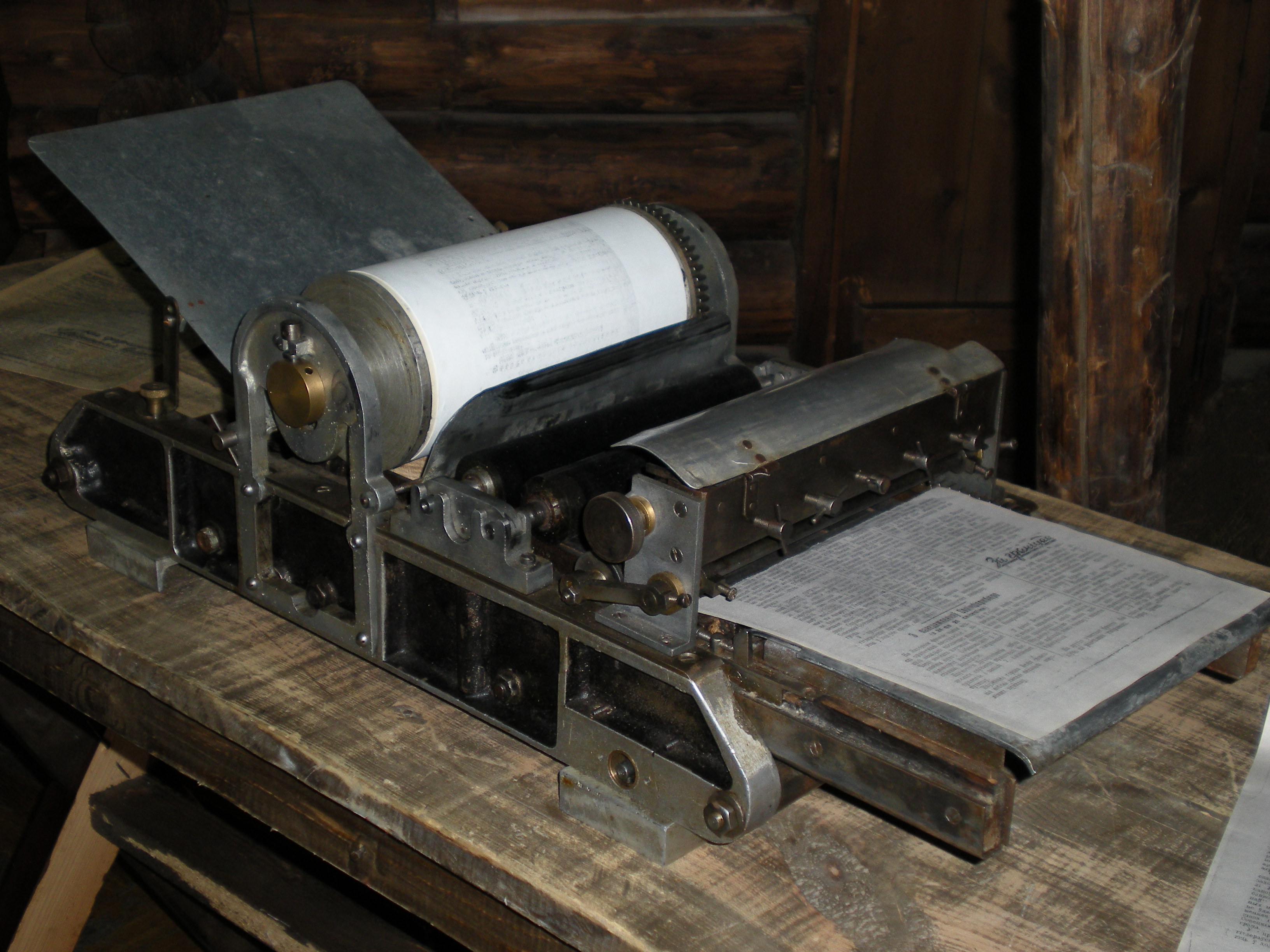
Battlefield Printing Press, Minsk
The Russians and Belarussians obviously know their T. E. Lawrence and it served them well, when they turned the Nazis in 1941.
I share two things with Lawrence;stature and birthday.
Don’t be Conventional!
On the BBC tonight, they had a program about a pilot who in the Second World War used to insert and extract agents of the SOE into German-occupied territories. One of the aircraft they used was the remarkable Westland Lysander, which although it wasn’t too good at its original job of Army Co-operation, was a superb aircraft to sneak in and out under the noses of the Germans, due to its slow speed and superb STOL performance.
But then the Second World War had its fair share of what could be described as unconventional aircraft.
The Mosquito didn’t look unconventional, but who’d have thought that an unarmed bomber built out of wood, would have been so successful. It was just that because it was light, aerodynamically efficient and could carry the same bomb-load as a B17, it could get to its targets fast and return. In fact Mosquitos often bombed Germany twice in one day.
But the theory of the heavily-armed four-engined bomber prevailed and we lost 250,000 aircrew bombing the Nazis, as did the Americans. Mosquitos incidentally had a much higher return rate and it could also be argued that because they were so much more agile and fast, they could have hit strategic targets, like ball-bearing factories, morning, noon and night. So there was also a moral case for using de Havilland’s wooden wonder.
The Mosquito is probably the only Second World War aircraft, that has a legacy in modern designs. Bombers these days are not armed and British ones haven’t been for some decades. This is because de Havilland’s fast unarmed concept was shown to be so superior, to any armed one. But the biggest legacy is in the wings of Airbuses, which like the Mosquito are glued together, rather than riveted. You can trace the technology back through Tridents and Comets to the Mosquito and before that to the Albatross.
Supermarine is well-known for the Spitfire, but another of its products was the distinctly unconventional Walrus, designed like the Spitfire by R. J. Mitchell. It was an amphibious aircraft that could be lauched and recovered from naval ships like cruisers and battleships, but it found its major use in picking up downed airmen out of the sea. This maritime-rescue role has been taken over by helicopters, but perhaps the role could be handled better, by a modern fixed-wing aircraft of unconventional design. The Americans have experimented with using Lockheed Hercules and pick-up systems, but nothing sensible has emerged.
The Americans too had an unconventional amphibian, the Consolidated Catalina. Like the Mosquito, the Cat seemed to revel in every task thrown at it. But unlike the Mosquito, you can still see a few examples flying.
And then there is the Swordfish or Stringbag. This aircraft was probably obselete when the war started, but went on to sink large amounts of Axis shipping. The Swordfish also destroyed a large part of the Italian fleet at the Battle of Taranto. Was this battle the blueprint for Pearl Harbor? The Japanese certainly gave what the Fleet Air Arm did with a handful of obselete bi-planes more than a cursory glance!
I have always thought unconventionally! It has never done me any harm! Although it’s got me into a few scrapes.
The Elephant Man
This fascinating tale about the war in Burma has just been saved for posterity. It is now safe in the hands of Cambridge University.
They had the widow of one of the men he saved on the television last night, who filled in a few more details.
I can see a film being made of this tale. It’s the lure of the elephants! After all isn’t the most loved film made by Michael Winner, Hannibal Brooks?
And after all we haven’t had a film starring elephants for many years!
A Date in My Diary
Last night, the BBC repeated the program about the Coventry Blitz. It reminded me that I shall be going to see Ipswich at Coventry on New Year’s Day. I shall of course visit both cathedrals.
I was talking to an Italian tourist at that I met at Mallaig about other places to go in the UK and I suggested Coventry. He mentioned that the verb to coventrate, or lay waste by areial bombing, is now incorporated into the Italian language.
Are Dictators Stupid?
It would appear that Robert Mugabe has fallen for a scam where a mystic claims he can get diesel out of rock. The story is here in The Times.
So he proves my title for a start.
This is one of my favourite books. The Wages of Destruction: The Making and Breaking of the Nazi Economy
Lisa Kudrow
Lisa Kudrow is an actress I’ve never come across before, but then I’ve never seen any episode of Friends. However, I’ve just seen her trace her family history on the American version of Who Do You Think You Are?
Lisa is Jewish and many of her ancestors were murdered by the Nazis in Belarus. It was a moving story, but it did have a happy ending, when she was reunited with a Polish man, who had met her father years before.
I have been to Belarus to see England play football and it is a country with a lot of sorrows. It lost about a third of its population in the Second World War and it wasn’t until about thirty years ago, that it recovered to its pre-war level. I showed some of the pictures, I took in this post.
I also wrote a piece for the East Anglian Daily Times about the trip. It is in two parts.
Both these files are in a PDF format.
One day, I hope I’ll be able to Belarus again.
Why We Didn’t Lose World War II
I have just read this article on the BBC about building a Wellington bomber in under 24 hours. It was not so much that we did it, but how we did it.
This paragraph in the article sums up why we held the fort long enough for the Japanese to attack the Americans at Pearl Harbor.
“Women were absolutely vital – first of all to the war effort as a whole, and to aircraft production,” says historian Sir Max Hastings, author of the book Bomber Command. “They were very good at what they did. Britain mobilised women more efficiently than any other wartime nation, except perhaps the Russians.”
Hitler never mobilised the German women and this was one of his biggest mistakes. But what do you expect from a power-crazed racist idiot? Not sound sense!
Women did virtually everything to support the war effort in the UK. They may not have flown combat missions, but a lot of the delivery of planes to and from front line squadrons was performed by pilots of the Air Transport Auxiliary, of whom in one in eight were women. Interestingly, women pilots were paid the same as the men. In fact the Air Transport Auxiliary is another of those organisations we created that made the most of scant resources. When they were disbanded after the war, Lord Beaverbrook said this.
“Without the ATA the days and nights of the Battle of Britain would have been conducted under conditions quite different from the actual events. They carried out the delivery of aircraft from the factories to the RAF, thus relieving countless numbers of RAF pilots for duty in the battle. Just as the Battle of Britain is the accomplishment and achievement of the RAF, likewise it can be declared that the ATA sustained and supported them in the battle. They were soldiers fighting in the struggle just as completely as if they had been engaged on the battlefront.”
I once asked my father, who at some time may have been an aide to Lord Beaverbrook, why women didn’t fly combat in the Second World War. He said it wasn’t about competence, but because if they had and it had been known, it would have had a bad effect on the morale of the population.
But in one story I’ve read, women would have been called upon to fight in the air. If the Germans had landed, one of the lines of defence was what best is described as a immense swarm of Tiger Moths. I read about this in a history of the Mosquito. Hundreds of Tiger Moths were fitted with bomb racks by de Havilland and assigned a pilot and a support truck and personnel. They were to fight tanks from the lanes. The rag-bag collection of pilots would have included women.
As my next door neighbour, a retired British Army Colonel, once said, “in case of war, ignore all the rules!”
We could all do to look closely at the lessons of history!
How Internet Rumours Start
I was looking down the list of flying exhibits at Duxford today and noticed that the Royal Netherlands Air Force were flying in their Spitfire. So I was curious as to how they acquired their plane and searched the Internet. I found the details on this page at the Spitfire Society.
But there is also this interesting bit on the page under a heading of Dissimilar Combat Exercises.
In 1963 it was thought that the English Electric Lightning might have to be used against P-51 Mustangs in Indonesia, and the Mk XIX PM631 of the BBMF was diverted to Central Fighter Establishment Binbrook to provide an opponent similar to the Mustangs in a dissimilar combat exercise. During this exercise it developed engine troubles, and PS853, which while being a Gate Guardian at CFE Binbrook had also been maintained in flying condition on the orders of the Station CO, took over the role.
Has anyone any information on the story that in the simulator, a Spitfire armed with Sidewinders has a fair chance against a Tornado?
The question has to be asked, as to why need all the expensive military hardware, politicians and those in the armed forces, say we need.
But how many people would take the last part of the extract and believe it to be the truth?
 The Anonymous Widower