You don’t have to be mad to support Ipswich, but it helps!
On Friday, I bought my train ticket to go to see Ipswich play Leicester at Portman Road, so if I had decided not to go because of the weather it would have cost me £23.55. I could afford that and knew that as I walked along the Ball’s Pond Road to Dalston Kingsland station, the weather didn’t look at all promising.
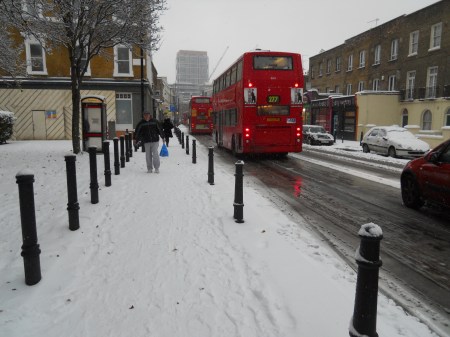
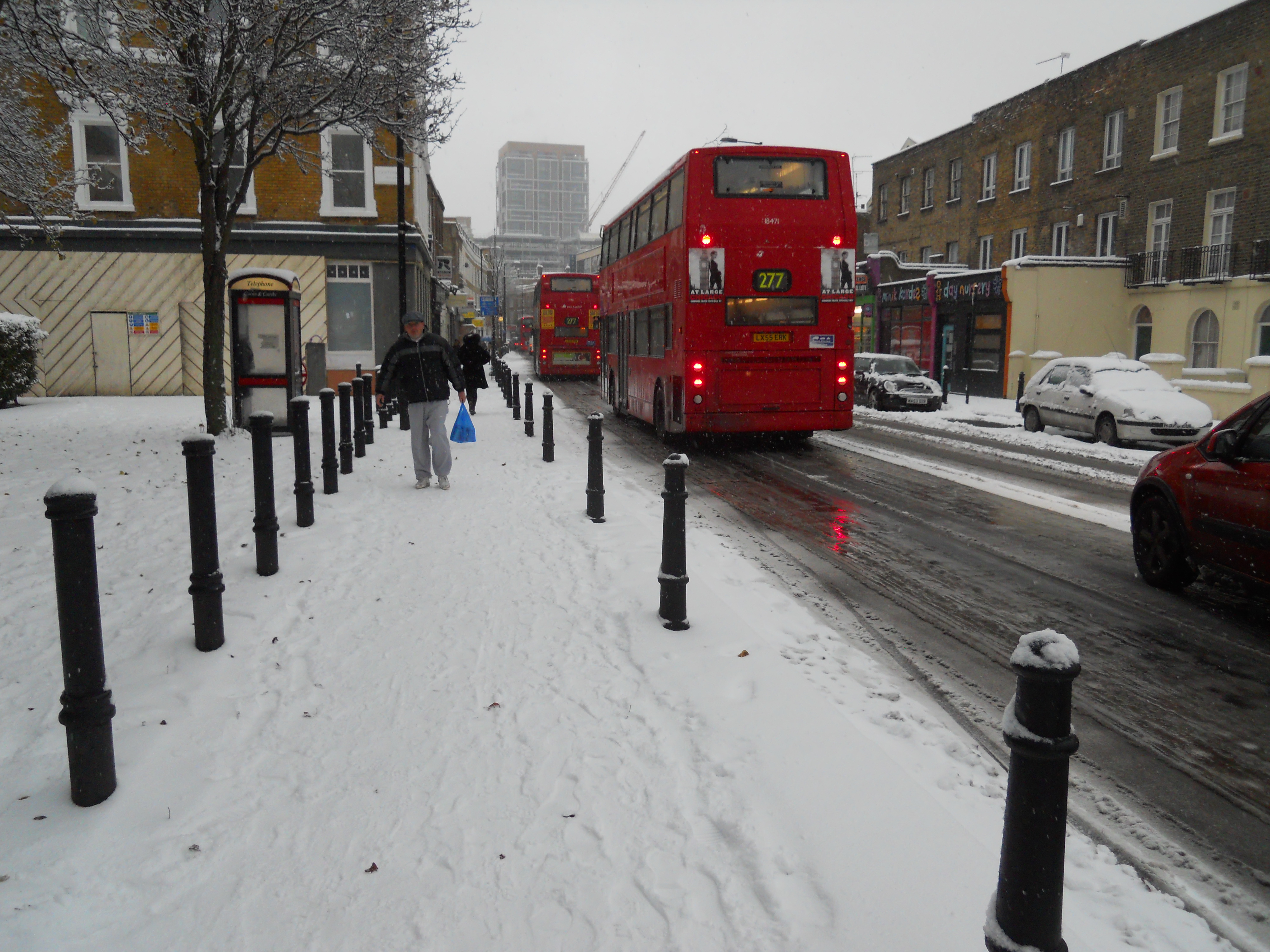
- Snow in the Ball’s Pond Road
I did get as far as the cash-point on the corner, but immediately returned home and then went to a pub where I had some lunch and some cider.
At about two, I thought that I’d go as snow often makes for good entertainment. So I retraced my steps to the station, bought a paper and then found that the station was closed. So I had to taske the alternative route, via Dalston Junction, Whitechapel and Mile End, where I got the Central Line for Stratford, to get the fast train to Ipswich.
The Olympic stadium looked good in the snow.
- Olympic Stadium in the Snow
But at least the Olympics are in August not the winter!
I actually fell asleep on the train to Ipswich, but that had nothing to do with missing the first twelve minutes or so of the match. The move has been tiring and I just needed the sleep. I completely missed the first goal and only heard the roar of the crowd as the second went in.
I just managed to see the third through the snow, but as most of the action for that goal happened just in front of me.
The second half was much of the same, as 16,728 souls peered through the snow.

Football in the Snow
But all thanks go to the referee, who resisted all efforts by the Leicester players to abandon the match. And of course to the ground staff, who kept the game going.
I had a wait at the station for a train back to London, but when it arrived it was new, warm and comfortable and arrived at its destination without gaining any more delays. It was then a tube to Liverpool Street and a taxi from the station to home. The only bad information I received on the journey home was from the charming policewoman at Liverpool Street, who said that the taxis weren’t running. But they were.
Interestingly, her colleague was in a uniform which said Politie, so he could have been Dutch. Are we that short of police these days that we have to borrow them from other countries? I made a mistake in not taking a picture.
But I suppose, when Ipswich fans talk over a drink in a few years time, I will be able so say “I was there!”
Isn’t life wonderful.
New Trains for Old
Ever since I’ve lived in West Suffolk, the trains between Ipswich and Cambridge have been on their last legs. But these last few weeks with the cold weather has been a bit of a nightmare, with possibly the worst day shown here. Some days the trains haven’t been able to keep to the timetable because of cold weather, suicides and mechanical problems. On possibly four occasions, the trains have either not turned up or been very late at Dullingham. To make matters worse some journeys out of Cambridge have been very crowded to say the least.
But all was supposed to change today, as larger, faster, more comfortable and very much newer Class 170 have been cascaded onto the service from the Cambridge to Norwich service.
This video shows the first train arriving at Dullingham, exactly on time at 10:06.
And here’s the train at its destination in Cambridge.

The First Ipswich-Cambridge Class 170 at Cambridge
Coming back I did have a problem at Tottenham Hale getting the train to Cambridge, but after diverting to King’s Cross, I arrived at Cambridge to get the on-time 17:12 to Newmarket for a taxi home.
There is only one problem with the new timetable and that is after just getting used to the old one, I have to look up each train to find out their times. But after today’s experience with the new service, it is to be hoped that the timetable will be what happens and not what is supposed to.
Born 1967, Still Going Strong
I took this picture of the door plate on a Victoria Line train yesterday.
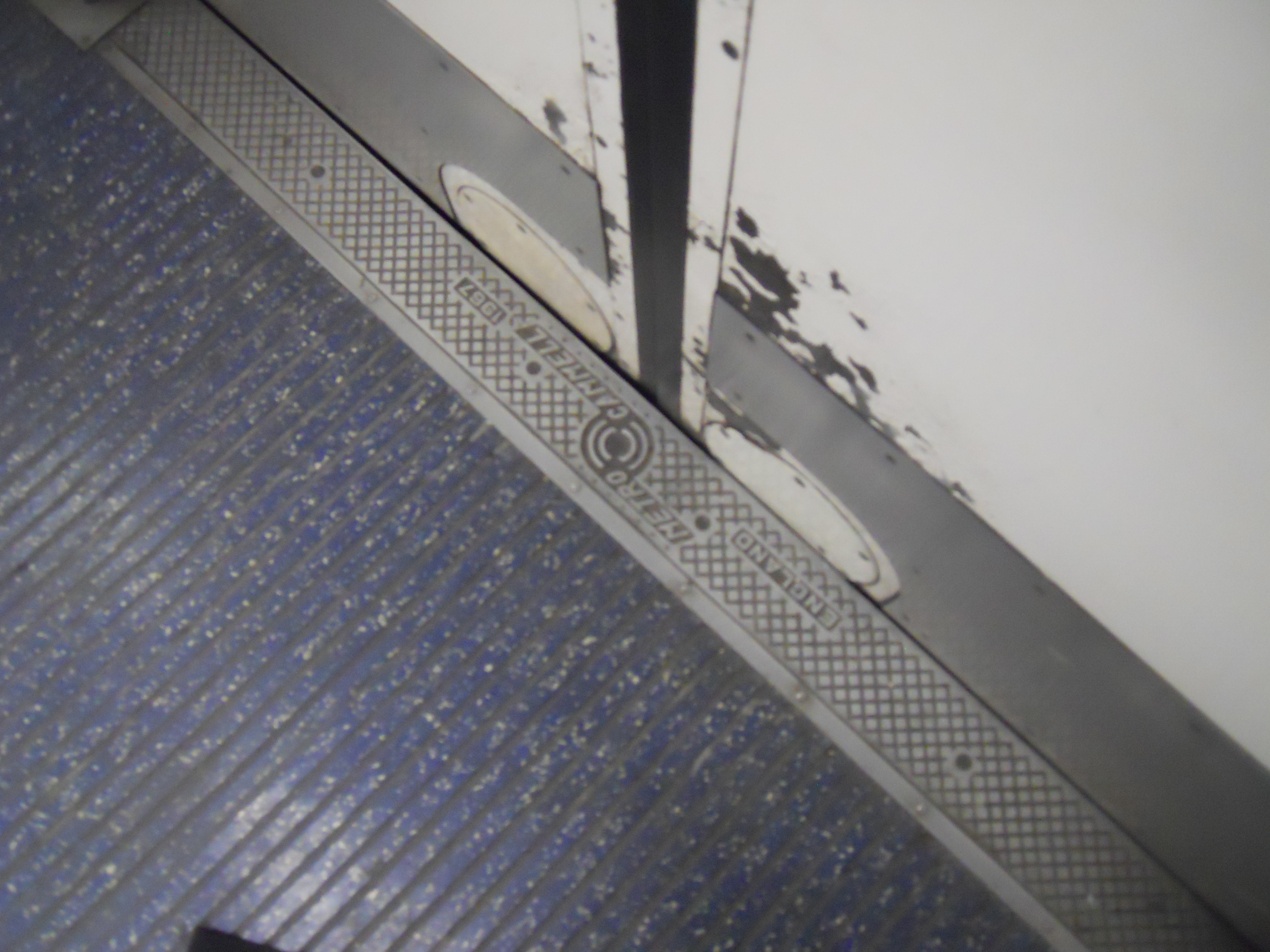
Victoria Line Train Door Plate
Note the date of 1967, which says that the train was built in that year.
Or it was originally intended to, although the plate on the other side of the carriage said 1972. In fact, on the train I took from King’s Cross to Highbury and Islington, there was a mixture of 1967s and 1972s. I doubt it matters, but I do like to see the age of my train!
It is rather sad, but all new trains now seem to be undated.
The Train that Won’t Go Quietly!
There are very few engineering projects in the world, that last a long time, as the technology gets replaced. To me some of the best in the UK are :-
The New River – Built in 1613 to supply London with fresh water, It is still used in part for that purpose nearly four centuries later. Will there be a celebration in 2013?
The Thames Embankments and Bazalgette‘s Sewers in London – These transformed the city and also laid down the basic quality control standards for large construction projects. I seem to remember reading that only one person died in the construction of the sewers, which was a major achievement for the ninteenth century.
The Forth Bridge – Probably the best known bridge in the world. Opened in 1890, it still carries nearly 200 trains a day.
The Thames Tunnel – The first tunnel under a navigable river, that now carries the East London Line under the Thames.
St. Pancras Station – The head of SNCF described it as the finest station in the world. I’ll agree with him. It was originally opened in 1868 and a lot of the original design is still intact.
Welwyn Viaduct – An extraordinary structure in Hertfordshire, that still carries the East Coast Main Line over 150 years after it was built.
We may have structures that last for years but actual vehicles that last more than a four decades or so are rare indeed.
The Mersey Ferries have been around for centuries, but the current three boats are all over fifty years old. I remember them with affection from my days at Liverpool University in the mid-1960s.
The London Routemaster bus was launched in 1956 and although most were replaced by 2005, their are still two heritage routes in central London. I rode on one in September.
The Victoria Line in London has two distinctions. It is the oldest fully-automated railway in the world and it still has some trains dating from 1967. I have travelled on some quite recently and they are still in good condition. at 43 years old.
And then there is the Inter-City 125 or High Speed Train. It may not be as venerable as the other three examples, but then they don’t travel at 200 km/hr or 125 mph over routes that measure hundreds rather than tens of miles. It was also designed as a stop-gap design after the failure of British Railways to get the tilting APT to work.
Now over thirty five years since the trains were introduced, they are being refurbished, re-engined and are still in front-line service all over the country.
On my trip north from Edinburgh to Inverness in the cab of HST, 43313, talked about some of the problems with the trains and added to my knowledge.
The old rather smoky diesel engines have now been replaced in many power cars with modern units.
The rather draughty and noisy doors in the cab have now been replaced to make the working environment second-to-none.
But the slam doors of the Mark 3 coaches with their rather quaint traditional windows are a worry.
But that is now being addressed by sound engineering according to Modern Railways.
Who’s to say when we’ll see the last of the HSTs. I wouldn’t be surprised if some are still running in 2030 or even 2040, as they are classic Darwinian train, that evolves to beat every attempt to kill it off.
In the same magazine, it was also announced that one of the HSTs had run from Plymouth to Paddington non-stop in just two hours forty minutes. That is an average speed of 84.375 mph. London to Paris by Eurostar is 307 miles and takes two hours fifteen minutes at an average speed of 136.444 mph.
So Eurostar is quicker, but it runs on a line virtually without curves and it isn’t thirty five years old.
As Modern Railways said, the Plymouth to Paddington run wasn’t bad for a thirty-five year old, British Rail-era diesel train dismissed as obselete by Labour transport ministers almost a decade ago!
I could talk about pots and kettles, but in a way isn’t the HST a superb two-fingered salute to the bunch of NuLabor morons, who almost bankrupted this country, by their idiotic policies?
The Part-Time Electric Train
Nearly all diesel trains are not pure diesel, where a large engine drives the wheels mechanically, but mostly diesel electric, where the diesel engine generates electricity and this is then used to drive electric traction motors that actually power the train. This may seem a bit complicated, but it isn’t really any less so than the transmission of a hybrid car, such as a Toyota Prius. It does have advantages though in terms of efficiency, acceleration and reliability.
When I went to Sheffield, I travelled in a train called a Class 222 or Meridian. These are diesel-electric multiple units with one diesel engine, one generator and two traction motors in each coach, which are capable of 200 km/hr.
I found the train comfortable, but some have criticised them because of the vibration caused by the diesel engine underneath the coach floor.
It is often said that the best ideas come in the hardest of times and Modern Railways this month had a long comment about converting these trains and the similar Voyagers to a bi-mode diesel-eletric/electric operation.
As on the southern part of their route north from St. Pancras to Sheffield and Nottingham, they run under the wires of the surburban electrics until Bedford, why not add an extra coach with a pantograph and the associated electrical equipment to each train. This would bring a much-needed increase in capacity, but with several other advantages.
- As the train would be electrically powered at the southern end, there would be an increase in efficiency and a decrease in costs and direct carbon emissions.
- There would be considerable savings in the cost of maintaining the diesel engines as these have to be replaced regularly.
- There would be a certain amount of decrease in noise and vibration.
- As to passengers and most staff, they would just be a train that was one carriage longer, there would not be the same familiarisation process and working in, that usually accompanies any new rolling stock.
But the biggest advantage would come, if it was decided that London to Nottingham and Sheffield were to be electrified. As each new section of electric line is added, the trains could immediately use the new line, thus saving more in costs.
Ultimately, when the eletrification was to be complete, you would prefer to switch totally to either new or cascaded electric trains. But you actually have flexibility in when they are built and enter service, as they don’t have to be immediately ready, when electification is completed, but at the time that is optimum with respect to cost, passenger numbers and having a new use for the lengthened and modified Meridians.
So what might seem a crazy idea has a lot of things going for it!
If we do electrify substantial parts of the rail network, these bi-mode trains would not be short-term white elephants after being replaced by electric trains on the London to Sheffield route, as a similar progressive electrification could be applied on the services out of Paddington to Bristol, Cardiff and Swansea, as it has been stated that electrification on this route will be applied in stages. Electrification is also starting between Liverpool, Manchester, Preston and Blackpool, so perhaps Trans-Pennine is another route, especially as at the eastern end it uses the East Coast Main Line.
It also has to be born in mind, that these trains would obviously be modified in the UK, so would create and sustain much-needed jobs.
There has been talk of replacing the HST with a bi-mode train, but the economics of that are very questionable, as that would be complete new trains, whereas the bi-mode Meridian/Voyager is a clever stop-gap. that makes electrification much more affordable.
Even after the electrification is substantially complete, the bi-mode trains would have substantial use on routes, which are effectively branches off the main electrified network, such as Bristol-Penzance, Doncaster-Hull, Peterborough-Ipswich, Edinburgh-Aberdeen, Edinburgh-Inverness, Ely-Norwich etc., where extra capacity is much needed.
They could also be used to effectively prove if a route would benefit from modern trains or a frequent service, by running the trains in diesel mode only.
Travels in the Snow
I had to go to London today, to see the man, who is decorating my new house and make sure everything was OK.
I was dropped at Whittlesford and the trains were running very much to time. As a fallback, I checked that the new Holiday Inn at the station was open, so if I needed to wait for my taxi, then I could do it with a coffee in the warm. It was, so that was probably an omen that I wouldn’t need it.
I didn’t take my normal route to Highbury and Islington from Tottenham Hale, but instead took a bus from Seven Sisters through Stamford Hill and Stoke Newington to the Essex Road. It worked and I had a much shorter walk than I normally do.
Everything was going well, so because of the weather I checked on a few things and walked to Carluccio’s in Upper Street for some lunch. After an excellent risotto, I walked to Highbury and Islington to get back to Totteham Hale.
I won’t say my troubles started there, as compared to many others, I didn’t suffer much. The Cambridge trains weren’t running, so it was suggested by staff that I go to King’s Cross and get a train from there.
Now the company that goes out of Kings Cross is First Capital Connect, which is a different one to that out of Liverpool Street. So I was worried that my ticket might not be valid!
By 16:30, I was in Cambridge, only to find that there were no trains to Newmarket, so I took the bus to the main Cambridge bus station, intending to get a bus to ether Newmarket or Haverhill. It actually doesn’t matter which as there are good taxis home from either, but the ones from Haverhill are slightly cheaper, as the town is closer. There was a large crowd waiting for the Newmarket buses, so as one was just leaving for Haverhill I took it. Unfortunately, it was a slow one, so I had an extensive tour of the many estates that surround the town before I got a taxi home.
If there is anything positive about today, it is that public transport must be flexible and that tickets must be interchangeable, if one service fails. Except for the taxi, which I would have had to pay for, wherever I returned home from, everything was covered by my day retiurn and Travelcard from Whittlesford or my bus pass.
Except for my walk too, everything was clean and warm and as I sat upstairs in the front of the bus from Cambridge to Haverhill, I was able to complete the Sudoku from the Times.
The one thing though that would have improved my journey would have been the unopened Cambridge busway, which surely will make getting from Cambridge station to the city centre aot easier. Or it might do in the future, if has been designed properly. And on that subject, shouldn’t the busway and the trains interface properly with buses that go to inaccessible towns like Haverhill?
Incidentally, it appears that the trains from Tottenham Hale are now running to time, so perhaps my diversion to King’s Cross was unnecessary.
It also seems that the overhead electric trains to the north of London are much more reliable than those to the south using a third rail for power. My engineering knowledge would suggest that overhead electric trains perform better in snowy weather, but I’m happy to be corrected. If this is true, it is rather strange that some railways south of the Thames were electrified using overhead cables, which were then changed for thrd rail. But the history of railway electrification in the UK is as complex as you can get, with innumerable systems, changes of policy and objectives. Read a simple history in Wikipedia.
A Strange Station
The train to Norwich stopped at Lakenheath station, which is one of the least-used stations in the UK and is unusual in that it has no weekday services and only one each way on Saturday and three on Sundays. However, there has been a large increase in passengers in recent years, due to the stations proximity to the RSPB at Lakenheath Fen.
There is a big lesson here, in that if you have a special interest site, that can generate significant traffic, then it is perhaps worth researching whether a station could be provided. In my travels around the UK, one example that suggests itself would be to have a station close to the retail park, which is near to where Scunthorpe United play. There are also serious plans for a station at the Ricoh Arena, where Coventry City play.
To Norwich in the Snow
The train from Dullingham to Cambridge was a few minutes late but for once in the last few weeks, it was actually two coaches, so it was fairly comfortable. The Cambridge to Norwich train was a three coach, Class 170. It has been promised that the two coach version of this train will be used on the Ipswich Cambridge line after December 12th. But hopefully, I’ll have moved before I need to use one.
The train sped through the snow, as this picture shows.
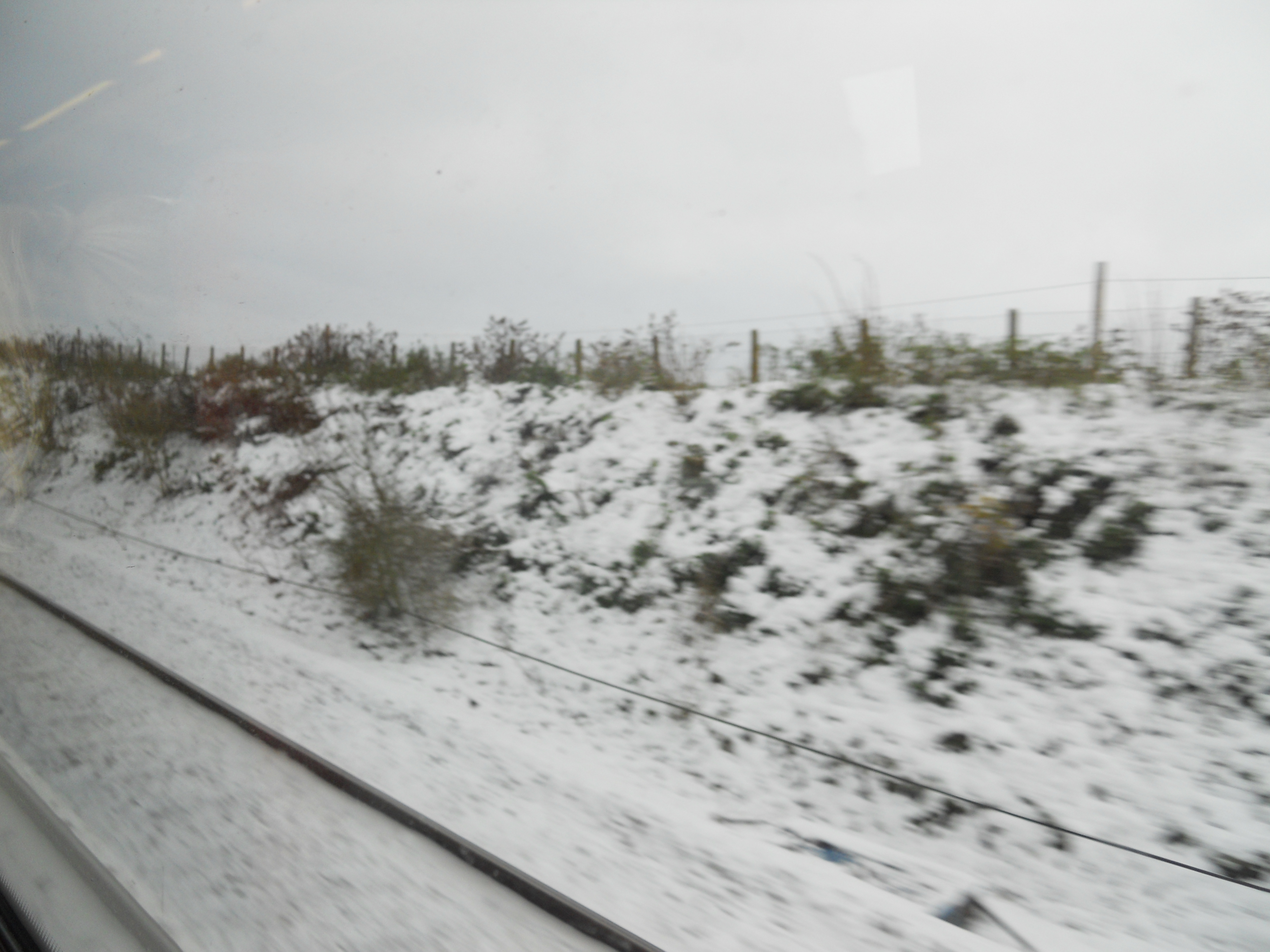
Through the Snow to Norwich
It reminds me off the old joke about the old lady who’d been on a train journey on a very snowy day and asked the conductor, “How does the driver know where he’s going, when he can’t see the rails.”
Norwich incidentally, is the only town in East Anglia with a proper railway station, with enough platforms laid out so that trains can be despatched efficiently.
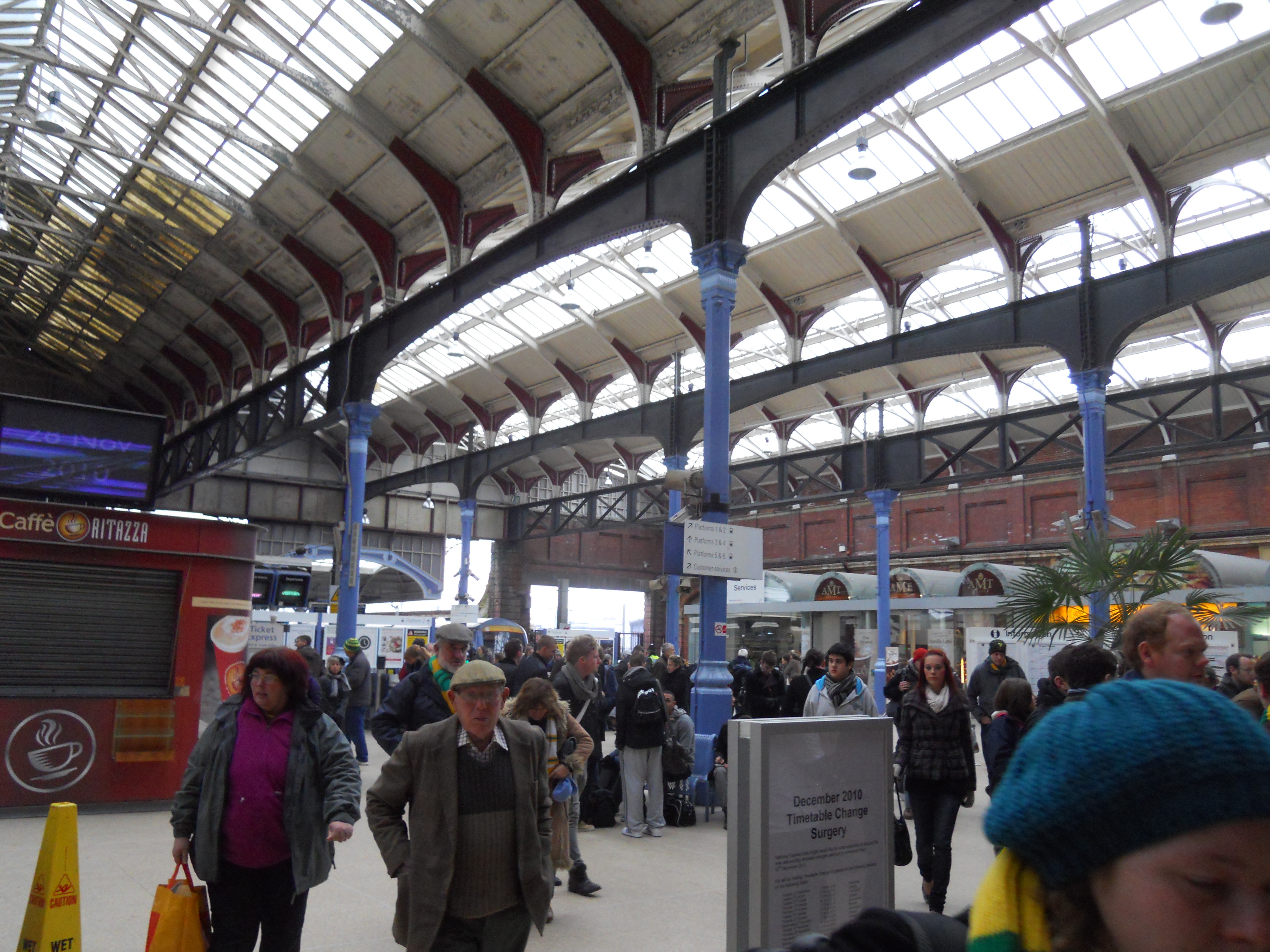
Inside Norwich Station
But is it not to be expected that East Anglia, the forgotten part of the UK, has such awful stations, as there are always more important places to buy votes, especially when Labour is in power. Norwich station seems to have slipped through the financial net or it could be that it is East Anglia’s only terminal station and was built properly in the first place.
But think of the others.
Bury St. Edmunds is best described as a building in keeping with the ruins of the Abbey.
Cambridge is effectively one long platform, which is the third longest in England, where trains are shunted, coupled and decoupled to try to run an effcient service. At least it is going to be upgraded with a new long platform. Hopefully, this will allow, Ipswich, Norwich and services to and past Peterborough to be expanded.
Ely is a busy junction station that works, but it is not the best place to connect between north-south and east-west services. It could do with a proper bridge and/or lifts so that passengers can transfer easier and a lot more car parking.
Felixstowe is a halt in the car park of a shopping centre.
Great Yarmouth is a low cost industrial building with a few facilities.
Ipswich is really a two platform halt on the main London to Norwich line, with additional platforms for the branches tucked along the sides.
Newmarket is a single platform with a shelter
Off to Norwich This Morning
I’ve just ordered the taxi to take me to the station to get my train to Cambridge. The weather doesn’t seem too bad, but it’s a bit cold. To say the least. The train was also on time at Ipswich and is just approaching Needham Market.
Here’s hoping it all goes well!
Cambridge Ipswich Trains
At last something is being done, but it will be too late for me!
From December 10th, there will be modern two coach, Class 170 trains, with extra services at night.
But last night it was cramped as the 18:43 out of Cambridge didn’t run due a train failure and the 19:43 was just one of the awful single carriage Class 153 trains, which struggled to accomodate all of the passengers.

A Crowded Cambrdge Ipswich Train
The picture shows just how bad it was. It was lucky, as I only had two stations to go.
Roll on December the 10th!

