Dutch Train Tickets
I think it is true to say, that Dutch train tickets and how you purchase them will be rather strange to many British travellers.
The use of credit cards is actively discouraged and for example, you’ll pay a surcharge if you can find a machine that accepts cash or credit cards.
No machine seems to accept notes.
At least at a few stations, like Den Haag Central and Schipol, there will be a ticket office, but I never found it at Den Haag HS.
I don’t know what you do there, if you haven’t got a debit card!
I did buy a ticket at Den Haag Central ticket office, but I was in a queue for twenty minutes. Just imagine, the flak a UK train company would get if you had to wait that length of time for a ticket. And we’re supposed to like queues!
I’ve used machines extensively in Italy and the Dutch system is certainly inferior. It’s also very foreigner friendly with several languages being shown. The Dutch use just two; Dutch and English.
On my way out at Schipol, I met a student from Delft University, who was researching the ticketing on Dutch trains. He was effectively being a ticketing advisor to all of the foreigners coming into the airport and wanting to take a train from the airport. When I last came into Gatwick, there were three Transport for London employees to make sure travellers got the right ticket advice.
Is it rather arrogant to expect visitors to your country to immediately know how buy tickets in a language they’ve never seen before, from a strange machine, which won’t accept cash or credit cards? A New Yorker wouldn’t be able to pop back to get his debit card!
This afternoon I was in Walthamstow Central station and gave the ticket machine a good once-over. The first thing you notice is that the UK machine, as are the Italian ones I remember, is very much bigger than the equivalent Dutch machine. but then it accepts coins and notes, as well as most credit and debit cards. It also deals with a lot more operations, like collecting tickets bought on-line.
The Dutch machine is a lot simpler and has much less glitz, so I suspect it was designed down to a price and as it looks cheap and nasty on the outside, I suspect the inside isn’t very bright.
After all it does the same thing as the British machine does and just issues you with a small piece of card.
The on-line tickets are all print yourself jobs on a sheet of A4 paper. In theory print at home tickets are one of those ideas that looks good on paper, but in practice could be a serious nuisance and especially at times, when it matters. Printers do run out of paper and ink and just suppose you book a ticket in a hotel room on your laptop.
When I bought the ticket for Brussels to Den Haag, I got one ticket for each leg of the journey. I didn’t have a problem, but the layout of the information like carriage and seat number is not good and I had to get someone to tell me the latter, as I got it wrong and was going to the wrong seat.
On the high speed train, you need a reservation and walk-up tickets seem very discouraged. Not having tried it, I wouldn’t know and if anybody has, I’d like to know.
But Dutch train ticketing seems to be a system designed to be cheap to run and easier for the company, than the customers. The very fact that two months ago, one ticket got me from London to The Hague and this week it was three tickets is surely a retrograde step.
They may be very last century, but I’m beginning to like the simple card tickets designed by British Rail more and more.
An Excursion In Brussels
I had nearly three hours to wait for my train in Brussels Midi and as I wasn’t sure about our eating arrangements, I thought a quick snack would be in order in the city. From previous experience, I know that the city has good places where I can get a good gluten-free meal.
A quick look around the station after my gentle argument with the guy in Information, indicated that there was nothing but bars and gluten-rich snack places in the station. There was a Starbucks, but you don’t go to one of the gastronomic capitals of the world to go to Starbucks.
So I decided to get a Metro to the area around the cathedral. I couldn’t fathom out the automatic machines, but at least there was a friendly ticket office, where they could understand my French. After getting confused and being sorted on the line to take to go north by an Italian from Milan, where we mused on the confusing maps and directions in the Brussels Metro, I finally got to a station called de Brouckère somewhere near where I thought I wanted to be. I emerged and found my way with ease.


If I’d had more time there was an exhibition of the Terracotta Army, which looked worth visiting.
Eventually, I found a street full of Thai restaurants, which I walked down to the end and found a welcoming-looking place called Le Roi des Belges.
So I took a chance and entered.
I asked if the waitress if the food and especially the plat du jour of salmon was gluten free. It wasn’t just gluten-free but delicious, being cooked with asparagus, tomatoes, herbs and mashed potato. The Belgian speciality of frites was absent. with a Pepsi, it cost me just €12.
it appeared to me though, that this could be the sort of restaurant, that will often be full. So be prepared to go somewhere else, if you turn up on the off-chance.
I walked on to the next Metro station and got the tram back to Brussels Midi.
When I was on the high speed train, it made another stop in Brussels Central station. If you know the city, then you might pick up your onward train to The Netherlands from here.
To The Hague And Back
On Tuesday, I took the Eurostar to see a friend in The Hague. This is a picture of me, eating a gluten-free breakfast in Premium Economy on Eurostar.
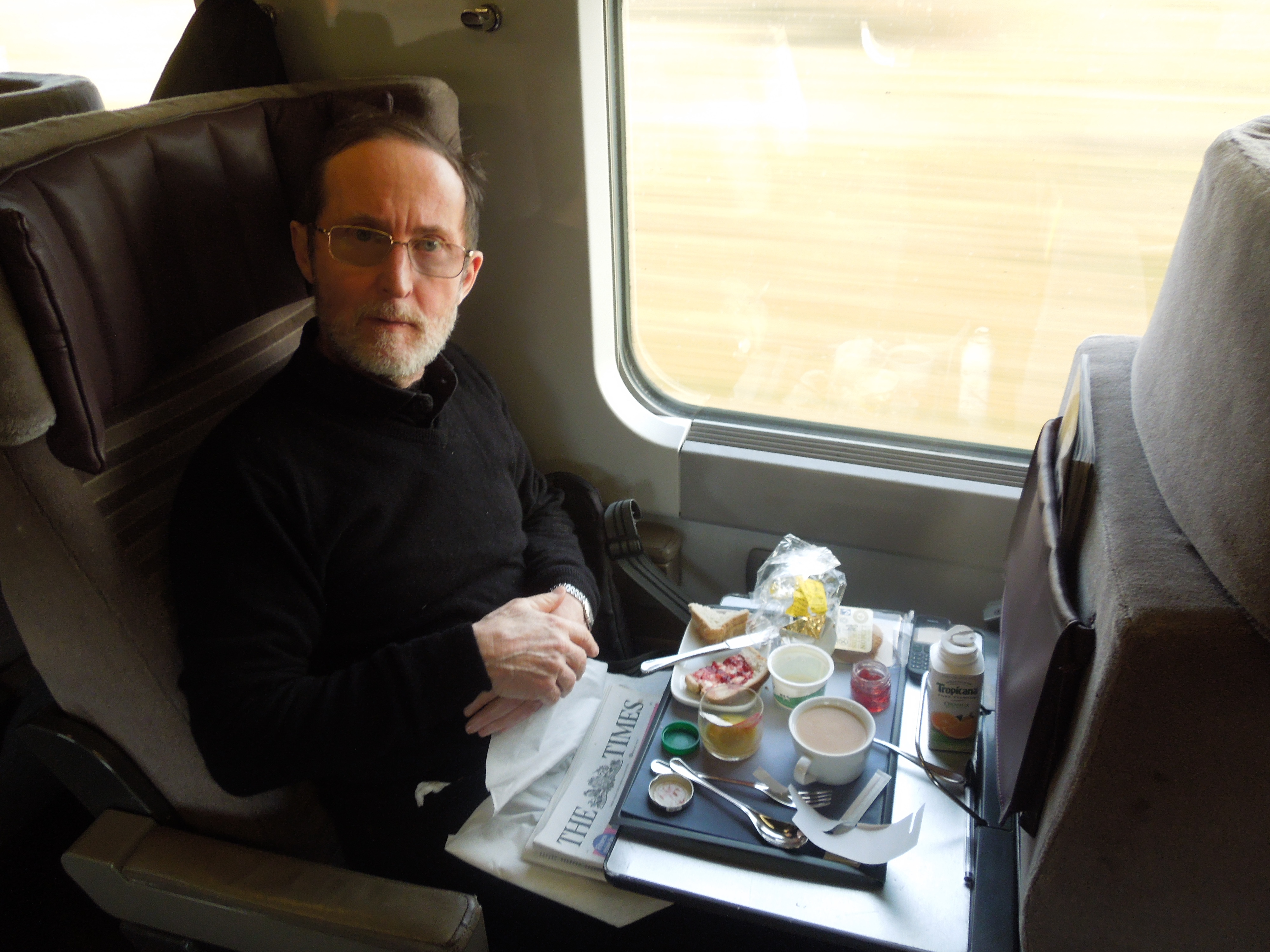
Eating A Gluten-Free Breakfast On Eurostar
I know it is only a snack, but it is nice to get something if you’re a coeliac and need gluten-free food.
I had orange juice, yoghurt, as much tea as I wanted, some Dove Farms biscuits, gluten-free bread, butter and a small pot of Tiptree jam.
This leg of the journey cost me £107. That may seem a lot, especially as I could have flown to Brussels on BA for £59, if I’d have booked earlier. But I would doubt, I’d have got such a nice breakfast and I would then have to get to and from the two airports at Heathrow and Brussels.
I actually booked a few days ago, but Standard Premier, always seems to be the same price of £107. I could have travelled in Standard for less at less than forty pounds or to any Belgian station for just £44. Standard Premier to any Belgian station is £116. For many travelling to the southern parts of the Netherlands, that will be a good option, as you can go to Antwerp and travel on from there. You’ll also get to see the triple decker station.
If you’re on an evening train, I’ve usually found the dinner and free wine to be excellent.
I had booked a connection in Brussels, that gave me over three hours in the Belgian capital, so I had time to do two things. One was to take an excursion to get some lunch and the other was to see if I could get a ticket on the InterCity train to The Hague.
I tried the Information, and the guy there said that the train had been discontinued. He did offer me a local train, that went via changes at Antwerp and Rosendaal, but I didn’t want to go on a mystery tour of the Low Countries. There were no machines to try out, so I decided to stop being a nuisance and use my ticket on the Fyra high-speed train to Rotterdam. Incidentally, there does seem to be a few teething problems with the organisation at Brussels, with Eurostar and Thalys up one end of the station and the Fyra at the other. They also changed the platform about fifteen or so minutes before the train departed. The carriage numbers are a bit confusing too, if you’ve been used to the old British Rail system of A-K and First generally towards London. Sometimes, I think the EU should lay down a few standards that would help us all.
Fyra Arrives At Rotterdam
The picture shows the train after arrival at Rotterdam.
The train is a typical boring train, where in Standard Class, you get comfortable seats with only minimal leg-room. It was no more comfortable than the Mk 3 coach, I ride in to Ipswich. But one thing that was disconcerting was that there were quite a few thumps coming from the suspension. My neighbour on the train; a Greek physicist, said that that was common. Incidentally, she’d paid the same €22, that I had for my ticket. It was just a sheet of A4 paper. More on this later.
I then took the local train to Den Haag HS station. I stood all the way, as I was talking to a Swiss lady with a Canadian accent, who worked for Rotterdam police.
I actually arrived earlier than I’d expected, as the Den Haag train I got was an earlier connection, so I had a look round the station, as the next day, I would be getting a ticket from there to Schipol for my flight home. I did find an automatic ticket machine, but it only took debit cards and not even cash. I couldn’t find the ticket office either.
Going home, I was dropped at Den Haag Centraal station and the machines were the same; debit card only. After a twenty minute queue at the ticket office, I eventually used cash to buy a ticket to Schipol to take my flight to the jewel of the Essex coast; Southend. If the Dutch are serious about attracting visitors, they need to look at their ticket machines.
The take-off time was 18:00, but we left early and at 18:05 or sixty-five minutes later because of the time difference, I was on the train towards Liverpool Street. I was sitting watching the television with a cup of tea soon soon after seven.
That six o’clock easyJet flight is certainly the fastest way to get back from Schipol to East and Central London, if you have no baggage, as they always seem to be early at Southend. It also cost me less than forty pounds for the ticket and I had a nourishing gluten-free tomato soup on the journey. Not to Eurostar’s standard but who could serve a meal properly in less than forty minutes. I even got an apology from the stewardess about the soup, as she couldn’t give it enough of a stir. But there were other passengers to serve!
The Engineers Get To Grips With Food
This report from the BBC, would seem to suggest that the Institute of Mechanical Engineers are venturing into areas that are none of their business. This is two key paragraphs.
The report found that between 30% and 50% of the four billion tonnes of food produced around the world each year went to waste.
It suggested that half the food bought in Europe and the US was thrown away.
I don’t think it is a surprising set of findings, but what are governments doing about it. Nothing! Which is a total scandal.
Perhaps, it’s about time we had more engineers at all levels in Government, all over the world. Waste is anathema to every engineer I’ve ever met!
I wonder if there has ever been a President or Prime Minister anywhere, who has had an engineering qualification? Even an O Level or equivalent in Technical Drawing would be rare. The nearest I can think of is Jimmy Carter, who was deeply involved in the clearing up of this nuclear incident in Canada. After his presidency he has shown himself to be a very practical man.
 The Anonymous Widower