Walking Across Glasgow City Centre – 3rd October 2026
I walked from my hotel, which was next to Glasgow High Street station to Glasgow Central station.
I took these pictures as I walked.
















































Note.
- The Moxy Hotel was fine with a good bed.
- Glasgow has liths with maps.
- George Square is being relaid with new paving.
- Kaffateria was excellentfor coffee and some gluten-free snacks.
- I walked to Glasgow Central station.
- There is an accessible electric bus for poor walkers.
I have a couple of thoughts.
Glasgow needs a credit card contactless ticketing system for both Glaswegians and visitors.
There needs to be a few more liths.
But what surprised me, is that how easy I walked across the city.
Could There Be Better Transport Connections Between Leeds/Bradford and Glasgow/Edinburgh?
I shall start this post with eleven questions, that I will ask Google AI.
How Many People Live In the Greater Leeds/Bradford Area?
I received this answer from Google AI.
The greater Leeds-Bradford urban and larger urban zone has an estimated population of about 1.65 million to 2.4 million people. The core combined Leeds-Bradford continuous built-up area holds roughly 1.66 million people, while the wider Leeds City Region and Larger Urban Zone reaches approximately 2.4 million.
How Many People Live In the Greater Glasgow Area?
I received this answer from Google AI.
The Greater Glasgow urban area has an estimated population of over 1 million people. Depending on how the boundaries are drawn, the wider NHS health board region contains about 1.2 million, and the broader Glasgow City Region counts roughly 1.8 million residents.
How Many People Live In the Greater Edinburgh Area?
I received this answer from Google AI.
The greater Edinburgh metropolitan or wider city region has an estimated population of approximately 912,000 to 1.35 million, depending on the regional boundary used. The City of Edinburgh council area itself holds 531,370 residents.
How Many Sheduled Air Services Are There Between Leeds/Bradford and Glasgow Airports?
I received this answer from Google AI.
There are currently zero direct, scheduled non-stop air services operating between Leeds Bradford Airport (LBA) and Glasgow Airport (GLA).
How Many Scheduled Air Services Are There Between Leeds/Bradford and Edinburgh Airports?
I received this answer from Google AI.
There are currently zero direct, scheduled non-stop air services operating between Leeds Bradford Airport (LBA) and Edinburgh Airport (EDI).
How Many Scheduled Direct Rail Services Are There Between Leeds or Bradford and Glasgow?
I received this answer from Google AI.
There is typically only 1 scheduled direct train service per day in each direction between Leeds and Glasgow (operated via CrossCountry), and n0 direct scheduled services between Bradford and Glasgow.
How Many Sheduled Direct Rail Services Are There Between Leeds or Bradford and Edinburgh?
I received this answer from Google AI.
There are typically only 1 to 2 scheduled direct train services per day running from Leeds to Edinburgh (usually operated by CrossCountry or via select extensions), taking roughly 3 hours. Bradford has zero regular scheduled direct rail services to Edinburgh; journeys from Bradford require at least one change (commonly transferring at Leeds).
How Long Does It Take To Drive Between Leeds And Glasgow?
I received this answer from Google AI.
Driving between Leeds and Glasgow takes about 3 hours and 50 minutes to 4 hours and 15 minutes under normal conditions, covering a distance of roughly 210 to 222 miles via the A1(M) and M74.
How Long Does It Take To Drive Between Leeds And Edinburgh?
I received this answer from Google AI.
Driving between Bradford and Glasgow takes about 3.5 to 4 hours under normal conditions. The total distance is roughly 200 miles (322 km), mostly following the A1(M) or M6 motorways depending on your chosen route.
How Long Does It Take To Drive Between Bradford And Glasgow?
I received this answer from Google AI.
Driving between Leeds and Glasgow takes about 3 hours and 50 minutes to 4 hours and 15 minutes under normal conditions, covering a distance of roughly 210 to 222 miles via the A1(M) and M74.
How Long Does It Take To Drive Between Bradford And Edinburgh?
I received this answer from Google AI.
Driving between Bradford and Edinburgh takes about 4 hours to 4.5 hours under normal traffic conditions. The total driving distance is roughly 196 to 202 miles, primarily heading north via the A1(M) or M1 and A69/M74 routes.
But I do think that Northern England and Scotland could be getting closer together in the next few years.
Consider.
- LNER stopped running between King’s Cross and Glasgow a couple of years ago.
- No airlines fly between Leeds/Bradford and Glasgow or Edinburgh Airports.
- TransPennine Express run direct rail services between both Liverpool and Manchester, and Glasgow.
- There are only occasional direct rail services between Leeds or Bradford, and Glasgow or Edinburgh.
- Driving is not an easy or quick option.
- Lumo run a few limited rail services between Glasgow and Stirling, and London.
There is a big gap in rail and air services between the 1.5 million people in Leeds/Bradford and nearly 2 million in Central Scotland.
But.
- Between Bradford and Carlisle is the Settle and Carlisle Line.
- The Settle and Carlisle is one of the most scenic lines in Europe, if not the world.
- The Settle and Carlisle is not electrified.
- Until 1974, it was used by the Thames-Clyde Express between London St. Pancras and Glasgow.
- Avanti have used the route for engineering diversions, using their new five-car Class 805 trains in pairs.
- Bradford Forster Square station has been updated so that ten-car trains on the route can call at both Leeds and Bradford Forster Square stations
- I believe that in a couple of years, LNER will have CAF tri-mode trains and Hitachi battery-electric trains, that will be able to bridge the gap in the electrification between Skipton and Carlisle.
Selected Kings Cross and Bradford Forster Square services could be extended to Skipton, Settle, Carlisle, Dumfries, Kilmarnock and Glasgow.
There will be three major benefits.
- Several towns and cities will gain a London service.
- The extra services will help to take on the airlines between London and Glasgow.
- Leeds and Bradford will be connected to Glasgow.
No major infrastructure would need to be created.
I have other thoughts.
Can Ten-Car Trains Use The Settle And Carlisle?
This article on the BBC is entitled Rail Operator Crosses Picturesque Line.
There is a picture in the article of two Avanti five-car Class 805 trains crossing the Ribblehead Viaduct on the Settle and Carlisle Line.
If they can do it, I suspect that a new 10-car CAF Class 897 train can also run on the line.
Could High-Class Food Be Served Between London And Glasgow?
Google AI gives this history of Pullman Dining on current GWR services.
Great Western Railway (GWR) has been running Pullman Dining on its Intercity Express Trains (Class 800 and sister Class 802 units) for about seven years, since the new Hitachi-built fleets rolled out fine-dining menus around 2017 to 2018 to replace the legacy High Speed Train (HST) sets.
In On The 10:45 From Paddington, I describe one of the best simple meals I’ve ever had.
I’m sure there are a few Scottish chefs, who could create a Scottish-themed menu for services to Scotland via the Settle and Carlisle.
Passengers Would Have A Choice Between London And Glasgow
These would be the options.
- Fast – Ryanair and lose a lot of brownie points.
- All-Electric Semi-Fast – Avanti or Lumo.
- Slower, but enjoying the scenery and why not a meal – LNER via Settle and Carlisle.
Five trains per day each way would add 3,000 seats per day, which would be around 15 of Ryanair’s 737s per day.
Will Leeds/Bradford Airport Have A Glasgow Or Edinburgh Flight Some Time Soon?
Consider.
- Between Leeds-Bradford and Glasgow airports is 177.4 miles.
- Between Leeds-Bradford and Edinburgh airports is 159.5 miles.
- The all-electric Eviation Alice has a range of 250 miles with 10 passengers.
- The all-electric Heart Aviation ES-30 has a range of 220 miles with 30 passengers.
Google AI gives this view on when the Heart Aviation ES-30 will enter service.
The Heart Aerospace ES-30 hybrid-electric airplane is scheduled to enter commercial service in 2028, though some industry analysis and program updates suggest development adjustments could stretch the timeline closer to 2029 or 2031.
The Eviation Alice doesn’t give a date at present.
Given the option, I suspect some travellers would prefer to fly.
My First Ocado Zoom Delivery
I’d run out of Adnams Ghost Ship 0.5% and strawberries, so I asked Ocado to Zoom up a few.








Strangely, they didn’t come in grey plastic bags, but in brown paper bags secured by sticky labels.
Poland Receives Its First Electricity from Offshore Wind As Baltic Power Starts Delivering
The title of this post, is the same as that of this article on offshoreWIND.biz.
This is the sub-heading.
Electricity generated by the Baltic Power offshore wind farm has entered Poland’s national power grid, marking the first time the electricity generated by offshore wind turbines is added to the country’s energy mix.
This first paragraph gives more details of the project.
54 of 76 turbines have already been installed at Poland’s first offshore wind farm, with the first now generating electricity. Construction is scheduled for completion this autumn, ORLEN and Northland Power, the owners of the project, said.
When complete, the Baltic Power wind farm will generate up to 1.2 GW.
How Much Offshore Wind Does Poland Have Planned?
I asked Google AI, the question in the title of this section and received this reply.
Poland has massive offshore wind plans in the Baltic Sea.
The country targets 5.9 GW by 2030 and 18 GW by 2040. To meet these goals, the government is pursuing two primary development phases to transition the national grid away from coal.
A breakdown of Poland’s offshore wind rollout includes:
Phase I (Advanced Projects): Includes 5.9 GW of capacity.
Baltic Power: Poland’s first offshore wind farm (1.2 GW), developed by Orlen and Northland Power, officially connected to the national grid in July 2026.
Bałtyk 2 & 3: Equinor and Polenergia have finalized financing for an additional 1.4 GW, slated for commercial operation around 2028.
Phase II (Auction-Backed): Poland recently allocated over 3.4 GW in new capacity through competitive offshore wind auctions, pushing development well into the next decade.
Long-Term Outlook: Industry groups estimate the total technical potential in Poland’s portion of the Baltic Sea could reach up to 33 GW.
Will Poland Be Welcoming Any Invading Germany Wind Farms?
In New Study Shows How North Sea Offshore Wind Can Yield More While Costing Less, I talked about how Germany doesn’t have enough sea in which to place the wind farms it needs to generate the green electricity and hydrogen it needs.
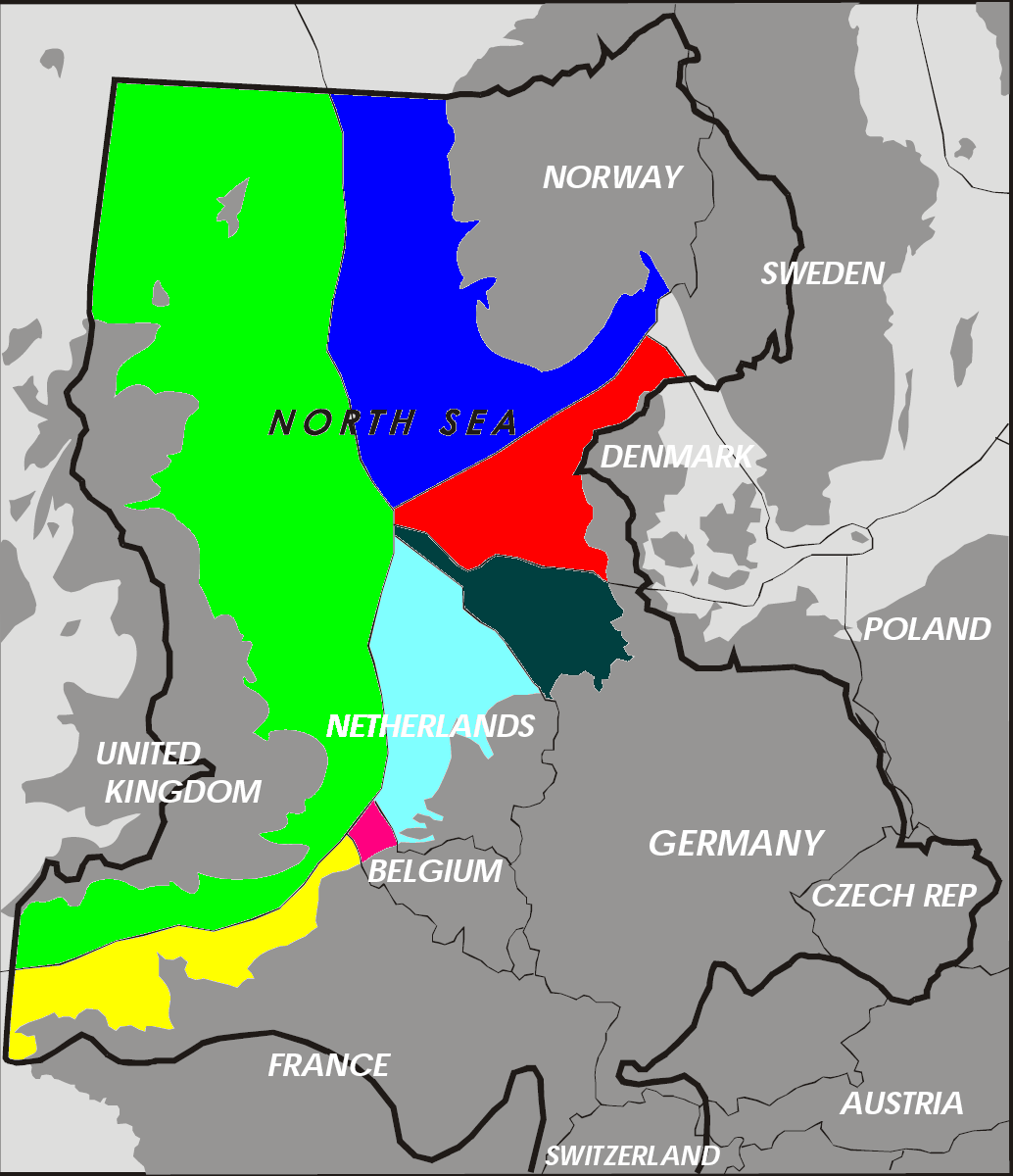
This map from Wikipedia shows Exclusive Economic Zones in the North Sea, but it also shows who has control of the sea in the Baltic.
Note.
- Yellow is France.
- Mauve is Belgium, who drew the short straw.
- Light Blue is The Netherlands.
- Black is Germany, who despite their large land area, don’t have as much sea as the UK.
- Red is Denmark.
- Dark Blue is Norway.
- Green is The UK.
- Germany and Poland seen to share the Southern Baltic.
I wouldn’t be surprised to see Germany and Poland co-operating to maximize the wind power capacity of the Southern Baltic.
A Visit To Poland’s Coal Capital
On one of my trips to Poland, I went to Katowice, which is in Poland’s coal-mining region. I wrote about it in An Excursion In Katowice.
Google AI produced this snapshot of Katowice.
Katowice is historically known as the “Polish Coal Capital” and served as the absolute backbone of the region’s heavy industry. First transforming into an industrial powerhouse in the mid-19th century due to rich local coal and metal reserves, the city’s economy and rapid growth were entirely reliant on coal mining and steel.
While coal and heavy industry historically anchored its identity, the city of Katowice has aggressively transformed into a modern cultural, technological, and business hub. The wider Silesia region remains heavily tied to coal mining, but the municipality itself has shifted its focus to avoid reliance on it.
My visit to Katowice was an excellent pit-stop on a train ride between Krakow and Prague, when I did my Home Run From Krakow.
If you like your food and like me, you’re coeliac, I would certainly recommend Poland for a few days away.
Strangely, the language is not a problem, as if you get three Poles together, one will speak English better than what you do.
Yellow Ladder Coffee – Whitechapel Station
This is a small coffee shop in the interchange level at Whitechapel station.





I didn’t have time for a coffee as I passed through today, but I will in future.
Was There Often A Barrel Of Beer Available In Places Like Foundries, Where The Work Was Hot And Hard?
Readers of The Times has been discussing electrolytes in this hot weather and especially the possibility that beer contains electrolytes.
This was posted.
My elder father informed me yesterday his fridge is full of alcohol free Erdinger wheat beer. It is marketed as good for replacing electrolytes.
So there could be something in it.
At the moment, as I type this the temperature is 35.5 degrees and the humidity is 26%, so I’m finishing off last night’s bottle of Adnam’s Ghost Ship Alcohol-Free 0.5 % Beer.
I asked Google AI, the question in the title of this post and received this reply.
Yes. In heavy industries like foundries, glassworks, and steel mills, consuming large volumes of liquid was a medical necessity to replace what was lost to sweat. Historically, workers frequently supplemented their diets with beer—sometimes supplied by the company, sometimes delivered by local pubs, and sometimes factored into their pay.
Historical Context & Working Conditions
The Thirst Quenchers: In sweltering industrial environments where temperatures could exceed \(65^{\circ }\text{C}\) (\(150^{\circ }\text{F}\)), workers suffered massive fluid loss. A furnaceman or steelworker could sweat out up to twenty pints a day.
The “Beer Allowance”: In places like Britain’s steelworks in Sheffield, it was customary for workers to receive a weekly beer allowance—sometimes up to forty pints—often supplied directly to the sweltering factory floor via young workers known as “bucket boys”.
Liquid Nutrition: Before the advent of modern refrigeration and reliable municipal water, low-alcohol table beer provided crucial calories and hydration without the risk of waterborne illnesses. It was treated more like a food source than an intoxicant.
The Shift to Modernity
The Temperance Movement: The availability of alcohol at work gradually changed during the 19th and 20th centuries. The rise of the Temperance Movement and stricter workplace safety regulations meant that by the mid-to-late 20th century, foundries began phasing out alcohol in favor of safer, hydration-focused alternatives.
Modern Replacements: Today, foundries and heavy industries prioritize hydration through water, electrolyte replenishment, and salt tablets rather than on-site alcohol.
I should say, the following.
- My paternal grandfather was an alcoholic and it eventually caused his early death at around 40.
- I lose a lot of water through my skin. See My Strange Skin.
- I’ve always preferred beer to any other drink. But I’ve never had an alcohol-related problem.
So do I drink beer and usually real beer because of its electrolytes?
Olympia Exhibition Centre – 18th June 2026
I went back to Olympia today and took these pictures.












I don’t think, I’ll be going again, as they don’t seem to have any gluten-free food.
An Extreme Day Out – Bedlington And Northumberland Park Stations
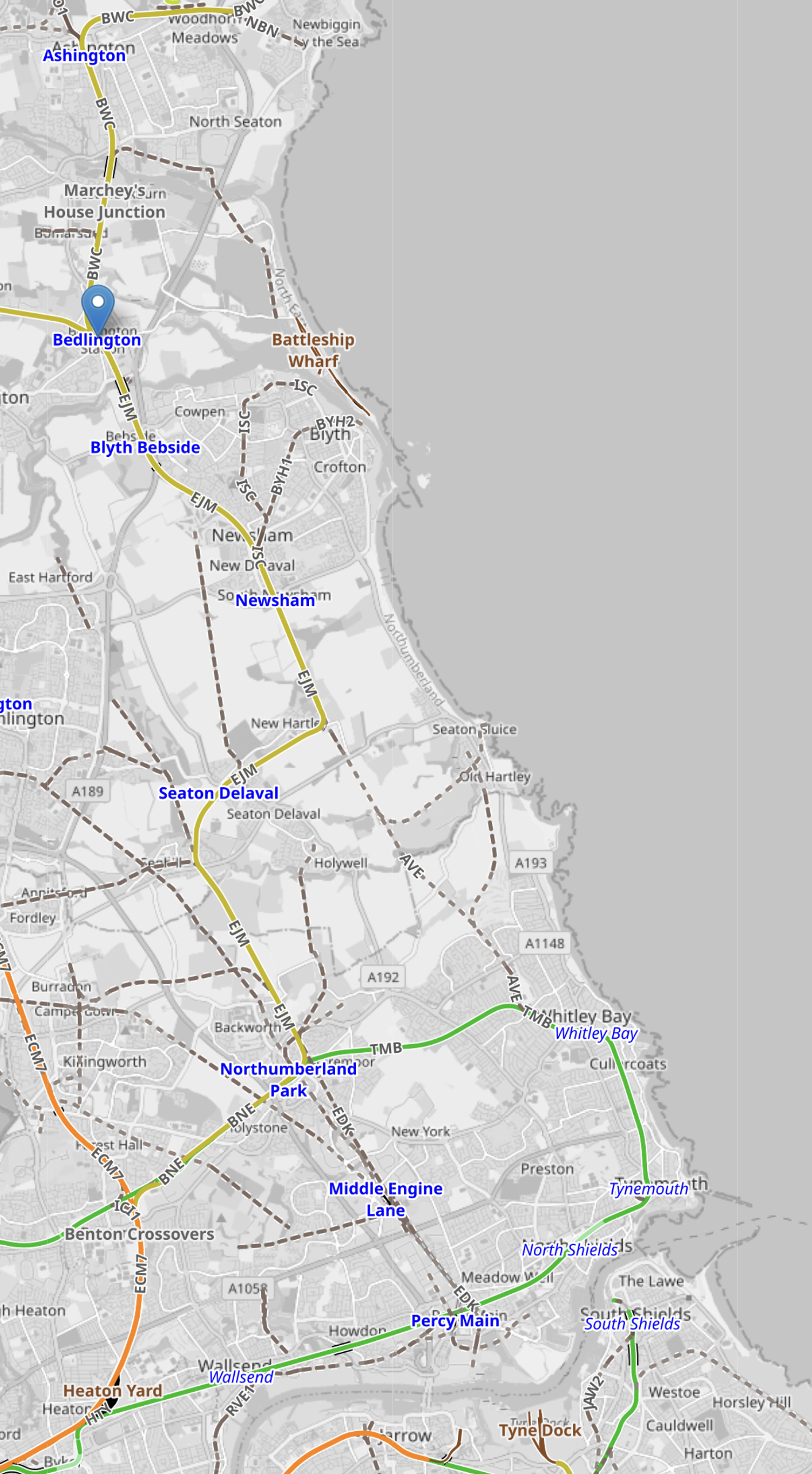
This OpenRailwayMap shows the Northumberland Line and the Eastern part of the Newcastle Metro.
Note.
- The yellow track is the Northumberland Line.
- It terminates in the North at Ashington in the top-left corner of the map.
- Bebington station is indicated by the blue arrow.
- It terminates in the South at Newcastle station.
- The green track is the Newcastle Metro.
- There is now an interchange between the two lines at Northumberland Park station.
In the following sections, I’ll describe my trip.
King’s Cross And Newcastle Return For £66.35
I bought my two long distance tickets on a walk-up basis at King’s Cross and Newcastle stations from the machines.
- I traveled North on a Lumo service to Glasgow for £27.20.
- I did indulge myself with a tea for £2.60.
- I traveled South on an LNER service for £36.55.
- One of the reasons, I buy tickets on a walk-up basis, is that with my uncomplicated pancolonic diverticular disease, I might decide to cancel at the last minute, so it avoids the hassle of getting refunds.
Both services were within a few minutes of the timetable, although LNER had said they would be late, due to signalling problems.
My Route In Northumberland For £2.60
I bought a return ticket at Newcastle station for Ashington, which is the current terminus of the Northumberland Line.
- I actually didn’t go past Bedlington station, where I turned round and had a drink.
- As there are two trains per hour on the Northumberland Line, waits are not generally not too long.
- I only came back as far as Northumberland Park, where I swapped to the Metro for Newcastle station.
If I had had more time, I would have stopped at Seaton Delaval station to have a gluten-free dinner, which I wrote about in Seaton Delaval Station – 30th March 2025.
From Newcastle to Bedlington Station
I took these pictures going to Bedlington station.















I would have taken more pictures, but the train was rather full.
Bedlington Station And Bedlington
I took these pictures at and around Bedlington station.




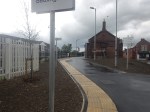




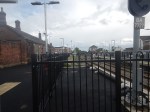





Note.
- Although it is a completely rebuilt station, it has a level crossing.
- But is the signal box keeping a watchful eye over trains and the road?
- Bedlington station appears to be step-free using ramps and the level crossing.
- Just to the North of the station, the tracks split to Ashington and Morpeth.
In my forty minutes or so in Bedlington, I didn’t see a terrier.
Are Any Bedlington Terriers Still Bred At Or Near Bedlington?
I had to ask Google AI, this question and I received this reply.
Yes, Bedlington Terriers are still bred in and around their namesake town in Northumberland, UK. While they are a relatively rare breed overall, the historic North East region remains one of the primary strongholds for these distinct “lamb-like” dogs.
Northumberland Park Station
I took these pictures at Northumberland Park station.

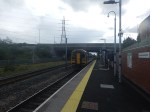
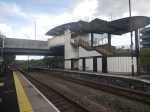
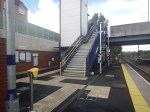

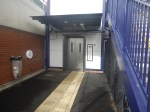

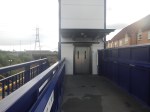
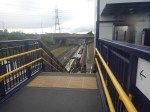
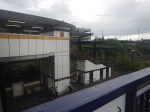

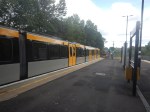
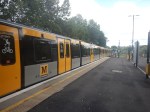



Note.
- The Northumberland Line uses a single bi-directional platform on the North side of the station.
- The Newcastle Metro uses an island platform on the South side of the station.
- Both platforms have steps and lifts.
- There are around 400 parking spaces and a Sainsbury’s Superstore at the station.
At 78, after a stroke, I didn’t find the change between the two lines difficult. But I did use the lifts!
What Are The Future Plans For The Northumberland Line?
I couldn’t resist asking Google AI this question and I received this answer.
With the Bedlington and Northumberland Park stations fully operational, the core phase of the Northumberland Line connecting Ashington to Newcastle is complete. Future plans now focus on route extensions, additional stops, and increasing capacity to handle high passenger demand.
Key Future Plans
Extension to the Coast: The North East Combined Authority is actively funding the development of an extension to Newbiggin-by-the-Sea, utilizing existing freight tracks. Planning submissions for this expansion are targeted for 2028.
New Station Proposals: Proposals are being explored to build an additional stop serving the Wansbeck General Hospital and to replace the long-closed Choppington station.
Increased Capacity: Operator Northern Rail is in ongoing discussions with transport partners to lengthen train services (which are currently constrained to two to four coaches) to help accommodate massive patronage on the line.
Integrated Ticketing: The Northumberland County Council is exploring integrated ticketing with the Tyne and Wear Metro to allow for seamless travel between the two networks at stations like Northumberland Park.
From my observations on the line over the last few years, I would go along with Google AI’s recommendations.
These are some specific thoughts.
Extension To Newbiggin-by-the-Sea
This OpenRailwayMap shows the tracks that used to exist between Ashington and Newbiggin-by-the-Sea.
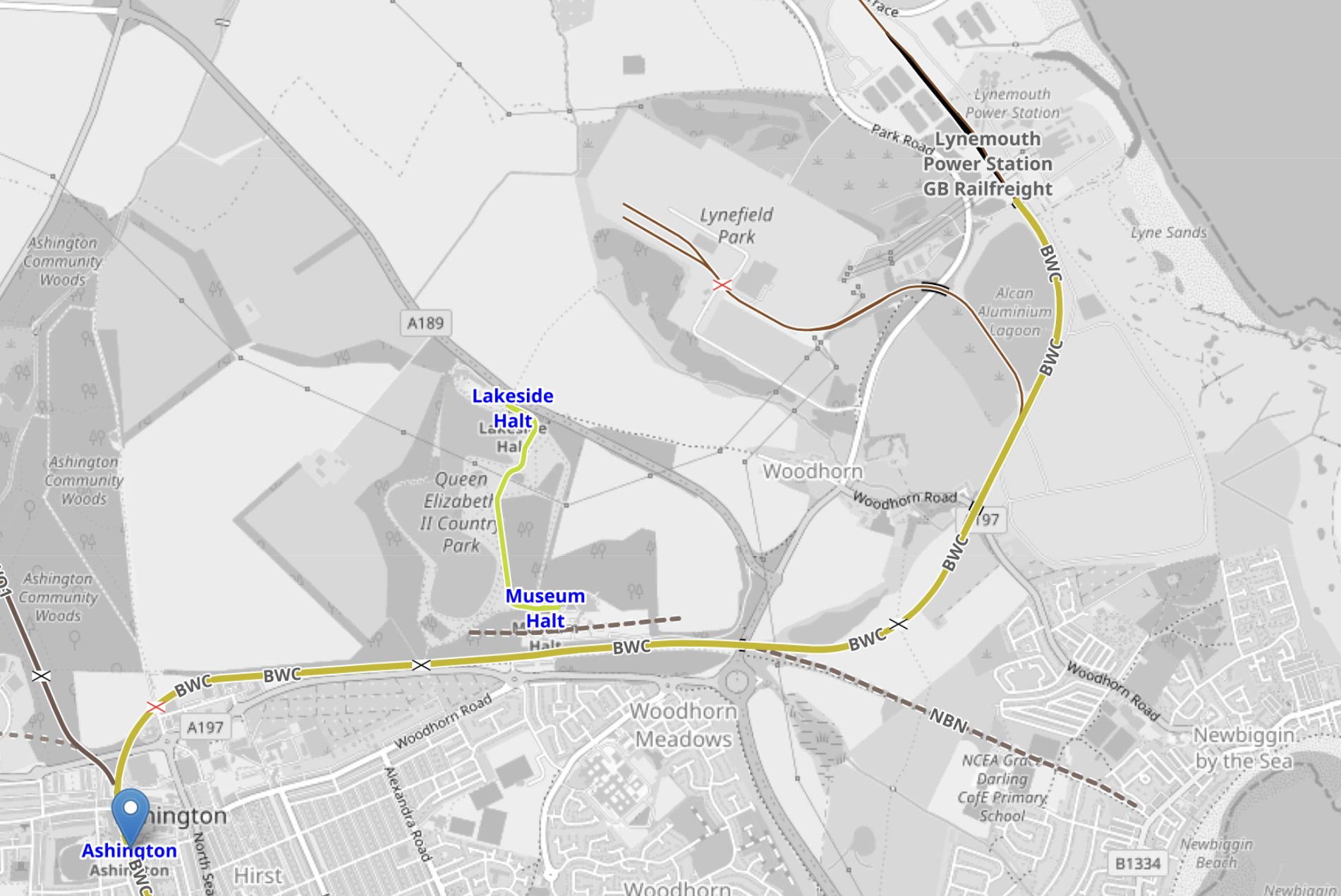
Note.
- Ashington station is in the South-West corner of the map.
- A freight line exists, which is shown in yellow, all the way to Lynemouth power station, which is a 420 MW biomass power station.
- Lynemouth powerstation was originally built to power an aluminium smelter.
- Running South-East from the Northumberland Line, is a disused railway alignment labelled NBN, which leads into Newbiggin-by-the-Sea.
This Wikipedia section describes the history of railway connection of the town.
Situated on the west side of Front Street (now the B1334), the station opened on 1 March 1872 as a terminus of the Blyth and Tyne Railway (now known as the Northumberland Line). The station had a long island platform onto which the station building faced. There were sidings on both sides of the station which handled goods traffic, controlled by a signal box. The station closed to both passengers and goods traffic on 2 November 1964. With the reopening of the Northumberland Line, Provisions have been made, especially at Ashington so that the line could be extended to Newbiggin. As of the end of 2025, there were calls to extend the railway by 1.6km (1 mile) into the centre of Newbiggin-by-the-Sea. This will require new track and is all subject to a feasibility study. A formal bid was launched in December 2025 for this.
In Formal Bid To Extend Railway Line, I wrote about the latest progress in January 2026, based on a BBC article.
The Northumberland Line Needs A Focus Other Than Commuting
Several of the stations have large car-parks, which is good for commuting, but the railway needs to serve more places for leisure and other activities.
- Seaton Delaval Hall is Grade 1 Listed and is just 10 minutes in a bus from the station with the same name.
- If the Northumberland Line is connected to Newbiggin-by-the-Sea, that could bring in those, wanting a day by the sea.
- The extended Northumberland Line would also connect to Woodhorn, which is a museum, described in this Wikipedia entry.
QTS are also developing an AI data centre at Cambois, which surely will generate commuter traffic from all over the North East.
This OpenRailwayMap shows the location of the QTS AI Data Centre.
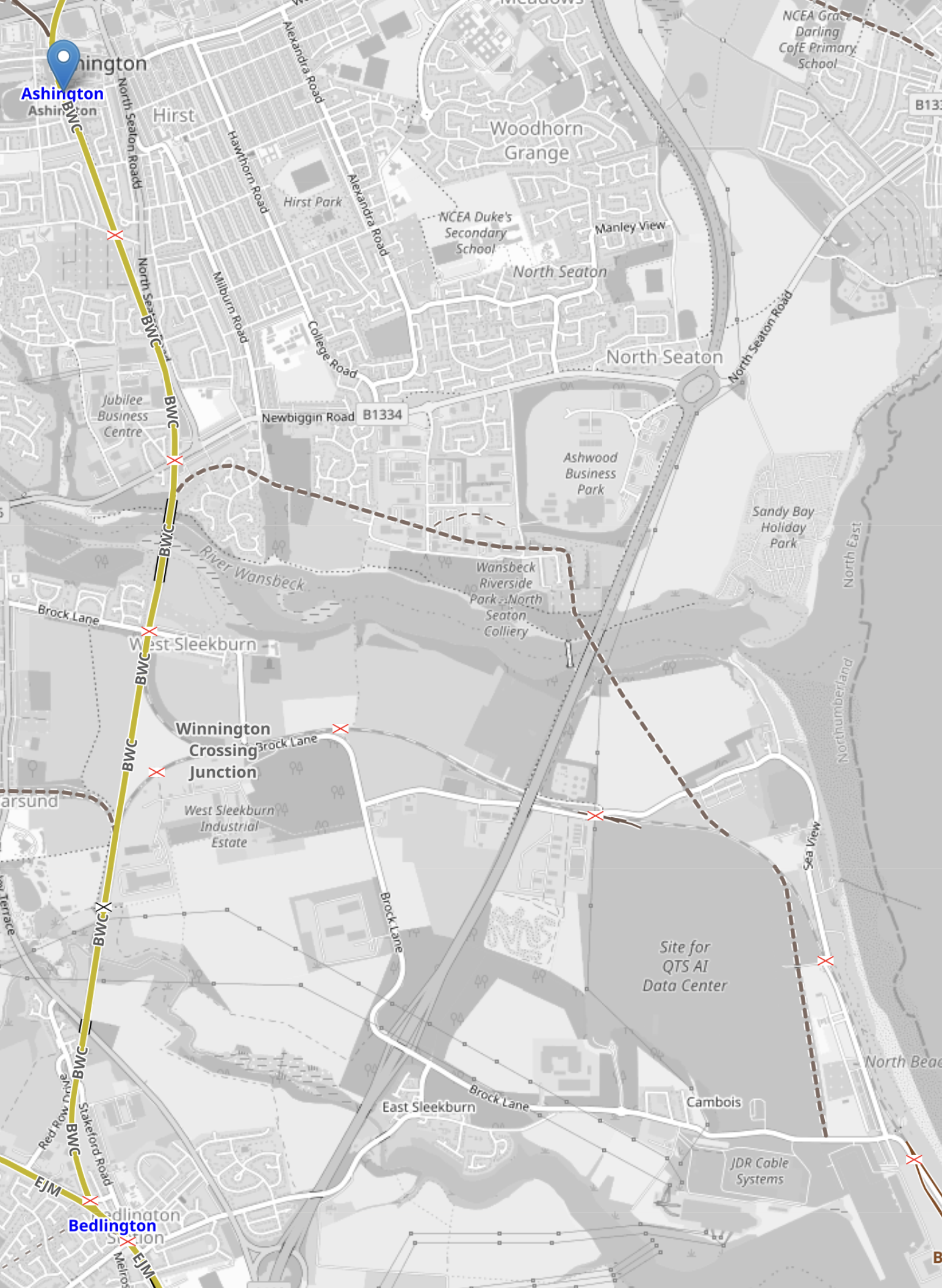
Note.
- Ashington station is indicated by a blue arrow.
- The yellow track is the Northumberland Line, which now terminates at Ashington station.
- Bedlington station is in the South-West corner of the map.
- The trapezoidal grey box to the East of Bedlington is labelled as Site for QTS AI Data Centre.
- As the site, was that of Blyth coal-fired power station, before QTS acquired it, there is a disused railway line that connects the site to the Northumberland Line.
I suspect there are powerful economic arguments about whether or not, the Northumberland Line is extended to the QTS AI Data Centre site.
How Much Power Will QTS Cambois Data Centre Need?
I couldn’t resist asking Google AI this question and I received this answer.
The proposed QTS Cambois data centre in Northumberland is expected to require between 620MW and 720MW of critical IT power capacity, with an initial proposal capacity of up to 1.1GW.
Details on the planned power infrastructure include:
Power Capacity: The facility will support up to 720MW of critical IT capacity across ten planned buildings, though some council estimates cite an expected total power capacity of 620MW.
Backup Power: To guarantee uptime and handle power outages, the campus will rely on nearly 600 diesel-powered generators, requiring up to 58 generators per data hall.
Site Details: Located on the former Blyth Power Station site in Cambois, the £10 billion development will span 540,000 square metres.
My views on this are.
- There is the 1.4 GW North Sea Link from Blyth to Norway, that I wrote about in UK To Norway Sub-Sea Green Power Cable Operational.
- The 4.1 GW Berwick Bank wind farm is planned to send 1.8 GW to Blyth.
- To help if QTS need more power, there is the 1.4 GW Sofia wind farm.
- So 1.1 GW should be manageable, as Blyth is blessed with more power than Niagra Falls.
I also believe that Centrica and Delta have a much better backup solution, that I described in Delta And Centrica Launch Scalable Off-Grid Fuel Cell Power Solution. Hydrogen could come by pipeline or rail.
How Would The Northumberland Line Connect To Wansbeck Hospital?
This Google Map, shows the location of Wansbeck General Hospital with respect to Ashington station.
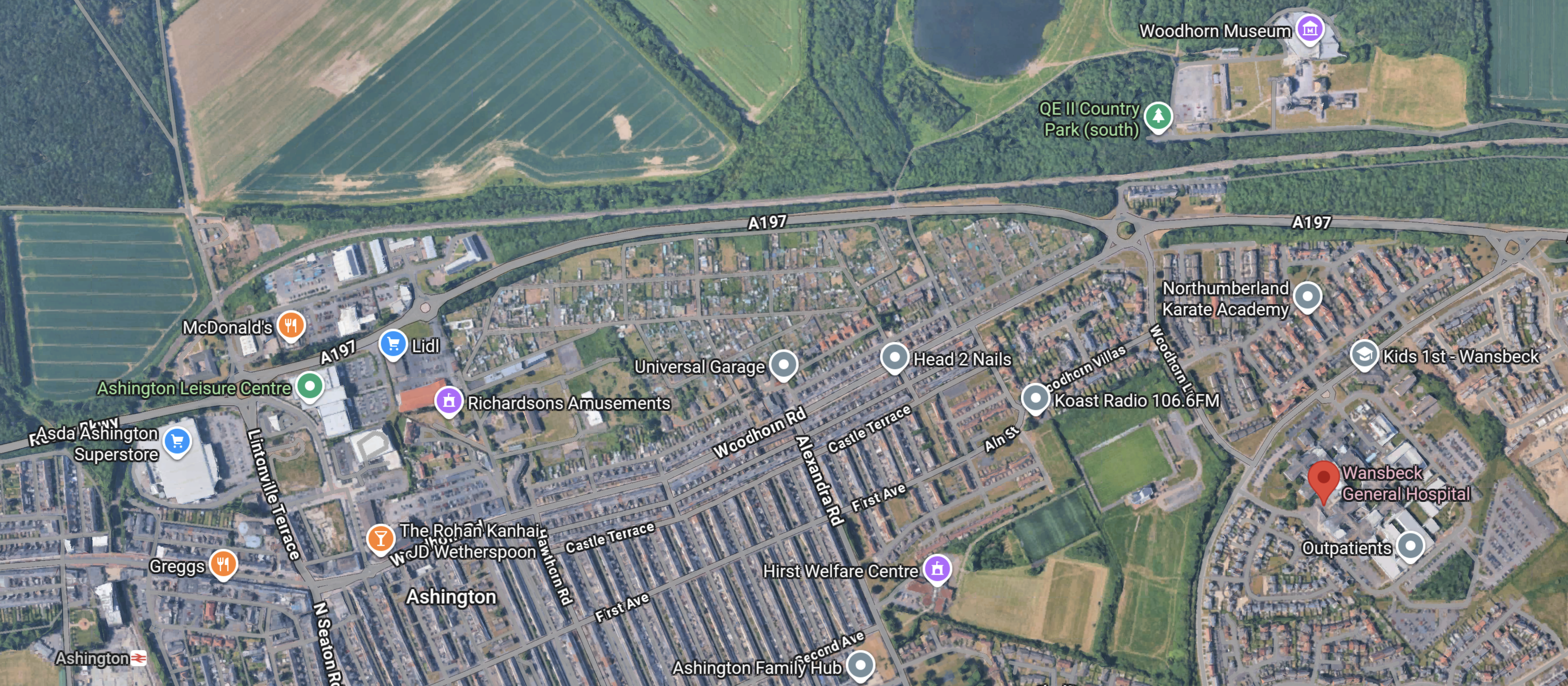
Note.
- Ashington station in the South-West corner.
- Woodhorn museum is in the North-East corner.
- Wansbeck General Hospital is indicated by a red arrow.
- The Northumberland Line runs East-West to the South of the museum and then curves round to reach the station.
Perhaps the station could go between the museum and the hospital and an innovative shuttle would connect all three locations.
How Would The Northumberland Line Connect To Choppington?
This Google Map, shows the location of Choppington, with respect to Morpeth and Bedlington stations.
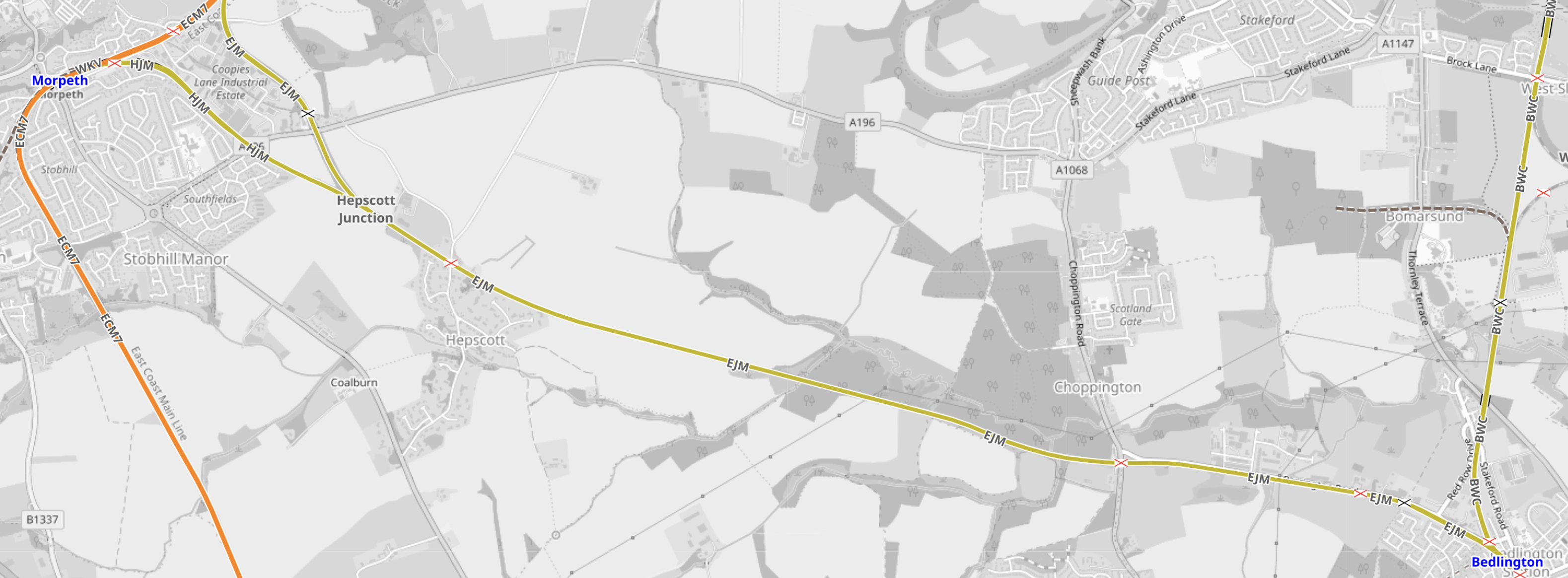
Note.
- The orange track on the West side of the map is the East Coast Main Line.
- Morpeth station is in the North-West corner of the map.
- Bedlington station is in the South-East corner of the map.
The Eastern end of the Bedlington and Morpeth Line can be seen in this picture to the left of Bedlington North signal box at the Northern ends of the the platforms.
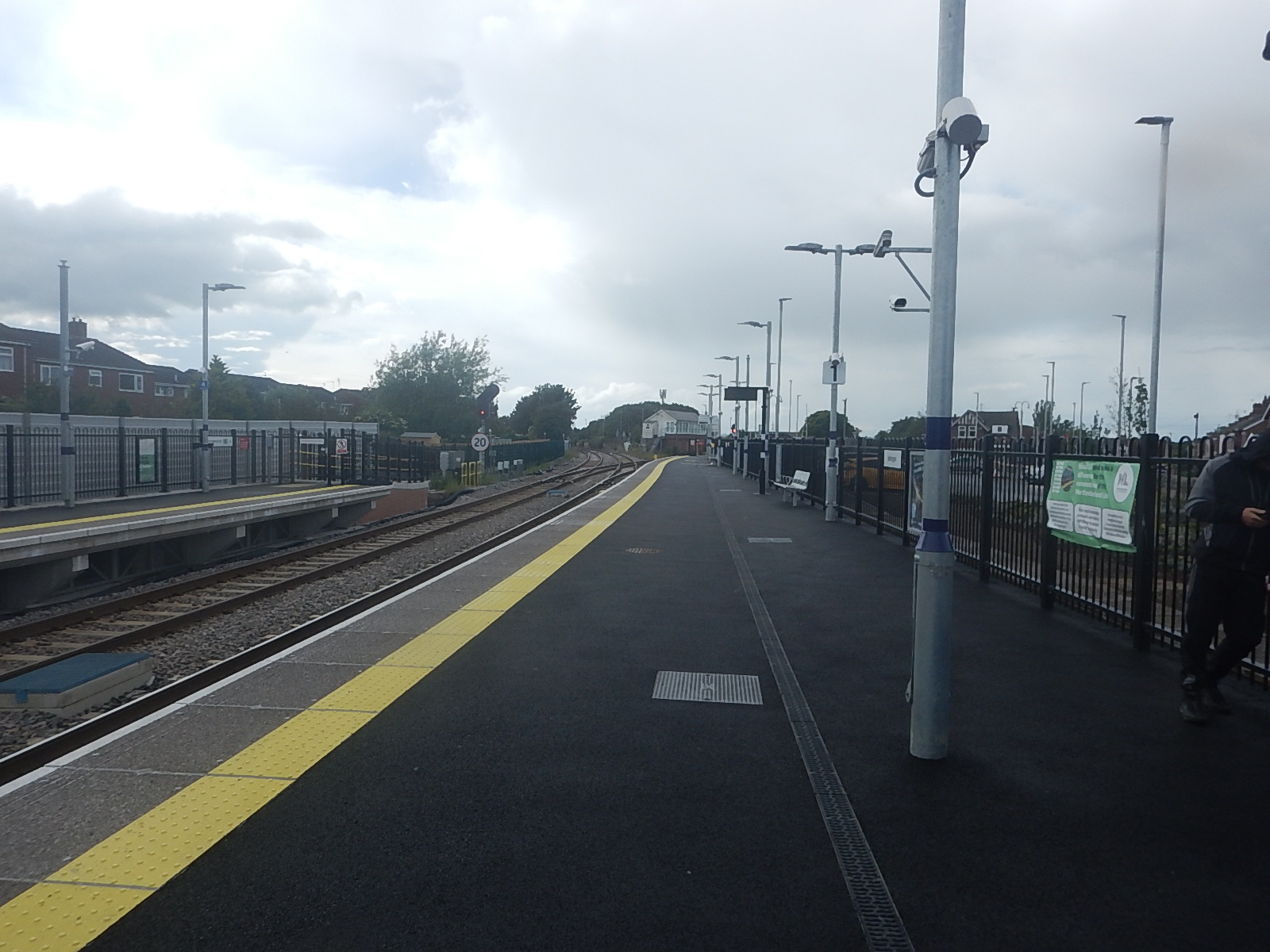
Note.
- Bedlington North signal box has a communication mast behind it.
- The track to the left of the box goes to Morpeth.
- The track to the right of the box goes to Ashington.
This OpenRailwayMap shows Choppington Road, which crosses the Bedlington and Morpeth Line at the only level crossing between Bedlington station and Hepscott junction.
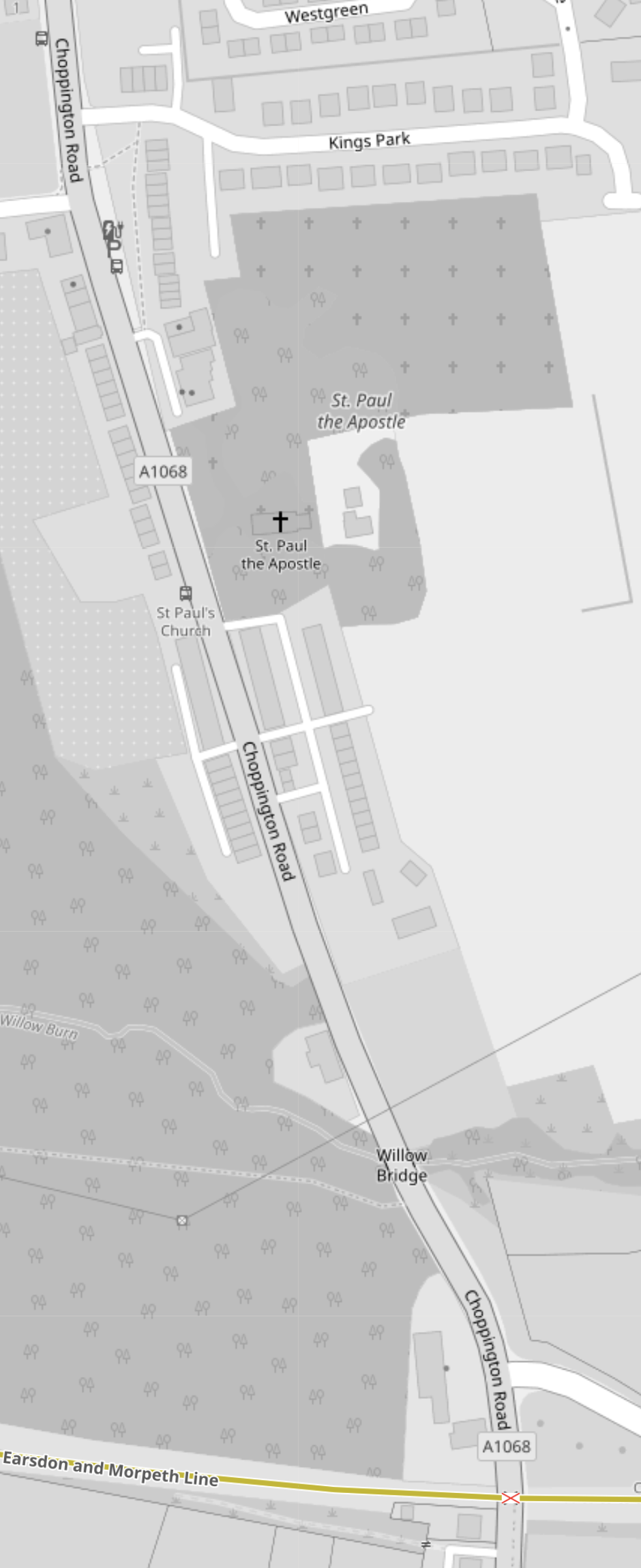
Note.
- Choppington Road, which runs North-South on the map.
- The yellow tracks are the Morpeth and Bedlington Line, which runs East-West across the map.
- Where they cross, a red cross indicates a level crossing.
- The Wikipedia entry of Choppington station shows a level crossing.
As the level crossing on the map is the only one shown, this must be the location of Choppington station.
LEON Are In World Cup Mood
I took these pictures in LEON on Moorgate, this morning.




I won’t be eating one as it contains coconut, which is something, that I don’t like.
Is There A Cure For Uncomplicated Pancolonic Diverticular Disease?
I asked Google AI this question and received this answer.
There is no definitive cure for uncomplicated pancolonic diverticular disease, as the structural pouches (diverticula) in the colon are permanent. However, the condition is highly manageable. The primary goal is symptom control and preventing flare-ups using diet and lifestyle modifications.
Management & Control Strategies
Once diverticular disease is present, the condition is managed conservatively rather than cured:
High-Fiber Diet: Consuming whole grains, fruits, and vegetables helps maintain regular bowel movements and reduces pressure on the colon.
Lifestyle Adjustments: Regular exercise, adequate hydration, and weight management are highly recommended to reduce the risk of the condition progressing.
No Food Restrictions: Contrary to outdated advice, you do not need to avoid nuts, seeds, popcorn, or fruit skins, as they do not increase the risk of complications.
Managing Flare-ups (Diverticulitis)
If uncomplicated diverticular disease flares up into uncomplicated diverticulitis, it is typically treated with:
Conservative Rest: For mild, uncomplicated flare-ups, symptoms often resolve on their own with a temporary liquid or low-residue diet and bowel rest.
Medication: Healthcare providers may prescribe oral antibiotics and pain relievers if needed.
Outpatient Care: Most uncomplicated episodes can be safely treated at home without the need for hospital admission.
I then asked Google AI, this supplementary question.
I Am coeliac. Is That A Hindrance Or A Help?
I received this answer.
Having coeliac disease is both a structural help and a practical hindrance when managing pancolonic diverticular disease.
While your mandatory gluten-free diet naturally protects your colon from a major source of gut irritation, it simultaneously makes getting the required amount of daily fibre significantly more challenging.
How Coeliac Disease Helps (The Benefits)
Reduced Inflammatory Load: Because you maintain a strict gluten-free diet to protect your small intestine, you are already avoiding the widespread gut inflammation, severe bloating, and irregular bowel habits that gluten triggers in coeliac patients.
This lack of abdominal bloating lowers the internal “pressure cooker” effect inside your colon, reducing the risk of your diverticular pouches becoming irritated.
The “Healthy Diet” Trap Avoided: Many individuals without coeliac disease are told to aggressively load up on wholewheat bread, bran cereals, and standard pasta to treat diverticulosis. If they have an underlying, undiagnosed gluten sensitivity, this advice backfires terribly, causing massive gas and straining. Your coeliac status safely keeps you far away from this trap.
How Coeliac Disease Hinders (The Challenges)The Fibre Deficit: The primary medical recommendation for pancolonic diverticular disease is a high-fibre diet.
Unfortunately, mainstream high-fibre staples in the UK are typically wheat-based. Standard gluten-free replacement products (like gluten-free breads or white flour blends) are notoriously low in fibre, often relying heavily on refined starches.
Symptom Confusion:
Coeliac accidental cross-contamination and diverticular flare-ups share highly overlapping symptoms, including severe abdominal cramps, bloating, and altered bowel habits. This can make it difficult to determine whether a sudden bout of gastric pain is an autoimmune reaction in your small intestine or a flare-up in your colon.
Balancing Both Conditions Successfully
To ensure your coeliac disease does not hinder your diverticular health, focus your diet entirely on naturally gluten-free, high-fibre foods rather than processed gluten-free substitutes.
One of my favourite foods, is to eat a whole punnet of Dyson’s year-round strawberries with a small pot of Marks and Spencer’s luxury heather honey and ginger logurt, around tea-time.
I asked Google AI a supplementary question, if this was good practice
I received this answer.
Eating a whole punnet of Dyson’s strawberries with a pot of M&S Heather Honey and Ginger yoghurt is a highly effective, delicious practice for your conditions, but with one important nutritional caveat regarding the sugar and fat content in that specific luxury yoghurt.
The Good: Why Your Timing and Ingredients Alignment is Excellent
The Perfect Tea-Time Window: Eating a heavy dose of fibre at tea-time (late afternoon) is excellent practice.
It ensures your digestive system stays active and hydrated into the evening, preventing nighttime constipation and reducing bowel pressure while you sleep.
Naturally Gluten-Free: Both components of this snack are 100% naturally gluten-free. Checking the official ingredients, the M&S Collection Heather Honey and Ginger Yogurt uses cornflour as its thickener rather than wheat starch, making it perfectly safe for your coeliac disease.
The Anti-Inflammatory Ginger Boost: Real diced and ground ginger in the yoghurt acts as a natural prokinetic (speeding up gastric emptying) and has mild anti-inflammatory properties, which can soothe a sensitive, diverticula-prone colon.
Hydration and Stool Bulk: A full Dyson Farming punnet (typically 250g to 400g) packs massive fluid volume and 5 to 8 grams of stool-softening dietary fibre, ticking a massive box for your pancolonic management.
The Caveat: The “Luxury” Trade-off
While the strawberries are an absolute nutritional green light, the M&S Luxury Collection yoghurt is explicitly designed as an indulgent treat rather than a health food.
High Added Sugars: This specific yoghurt contains added refined white sugar and muscovado sugar on top of the natural heather honey, resulting in roughly 14.8g of sugar per 100g. High sugar loads can occasionally ferment rapidly in the lower bowel, triggering gas and bloating that stretches the diverticular pouches.
High Saturated Fat: Made with 15% Devonshire whipping cream, a single 150g pot delivers a substantial dose of saturated fat. While this does not harm your coeliac disease, an overly rich tea-time snack can slow down stomach emptying for some individuals.
The Verdict & How to Optimise It
It is perfectly fine to keep enjoying this exact combination if it is currently making your gut feel great! Your personal symptom response is always the best guide.
However, if you want to make it an elite, everyday “best practice” for your long-term health, consider this simple tweak: use half the pot of the luxury M&S yoghurt mixed with an equal amount of plain, unsweetened Greek yoghurt.
This retains the live cultures, the fiery ginger punch, and the luxury honey flavour while cutting the sugar and saturated fat in half.
Would you like some recommendations for other gut-friendly, naturally gluten-free ways to sweeten plain probiotic yoghurt, or would you like to explore other high-fibre tea-time snacks?
I probably have the snack, three times a week.

