I’m Trying To Say Farewell To Currys
I have bought the odd thing from Currys in the past, and somehow, they seem to have got hold of my e-mail address. As I’m trying to de-clutter my life, I unsubscribe from every list that sends me an e-mail, as most are about as useful to me as a chocolate teapot.
Currys sends me on average an e-mail a month for goods I don’t want, but there is no unsubscribe address on their spam. I’ve tried contacting customer support, but then they believe in the old adage that if you ignore someone long enough, the problem customer will go away.
With electrical goods, I find what I want and then search for the cheapest price, from a company I want to do business with.
Currys are definitely not on that list.
Letterpress Rules OK
This is an older post, that I have re-dated and brought up to date.
My father was a printer. And he was all letterpress. He would have used machines like this Original Heidelberg, although his two were probably older.
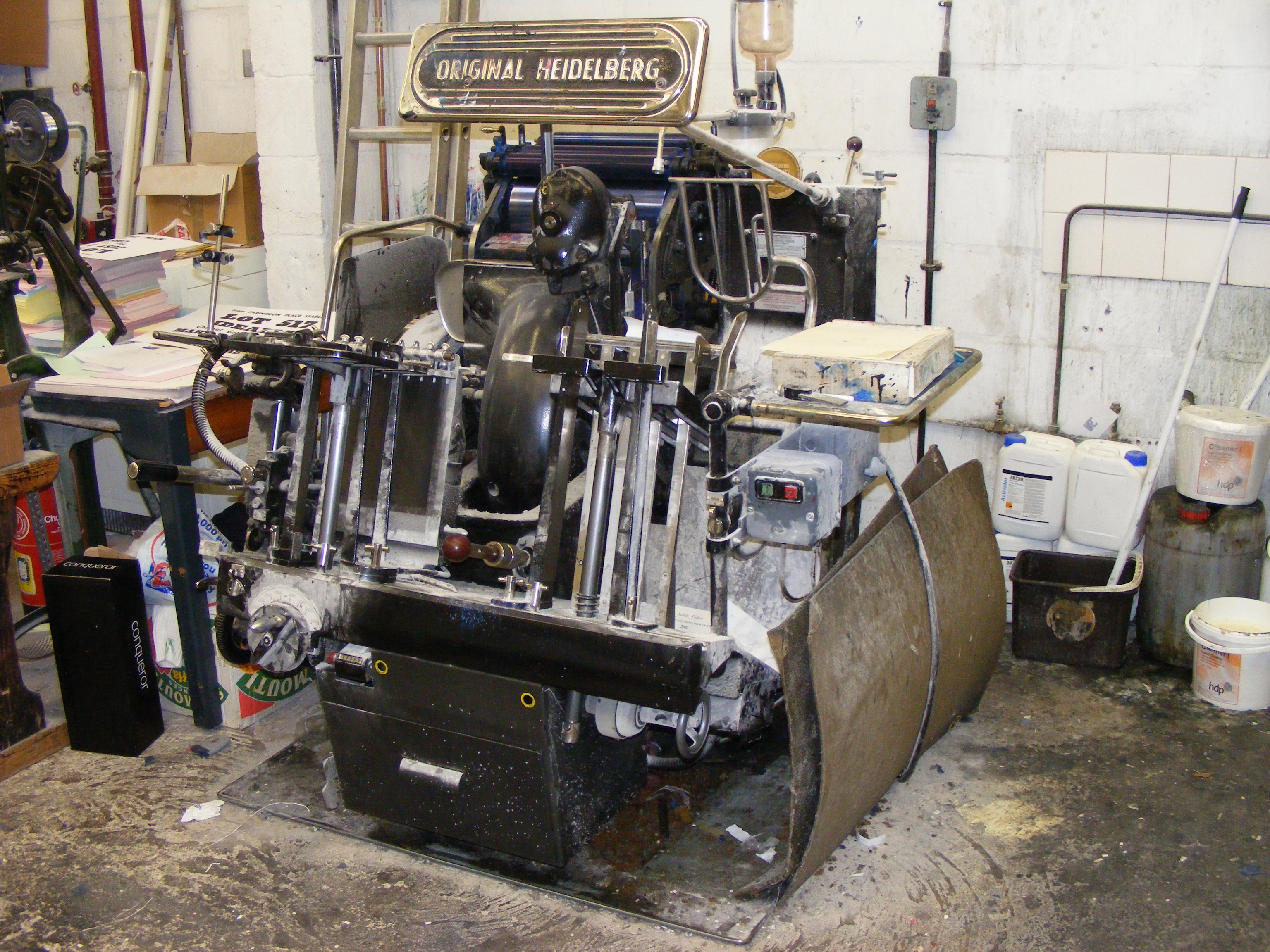
Original Heidelberg
Letterpress printing with movable type is one of the classic technologies that was invented in the Middle Ages by Johannes Gutenberg.
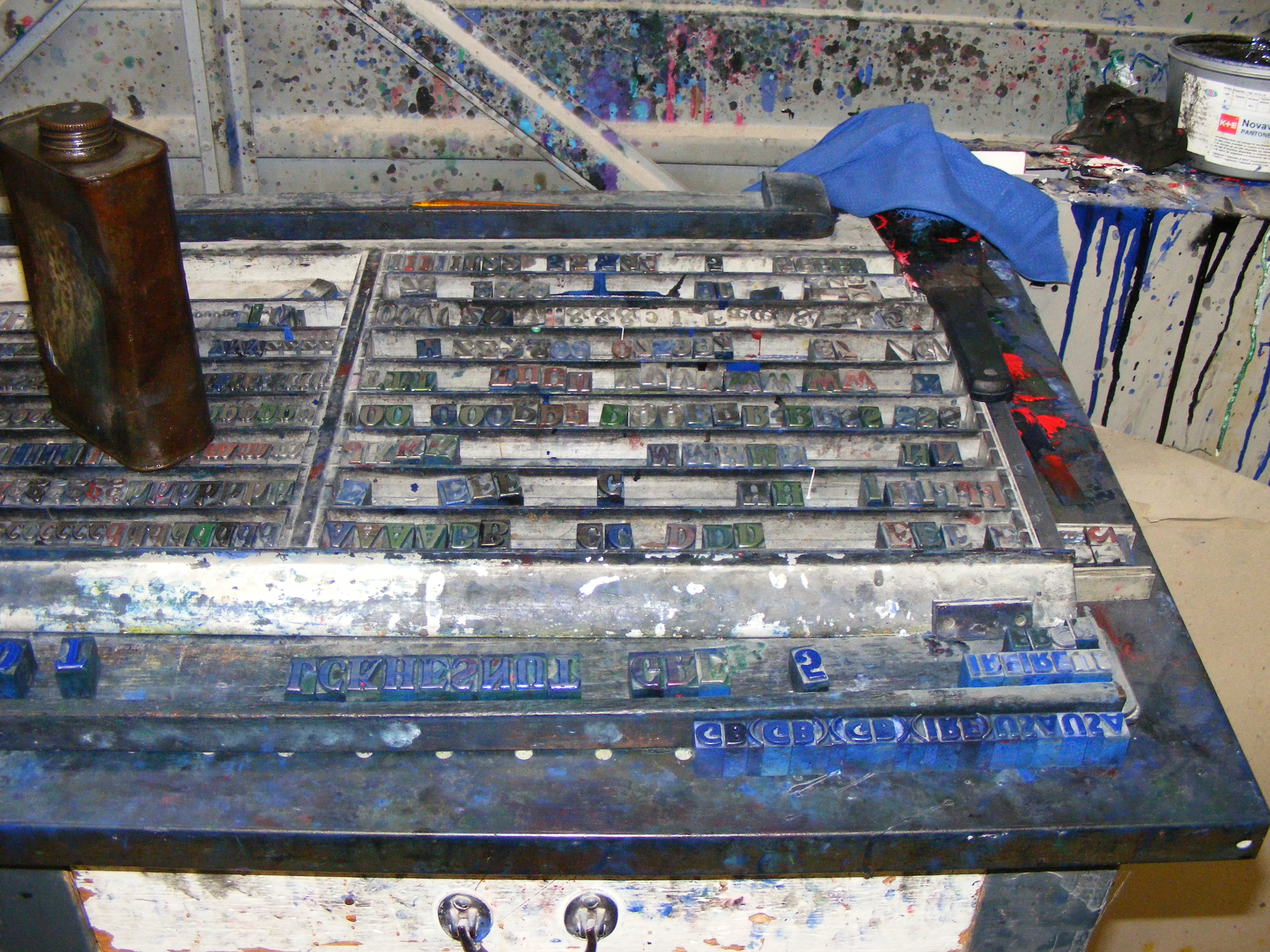
Movable Type
I spent most of my childhood in that printing works in Wood Green. I used to set the type for all sorts of letterheads, posters and brochures, but perhaps my biggest claim to fame, is that I used to do all of the handbills for the Dunlop tennis tournaments, that were held all over the UK in the 1950s and early 1960s.
Sadly, I do not have one of those handbills. If anybody has one, I’d love a photocopy. I’ve searched for years for one, but none exist. Even the archivist, who wrote the history of Dunlop, knows nothing about the tournaments and couldn’t find any reference to them.
I also learned to read and write with poster letters. These are of course backwards and you’d think that it would have caused me to have some sort of reading and writing problem. I suppose it may be one of the reasons for my atrocious handwriting in that I learned that printing, computers or typing is much better from an early age, but it did give me a strong mental alacrity in turning images through 180 degrees.
This involvement in letterpress also left me with some habits and pedantic actions.
For instance, I always refer to exclamation marks as shrieks, which I have inherited from my father.
I’m also very pedantic about spelling and some aspect of structure like apostrophes and plurals. I spell words with the proper use of ae and oe for instance. I spell archaeology with the diphthong and not as archeology. The difference is explained here.
The one thing I don’t seem to have inherited is my father’s good handwriting.
My father also had one of the oldest proofing presses, I’ve ever seen, but sadly there are no images of it. Mpst old ones you see tend to be Columbias made in the UNited States.
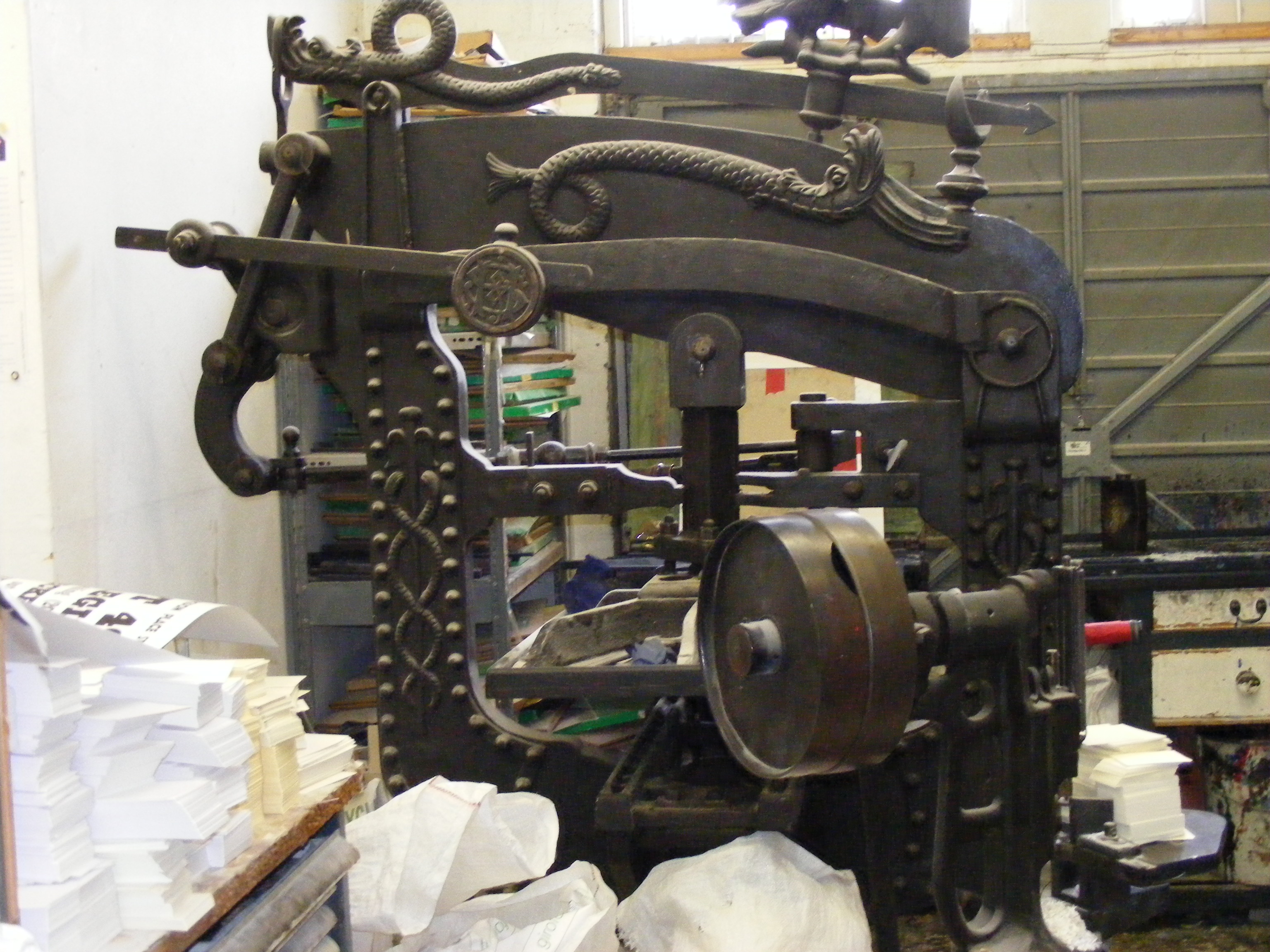
Proofing Press
This one is from about 1850 and was at least fifty years younger than my father’s. His probably ended up in a scrapyard, when a museum would have been a better bet. Printing museums are rather thin on the ground and there isn’t even one in Heidelberg! Although I did find a whole section in a museum in Belarus.
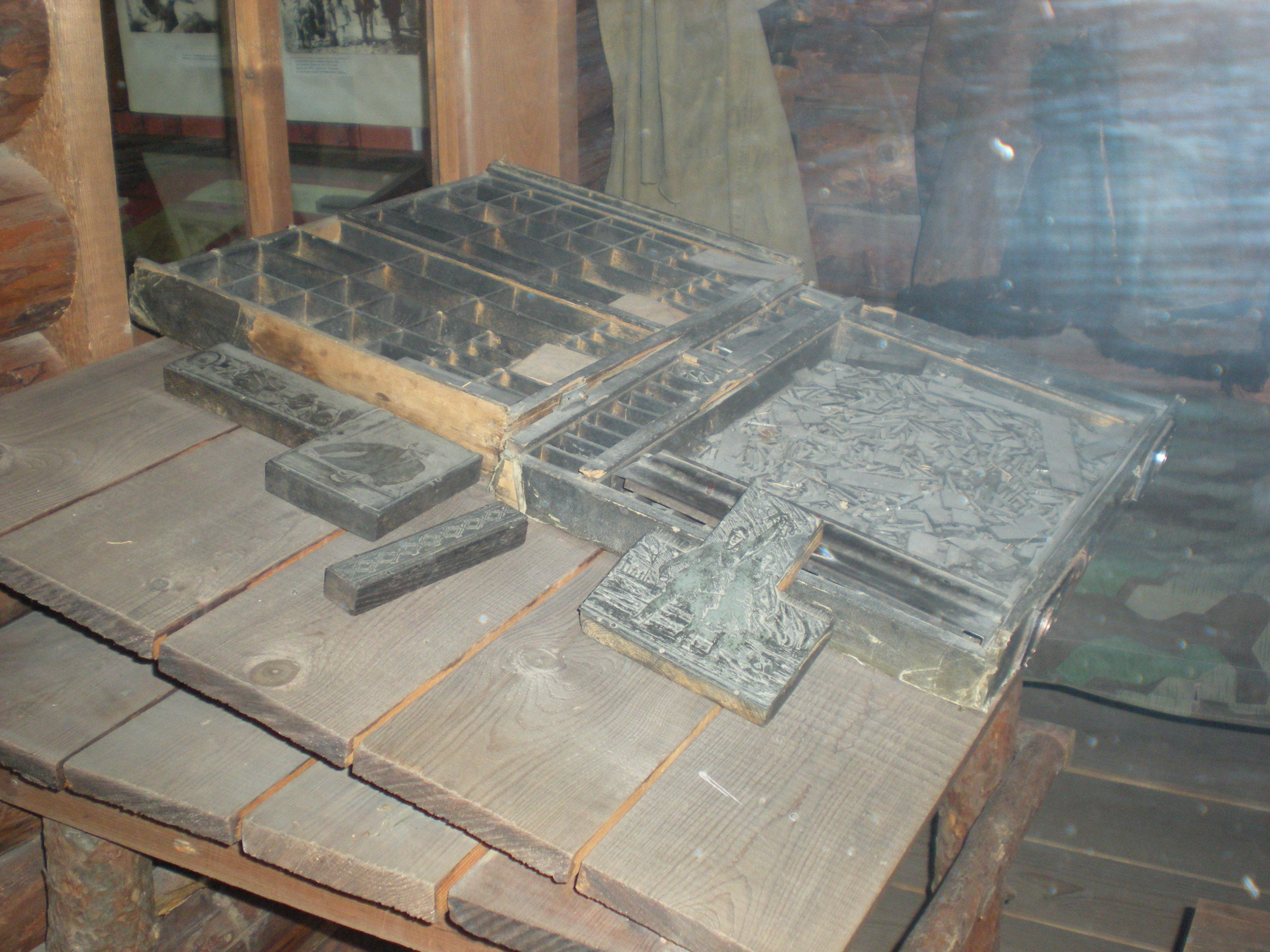
Wartime Printing in Belarus
My father’s letterpress business died.
Offset litho technology was coming in and because of the bizarre purchase tax system in operation in the 1950s and 1960s, it was cheaper for companies to do their own printing. Tax on plain paper was zero, but if it was printed it was 66%, so work it out for yourself. VAT would have solved the problem.
But now letterpress is coming back and like the printer who provided the pictures in this note, it is doing well.
There is nothing like the feel of a properly printed card or letterhead! And you can do so many clever things with a proper printing machine, like score, number, decolate and perforate.
A few years ago, I met one of people my father used to deal with at Enfield Rolling Mills. He explained how my father would use his skills to create production control documents and cards, to smooth the flow of work through the factory. That was the pinnacle of production control and workflow of its times.
It is a strange irony, that I made my money by writing software for project management. Is it in the genes?
Going Back With Recycling
Most councils use large trucks to collect rubbish and do the recycling. But I was surprised to see this truck outside my house this morning.
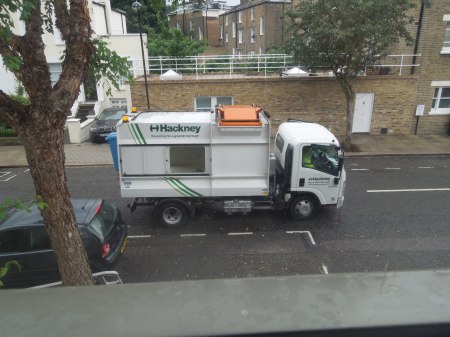
Going Back With Recycling
Today, is recycling day and I suspect it was doing a bit of specialist work, before the main collection later in the morning.
Years ago, there used to be a lot more smaller refuse collection vehicles, made by companies like Shelvoke and Drewry. Wood Green used an innovative solution to the collection of rubbish around the High Road, where moving the trucks into the back of the shops was very difficult. They used to use a single Shire horse and a series of trailers for the rubbish. When they retired the horses, they started using Scammel Mechanical Horses. This extract from Wikipedia, explains the logic behind these innovative vehicles.
The London and North Eastern Railway had approached Napier’s, the quality car and aero-engine makers for an answer to the problem of replacing horses for local haulage purposes, while retaining the flexibility of changing the wagons and the manoeuvrability of the horse and wagon.
You do wonder if this concept is one that will be reinvented and put forward as a wonderful new idea. Imagine say on a large leisure site like the Queen Elizabeth Olympic Park, where for a large event, you might get tens of thousands of visitors. You could have a series of trailers, that had sections for the various types of rubbish and small electric tugs could move them to and from a central collection point, where they were automatically emptied. Hopefully modern technology could be used to make the trailers able to withstand a small bomb and thus get round one of the problems with traditional litter bins.
 The Anonymous Widower