Open Data Will Improve Public Transport
I was actually looking to see if anybody else had spotted that London buses now have time displays, which I reported here.
But I did find this article entitled, Smart data will only work if the network data is truly open.
The article says that London has one of the biggest real-time passenger information systems in the world. All of the data is available free for developers. The article then says this.
Developers have created more than 100 apps for the city’s buses alone. They offer everything from route planners for the disabled to scalable tube maps, with live updates when lines are disrupted, and apps that let you know where to board a train so you can get off as close to your exit as possible.
So is it right to think that as time goes on, more and better apps will be written to make difficult journeys easier?
You could envisage apps, where you entered your start and destination and the system made suggestions, as to how to get there fastest, when say the local low life had nicked the signal cable or a bus or train had broken down.
The one thing that the article misses, is the data connection from the smart device to the central system.
Surely to cope in the near future, all vehicles will have a wi-fi connection. First Manchester is reported here to be fitting wi-fi to all its buses.
Once you have a fast local connection between vehicles and passengers, other possibilities will become feasible.
As an example, I often catch a 38 bus to the Angel, where to get to Kings Cross, I change to a 73 bus or take the Northern line. If the bus had a rearward facing camera, I could link to this to check for the 73 bus.
One of the great things about this technology is that you don’t need everybody to be using it on a bus, as bus passengers will talk to each other and share their information. I say this because you see people at bus stops texting to find the arrivals and then showing them to other passengers.
None of the apps because of the open data will cost Transport for London a penny. The reverse could be true in that the apps might encourage more passengers to travel and travel on the more lightly-used part of the network. If more people travelled by bus, hopefully this would reduce car traffic, thus allowing more road space for buses.
Such is the power of software!
If You Want To Know The Time Get On A Bus
I was on three big red taxis today and they’ve had a software upgrade on the information display.

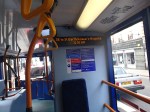

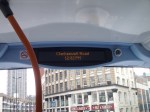
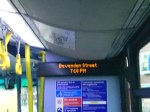
I haven’t noticed the time before, but I was away Tuesday and Wednesday and only took one bus yesterday.
Since I created this post, I’ve been on about six or so buses. All were showing the time! Even a very elderly example! I did see a New Bus for London pass and it looked like this was showing the time as well.
It will be interesting to see the indirect effects of this technology change!
Will people be on time more, as they should spot they are late, even when they’ve left their watch at home?
Will it cut watch thefts, as people might wear them less on public transport?
Will there be a clamour for more clocks on the Underground, the Overground and trains?
Do British Trains Do Toilets Well?
I travel on trains a lot and so I tend to use the facilities quite a bit.
I have come across the concessional blocked one on a train, but in the last few months, all have been immaculate.
A lot of the ones I’ve used in stations over the last year, have been immaculate too, like the ones at Southport, Wigan and Lowestoft!
In my travels across Europe, if I give the British toilets say eight out of ten, some countries don’t get above five. And we’re not talking about countries with lower standards of living than the UK.
So perhaps toilets are something that British trains do well?
Why Is Liverpool Street In London So Named?
I pass through Liverpool Street station in London several times a week. As I have strong educational and connections to Liverpool, I’d started to wonder why the street that gives the station is so named.
Liverpool Street is the street that lies in front of the main south entrance to the station and you cross it going between the heart of the City of London and the station.
It is obviously, a road that doesn’t go or point anywhere near Liverpool.
So it is either a name chosen by some developer in the mists of time or perhaps it is named after a historical figure.
The obvious candidate is one of the Earls of Liverpool. According to Wikipedia, it was named after the Second Earl of Liverpool, who was Prime Minister from 1812 to 1827.
Wikipedia doesn’t record if he visited the city after which his title was named.
 The Anonymous Widower