A Marks And Spencer Gluten-Free Baguette
This was my lunch today.

A Marks And Spencer Gluten-Free Baguette
The baguette was from Marks and Spencer and was just warmed through in the oven, before filling with bacon.
I can’t remember, when I last had a baguette that was this acceptable. If it looks small, it’s because there was another bit, that I’d already eaten before the photo was taken.
This new Marks and Spencer’s product certainly makes it easier to cope with a visitor, who needs gluten-free food.
A 3D Map Of London
This 3D map of London is at the Building Centre close to Tottenham Court Road station.


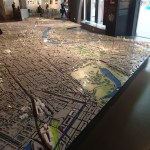
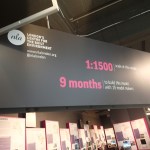

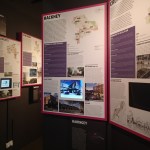
Unfortunately, dalston is just off the map, But it was good nevertheless.
Places And Spaces At The Building Centre
I went to this exhibition this morning, which shows how the various stations on Crossrail will look.
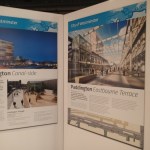


It was certainly a good free exhibition and whetted my appetite for what is to come.
Do We Need Double-Deck Trains In The UK?
You regularly see articles like this one in the Guardian extolling the virtues of double-deck trains. Here’s an extract.
Consultants have drawn up blueprints for double-deckers up to 400 metres long, carrying more than 1,000 passengers, on the network. Supporters of high speed rail say tackling the limited capacity offered by existing lines is crucial.
Greening told the Sunday Times she was excited by the idea of “continental-style double-decker trains that immediately give you more seats and more space”. The trains could have glass viewing ceilings and meeting areas.
Have any of these advocates of double-deck trains ever travelled on one?
They may work on the Continent, but UK railways are different to the rest of the Continent and probably the rest of the world, in that we’re increasingly going for walk-in step-free access to our trains, whereas everybody else has low platforms and several steps up into the train, as I pointed out in this article. In the article I quoted from the specification issued by Crossrail for their Class 345 trains.
Wide through gangways between carriages, and ample space in the passenger saloons and around the doors, will reduce passenger congestion while allowing room for those with heavy luggage or pushchairs.
From what I have read here on First Capital Connect’s web site, the Class 700 might be very similar.
If you’ve ever tried to get in and out of a French, German or Italian express train in a hurry, you will realise that they’re designed to different principles. And they are a total nightmare with a heavy case, in a wheelchair or pushing a buggy. And I’m generally tslking about single-deck trains.
You must also consider the Health and Safety aspects of double-deck trains. If the British public felt they were dangerous and didn’t like the climbing up and down, they would get angry and Disgusted from Tunbridge Wells would get his computer out.
But the biggest problem of double-deck trains is that they need infrastructure clearance everywhere they might go. So if say you might want to run say one of the trains to an important event off its usual haunts, you would have to make sure that line was cleared to accept it.
With normal height trains, like the Class 800, they are designed as go-anywhere trains, that can accept the far corners of the network.
You could argue that the double-deck trains would only stay on high speed or high-density commuter lines, but then for reasons of efficiency trains they must also be able to run on other lines.
Double-deck trains are one of these ideas that look good to politicians, but create more problems than they solve.
A Beginner’s Guide On Opposing HS2
I found this here on Rail News.
Read it and enjoy.
As I’m a simple man, who prefers words of one syllable, my views on HS2 are as follows.
1. The best way to increase the capacity of our motorways is to move as much freight as possible off the roads onto the railways. As there are a limited number of freight paths on the East and West Coast Main Lines, one way to increase capacity would be to create a new high speed railway that is used by the high speed passenger trains from London to the Midlands, North and Scotland. Passenger trains would take HS2, thus releasing capacity on older lines for freight.
2. It is well known that speed attracts more passengers. At the moment there’s a lot of speculation about Norwich in Ninety. Every route from London has a time, that would attract passengers. Perhaps, it should be Birmingham in an hour, Cardiff and Manchester in two and Edinburgh in four. Speed will attract people to use the trains, hopefully freeing up the roads.
3. A lot of our older stations like Euston and Manchester Piccadilly need rebuilding, or are on cramped sites like Birmingham, Leeds and Newcastle, so building HS2 with a few well-connected and spacious stations may well make a better railway for every passenger. The network’s Victorian designers didn’t envisage the number and size of trains we are using today, let alone those that we will, in a few years time.
4. HS2 is making us think. In the past couple of months, George Osborne has laid out a plan for HS3 across the north of England from Liverpool and Manchester to Hull. The government has now announced that the existing line will be electrified as a priority. Would a politician have ever thought of this without HS2?
5. I also believe that HS2 should be freight enabled, so that at night, when the line won’t be busy, freight trains can be sneaked up and down the country. Network Rail are experimenting with using Euston in the middle of the night, as a distribution point for retail goods, so could we see that in cities like Birmingham, Leeds, Liverpool and Manchester?
6. I also think that HS2 could be the solution to how we get freight from London Gateway up to the North, if we built a tunnelled link from HS2 to HS1, This would also allow direct passenger and freight services between most of the UK and the Continent. Surely, it would be a better way to distribute Jaguars, Land-Rovers, Toyotas and Nissans all over the Continent and perhaps even further. That is just one example of probably many on how rail freight could be used.
7. I have my doubts about direct passenger services between say Manchester and Berlin, as for a journey of that length, the easyRyans of this would will always be a lot quicker and probably cheaper.
8. A properly linked up high speed rail system, connected to most parts of the country, will open up all sorts of possibilities.
9. Suppose the North Wales Coast line between Holyhead and Crewe was electrified and made into a full-size faster line, would this ease the problem of transporting freight and passengers to and from Ireland? At the present time it take nearly four hours to get to Holyhead from London, so with something like a Class 800 train, under three hours should be possible, even without the sections of HS2 north of Birmingham.
10. South Wales isn’t a problem from London and the South East, as by the end of this decade, Brunel’s Great Western will be making his ghost jump for joy, as trains speed along an electrified railway to Cardiff and South Wales as trains speed along at 225 kph. The line which, I’ve called HSW will probably change the way we think about high speed rail.
11. The main problem of South Wales is getting to Birmingham and the North. But this will probably be solved in the short term by the use of Class 800 running via Gloucester.
12. The Class 800 will have big part to play with HS2, as it will be used as a route extender, as I said in point 9, where it could be used to Holyhead.
 The Anonymous Widower